
The global Roof Insulation Market Study analyzes and forecasts the market size across 6 regions and 24 countries for diverse segments -By Type (Flat Roof, Pitched Roof), By Product (Batts & Rolls, Rigid Insulation, Spray Applied, Reflective Systems, Others), By Material (Glass Wool, Stone Wool, Plastic Foam, Others).
In 2024, the roof insulation market is witnessing robust growth driven by the increasing demand for energy-efficient building solutions, thermal comfort, and sustainability in residential, commercial, and industrial construction projects. Roof insulation materials play a crucial role in reducing heat transfer, minimizing energy consumption, and enhancing indoor comfort levels by maintaining stable temperatures and reducing HVAC loads. The construction industry is a major consumer of roof insulation materials, with applications ranging from residential roofing systems and commercial buildings to industrial warehouses and institutional facilities, benefiting from their ability to improve energy efficiency, reduce heating and cooling costs, and meet building code requirements. Further, the retrofitting and renovation market utilize roof insulation materials to upgrade existing buildings, improve thermal performance, and comply with energy efficiency regulations. Additionally, the green building sector emphasizes sustainable roofing solutions such as cool roofs and green roofs, incorporating insulation materials to minimize environmental impact, mitigate urban heat island effects, and promote biodiversity. With advancements in insulation technology, building envelope design, and energy performance standards, the roof insulation market is poised for d expansion, driven by innovations in material efficiency, installation methods, and building energy management systems.
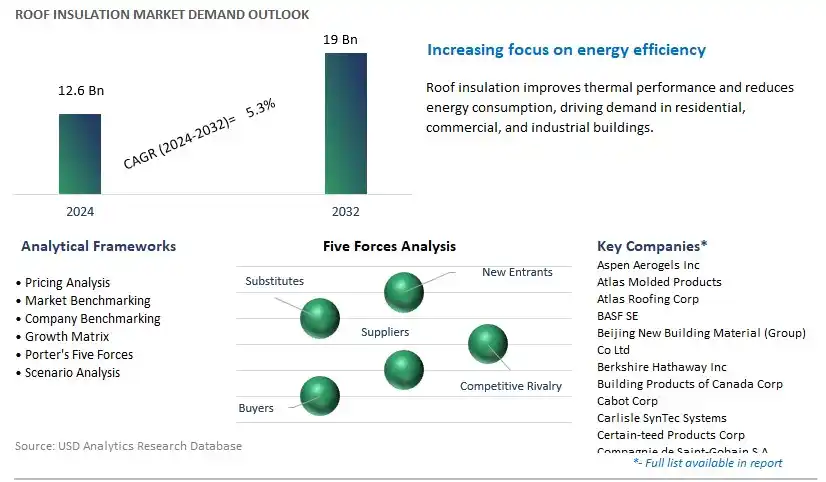
The market report analyses the leading companies in the industry including Aspen Aerogels Inc, Atlas Molded Products, Atlas Roofing Corp, BASF SE, Beijing New Building Material (Group) Co Ltd, Berkshire Hathaway Inc, Building Products of Canada Corp, Cabot Corp, Carlisle SynTec Systems, Certain-teed Products Corp, Compagnie de Saint-Gobain S.A., Dow Inc, DuPont deNumorous Inc, General Aniline & Film Corp, Guardian Building Products Inc, Huntsman International LLC, IKO Industries Ltd, Insulation Company of America, Insulation Technology Inc, Johns Manville Corp, Kingspan Group PLC, Knauf Insulation GmbH, Lapolla Industries Inc, Morgan Advanced Materials PLC, Owens Corning Inc, Paroc Group Oyj, Rockwool International A/S, Synthos SA, and others.
One prominent market trend in roof insulation is the increasing demand for energy-efficient buildings. With rising energy costs and growing concerns about climate change, there is a heightened focus on improving the energy performance of buildings. Roof insulation plays a critical role in reducing heat loss during the winter and heat gain during the summer, helping to maintain comfortable indoor temperatures and lower heating and cooling costs. As building codes and regulations continue to emphasize energy efficiency standards, the demand for high-performance roof insulation solutions is expected to grow, particularly in residential, commercial, and industrial construction projects.
A key market driver for roof insulation is regulatory mandates and incentives for energy efficiency. Governments and regulatory bodies worldwide are implementing policies, building codes, and incentive programs to promote energy-efficient building practices and reduce greenhouse gas emissions. Requirements for minimum insulation levels, energy performance ratings, and green building certifications drive the demand for roof insulation solutions that meet or exceed specified standards. Incentives such as tax credits, rebates, grants, and low-interest loans further encourage building owners, developers, and contractors to invest in energy-saving measures, including roof insulation upgrades and retrofits.
An emerging opportunity in the roof insulation market lies in innovation in sustainable and high-performance materials. While traditional insulation materials such as fiberglass, foam, and mineral wool are widely used, there is growing interest in eco-friendly alternatives that offer superior thermal performance, durability, and environmental sustainability. Opportunities exist to develop innovative roof insulation materials derived from renewable resources, recycled content, or advanced technologies such as aerogels and vacuum insulation panels (VIPs). By investing in research and development, collaboration, and commercialization of sustainable insulation solutions, stakeholders can capitalize on the growing demand for eco-friendly roof insulation products and gain a competitive edge in the market.
The Flat Roof Type segment is the largest segment within the Roof Insulation Market. Flat roofs are commonly found in commercial, industrial, and residential buildings, offering potential advantages such as cost-effectiveness, ease of installation, and versatility in design. Insulating flat roofs is essential for maintaining thermal comfort, energy efficiency, and structural integrity of buildings. Insulation materials are installed above the roof deck to minimize heat transfer, prevent moisture intrusion, and reduce energy consumption for heating and cooling. Flat roof insulation plays a crucial role in regulating indoor temperatures, reducing HVAC (Heating, Ventilation, and Air Conditioning) loads, and enhancing overall building performance. Additionally, flat roof insulation helps prevent condensation, ice dams, and water damage, prolonging the lifespan of roofing systems and reducing maintenance costs. Various insulation materials are used in flat roof applications, including rigid foam boards, spray foam, mineral wool, and reflective insulation, among others, offering different thermal resistance (R-value), moisture resistance, and fire ratings to meet specific project requirements. Moreover, the growing emphasis on energy efficiency, sustainability, and building code compliance drives the demand for high-performance flat roof insulation solutions. As building owners, architects, and contractors prioritize energy-efficient building envelopes, the Flat Roof Type segment is expected to maintain its dominance in the Roof Insulation Market.
The Spray Applied segment is the fastest-growing segment within the Roof Insulation Market. Spray applied insulation offers numerous advantages over traditional insulation products such as batts, rolls, and rigid boards. This method involves spraying liquid foam insulation onto the roof deck or substrate, where it expands and cures to form a seamless, continuous layer of insulation. Spray applied insulation provides excellent thermal performance, air sealing, and moisture resistance, helping to create a more energy-efficient and comfortable indoor environment. Additionally, its seamless application eliminates gaps, voids, and thermal bridging, reducing heat loss and improving overall insulation effectiveness. Spray applied insulation is highly adaptable and can be applied to various roof configurations, including irregular shapes, uneven surfaces, and hard-to-reach areas, ensuring complete coverage and maximum insulation performance. Moreover, the lightweight nature of spray foam insulation minimizes structural loads on buildings, allowing for greater design flexibility and cost savings. Furthermore, spray applied insulation offers superior durability and longevity, with minimal maintenance requirements over its service life. As building owners, designers, and contractors increasingly prioritize energy efficiency, air quality, and sustainability, the demand for spray applied insulation continues to rise. Additionally, stringent building codes and energy efficiency standards drive the adoption of high-performance insulation solutions, further fuelling the growth of the Spray Applied segment in the Roof Insulation Market.
The Plastic Foam segment is the largest segment within the Roof Insulation Market. Plastic foam insulation materials, such as expanded polystyrene (EPS), extruded polystyrene (XPS), polyisocyanurate (PIR), and polyurethane (PU), offer numerous advantages that contribute to their widespread adoption in roofing applications. These materials are lightweight, easy to handle, and provide excellent thermal insulation properties, helping to minimize heat transfer and maintain indoor comfort levels. Additionally, plastic foam insulation is highly resistant to moisture, mold, and pests, ensuring long-term durability and performance in various climate conditions. Plastic foam insulation boards can be easily cut and shaped to fit irregular roof geometries, enabling efficient installation and reducing material waste. Moreover, plastic foam insulation materials offer high compressive strength and dimensional stability, providing structural support and maintaining insulation performance over time. Furthermore, the versatility of plastic foam insulation allows for the incorporation of additional features such as vapor barriers, reflective coatings, and fire retardants to enhance performance and meet specific project requirements. As building codes and energy efficiency standards become increasingly stringent, the demand for high-performance insulation materials like plastic foam continues to grow. Additionally, the ongoing emphasis on sustainability and environmental responsibility drives the adoption of foam insulation materials with recycled content and low global warming potential (GWP). Given these factors, the Plastic Foam segment maintains its dominance in the Roof Insulation Market.
By Type
Flat Roof
Pitched Roof
By Product
Batts & Rolls
Rigid Insulation
Spray Applied
Reflective Systems
Others
By Material
Glass Wool
Stone Wool
Plastic Foam
Others
Countries Analyzed
North America (US, Canada, Mexico)
Europe (Germany, UK, France, Spain, Italy, Russia, Rest of Europe)
Asia Pacific (China, India, Japan, South Korea, Australia, South East Asia, Rest of Asia)
South America (Brazil, Argentina, Rest of South America)
Middle East and Africa (Saudi Arabia, UAE, Rest of Middle East, South Africa, Egypt, Rest of Africa)
Aspen Aerogels Inc
Atlas Molded Products
Atlas Roofing Corp
BASF SE
Beijing New Building Material (Group) Co Ltd
Berkshire Hathaway Inc
Building Products of Canada Corp
Cabot Corp
Carlisle SynTec Systems
Certain-teed Products Corp
Compagnie de Saint-Gobain S.A.
Dow Inc
DuPont deNumorous Inc
General Aniline & Film Corp
Guardian Building Products Inc
Huntsman International LLC
IKO Industries Ltd
Insulation Company of America
Insulation Technology Inc
Johns Manville Corp
Kingspan Group PLC
Knauf Insulation GmbH
Lapolla Industries Inc
Morgan Advanced Materials PLC
Owens Corning Inc
Paroc Group Oyj
Rockwool International A/S
Synthos SA
*- List Not Exhaustive
TABLE OF CONTENTS
1 Introduction to 2024 Roof Insulation Market
1.1 Market Overview
1.2 Quick Facts
1.3 Scope/Objective of the Study
1.4 Market Definition
1.5 Countries and Regions Covered
1.6 Units, Currency, and Conversions
1.7 Industry Value Chain
2 Research Methodology
2.1 Market Size Estimation
2.2 Sources and Research Methodology
2.3 Data Triangulation
2.4 Assumptions and Limitations
3 Executive Summary
3.1 Global Roof Insulation Market Size Outlook, $ Million, 2021 to 2032
3.2 Roof Insulation Market Outlook by Type, $ Million, 2021 to 2032
3.3 Roof Insulation Market Outlook by Product, $ Million, 2021 to 2032
3.4 Roof Insulation Market Outlook by Application, $ Million, 2021 to 2032
3.5 Roof Insulation Market Outlook by Key Countries, $ Million, 2021 to 2032
4 Market Dynamics
4.1 Key Driving Forces of Roof Insulation Industry
4.2 Key Market Trends in Roof Insulation Industry
4.3 Potential Opportunities in Roof Insulation Industry
4.4 Key Challenges in Roof Insulation Industry
5 Market Factor Analysis
5.1 Value Chain Analysis
5.2 Competitive Landscape
5.2.1 Global Roof Insulation Market Share by Company (%), 2023
5.2.2 Product Offerings by Company
5.3 Porter’s Five Forces Analysis
5.4 Pricing Analysis and Outlook
6 Growth Outlook Across Scenarios
6.1 Growth Analysis-Case Scenario Definitions
6.2 Low Growth Scenario Forecasts
6.3 Reference Growth Scenario Forecasts
6.4 High Growth Scenario Forecasts
7 Global Roof Insulation Market Outlook by Segments
7.1 Roof Insulation Market Outlook by Segments, $ Million, 2021- 2032
By Type
Flat Roof
Pitched Roof
By Product
Batts & Rolls
Rigid Insulation
Spray Applied
Reflective Systems
Others
By Material
Glass Wool
Stone Wool
Plastic Foam
Others
8 North America Roof Insulation Market Analysis and Outlook To 2032
8.1 Introduction to North America Roof Insulation Markets in 2024
8.2 North America Roof Insulation Market Size Outlook by Country, 2021-2032
8.2.1 United States
8.2.2 Canada
8.2.3 Mexico
8.3 North America Roof Insulation Market size Outlook by Segments, 2021-2032
By Type
Flat Roof
Pitched Roof
By Product
Batts & Rolls
Rigid Insulation
Spray Applied
Reflective Systems
Others
By Material
Glass Wool
Stone Wool
Plastic Foam
Others
9 Europe Roof Insulation Market Analysis and Outlook To 2032
9.1 Introduction to Europe Roof Insulation Markets in 2024
9.2 Europe Roof Insulation Market Size Outlook by Country, 2021-2032
9.2.1 Germany
9.2.2 France
9.2.3 Spain
9.2.4 United Kingdom
9.2.4 Italy
9.2.5 Russia
9.2.6 Norway
9.2.7 Rest of Europe
9.3 Europe Roof Insulation Market Size Outlook by Segments, 2021-2032
By Type
Flat Roof
Pitched Roof
By Product
Batts & Rolls
Rigid Insulation
Spray Applied
Reflective Systems
Others
By Material
Glass Wool
Stone Wool
Plastic Foam
Others
10 Asia Pacific Roof Insulation Market Analysis and Outlook To 2032
10.1 Introduction to Asia Pacific Roof Insulation Markets in 2024
10.2 Asia Pacific Roof Insulation Market Size Outlook by Country, 2021-2032
10.2.1 China
10.2.2 India
10.2.3 Japan
10.2.4 South Korea
10.2.5 Indonesia
10.2.6 Malaysia
10.2.7 Australia
10.2.8 Rest of Asia Pacific
10.3 Asia Pacific Roof Insulation Market size Outlook by Segments, 2021-2032
By Type
Flat Roof
Pitched Roof
By Product
Batts & Rolls
Rigid Insulation
Spray Applied
Reflective Systems
Others
By Material
Glass Wool
Stone Wool
Plastic Foam
Others
11 South America Roof Insulation Market Analysis and Outlook To 2032
11.1 Introduction to South America Roof Insulation Markets in 2024
11.2 South America Roof Insulation Market Size Outlook by Country, 2021-2032
11.2.1 Brazil
11.2.2 Argentina
11.2.3 Rest of South America
11.3 South America Roof Insulation Market size Outlook by Segments, 2021-2032
By Type
Flat Roof
Pitched Roof
By Product
Batts & Rolls
Rigid Insulation
Spray Applied
Reflective Systems
Others
By Material
Glass Wool
Stone Wool
Plastic Foam
Others
12 Middle East and Africa Roof Insulation Market Analysis and Outlook To 2032
12.1 Introduction to Middle East and Africa Roof Insulation Markets in 2024
12.2 Middle East and Africa Roof Insulation Market Size Outlook by Country, 2021-2032
12.2.1 Saudi Arabia
12.2.2 UAE
12.2.3 Oman
12.2.4 Rest of Middle East
12.2.5 Egypt
12.2.6 Nigeria
12.2.7 South Africa
12.2.8 Rest of Africa
12.3 Middle East and Africa Roof Insulation Market size Outlook by Segments, 2021-2032
By Type
Flat Roof
Pitched Roof
By Product
Batts & Rolls
Rigid Insulation
Spray Applied
Reflective Systems
Others
By Material
Glass Wool
Stone Wool
Plastic Foam
Others
13 Company Profiles
13.1 Company Snapshot
13.2 SWOT Profiles
13.3 Products and Services
13.4 Recent Developments
13.5 Financial Profile
Aspen Aerogels Inc
Atlas Molded Products
Atlas Roofing Corp
BASF SE
Beijing New Building Material (Group) Co Ltd
Berkshire Hathaway Inc
Building Products of Canada Corp
Cabot Corp
Carlisle SynTec Systems
Certain-teed Products Corp
Compagnie de Saint-Gobain S.A.
Dow Inc
DuPont deNumorous Inc
General Aniline & Film Corp
Guardian Building Products Inc
Huntsman International LLC
IKO Industries Ltd
Insulation Company of America
Insulation Technology Inc
Johns Manville Corp
Kingspan Group PLC
Knauf Insulation GmbH
Lapolla Industries Inc
Morgan Advanced Materials PLC
Owens Corning Inc
Paroc Group Oyj
Rockwool International A/S
Synthos SA
14 Appendix
14.1 Customization Offerings
14.2 Subscription Services
14.3 Related Reports
14.4 Publisher Expertise
By Type
Flat Roof
Pitched Roof
By Product
Batts & Rolls
Rigid Insulation
Spray Applied
Reflective Systems
Others
By Material
Glass Wool
Stone Wool
Plastic Foam
Others
Countries Analyzed
North America (US, Canada, Mexico)
Europe (Germany, UK, France, Spain, Italy, Russia, Rest of Europe)
Asia Pacific (China, India, Japan, South Korea, Australia, South East Asia, Rest of Asia)
South America (Brazil, Argentina, Rest of South America)
Middle East and Africa (Saudi Arabia, UAE, Rest of Middle East, South Africa, Egypt, Rest of Africa)
Global Roof Insulation Market Size is valued at $12.6 Billion in 2024 and is forecast to register a growth rate (CAGR) of 5.3% to reach $19 Billion by 2032.
Emerging Markets across Asia Pacific, Europe, and Americas present robust growth prospects.
Aspen Aerogels Inc, Atlas Molded Products, Atlas Roofing Corp, BASF SE, Beijing New Building Material (Group) Co Ltd, Berkshire Hathaway Inc, Building Products of Canada Corp, Cabot Corp, Carlisle SynTec Systems, Certain-teed Products Corp, Compagnie de Saint-Gobain S.A., Dow Inc, DuPont deNumorous Inc, General Aniline & Film Corp, Guardian Building Products Inc, Huntsman International LLC, IKO Industries Ltd, Insulation Company of America, Insulation Technology Inc, Johns Manville Corp, Kingspan Group PLC, Knauf Insulation GmbH, Lapolla Industries Inc, Morgan Advanced Materials PLC, Owens Corning Inc, Paroc Group Oyj, Rockwool International A/S, Synthos SA
Base Year- 2023; Estimated Year- 2024; Historic Period- 2018-2023; Forecast period- 2024 to 2032; Currency: Revenue (USD); Volume