
The global Rose Wine Market Comprehensive Study analyzes and forecasts the market size across 6 regions and 24 countries for diverse segments -By Product (Still Wine, Sparkling Wine, Fortified Wine, and Vermouth), By Color (Red Wine, Rose Wine, White Wine), By Distribution Channel (Supermarkets/ Hypermarkets, Specialty Stores, Online Retail)
The rose wine market in 2024 is thriving, fueled by its increasing popularity among wine enthusiasts and casual drinkers alike. Rose wine, known for its refreshing taste and versatility, is enjoyed in a variety of settings, from casual gatherings to fine dining. The market is characterized by a wide range of styles, from dry to sweet, and a focus on high-quality, locally produced wines. Innovations in winemaking techniques and the growing trend of wine tourism are enhancing the appeal of rose wine. Additionally, the rise of millennial and Gen Z consumers, who favor lighter and more approachable wines, is significantly contributing to market growth.
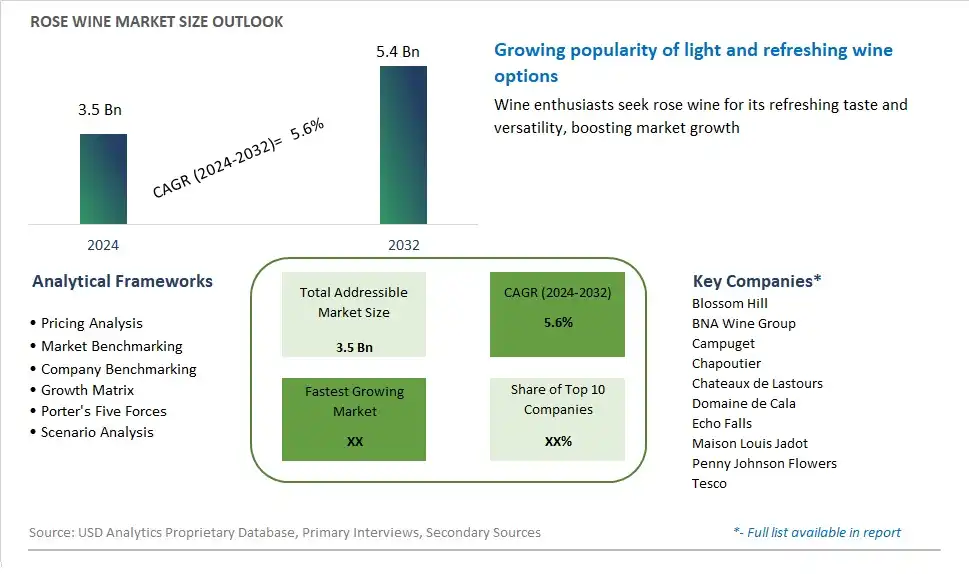
The market report analyses the leading companies in the industry including Blossom Hill, BNA Wine Group, Campuget, Chapoutier, Chateaux de Lastours, Domaine de Cala, Echo Falls, Maison Louis Jadot, Penny Johnson Flowers, Tesco, and Others.
A prominent market trend in the rose wine segment is the rising popularity of rosé wine as a lifestyle choice among consumers. Once considered a seasonal beverage or occasional indulgence, rosé wine has evolved into a year-round favorite, embraced by a diverse demographic of wine enthusiasts. Its light, refreshing character, and versatility make it well-suited for various occasions, from casual gatherings to formal celebrations, contributing to its appeal as a lifestyle beverage. This trend is driven by shifting consumer preferences towards lighter, fruit-forward wines, as well as the influence of social media and cultural trends that celebrate the enjoyment of wine as part of a vibrant and convivial lifestyle.
The market driver for rosé wine is the demand for premium and Provence-style rosé wines among consumers. Provence-style rosés, characterized by their pale pink hue, crisp acidity, and delicate fruit flavors, have set the benchmark for quality rosé wines globally. As consumers become more discerning and knowledgeable about wine, there is a growing preference for rosé wines that reflect the elegance and sophistication of Provence-style winemaking. This driver is reinforced by the perception of rosé wine as a premium product associated with leisure, luxury, and sophistication, driving demand for high-quality rosé wines from renowned wine regions such as Provence, California, and New Zealand.
One potential opportunity for the rosé wine market lies in innovation in packaging formats and flavor profiles. While traditional bottled rosé wines remain popular, there is an opportunity to explore alternative packaging formats such as cans, Tetra Paks, and single-serve bottles to cater to changing consumer preferences for convenience and portability. Additionally, experimenting with new flavor profiles, grape varietals, and winemaking techniques can diversify the range of rosé wines available in the market and appeal to adventurous consumers seeking novel tasting experiences. By embracing innovation in packaging and flavor, wine producers can differentiate their rosé wines, attract new consumers, and capitalize on emerging trends in the wine market.
In the Rose Wine market segmented by product, the Still Wine segment is the largest, driven by its wide consumer appeal, versatility, and established market presence. Still rose wine, characterized by its refreshing flavors, delicate aromas, and varying levels of sweetness, holds a significant share of the rose wine market due to its popularity among consumers seeking versatile and approachable wine options. This segment's dominance is reinforced by the diverse range of still rose wines available, including dry, off-dry, and sweet varieties, catering to different taste preferences and occasions. Additionally, still rose wine's versatility makes it suitable for various culinary pairings, from light salads and seafood dishes to hearty meats and cheeses, enhancing its appeal across different dining experiences. Further, the traditional winemaking techniques employed in producing still rose wines ensure consistency in quality and flavor profiles, further solidifying its position as the largest segment in the Rose Wine market. Furthermore, the widespread availability of still rose wines in retail outlets, restaurants, and online platforms contributes to its accessibility and market dominance. Overall, the combination of consumer preference, versatility, and accessibility positions the Still Wine segment as the largest in the Rose Wine market.
In the Rose Wine market segmented by color, the Rose Wine segment is the fastest-growing, propelled by shifting consumer preferences towards lighter, more versatile, and refreshing wine options. Rose wine, known for its appealing pink hue and balanced flavor profile, has witnessed a surge in popularity among wine enthusiasts and casual drinkers alike. This growth is driven by several factors, including the rise of wine culture, social media influence, and changing drinking habits among millennials and Gen Z consumers, who seek wines that offer a balance between complexity and approachability. Additionally, the versatility of rose wine makes it suitable for a wide range of occasions, from casual gatherings to formal events, further fueling its popularity. Further, the increasing availability of high-quality rose wines from diverse wine regions around the world, coupled with innovative marketing strategies and branding efforts, contributes to the segment's rapid growth. Furthermore, rose wine's association with outdoor dining, brunches, and summer gatherings enhances its appeal as a refreshing and sociable beverage choice. Overall, the combination of consumer demand for lighter and more versatile wine options, coupled with effective marketing initiatives, positions the Rose Wine segment as the fastest-growing in the Rose Wine market.
In the Rose Wine market segmented by distribution channel, the Supermarkets/Hypermarkets segment is the largest, driven by its widespread availability, convenience, and consumer accessibility. Supermarkets and hypermarkets serve as key retail channels for consumers seeking a diverse selection of wines, including rose wine, during their routine grocery shopping trips. This segment's dominance is reinforced by the extensive shelf space dedicated to wine displays, promotional offers, and strategic positioning within these retail outlets, attracting impulse purchases and driving sales volume. Further, supermarkets and hypermarkets often carry a wide range of rose wine brands and varietals, catering to different price points and consumer preferences, further solidifying their position as the preferred destination for wine purchases. Additionally, the convenience of one-stop shopping, ample parking facilities, and extended operating hours offered by supermarkets and hypermarkets contribute to their appeal among busy consumers seeking convenience and value. Furthermore, the rising trend of wine consumption at home, particularly during the COVID-19 pandemic, has led to increased sales of rose wine through retail channels, further boosting the dominance of the Supermarkets/Hypermarkets segment in the Rose Wine market. Overall, the combination of convenience, accessibility, and diverse product offerings positions the Supermarkets/Hypermarkets segment as the largest in the Rose Wine market.
By Product
Still Wine
Sparkling Wine
Fortified Wine and Vermouth
By Color
Red Wine
Rose Wine
White Wine
By Distribution Channel
Supermarkets/ Hypermarkets
Specialty Stores
Online Retail
Countries Analyzed
North America (US, Canada, Mexico)
Europe (Germany, UK, France, Spain, Italy, Russia, Rest of Europe)
Asia Pacific (China, India, Japan, South Korea, Australia, South East Asia, Rest of Asia)
South America (Brazil, Argentina, Rest of South America)
Middle East and Africa (Saudi Arabia, UAE, Rest of Middle East, South Africa, Egypt, Rest of Africa)
Blossom Hill
BNA Wine Group
Campuget
Chapoutier
Chateaux de Lastours
Domaine de Cala
Echo Falls
Maison Louis Jadot
Penny Johnson Flowers
Tesco
*- List Not Exhaustive
Chapter 1. TABLE OF CONTENTS
Chapter 2. Introduction to Rose Wine Market
2.1. Market Overview
2.2. Key Statistics and Report Highlights
2.3. Scope of the Comprehensive Study
2.3.1. Market Definition
2.3.2 Countries and Regions Covered
2.3.3 Research Objective
2.3.4 Units, Currency, and Conversions
2.3.5 Industry Value Chain
2.4. Key Market Segments
2.5. Key Companies
2.6. Study Period
Chapter 3. Strategic Analysis Review
3.1. Rose Wine Pricing Analysis and Forecast
3.2. Porter’s Five Forces
3.3. Market Ecosystem
3.4. SWOT Analysis
3.5. Regulatory Scenario
3.3. Effects of Inflation, Russia-Ukraine War, moderating economic growth, and other macroeconomic factors
Chapter 4. Competitive Landscape
4.1. Market Share Analysis
4.1.1. Global Rose Wine Market Share by Company, 2023
4.1.2. Product Offerings of Leading Rose Wine Companies
4.2. Market Entropy
4.2.1. New Product Launches in the Industry
4.2.2. Mergers, Acquisitions, Joint ventures, and Partnerships
4.3. Key Strategies and Best Practices
Chapter 5. Global Market Projections: Best, Reference, and Low Case Scenarios
5.1. Growth Analysis- Case Scenario Definitions
5.2. Low Growth Case Scenario Forecasts
5.3. Reference Growth Case Scenario Forecasts
5.4. High Growth Case Scenario Forecasts
Chapter 6. Market Dynamics
6.1. Rose Wine Market Drivers
6.2. Rose Wine Market Challenges
6.6. Rose Wine Market Opportunities
6.4. Rose Wine Market Trends
Chapter 7. Global Rose Wine Market Outlook Trends
7.1. Global Rose Wine Revenue (USD Million) and CAGR (%) by Type (2021-2032)
7.2. Global Rose Wine Revenue (USD Million) and CAGR (%) by Application (2021-2032)
7.3. Global Rose Wine Revenue (USD Million) and CAGR (%) by Product (2021-2032)
By Product
Still Wine
Sparkling Wine
Fortified Wine and Vermouth
By Color
Red Wine
Rose Wine
White Wine
By Distribution Channel
Supermarkets/ Hypermarkets
Specialty Stores
Online Retail
Chapter 8. Global Rose Wine Regional Analysis and Outlook
8.1. Global Rose Wine Revenue (USD Million) By Regions (2021- 2032)
8.2. North America Rose Wine Revenue (USD Million) by Country (2021-2032)
8.2.1. United States Rose Wine Regional Analysis and Outlook
8.2.2. Canada Rose Wine Regional Analysis and Outlook
8.2.3. Mexico Rose Wine Regional Analysis and Outlook
8.3. Europe Rose Wine Revenue (USD Million), by Country (2021-2032)
8.3.1. Germany Rose Wine Regional Analysis and Outlook
8.3.2. France Rose Wine Regional Analysis and Outlook
8.3.3. United Kingdom Rose Wine Regional Analysis and Outlook
8.3.4. Spain Rose Wine Regional Analysis and Outlook
8.3.5. Italy Rose Wine Regional Analysis and Outlook
8.3.6. Russia Rose Wine Regional Analysis and Outlook
8.3.7. Rest of Europe Rose Wine Regional Analysis and Outlook
8.4. Asia Pacific Rose Wine Revenue (USD Million) by Country (2021-2032)
8.4.1. China Rose Wine Regional Analysis and Outlook
8.4.2. Japan Rose Wine Regional Analysis and Outlook
8.4.3. India Rose Wine Regional Analysis and Outlook
8.4.4. South Korea Rose Wine Regional Analysis and Outlook
8.4.5. Australia Rose Wine Regional Analysis and Outlook
8.4.6. South East Asia Rose Wine Regional Analysis and Outlook
8.4.7. Rest of Asia Pacific Rose Wine Regional Analysis and Outlook
8.5. South America Rose Wine Revenue (USD Million), by Country (2021-2032)
8.5.1. Brazil Rose Wine Regional Analysis and Outlook
8.5.2. Argentina Rose Wine Regional Analysis and Outlook
8.5.3. Rest of South America Rose Wine Regional Analysis and Outlook
8.6. Middle East and Africa Rose Wine Revenue (USD Million) by Country (2021-2032)
8.6.1. Middle East Rose Wine Regional Analysis and Outlook
8.6.2. Africa Rose Wine Regional Analysis and Outlook
Chapter 9. North America Rose Wine Analysis and Outlook
9.1. North America Rose Wine Revenue (USD Million) by Segments (2021-2032)
9.1.1. North America Rose Wine Revenue (USD Million) by Type (2021-2032)
9.1.2. North America Rose Wine Revenue (USD Million) by Application (2021-2032)
9.1.3. North America Rose Wine Revenue (USD Million) by Product (2021-2032)
By Product
Still Wine
Sparkling Wine
Fortified Wine and Vermouth
By Color
Red Wine
Rose Wine
White Wine
By Distribution Channel
Supermarkets/ Hypermarkets
Specialty Stores
Online Retail
Chapter 10. Europe Rose Wine Analysis and Outlook
10.1. Europe Rose Wine Revenue (USD Million), by Segments (USD Million) (2021-2032)
10.1.1. Europe Rose Wine Revenue (USD Million) by Type (2021-2032)
10.1.2. Europe Rose Wine Revenue (USD Million) by Application (2021-2032)
10.1.3. Europe Rose Wine Revenue (USD Million) by Product (2021-2032)
By Product
Still Wine
Sparkling Wine
Fortified Wine and Vermouth
By Color
Red Wine
Rose Wine
White Wine
By Distribution Channel
Supermarkets/ Hypermarkets
Specialty Stores
Online Retail
Chapter 11. Asia Pacific Rose Wine Analysis and Outlook
11.1. Asia Pacific Rose Wine Revenue (USD Million), and Revenue (USD Million) by Segments (2021-2032)
11.1.1. Asia Pacific Rose Wine Revenue (USD Million) by Type (2021-2032)
11.1.2. Asia Pacific Rose Wine Revenue (USD Million) by Application (2021-2032)
11.1.3. Asia Pacific Rose Wine Revenue (USD Million) by Product (2021-2032)
By Product
Still Wine
Sparkling Wine
Fortified Wine and Vermouth
By Color
Red Wine
Rose Wine
White Wine
By Distribution Channel
Supermarkets/ Hypermarkets
Specialty Stores
Online Retail
Chapter 12. South America Rose Wine Analysis and Outlook
12.1. South America Rose Wine Revenue (USD Million), by Segments (2021-2032)
12.1.1. South America Rose Wine Revenue (USD Million) by Type (2021-2032)
12.1.2. South America Rose Wine Revenue (USD Million) by Application (2021-2032)
12.1.3. South America Rose Wine Revenue (USD Million) by Product (2021-2032)
By Product
Still Wine
Sparkling Wine
Fortified Wine and Vermouth
By Color
Red Wine
Rose Wine
White Wine
By Distribution Channel
Supermarkets/ Hypermarkets
Specialty Stores
Online Retail
Chapter 13. Middle East and Africa Rose Wine Analysis and Outlook
13.1. Middle East and Africa Rose Wine Revenue (USD Million), by Segments (2021-2032)
13.1.1. Middle East and Africa Rose Wine Revenue (USD Million) by Type (2021-2032)
13.1.2. Middle East and Africa Rose Wine Revenue (USD Million) by Application (2021-2032)
13.1.3. Middle East and Africa Rose Wine Revenue (USD Million) by Product (2021-2032)
By Product
Still Wine
Sparkling Wine
Fortified Wine and Vermouth
By Color
Red Wine
Rose Wine
White Wine
By Distribution Channel
Supermarkets/ Hypermarkets
Specialty Stores
Online Retail
Chapter 14. Rose Wine Company Profiles
14.1 Business Overview
14.2 Product Profiles
14.3 SWOT Profiles
14.5 Recent Developments
14.6 Financial Profile
List of Companies
Blossom Hill
BNA Wine Group
Campuget
Chapoutier
Chateaux de Lastours
Domaine de Cala
Echo Falls
Maison Louis Jadot
Penny Johnson Flowers
Tesco
15. Methodology and Data Sources
15.1 Customization Offerings
15.2 Subscription Services
15.3 Related Reports
15.4 Publisher Expertise
LIST OF TABLES
Table 1 Market Segmentation Analysis
Table 2 Global Rose Wine Market Share of Leading Companies, 2023
Table 3 Product Offerings of Leading Companies
Table 4 Low Growth Scenario Forecasts
Table 5 Reference Case Growth Scenario
Table 6 High Growth Case Scenario
Table 7 Global Rose Wine Revenue (USD Million) And CAGR (%) By Type (2021-2032)
Table 8 Global Rose Wine Revenue (USD Million) And CAGR (%) By Application (2021-2032)
Table 9 Global Rose Wine Revenue (USD Million) And CAGR (%) By Product (2021-2032)
Table 10 Global Rose Wine Market Revenue (USD Million) By Regions (2021-2032)
Table 11 Global Rose Wine Market Share (%) By Regions (2021-2032)
Table 12 North America Rose Wine Revenue (USD Million) By Country (2021-2032)
Table 13 Europe Rose Wine Revenue (USD Million) By Country (2021-2032)
Table 14 Asia Pacific Rose Wine Revenue (USD Million) By Country (2021-2032)
Table 15 South America Rose Wine Revenue (USD Million) By Country (2021-2032)
Table 16 Middle East and Africa Rose Wine Revenue (USD Million) By Region (2021-2032)
Table 17 North America Rose Wine Revenue (USD Million) By Type (2021-2032)
Table 18 North America Rose Wine Revenue (USD Million) By Application (2021-2032)
Table 19 North America Rose Wine Revenue (USD Million) By Product (2021-2032)
Table 20 Europe Rose Wine Revenue (USD Million) By Type (2021-2032)
Table 21 Europe Rose Wine Revenue (USD Million) By Application (2021-2032)
Table 22 Europe Rose Wine Revenue (USD Million) By Product (2021-2032)
Table 23 Asia Pacific Rose Wine Revenue (USD Million) By Type (2021-2032)
Table 24 Asia Pacific Rose Wine Revenue (USD Million) By Application (2021-2032)
Table 25 Asia Pacific Rose Wine Revenue (USD Million) By Product (2021-2032)
Table 26 South America Rose Wine Revenue (USD Million) By Type (2021-2032)
Table 27 South America Rose Wine Revenue (USD Million) By Application (2021-2032)
Table 28 South America Rose Wine Revenue (USD Million) By Product (2021-2032)
Table 29 Middle East and Africa Rose Wine Revenue (USD Million) By Type (2021-2032)
Table 30 Middle East and Africa Rose Wine Revenue (USD Million) By Application (2021-2032)
Table 31 Middle East and Africa Rose Wine Revenue (USD Million) By Product (2021-2032)
LIST OF FIGURES
Figure 1. Market Scope
Figure 2. Pricing Forecasts Per Unit, 2023- 2032
Figure 3. Porter’s Five Forces
Figure 4. Global Rose Wine Market Revenue (USD Million) By Regions (2021-2032)
Figure 5. Global Rose Wine Market Share (%) By Regions (2023)
Figure 6. North America Rose Wine Revenue (USD Million) By Country (2021-2032)
Figure 7. United States Rose Wine Revenue (USD Million) By Country (2021-2032)
Figure 8. Canada Rose Wine Revenue (USD Million) By Country (2021-2032)
Figure 9. Mexico Rose Wine Revenue (USD Million) By Country (2021-2032)
Figure 10. Europe Rose Wine Revenue (USD Million) By Country (2021-2032)
Figure 11. Germany Rose Wine Revenue (USD Million) By Country (2021-2032)
Figure 12. France Rose Wine Revenue (USD Million) By Country (2021-2032)
Figure 13. United Kingdom Rose Wine Revenue (USD Million) By Country (2021-2032)
Figure 14. Spain Rose Wine Revenue (USD Million) By Country (2021-2032)
Figure 15. Italy Rose Wine Revenue (USD Million) By Country (2021-2032)
Figure 16. Russia Rose Wine Revenue (USD Million) By Country (2021-2032)
Figure 17. Rest of Europe Rose Wine Revenue (USD Million) By Country (2021-2032)
Figure 11. Asia Pacific Rose Wine Revenue (USD Million) By Country (2021-2032)
Figure 12. China Rose Wine Revenue (USD Million) By Country (2021-2032)
Figure 13. Japan Rose Wine Revenue (USD Million) By Country (2021-2032)
Figure 14. India Rose Wine Revenue (USD Million) By Country (2021-2032)
Figure 15. South Korea Rose Wine Revenue (USD Million) By Country (2021-2032)
Figure 16. Australia Rose Wine Revenue (USD Million) By Country (2021-2032)
Figure 17. South East Asia Rose Wine Revenue (USD Million) By Country (2021-2032)
Figure 18. South America Rose Wine Revenue (USD Million) By Country (2021-2032)
Figure 19. Brazil Rose Wine Revenue (USD Million) By Country (2021-2032)
Figure 20. Argentina Rose Wine Revenue (USD Million) By Country (2021-2032)
Figure 21. Rest of Asia Pacific Rose Wine Revenue (USD Million) By Country (2021-2032)
Figure 22. Middle East and Africa Rose Wine Revenue (USD Million) By Region (2021-2032)
Figure 23. Saudi Arabia Rose Wine Revenue (USD Million) By Region (2021-2032)
Figure 24. The UAE Rose Wine Revenue (USD Million) By Region (2021-2032)
Figure 25. Rest of Middle East Rose Wine Revenue (USD Million) By Region (2021-2032)
Figure 26. South Africa Rose Wine Revenue (USD Million) By Region (2021-2032)
Figure 27. Africa Rose Wine Revenue (USD Million) By Region (2021-2032)
Figure 28. North America Rose Wine Revenue (USD Million) By Type (2021-2032)
Figure 29. North America Rose Wine Revenue (USD Million) By Application (2021-2032)
Figure 30. North America Rose Wine Revenue (USD Million) By Product (2021-2032)
Figure 31. Europe Rose Wine Revenue (USD Million) By Type (2021-2032)
Figure 32. Europe Rose Wine Revenue (USD Million) By Application (2021-2032)
Figure 33. Europe Rose Wine Revenue (USD Million) By Product (2021-2032)
Figure 34. Asia Pacific Rose Wine Revenue (USD Million) By Type (2021-2032)
Figure 35. Asia Pacific Rose Wine Revenue (USD Million) By Application (2021-2032)
Figure 36. Asia Pacific Rose Wine Revenue (USD Million) By Product (2021-2032)
Figure 37. South America Rose Wine Revenue (USD Million) By Type (2021-2032)
Figure 38. South America Rose Wine Revenue (USD Million) By Application (2021-2032)
Figure 39. South America Rose Wine Revenue (USD Million) By Product (2021-2032)
Figure 40. Middle East and Africa Rose Wine Revenue (USD Million) By Type (2021-2032)
Figure 41. Middle East and Africa Rose Wine Revenue (USD Million) By Application (2021-2032)
Figure 42. Middle East and Africa Rose Wine Revenue (USD Million) By Product (2021-2032)
By Product
Still Wine
Sparkling Wine
Fortified Wine and Vermouth
By Color
Red Wine
Rose Wine
White Wine
By Distribution Channel
Supermarkets/ Hypermarkets
Specialty Stores
Online Retail
Countries Analyzed
North America (US, Canada, Mexico)
Europe (Germany, UK, France, Spain, Italy, Russia, Rest of Europe)
Asia Pacific (China, India, Japan, South Korea, Australia, South East Asia, Rest of Asia)
South America (Brazil, Argentina, Rest of South America)
Middle East and Africa (Saudi Arabia, UAE, Rest of Middle East, South Africa, Egypt, Rest of Africa)
Global Rose Wine Market Size is valued at $3.5 Billion in 2024 and is forecast to register a growth rate (CAGR) of 5.6% to reach $5.4 Billion by 2032.
Emerging Markets across Asia Pacific, Europe, and Americas present robust growth prospects.
Blossom Hill, BNA Wine Group, Campuget, Chapoutier, Chateaux de Lastours, Domaine de Cala, Echo Falls, Maison Louis Jadot, Penny Johnson Flowers, Tesco
Base Year- 2023; Estimated Year- 2024; Historic Period- 2018-2023; Forecast period- 2024 to 2032; Currency: Revenue (USD); Volume