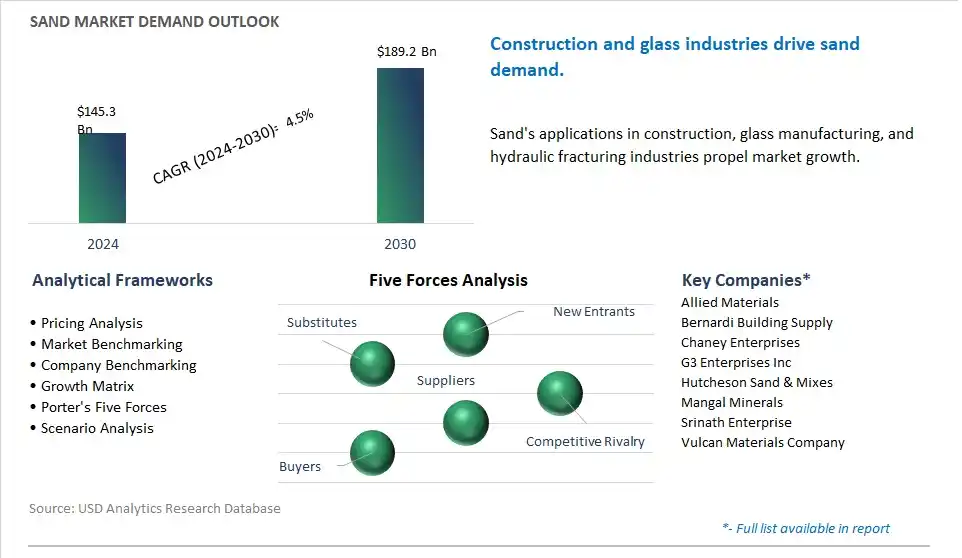
The global Sand Market is poised to register a 4.5% CAGR from $145.3 Billion in 2024 to $189.2 Billion in 2030.
The global Sand Market Study analyzes and forecasts the market size across 6 regions and 24 countries for diverse segments -By Type (Natural Sand, Manufactured Sand), By Application (Residential, Commercial, Infrastructure).
An Introduction to Global Sand Market in 2024
The future of the sand market is shaped by key trends such as construction, glass manufacturing, and hydraulic fracturing in the oil and gas industry. Sand, primarily composed of quartz and silica, is a crucial raw material used in various industries for its abrasive, thermal, and structural properties. In the construction sector, sand is used in concrete production, masonry, and asphalt paving, providing strength, stability, and durability to building materials. Moreover, in the glass industry, sand is a key ingredient in glass manufacturing processes, providing clarity, hardness, and heat resistance to glass products such as windows, bottles, and fiberglass. Additionally, in the oil and gas industry, sand is utilized as a proppant in hydraulic fracturing operations, where it is injected into oil and gas wells to prop open fractures and enhance hydrocarbon recovery from underground reservoirs. Furthermore, as industries seek sustainable alternatives and circular economy solutions, the sand market will witness innovations in sand recycling, alternative raw materials, and eco-friendly substitutes to minimize environmental impact and resource depletion. As global demand for construction materials, glass products, and energy resources continues to grow, the sand market will play a crucial role in supporting industrial development, infrastructure projects, and energy production while adapting to changing market dynamics and environmental considerations.
Sand Market Competitive Landscape
The market report analyses the leading companies in the industry including Allied Materials, Bernardi Building Supply, Chaney Enterprises, G3 Enterprises Inc, Hutcheson Sand & Mixes, Mangal Minerals, Srinath Enterprise, Vulcan Materials Company.
Sand Market Dynamics
Sand Market Trend: Growing Demand for Sustainable Construction Materials
A significant trend in the market for sand is the increasing demand for sustainable construction materials. As awareness of environmental issues rises and regulations become stricter, there is a growing emphasis on using environmentally friendly materials in construction projects. Sand, a key ingredient in concrete, asphalt, and other construction materials, is facing scrutiny due to concerns about its depletion from natural sources and its impact on ecosystems. The trend is driving the adoption of alternative sources of sand, such as recycled aggregates, manufactured sand, and industrial by-products, as well as the development of sustainable extraction and processing practices.
Sand Market Driver: Expansion of Infrastructure and Urban Development Projects
A primary driver for the market of sand is the expansion of infrastructure and urban development projects worldwide. Sand is an essential component in the construction of roads, bridges, buildings, and other infrastructure projects, as well as in urban development initiatives such as housing construction and landscaping. The rapid pace of urbanization, population growth, and economic development drives the demand for sand as construction activity intensifies in both developed and emerging markets. The need to build and upgrade infrastructure to support growing populations and urban centers acts as a key driver for the consumption of sand in construction projects.
Sand Market Opportunity: Development of Innovative Sand Alternatives and Recycling Technologies
An opportunity in the market for sand lies in the development of innovative alternatives and recycling technologies. With concerns about sand depletion and environmental sustainability, there is potential to explore alternative materials and technologies that can reduce reliance on natural sand resources. Manufacturers and researchers are investing in the development of alternative construction materials such as geopolymers, fly ash, and recycled aggregates, which can replace or supplement sand in various applications. Additionally, there is opportunity to invest in recycling technologies that can recover and reuse sand from construction and demolition waste, reducing the need for virgin sand extraction and minimizing environmental impact. By investing in innovative alternatives and recycling technologies, companies can address sustainability concerns, meet regulatory requirements, and capitalize on emerging opportunities in the market for sand.
Sand Market Share Analysis: Natural Sand generated the highest revenue in 2024
Natural sand has been traditionally used in various construction and industrial applications for centuries due to its abundance, accessibility, and versatility. Natural sand is formed through the erosion and weathering of rocks and minerals over time, resulting in a wide range of particle sizes and shapes that make it suitable for different construction purposes. Additionally, natural sand is valued for its superior properties such as high compressive strength, good drainage, and thermal conductivity, making it ideal for use in concrete production, road construction, landscaping, and other applications. Further, natural sand is cost-effective compared to manufactured sand, as it does not require additional processing or manufacturing steps. Furthermore, environmental regulations and sustainability considerations drive the preference for natural sand over manufactured alternatives in certain regions, further reinforcing its dominance in the Sand Market.
Sand Market Share Analysis: Infrastructure segment is poised to register the fastest growth rate (CAGR) over the forecast period to 2030
Rapid urbanization and population growth worldwide drive the demand for infrastructure development projects such as roads, bridges, highways, airports, ports, and railways. Sand is a key component in the construction of these infrastructure projects, used primarily in concrete, asphalt, and road base materials. Additionally, government initiatives and investments in infrastructure development, particularly in emerging economies, further boost the demand for sand. Further, the expansion of transportation networks, urban areas, and industrial zones requires significant quantities of sand for construction activities, driving the growth of the Infrastructure segment in the Sand Market. Furthermore, megatrends such as climate change adaptation and sustainable development also contribute to the demand for infrastructure projects that incorporate sand in environmentally friendly construction practices and materials. These factors collectively contribute to the rapid growth of the Infrastructure segment in the Sand Market.
Sand Market Report Segmentation
By Type
Natural Sand
Manufactured Sand
By Application
Residential
Commercial
Infrastructure
Regions Included
North America (US, Canada, Mexico)
Europe (Germany, UK, France, Spain, Italy, Russia, Rest of Europe)
Asia Pacific (China, India, Japan, South Korea, Australia, South East Asia, Rest of Asia)
South America (Brazil, Argentina, Rest of South America)
Middle East and Africa (Saudi Arabia, UAE, Rest of Middle East, South Africa, Egypt, Rest of Africa)
Sand Companies Profiled in the Market Study
Allied Materials
Bernardi Building Supply
Chaney Enterprises
G3 Enterprises Inc
Hutcheson Sand & Mixes
Mangal Minerals
Srinath Enterprise
Vulcan Materials Company
*- List Not Exhaustive
TABLE OF CONTENTS
1 Introduction to 2024 Sand Market
1.1 Market Overview
1.2 Quick Facts
1.3 Scope/Objective of the Study
1.4 Market Definition
1.5 Countries and Regions Covered
1.6 Units, Currency, and Conversions
1.7 Industry Value Chain
2 Research Methodology
2.1 Market Size Estimation
2.2 Sources and Research Methodology
2.3 Data Triangulation
2.4 Assumptions and Limitations
3 Executive Summary
3.1 Global Sand Market Size Outlook, $ Million, 2021 to 2030
3.2 Sand Market Outlook by Type, $ Million, 2021 to 2030
3.3 Sand Market Outlook by Product, $ Million, 2021 to 2030
3.4 Sand Market Outlook by Application, $ Million, 2021 to 2030
3.5 Sand Market Outlook by Key Countries, $ Million, 2021 to 2030
4 Market Dynamics
4.1 Key Driving Forces of Sand Industry
4.2 Key Market Trends in Sand Industry
4.3 Potential Opportunities in Sand Industry
4.4 Key Challenges in Sand Industry
5 Market Factor Analysis
5.1 Value Chain Analysis
5.2 Competitive Landscape
5.2.1 Global Sand Market Share by Company (%), 2023
5.2.2 Product Offerings by Company
5.3 Porter’s Five Forces Analysis
5.4 Pricing Analysis and Outlook
6 Growth Outlook Across Scenarios
6.1 Growth Analysis-Case Scenario Definitions
6.2 Low Growth Scenario Forecasts
6.3 Reference Growth Scenario Forecasts
6.4 High Growth Scenario Forecasts
7 Global Sand Market Outlook by Segments
7.1 Sand Market Outlook by Segments, $ Million, 2021- 2030
By Type
Natural Sand
Manufactured Sand
By Application
Residential
Commercial
Infrastructure
8 North America Sand Market Analysis and Outlook To 2030
8.1 Introduction to North America Sand Markets in 2024
8.2 North America Sand Market Size Outlook by Country, 2021-2030
8.2.1 United States
8.2.2 Canada
8.2.3 Mexico
8.3 North America Sand Market size Outlook by Segments, 2021-2030
By Type
Natural Sand
Manufactured Sand
By Application
Residential
Commercial
Infrastructure
9 Europe Sand Market Analysis and Outlook To 2030
9.1 Introduction to Europe Sand Markets in 2024
9.2 Europe Sand Market Size Outlook by Country, 2021-2030
9.2.1 Germany
9.2.2 France
9.2.3 Spain
9.2.4 United Kingdom
9.2.4 Italy
9.2.5 Russia
9.2.6 Norway
9.2.7 Rest of Europe
9.3 Europe Sand Market Size Outlook by Segments, 2021-2030
By Type
Natural Sand
Manufactured Sand
By Application
Residential
Commercial
Infrastructure
10 Asia Pacific Sand Market Analysis and Outlook To 2030
10.1 Introduction to Asia Pacific Sand Markets in 2024
10.2 Asia Pacific Sand Market Size Outlook by Country, 2021-2030
10.2.1 China
10.2.2 India
10.2.3 Japan
10.2.4 South Korea
10.2.5 Indonesia
10.2.6 Malaysia
10.2.7 Australia
10.2.8 Rest of Asia Pacific
10.3 Asia Pacific Sand Market size Outlook by Segments, 2021-2030
By Type
Natural Sand
Manufactured Sand
By Application
Residential
Commercial
Infrastructure
11 South America Sand Market Analysis and Outlook To 2030
11.1 Introduction to South America Sand Markets in 2024
11.2 South America Sand Market Size Outlook by Country, 2021-2030
11.2.1 Brazil
11.2.2 Argentina
11.2.3 Rest of South America
11.3 South America Sand Market size Outlook by Segments, 2021-2030
By Type
Natural Sand
Manufactured Sand
By Application
Residential
Commercial
Infrastructure
12 Middle East and Africa Sand Market Analysis and Outlook To 2030
12.1 Introduction to Middle East and Africa Sand Markets in 2024
12.2 Middle East and Africa Sand Market Size Outlook by Country, 2021-2030
12.2.1 Saudi Arabia
12.2.2 UAE
12.2.3 Oman
12.2.4 Rest of Middle East
12.2.5 Egypt
12.2.6 Nigeria
12.2.7 South Africa
12.2.8 Rest of Africa
12.3 Middle East and Africa Sand Market size Outlook by Segments, 2021-2030
By Type
Natural Sand
Manufactured Sand
By Application
Residential
Commercial
Infrastructure
13 Company Profiles
13.1 Company Snapshot
13.2 SWOT Profiles
13.3 Products and Services
13.4 Recent Developments
13.5 Financial Profile
Allied Materials
Bernardi Building Supply
Chaney Enterprises
G3 Enterprises Inc
Hutcheson Sand & Mixes
Mangal Minerals
Srinath Enterprise
Vulcan Materials Company
14 Appendix
14.1 Customization Offerings
14.2 Subscription Services
14.3 Related Reports
14.4 Publisher Expertise
By Type
Natural Sand
Manufactured Sand
By Application
Residential
Commercial
Infrastructure
Countries Analyzed
North America (US, Canada, Mexico)
Europe (Germany, UK, France, Spain, Italy, Russia, Rest of Europe)
Asia Pacific (China, India, Japan, South Korea, Australia, South East Asia, Rest of Asia)
South America (Brazil, Argentina, Rest of South America)
Middle East and Africa (Saudi Arabia, UAE, Rest of Middle East, South Africa, Egypt, Rest of Africa)
