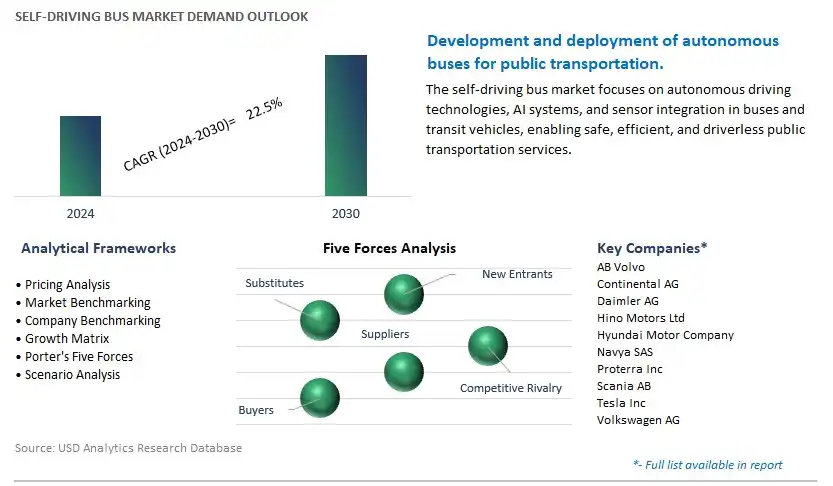
Self-driving Bus Market is estimated to increase at a growth rate of 22.5% CAGR over the forecast period from 2024 to 2030.
The global Self-driving Bus Market study analyzes and forecasts the market size across 6 regions and 24 countries for diverse segments including By Level of Automation (Level 3, Level 4, Level 5), By Component (Hardware, Software, Services).
An Introduction to Global Self-driving Bus Market, 2024
The Self-Driving Bus Market in 2024 represents a transformative shift in public transportation, offering autonomous solutions that redefine urban mobility and address challenges such as traffic congestion, emissions, and accessibility. Self-driving buses leverage advanced technologies such as artificial intelligence, LiDAR, and GPS to navigate predefined routes, detect obstacles, and safely transport passengers with minimal human intervention. With urban populations growing and cities seeking sustainable transportation alternatives, self-driving buses provide a scalable and efficient solution for improving public transit systems. Manufacturers and technology companies in this market focus on developing robust autonomous driving systems, passenger safety features, and vehicle-to-infrastructure (V2I) communication capabilities to ensure reliable and seamless operation in diverse urban environments. Moreover, integration with smart city initiatives and public transit networks enables self-driving buses to optimize route planning, reduce travel times, and enhance passenger convenience. Additionally, customization options such as seating configurations, accessibility features, and onboard amenities cater to diverse passenger needs and preferences. As cities embrace the potential of autonomous transportation, the Self-Driving Bus Market continues to advance, offering innovative solutions that redefine the future of urban mobility.
Self-driving Bus Competitive Landscape
The global Self-driving Bus market is highly competitive with a large number of companies focusing on niche market segments. Amidst intense competitive conditions, Self-driving Bus Companies are investing in new product launches and strengthening distribution channels. Key companies operating in the Self-driving Bus Market Industry include- AB Volvo, Continental AG, Daimler AG, Hino Motors Ltd, Hyundai Motor Company, Navya SAS, Proterra Inc, Scania AB, Tesla Inc, Volkswagen AG.
Self-driving Bus Market Trend: Integration of Advanced Sensor Technologies for Enhanced Safety and Navigation
A prominent trend in the Self-driving Bus market is the integration of advanced sensor technologies to enhance safety and navigation capabilities. Manufacturers are incorporating a range of sensors such as LiDAR, radar, cameras, and ultrasonic sensors into self-driving buses to enable real-time detection of obstacles, pedestrians, and other vehicles on the road. These sensors provide crucial data for autonomous systems to accurately perceive the surrounding environment, make informed decisions, and navigate complex urban landscapes with precision and reliability. Additionally, there's a growing emphasis on sensor fusion and artificial intelligence algorithms to improve sensor data processing, object recognition, and predictive modeling, further enhancing the autonomous driving capabilities of self-driving buses. This trend is reshaping the self-driving bus market, with manufacturers and technology providers investing in research and development to offer innovative solutions that ensure safe and efficient autonomous transportation for passengers and pedestrians.
Self-driving Bus Market Driver: Demand for Efficient and Sustainable Public Transportation Solutions
A key driver for the Self-driving Bus market is the increasing demand for efficient and sustainable public transportation solutions, driven by urbanization, population growth, and the need to reduce congestion, pollution, and carbon emissions in cities. With rapid urbanization and growing populations in urban areas, there's a corresponding increase in demand for public transportation services that are reliable, cost-effective, and environmentally friendly. Self-driving buses offer potential benefits such as improved traffic flow, reduced travel times, and lower operating costs compared to traditional buses operated by human drivers. Moreover, the integration of electric and autonomous technologies in self-driving buses aligns with government initiatives and sustainability goals to promote clean energy adoption and mitigate the impacts of climate change. This driver is fueled by factors such as increasing urban congestion, air quality concerns, government investments in smart city infrastructure, and the growing emphasis on sustainable transportation solutions, driving the adoption and deployment of self-driving buses as a key component of future urban mobility systems.
Self-driving Bus Market Opportunity: Collaboration with Smart City Initiatives and Public Transport Authorities
An emerging opportunity within the Self-driving Bus market lies in collaboration with smart city initiatives and public transport authorities, offering new avenues for deployment, partnership, and market expansion. As cities worldwide invest in smart infrastructure, intelligent transportation systems, and mobility-as-a-service platforms, there's growing interest and support for the integration of autonomous vehicles into urban transportation networks. Manufacturers of self-driving buses can seize this opportunity by collaborating with city governments, transit agencies, and public-private partnerships to pilot autonomous bus programs, demonstrate technology readiness, and showcase the benefits of self-driving buses in real-world urban environments. Additionally, there's potential for joint research projects, funding opportunities, and regulatory support to accelerate the deployment and adoption of self-driving buses as part of broader smart city initiatives. By aligning with stakeholders and leveraging synergies between autonomous transportation and urban planning, manufacturers can establish themselves as key players in the emerging market for autonomous public transportation solutions, driving growth and innovation in the self-driving bus market. This opportunity is fueled by factors such as government funding for smart city projects, public-private partnerships for urban mobility innovation, and the increasing recognition of autonomous vehicles as integral components of future urban transportation ecosystems, driving collaboration and market expansion in the self-driving bus market.
Self-driving Bus Market Segmentation
By Level of Automation
Level 3
Level 4
Level 5
By Component
Hardware
Software
ServicesGeographical Analysis
North America (United States, Canada, Mexico)
Europe (Germany, France, United Kingdom, Spain, Italy, Rest of Europe)
Asia Pacific (China, India, Japan, South Korea, Rest of Asia Pacific)
South America (Brazil, Argentina, Rest of South America)
Middle East and Africa (Saudi Arabia, UAE, Rest of Middle East, South Africa, Egypt, Rest of Africa
Self-driving Bus Companies
AB Volvo
Continental AG
Daimler AG
Hino Motors Ltd
Hyundai Motor Company
Navya SAS
Proterra Inc
Scania AB
Tesla Inc
Volkswagen AG
*- List not Exhaustive
TABLE OF CONTENTS
1 Introduction to 2024 Self-driving Bus Market
1.1 Market Overview
1.2 Quick Facts
1.3 Scope/Objective of the Study
1.4 Market Definition
1.5 Countries and Regions Analyzed
1.6 Units, Currency, and Conversions
1.7 Industry Value Chain
2 Research Methodology
2.1 Market Size Estimation
2.2 Sources and Research Methodology
2.3 Data Triangulation
2.4 Assumptions and Limitations
3 Executive Summary
3.1 Global Self-driving Bus Market Size Outlook, $ Million, 2021 to 2030
3.2 Self-driving Bus Market Outlook by Type, $ Million, 2021 to 2030
3.3 Self-driving Bus Market Outlook by Product, $ Million, 2021 to 2030
3.4 Self-driving Bus Market Outlook by Application, $ Million, 2021 to 2030
3.5 Self-driving Bus Market Outlook by Key Countries, $ Million, 2021 to 2030
4 Market Dynamics
4.1 Key Driving Forces of Self-driving Bus Industry
4.2 Key Market Trends in Self-driving Bus Industry
4.3 Potential Opportunities in Self-driving Bus Industry
4.4 Key Challenges in Self-driving Bus Industry
5 Market Factor Analysis
5.1 Value Chain Analysis
5.2 Competitive Landscape
5.2.1 Global Self-driving Bus Market Share by Company (%), 2023
5.2.2 Product Offerings by Company
5.3 Porter’s Five Forces Analysis
5.4 Pricing Analysis and Outlook
6 Growth Outlook Across Scenarios
6.1 Growth Analysis-Case Scenario Definitions
6.2 Low Growth Scenario Forecasts
6.3 Reference Growth Scenario Forecasts
6.4 High Growth Scenario Forecasts
7 Global Self-driving Bus Market Outlook by Segments
7.1 Self-driving Bus Market Outlook by Segments, $ Million, 2021- 2030
By Level of Automation
Level 3
Level 4
Level 5
By Component
Hardware
Software
Services
8 North America Self-driving Bus Market Analysis and Outlook To 2030
8.1 Introduction to North America Self-driving Bus Markets in 2024
8.2 North America Self-driving Bus Market Size Outlook by Country, 2021-2030
8.2.1 United States
8.2.2 Canada
8.2.3 Mexico
8.3 North America Self-driving Bus Market size Outlook by Segments, 2021-2030
By Level of Automation
Level 3
Level 4
Level 5
By Component
Hardware
Software
Services
9 Europe Self-driving Bus Market Analysis and Outlook To 2030
9.1 Introduction to Europe Self-driving Bus Markets in 2024
9.2 Europe Self-driving Bus Market Size Outlook by Country, 2021-2030
9.2.1 Germany
9.2.2 France
9.2.3 Spain
9.2.4 United Kingdom
9.2.4 Italy
9.2.5 Russia
9.2.6 Norway
9.2.7 Rest of Europe
9.3 Europe Self-driving Bus Market Size Outlook by Segments, 2021-2030
By Level of Automation
Level 3
Level 4
Level 5
By Component
Hardware
Software
Services
10 Asia Pacific Self-driving Bus Market Analysis and Outlook To 2030
10.1 Introduction to Asia Pacific Self-driving Bus Markets in 2024
10.2 Asia Pacific Self-driving Bus Market Size Outlook by Country, 2021-2030
10.2.1 China
10.2.2 India
10.2.3 Japan
10.2.4 South Korea
10.2.5 Indonesia
10.2.6 Malaysia
10.2.7 Australia
10.2.8 Rest of Asia Pacific
10.3 Asia Pacific Self-driving Bus Market size Outlook by Segments, 2021-2030
By Level of Automation
Level 3
Level 4
Level 5
By Component
Hardware
Software
Services
11 South America Self-driving Bus Market Analysis and Outlook To 2030
11.1 Introduction to South America Self-driving Bus Markets in 2024
11.2 South America Self-driving Bus Market Size Outlook by Country, 2021-2030
11.2.1 Brazil
11.2.2 Argentina
11.2.3 Rest of South America
11.3 South America Self-driving Bus Market size Outlook by Segments, 2021-2030
By Level of Automation
Level 3
Level 4
Level 5
By Component
Hardware
Software
Services
12 Middle East and Africa Self-driving Bus Market Analysis and Outlook To 2030
12.1 Introduction to Middle East and Africa Self-driving Bus Markets in 2024
12.2 Middle East and Africa Self-driving Bus Market Size Outlook by Country, 2021-2030
12.2.1 Saudi Arabia
12.2.2 UAE
12.2.3 Oman
12.2.4 Rest of Middle East
12.2.5 Egypt
12.2.6 Nigeria
12.2.7 South Africa
12.2.8 Rest of Africa
12.3 Middle East and Africa Self-driving Bus Market size Outlook by Segments, 2021-2030
By Level of Automation
Level 3
Level 4
Level 5
By Component
Hardware
Software
Services
13 Company Profiles
13.1 Company Snapshot
13.2 SWOT Profiles
13.3 Products and Services
13.4 Recent Developments
13.5 Financial Profile
List of Companies
AB Volvo
Continental AG
Daimler AG
Hino Motors Ltd
Hyundai Motor Company
Navya SAS
Proterra Inc
Scania AB
Tesla Inc
Volkswagen AG
14 Appendix
14.1 Customization Offerings
14.2 Subscription Services
14.3 Related Reports
14.4 Publisher Expertise
By Level of Automation
Level 3
Level 4
Level 5
By Component
Hardware
Software
Services
