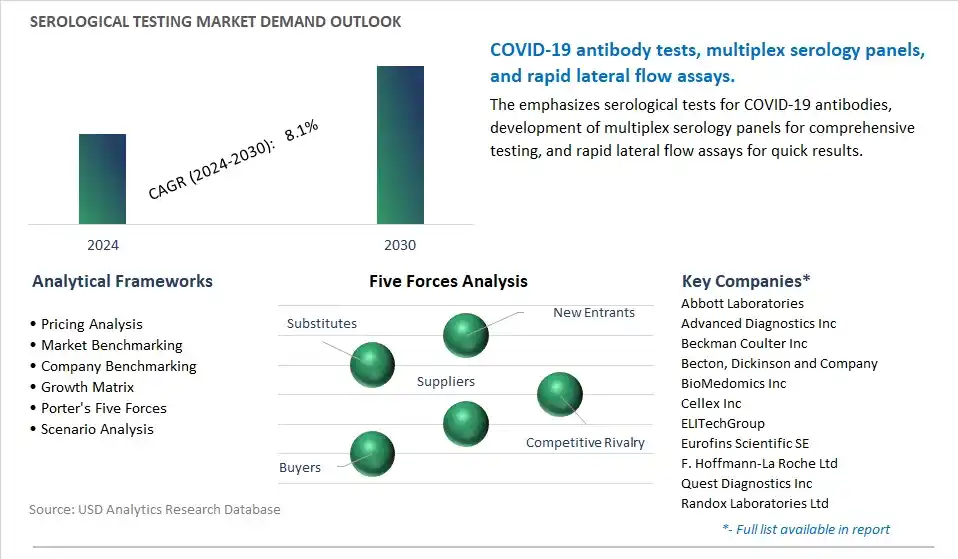
Serological Testing Market is estimated to increase at a Compounded Annual Growth Rate of 8.1% CAGR over the forecast period from 2024 to 2030
The Serological Testing Market study analyzes and forecasts the market size across 6 regions and 24 countries for diverse segments- By Technology (ELISA, NAT, CLIA/CMIA, Others), By Product (Instruments, Consumables and Reagents), By Application (Hepatitis, Coronavirus, Human Immunodeficiency Virus, Rotavirus infections, Others), By End-User (Diagnostic Laboratories, Hospitals, Others).
An Introduction to Serological Testing Market in 2024
The market for serological testing remains integral to diagnostic medicine in 2024, providing essential tools for detecting antibodies in serum or plasma samples for a wide range of infectious and autoimmune diseases. Serological testing plays a crucial role in disease diagnosis, surveillance, and population screening, enabling healthcare providers to assess immune responses, monitor disease progression, and inform treatment decisions. With advancements in immunoassay technology, automation, and multiplexing capabilities, serological tests offer improved sensitivity, specificity, and throughput, facilitating rapid and accurate detection of antibodies against pathogens such as viruses, bacteria, and parasites. Moreover, the market is influenced by emerging trends such as point-of-care serological testing devices, serosurveillance initiatives for emerging infectious diseases, and serological profiling for personalized medicine applications, reflecting the ongoing evolution and importance of serological testing in healthcare.
Market Trend: Adoption of Serological Testing for Infectious Diseases
A significant trend in the serological testing market is the increasing adoption of serological testing for infectious diseases. Serological tests, which detect antibodies produced by the immune system in response to pathogens, play a crucial role in the diagnosis and management of infectious diseases such as COVID-19, HIV, hepatitis, and Lyme disease. With the ongoing COVID-19 pandemic highlighting the importance of serological testing for assessing immune responses and monitoring population immunity, there is growing recognition of the utility of serological assays in infectious disease surveillance, epidemiological studies, and public health interventions. Additionally, advancements in serological test technologies, including rapid lateral flow assays, enzyme-linked immunosorbent assays (ELISA), and multiplex immunoassays, have enhanced the sensitivity, specificity, and scalability of serological testing platforms, driving their widespread adoption in clinical laboratories, healthcare settings, and point-of-care environments. This trend towards the expanded use of serological testing for infectious diseases fuels market growth and innovation in serological assay development, manufacturing, and deployment strategies.
Market Driver: Need for Surveillance and Control of Infectious Disease Outbreaks
A primary driver propelling the serological testing market forward is the need for surveillance and control of infectious disease outbreaks. Infectious diseases pose significant public health challenges globally, with outbreaks such as COVID-19, Ebola, Zika, and influenza threatening lives, straining healthcare systems, and disrupting economies. Serological testing plays a critical role in outbreak response efforts by enabling early detection of infections, identification of asymptomatic carriers, assessment of population immunity, and monitoring of disease transmission dynamics over time. In the context of the COVID-19 pandemic, serological testing has been instrumental in estimating the prevalence of SARS-CoV-2 antibodies in populations, informing vaccination strategies, and guiding public health policies related to social distancing, quarantine measures, and travel restrictions. As governments, healthcare organizations, and international agencies prioritize investments in infectious disease preparedness and response, there is a corresponding demand for serological testing solutions that provide accurate, timely, and actionable insights to support disease surveillance, containment, and control efforts. This imperative for effective infectious disease management drives market demand for serological testing technologies and drives innovation in assay development, automation, and data analytics.
Market Opportunity: Expansion into Point-of-Care and Remote Testing Solutions
An opportunity within the serological testing market lies in the expansion into point-of-care and remote testing solutions. While centralized laboratory testing remains the gold standard for many serological assays, there is a growing demand for decentralized testing options that offer rapid results, accessibility, and convenience for patients, healthcare providers, and community settings. Point-of-care serological tests, such as rapid lateral flow assays and handheld immunoassay devices, enable timely diagnosis and management of infectious diseases in primary care clinics, emergency departments, pharmacies, and outreach settings. Additionally, remote testing solutions, including home-based serological test kits and telemedicine platforms, empower individuals to self-administer tests, monitor their immune status, and seek appropriate medical guidance without the need for in-person clinic visits. By developing user-friendly, reliable, and cost-effective point-of-care and remote testing solutions, manufacturers can capitalize on opportunities to expand market reach, improve access to serological testing services, and enhance population health outcomes through early detection, prevention, and management of infectious diseases. This expansion into point-of-care and remote testing represents an opportunity for innovation and growth in the serological testing market, as companies leverage advances in technology and healthcare delivery models to meet evolving consumer preferences and healthcare needs in the era of infectious disease preparedness and response.
Serological Testing Market Share Analysis: Coronavirus
The fast-growing segment in the Serological Testing Market is the Coronavirus application. With the emergence of the COVID-19 pandemic, there has been an unprecedented demand for serological testing to detect antibodies against the SARS-CoV-2 virus. Serological tests play a crucial role in identifying individuals who have been previously infected with the virus and have developed an immune response, even if they were asymptomatic or had mild symptoms. These tests are vital for understanding the extent of virus spread within communities, guiding public health measures, and assessing immunity levels in populations. Among the various technologies used for serological testing, enzyme-linked immunosorbent assay (ELISA) and chemiluminescence immunoassay (CLIA/CMIA) have been widely adopted for COVID-19 antibody detection. The market for serological testing for Coronavirus is driven by the ongoing global efforts to control the pandemic, including vaccination campaigns, surveillance programs, and epidemiological studies. Diagnostic laboratories and hospitals are the primary end-users of serological testing for COVID-19, where these tests are performed on a large scale to support patient care, public health initiatives, and research endeavors.
Serological Testing Competitive Analysis
The market research study provides in-depth insights into leading companies including the SWOT analyses, product profile, financial details, and recent developments acrossAbbott Laboratories, Advanced Diagnostics Inc, Beckman Coulter Inc, Becton, Dickinson and Company, BioMedomics Inc, Cellex Inc, ELITechGroup, Eurofins Scientific SE, F. Hoffmann-La Roche Ltd, Quest Diagnostics Inc, Randox Laboratories Ltd, Thermo Fisher Scientific Inc
Serological Testing Market Segmentation
By Technology
ELISA
NAT
CLIA/CMIA
Others
By Product
Instruments
Consumables and Reagents
By Application
Hepatitis
Coronavirus
Human Immunodeficiency Virus
Rotavirus infections
Others
By End-User
Diagnostic Laboratories
Hospitals
Others
Geographical Analysis
North America (United States, Canada, Mexico)
Europe (Germany, France, United Kingdom, Spain, Italy, Rest of Europe)
Asia Pacific (China, India, Japan, South Korea, Rest of Asia Pacific)
South America (Brazil, Argentina, Rest of South America)
Middle East and Africa (Saudi Arabia, UAE, Rest of Middle East, South Africa, Egypt, Rest of Africa)
Serological Testing Market Companies
Abbott Laboratories
Advanced Diagnostics Inc
Beckman Coulter Inc
Becton, Dickinson and Company
BioMedomics Inc
Cellex Inc
ELITechGroup
Eurofins Scientific SE
F. Hoffmann-La Roche Ltd
Quest Diagnostics Inc
Randox Laboratories Ltd
Thermo Fisher Scientific Inc
Reasons to Buy the Serological Testing Market Study
• Deepen your industry insights and navigate uncertainties for strategy formulation, CAPEX, and Operational decisions
• Gain access to detailed insights on the Serological Testing Market, encompassing current market size, growth trends, and forecasts till 2030.
• Access detailed competitor analysis, enabling competitive advantage through a thorough understanding of market players, strategies, and potential differentiation opportunities
• Stay ahead of the curve with insights on technological advancements, innovations, and upcoming trends
• Identify lucrative investment avenues and expansion opportunities within the Serological Testing Market industry, guided by robust, data-backed analysis.
• Understand regional and global markets through country-wise analysis, regional market potential, regulatory nuances, and dynamics
• Execute strategies with confidence and speed through information, analytics, and insights on the industry value chain
• Corporate leaders, strategists, financial experts, shareholders, asset managers, and governmental representatives can make long-term planning scenarios and build an integrated and timely understanding of market dynamics
• Benefit from tailored solutions and expert consultation based on report insights, providing personalized strategies aligned with specific business needs.
TABLE OF CONTENTS
1 Introduction to 2024 Serological Testing Market
1.1 Market Overview
1.2 Quick Facts
1.3 Scope/Objective of the Study
1.4 Market Definition
1.5 Countries and Regions Covered
1.6 Units, Currency, and Conversions
1.7 Industry Value Chain
2 Research Methodology
2.1 Market Size Estimation
2.2 Sources and Research Methodology
2.3 Data Triangulation
2.4 Assumptions and Limitations
3 Executive Summary
3.1 Global Serological Testing Market Size Outlook, $ Million, 2021 to 2030
3.2 Serological Testing Market Outlook by Type, $ Million, 2021 to 2030
3.3 Serological Testing Market Outlook by Product, $ Million, 2021 to 2030
3.4 Serological Testing Market Outlook by Application, $ Million, 2021 to 2030
3.5 Serological Testing Market Outlook by Key Countries, $ Million, 2021 to 2030
4 Market Dynamics
4.1 Key Driving Forces of Serological Testing Industry
4.2 Key Market Trends in Serological Testing Industry
4.3 Potential Opportunities in Serological Testing Industry
4.4 Key Challenges in Serological Testing Industry
5 Market Factor Analysis
5.1 Value Chain Analysis
5.2 Competitive Landscape
5.2.1 Global Serological Testing Market Share by Company (%), 2023
5.2.2 Product Offerings by Company
5.3 Porter’s Five Forces Analysis
5.4 Pricing Analysis and Outlook
6 Growth Outlook Across Scenarios
6.1 Growth Analysis-Case Scenario Definitions
6.2 Low Growth Scenario Forecasts
6.3 Reference Growth Scenario Forecasts
6.4 High Growth Scenario Forecasts
7 Global Serological Testing Market Outlook by Segments
7.1 Serological Testing Market Outlook by Segments, $ Million, 2021- 2030
By Technology
ELISA
NAT
CLIA/CMIA
Others
By Product
Instruments
Consumables and Reagents
By Application
Hepatitis
Coronavirus
Human Immunodeficiency Virus
Rotavirus infections
Others
By End-User
Diagnostic Laboratories
Hospitals
Others
8 North America Serological Testing Market Analysis and Outlook To 2030
8.1 Introduction to North America Serological Testing Markets in 2024
8.2 North America Serological Testing Market Size Outlook by Country, 2021-2030
8.2.1 United States
8.2.2 Canada
8.2.3 Mexico
8.3 North America Serological Testing Market size Outlook by Segments, 2021-2030
By Technology
ELISA
NAT
CLIA/CMIA
Others
By Product
Instruments
Consumables and Reagents
By Application
Hepatitis
Coronavirus
Human Immunodeficiency Virus
Rotavirus infections
Others
By End-User
Diagnostic Laboratories
Hospitals
Others
9 Europe Serological Testing Market Analysis and Outlook To 2030
9.1 Introduction to Europe Serological Testing Markets in 2024
9.2 Europe Serological Testing Market Size Outlook by Country, 2021-2030
9.2.1 Germany
9.2.2 France
9.2.3 Spain
9.2.4 United Kingdom
9.2.4 Italy
9.2.5 Russia
9.2.6 Norway
9.2.7 Rest of Europe
9.3 Europe Serological Testing Market Size Outlook by Segments, 2021-2030
By Technology
ELISA
NAT
CLIA/CMIA
Others
By Product
Instruments
Consumables and Reagents
By Application
Hepatitis
Coronavirus
Human Immunodeficiency Virus
Rotavirus infections
Others
By End-User
Diagnostic Laboratories
Hospitals
Others
10 Asia Pacific Serological Testing Market Analysis and Outlook To 2030
10.1 Introduction to Asia Pacific Serological Testing Markets in 2024
10.2 Asia Pacific Serological Testing Market Size Outlook by Country, 2021-2030
10.2.1 China
10.2.2 India
10.2.3 Japan
10.2.4 South Korea
10.2.5 Indonesia
10.2.6 Malaysia
10.2.7 Australia
10.2.8 Rest of Asia Pacific
10.3 Asia Pacific Serological Testing Market size Outlook by Segments, 2021-2030
By Technology
ELISA
NAT
CLIA/CMIA
Others
By Product
Instruments
Consumables and Reagents
By Application
Hepatitis
Coronavirus
Human Immunodeficiency Virus
Rotavirus infections
Others
By End-User
Diagnostic Laboratories
Hospitals
Others
11 South America Serological Testing Market Analysis and Outlook To 2030
11.1 Introduction to South America Serological Testing Markets in 2024
11.2 South America Serological Testing Market Size Outlook by Country, 2021-2030
11.2.1 Brazil
11.2.2 Argentina
11.2.3 Rest of South America
11.3 South America Serological Testing Market size Outlook by Segments, 2021-2030
By Technology
ELISA
NAT
CLIA/CMIA
Others
By Product
Instruments
Consumables and Reagents
By Application
Hepatitis
Coronavirus
Human Immunodeficiency Virus
Rotavirus infections
Others
By End-User
Diagnostic Laboratories
Hospitals
Others
12 Middle East and Africa Serological Testing Market Analysis and Outlook To 2030
12.1 Introduction to Middle East and Africa Serological Testing Markets in 2024
12.2 Middle East and Africa Serological Testing Market Size Outlook by Country, 2021-2030
12.2.1 Saudi Arabia
12.2.2 UAE
12.2.3 Oman
12.2.4 Rest of Middle East
12.2.5 Egypt
12.2.6 Nigeria
12.2.7 South Africa
12.2.8 Rest of Africa
12.3 Middle East and Africa Serological Testing Market size Outlook by Segments, 2021-2030
By Technology
ELISA
NAT
CLIA/CMIA
Others
By Product
Instruments
Consumables and Reagents
By Application
Hepatitis
Coronavirus
Human Immunodeficiency Virus
Rotavirus infections
Others
By End-User
Diagnostic Laboratories
Hospitals
Others
13 Company Profiles
13.1 Company Snapshot
13.2 SWOT Profiles
13.3 Products and Services
13.4 Recent Developments
13.5 Financial Profile
List of Companies
Abbott Laboratories
Advanced Diagnostics Inc
Beckman Coulter Inc
Becton, Dickinson and Company
BioMedomics Inc
Cellex Inc
ELITechGroup
Eurofins Scientific SE
F. Hoffmann-La Roche Ltd
Quest Diagnostics Inc
Randox Laboratories Ltd
Thermo Fisher Scientific Inc
14 Appendix
14.1 Customization Offerings
14.2 Subscription Services
14.3 Related Reports
14.4 Publisher Expertise
By Technology
ELISA
NAT
CLIA/CMIA
Others
By Product
Instruments
Consumables and Reagents
By Application
Hepatitis
Coronavirus
Human Immunodeficiency Virus
Rotavirus infections
Others
By End-User
Diagnostic Laboratories
Hospitals
Others
Countries Analyzed
North America (United States, Canada, Mexico)
Europe (Germany, France, United Kingdom, Spain, Italy, Rest of Europe)
Asia Pacific (China, India, Japan, South Korea, Rest of Asia Pacific)
South America (Brazil, Argentina, Rest of South America)
Middle East and Africa (Saudi Arabia, UAE, Rest of Middle East, South Africa, Egypt, Rest of Africa)
