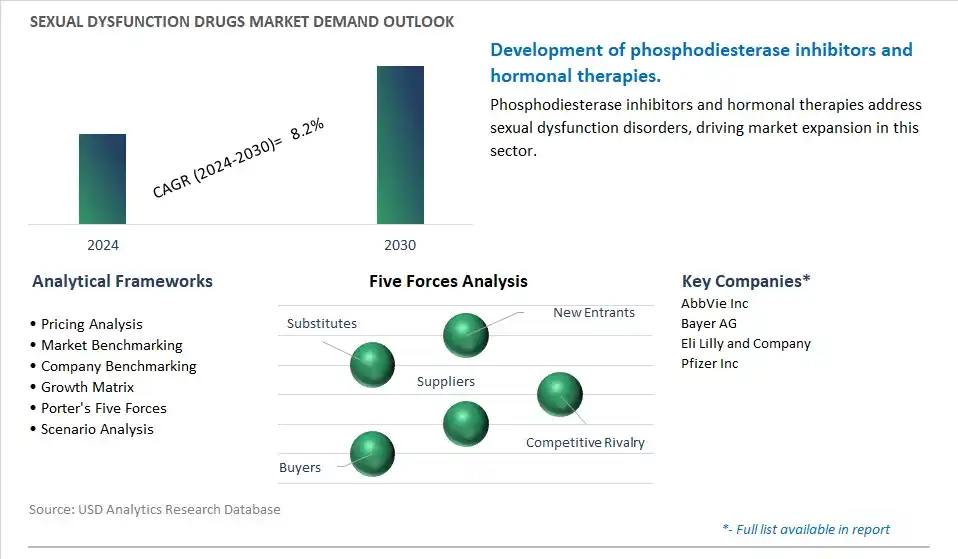
Sexual Dysfunction Drugs Market is estimated to increase at a growth rate of 8.2% CAGR over the forecast period from 2024 to 2030.
The global Sexual Dysfunction Drugs Market Study analyzes and forecasts the market size across 6 regions and 24 countries for diverse segments including By Therapy (Oral therapy, Intracavernosal therapy, Hormonal therapy, Transurethral therapy).
An Introduction to Sexual Dysfunction Drugs Market in 2024
The Sexual Dysfunction Drugs Market encompasses pharmaceuticals, medications, and therapies used in the treatment of sexual dysfunction disorders such as erectile dysfunction (ED), premature ejaculation (PE), hypoactive sexual desire disorder (HSDD), and female sexual arousal disorder (FSAD). Sexual dysfunction drugs include phosphodiesterase inhibitors (e.g., sildenafil, tadalafil), selective serotonin reuptake inhibitors (SSRIs), hormone therapies, prostaglandin E1 analogs, and psychosexual counseling interventions for improving sexual function, satisfaction, and intimacy. Market dynamics focus on patient education, stigma reduction, telemedicine consultations, and research on novel sexual health treatments to address diverse sexual wellness needs and enhance sexual health outcomes.
Sexual Dysfunction Drugs Market Competitive Landscape
The global Sexual Dysfunction Drugs Industry is highly competitive with a large number of companies focusing on niche market segments. Amidst intense competitive conditions, Sexual Dysfunction Drugs Companies are investing in new product launches and strengthening distribution channels. Key companies operating in the Sexual Dysfunction Drugs Industry include- AbbVie Inc, Bayer AG, Eli Lilly and Company, Pfizer Inc.
Sexual Dysfunction Drugs Market Trend: Focus on Novel Therapeutic Targets
In the Sexual Dysfunction Drugs market, a significant trend is the focus on identifying and targeting novel therapeutic pathways to address various forms of sexual dysfunction. With increasing research into the neurobiology, endocrinology, and psychosocial factors underlying sexual disorders, there's a shift towards developing drugs that modulate neurotransmitter systems, hormone levels, and psychological factors involved in sexual function. This trend includes the exploration of innovative drug targets, such as melanocortin receptors, oxytocin pathways, and neuroregulatory circuits, to offer new treatment options for individuals with sexual dysfunction.
Sexual Dysfunction Drugs Market Driver: Rising Prevalence of Sexual Dysfunction
The primary driver for the Sexual Dysfunction Drugs market is the rising prevalence of sexual dysfunction globally. Sexual disorders, including erectile dysfunction, premature ejaculation, hypoactive sexual desire disorder, and female sexual arousal disorder, affect millions of individuals of all ages and genders, causing distress, relationship problems, and reduced quality of life. As awareness of sexual health issues grows and societal stigma diminishes, there's an increasing demand for effective pharmacological interventions that address the diverse needs and preferences of individuals experiencing sexual dysfunction.
Sexual Dysfunction Drugs Market Opportunity: Development of Targeted Therapies
An opportunity exists in the development of targeted therapies for specific subtypes of sexual dysfunction, addressing underlying physiological and psychological factors contributing to sexual health problems. While existing treatments such as phosphodiesterase inhibitors and hormone replacement therapies offer symptomatic relief for some individuals, there's a need for tailored interventions that address the root causes of sexual dysfunction and provide personalized treatment approaches. Investing in research and drug development efforts aimed at identifying biomarkers, elucidating disease mechanisms, and validating novel drug targets could lead to the discovery of innovative therapies with improved efficacy, safety, and tolerability profiles, presenting significant opportunities for market differentiation and growth in the Sexual Dysfunction Drugs market.
Sexual Dysfunction Drugs Market Share Analysis: Hormonal Therapy is the fastest growing market segment over the forecast period to 2030
Among the various therapies for sexual dysfunction drugs, Hormonal Therapy stands out as the fastest-growing segment. Hormonal therapy involves the administration of hormones to address underlying hormonal imbalances that contribute to sexual dysfunction. This approach has gained traction due to its effectiveness in treating conditions such as hypoactive sexual desire disorder (HSDD) and erectile dysfunction (ED) caused by hormonal deficiencies. Hormonal therapy encompasses the use of medications like testosterone and estrogen to restore hormonal balance and improve sexual function. With increasing awareness of hormonal influences on sexual health and advancements in hormone replacement therapies, the demand for hormonal therapy for sexual dysfunction is on the rise. Additionally, the aging population and the growing prevalence of conditions like menopause and andropause contribute to the expansion of the hormonal therapy market for sexual dysfunction. As a result, the Hormonal Therapy segment is poised for significant growth, offering promising prospects for addressing sexual health concerns and enhancing overall well-being.
Sexual Dysfunction Drugs Market Segmentation
By Therapy
Oral therapy
Intracavernosal therapy
Hormonal therapy
Transurethral therapy
Geographical Analysis
North America (United States, Canada, Mexico)
Europe (Germany, France, United Kingdom, Spain, Italy, Rest of Europe)
Asia Pacific (China, India, Japan, South Korea, Rest of Asia Pacific)
South America (Brazil, Argentina, Rest of South America)
Middle East and Africa (Saudi Arabia, UAE, Rest of Middle East, South Africa, Egypt, Rest of Africa)
Sexual Dysfunction Drugs Companies
AbbVie Inc
Bayer AG
Eli Lilly and Company
Pfizer Inc
* List not Exhaustive
Reasons to Buy the Sexual Dysfunction Drugs Market Study
• Deepen your industry insights and navigate uncertainties for strategy formulation, CAPEX, and Operational decisions
• Gain access to detailed insights on the Sexual Dysfunction Drugs Market, encompassing current market size, growth trends, and forecasts till 2030.
• Access detailed competitor analysis, enabling competitive advantage through a thorough understanding of market players, strategies, and potential differentiation opportunities
• Stay ahead of the curve with insights on technological advancements, innovations, and upcoming trends
• Identify lucrative investment avenues and expansion opportunities within the Sexual Dysfunction Drugs Industry, guided by robust, data-backed analysis.
• Understand regional and global markets through country-wise analysis, regional market potential, regulatory nuances, and dynamics
• Execute strategies with confidence and speed through information, analytics, and insights on the industry value chain
• Corporate leaders, strategists, financial experts, shareholders, asset managers, and governmental representatives can make long-term planning scenarios and build an integrated and timely understanding of market dynamics
• Benefit from tailored solutions and expert consultation based on report insights, providing personalized strategies aligned with specific business needs.
TABLE OF CONTENTS
1 Introduction to 2024 Sexual Dysfunction Drugs Market
1.1 Market Overview
1.2 Quick Facts
1.3 Scope/Objective of the Study
1.4 Market Definition
1.5 Countries and Regions Analyzed
1.6 Units, Currency, and Conversions
1.7 Industry Value Chain
2 Research Methodology
2.1 Market Size Estimation
2.2 Sources and Research Methodology
2.3 Data Triangulation
2.4 Assumptions and Limitations
3 Executive Summary
3.1 Global Sexual Dysfunction Drugs Market Size Outlook, $ Million, 2021 to 2030
3.2 Sexual Dysfunction Drugs Market Outlook by Type, $ Million, 2021 to 2030
3.3 Sexual Dysfunction Drugs Market Outlook by Product, $ Million, 2021 to 2030
3.4 Sexual Dysfunction Drugs Market Outlook by Application, $ Million, 2021 to 2030
3.5 Sexual Dysfunction Drugs Market Outlook by Key Countries, $ Million, 2021 to 2030
4 Market Dynamics
4.1 Key Driving Forces of Sexual Dysfunction Drugs Industry
4.2 Key Market Trends in Sexual Dysfunction Drugs Industry
4.3 Potential Opportunities in Sexual Dysfunction Drugs Industry
4.4 Key Challenges in Sexual Dysfunction Drugs Industry
5 Market Factor Analysis
5.1 Value Chain Analysis
5.2 Competitive Landscape
5.2.1 Global Sexual Dysfunction Drugs Market Share by Company (%), 2023
5.2.2 Product Offerings by Company
5.3 Porter’s Five Forces Analysis
5.4 Pricing Analysis and Outlook
6 Growth Outlook Across Scenarios
6.1 Growth Analysis-Case Scenario Definitions
6.2 Low Growth Scenario Forecasts
6.3 Reference Growth Scenario Forecasts
6.4 High Growth Scenario Forecasts
7 Global Sexual Dysfunction Drugs Market Outlook by Segments
7.1 Sexual Dysfunction Drugs Market Outlook by Segments, $ Million, 2021- 2030
By Therapy
Oral therapy
Intracavernosal therapy
Hormonal therapy
Transurethral therapy
8 North America Sexual Dysfunction Drugs Market Analysis and Outlook To 2030
8.1 Introduction to North America Sexual Dysfunction Drugs Markets in 2024
8.2 North America Sexual Dysfunction Drugs Market Size Outlook by Country, 2021-2030
8.2.1 United States
8.2.2 Canada
8.2.3 Mexico
8.3 North America Sexual Dysfunction Drugs Market size Outlook by Segments, 2021-2030
By Therapy
Oral therapy
Intracavernosal therapy
Hormonal therapy
Transurethral therapy
9 Europe Sexual Dysfunction Drugs Market Analysis and Outlook To 2030
9.1 Introduction to Europe Sexual Dysfunction Drugs Markets in 2024
9.2 Europe Sexual Dysfunction Drugs Market Size Outlook by Country, 2021-2030
9.2.1 Germany
9.2.2 France
9.2.3 Spain
9.2.4 United Kingdom
9.2.4 Italy
9.2.5 Russia
9.2.6 Norway
9.2.7 Rest of Europe
9.3 Europe Sexual Dysfunction Drugs Market Size Outlook by Segments, 2021-2030
By Therapy
Oral therapy
Intracavernosal therapy
Hormonal therapy
Transurethral therapy
10 Asia Pacific Sexual Dysfunction Drugs Market Analysis and Outlook To 2030
10.1 Introduction to Asia Pacific Sexual Dysfunction Drugs Markets in 2024
10.2 Asia Pacific Sexual Dysfunction Drugs Market Size Outlook by Country, 2021-2030
10.2.1 China
10.2.2 India
10.2.3 Japan
10.2.4 South Korea
10.2.5 Indonesia
10.2.6 Malaysia
10.2.7 Australia
10.2.8 Rest of Asia Pacific
10.3 Asia Pacific Sexual Dysfunction Drugs Market size Outlook by Segments, 2021-2030
By Therapy
Oral therapy
Intracavernosal therapy
Hormonal therapy
Transurethral therapy
11 South America Sexual Dysfunction Drugs Market Analysis and Outlook To 2030
11.1 Introduction to South America Sexual Dysfunction Drugs Markets in 2024
11.2 South America Sexual Dysfunction Drugs Market Size Outlook by Country, 2021-2030
11.2.1 Brazil
11.2.2 Argentina
11.2.3 Rest of South America
11.3 South America Sexual Dysfunction Drugs Market size Outlook by Segments, 2021-2030
By Therapy
Oral therapy
Intracavernosal therapy
Hormonal therapy
Transurethral therapy
12 Middle East and Africa Sexual Dysfunction Drugs Market Analysis and Outlook To 2030
12.1 Introduction to Middle East and Africa Sexual Dysfunction Drugs Markets in 2024
12.2 Middle East and Africa Sexual Dysfunction Drugs Market Size Outlook by Country, 2021-2030
12.2.1 Saudi Arabia
12.2.2 UAE
12.2.3 Oman
12.2.4 Rest of Middle East
12.2.5 Egypt
12.2.6 Nigeria
12.2.7 South Africa
12.2.8 Rest of Africa
12.3 Middle East and Africa Sexual Dysfunction Drugs Market size Outlook by Segments, 2021-2030
By Therapy
Oral therapy
Intracavernosal therapy
Hormonal therapy
Transurethral therapy
13 Company Profiles
13.1 Company Snapshot
13.2 SWOT Profiles
13.3 Products and Services
13.4 Recent Developments
13.5 Financial Profile
List of Companies
AbbVie Inc
Bayer AG
Eli Lilly and Company
Pfizer Inc
14 Appendix
14.1 Customization Offerings
14.2 Subscription Services
14.3 Related Reports
14.4 Publisher Expertise
