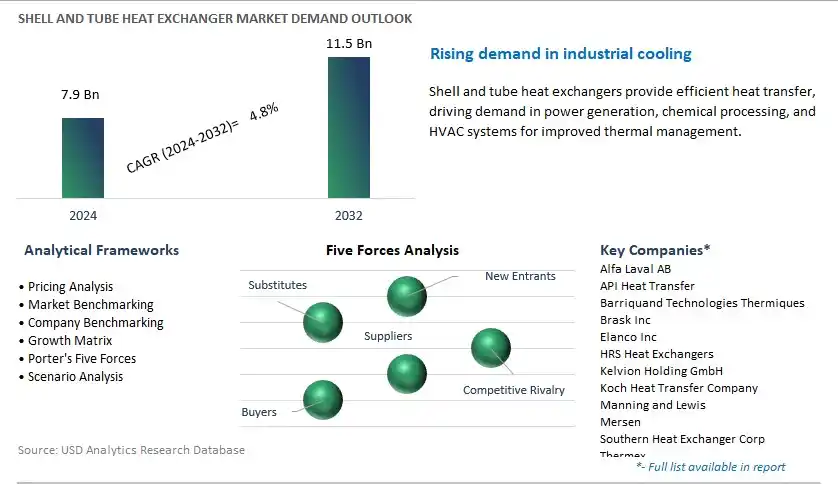
Global Shell and Tube Heat Exchanger Market Size is valued at $7.9 Billion in 2024 and is forecast to register a growth rate (CAGR) of 4.8% to reach $11.5 Billion by 2032.
The global Shell and Tube Heat Exchanger Market Study analyzes and forecasts the market size across 6 regions and 24 countries for diverse segments -By Material (Haste Alloy, Titanium, Nickel & Nickel Alloys, Tantalum, Steel, Others), By End-User (Power Generation, Petrochemicals, Chemical, Food & Beverages, HVAC & Refrigerators, Pulp & Paper, Others).
An Introduction to Shell and Tube Heat Exchanger Market in 2024
In 2024, the shell and tube heat exchanger market remains vital for efficient heat transfer and thermal management in various industrial processes, HVAC systems, and power generation applications. Shell and tube heat exchangers consist of a bundle of tubes housed within a cylindrical shell, allowing for the exchange of heat between two fluids, typically a hot fluid flowing inside the tubes and a cold fluid circulating around the shell. These exchangers are widely used in industries such as oil and gas, chemical processing, food and beverage, and power plants for applications such as heating, cooling, condensing, and evaporation. The oil and gas sector is a major consumer of shell and tube heat exchangers, employing them in processes such as crude oil refining, natural gas processing, and petrochemical production for heat recovery and temperature control. Additionally, shell and tube heat exchangers find applications in HVAC systems for commercial buildings, industrial facilities, and power plants, providing efficient heat exchange in heating, ventilation, air conditioning, and refrigeration processes. With advancements in design optimization, material selection, and manufacturing technologies, the shell and tube heat exchanger market s to evolve to meet the growing demand for energy-efficient and environmentally friendly heat transfer solutions in various industries and applications.
Shell and Tube Heat Exchanger Market Competitive Landscape
The market report analyses the leading companies in the industry including Alfa Laval AB, API Heat Transfer, Barriquand Technologies Thermiques, Brask Inc, Elanco Inc, HRS Heat Exchangers, Kelvion Holding GmbH, Koch Heat Transfer Company, Manning and Lewis, Mersen, Southern Heat Exchanger Corp, Thermex, Tinita Engineering Pvt. Ltd, WCR Inc, Xylem Inc, and others.
Shell and Tube Heat Exchanger Market Dynamics
Market Trend: Increasing Adoption of Shell and Tube Heat Exchangers in Energy-Efficient Applications
One prominent market trend in shell and tube heat exchangers is the increasing adoption of these systems in energy-efficient applications. As industries and commercial sectors strive to reduce energy consumption and operating costs, there is a growing demand for heat exchangers that can efficiently transfer heat between fluid streams with minimal energy loss. Shell and tube heat exchangers offer high thermal efficiency, versatility, and reliability, making them ideal for a wide range of heating, cooling, and heat recovery applications in industries such as oil and gas, chemical processing, power generation, HVAC, and refrigeration. This trend is driven by the need for sustainable and eco-friendly solutions that optimize energy usage and enhance process efficiency in various industrial and commercial processes.
Market Driver: Growth in Industrialization and Process Industries
A key market driver for shell and tube heat exchangers is the growth in industrialization and process industries. With the expansion of manufacturing, refining, and chemical processing sectors worldwide, there is a continuous demand for heat exchangers to support various production processes, such as heating, cooling, condensation, and evaporation. Shell and tube heat exchangers play a vital role in facilitating heat transfer between different fluid streams, enabling efficient operation and temperature control in industrial equipment and systems. The drive for increased production capacity, improved product quality, and regulatory compliance fuels the demand for shell and tube heat exchangers as essential components of process equipment in diverse industries.
Market Opportunity: Development of Advanced Materials and Design Innovations
An emerging opportunity in the shell and tube heat exchanger market lies in the development of advanced materials and design innovations. While traditional shell and tube heat exchangers have been widely used for decades, there is potential to enhance their performance, durability, and efficiency through material advancements and design optimizations. Opportunities exist to explore new materials with improved corrosion resistance, thermal conductivity, and mechanical properties, such as high-performance alloys, composite materials, and nanostructured coatings. Additionally, there is room for innovation in heat exchanger design to optimize fluid flow patterns, enhance heat transfer efficiency, and reduce pressure drop across the exchanger. By investing in research and development initiatives focused on material science and engineering design, manufacturers can develop next-generation shell and tube heat exchangers that meet the evolving needs of industrial processes, improve energy efficiency, and drive sustainable growth in the heat exchanger market.
Shell & Tube Heat Exchanger Market Share Analysis: Steel segment generated the highest revenue in 2024
The largest segment in the Shell & Tube Heat Exchanger Market is typically the "Steel" segment. This is primarily due to the widespread use of steel in various industrial applications and its suitability for manufacturing heat exchangers. Steel offers potential advantages, including high strength, durability, corrosion resistance, and cost-effectiveness, making it a preferred material choice for constructing shell and tube heat exchangers. Additionally, steel is readily available, easy to fabricate, and compatible with a wide range of fluids and operating conditions, further contributing to its dominance in the market. While materials like Haste Alloy, Titanium, Nickel & Nickel Alloys, and Tantalum offer specific benefits in terms of corrosion resistance and thermal conductivity, steel remains the most commonly used material for shell and tube heat exchangers across industries due to its overall performance and cost-efficiency.
Shell & Tube Heat Exchanger Market Share Analysis: Petrochemicals is poised to register the fastest CAGR over the forecast period
The Petrochemicals segment is the fastest-growing segment in the Shell & Tube Heat Exchanger Market, driven by the expansion of the petrochemical industry and increasing demand for heat exchange solutions in petrochemical processing facilities. Shell and tube heat exchangers play a critical role in petrochemical plants by facilitating heat transfer processes involved in refining crude oil and processing various petrochemical products. These heat exchangers are utilized in processes such as distillation, condensation, evaporation, and heating of fluids to optimize energy efficiency and ensure product quality. With the growing global demand for petrochemical products, driven by industrialization, urbanization, and infrastructure development, petrochemical companies are investing in capacity expansion and modernization projects, leading to a surge in the demand for heat exchangers. Additionally, advancements in technology and increasing regulations regarding energy efficiency and emissions drive the adoption of efficient heat exchange solutions in the petrochemical industry, further fuelling the growth of the Petrochemicals segment in the Shell & Tube Heat Exchanger Market.
Shell and Tube Heat Exchanger Market
By Material
Haste Alloy
Titanium
Nickel & Nickel Alloys
Tantalum
Steel
-Stainless Steel
-Duplex Steel
-Carbon Steel
-Super Duplex Steel
-Others
Others
By End-User
Power Generation
Petrochemicals
Chemical
Food & Beverages
HVAC & Refrigerators
Pulp & Paper
Others
Countries Analyzed
North America (US, Canada, Mexico)
Europe (Germany, UK, France, Spain, Italy, Russia, Rest of Europe)
Asia Pacific (China, India, Japan, South Korea, Australia, South East Asia, Rest of Asia)
South America (Brazil, Argentina, Rest of South America)
Middle East and Africa (Saudi Arabia, UAE, Rest of Middle East, South Africa, Egypt, Rest of Africa)
Shell and Tube Heat Exchanger Companies Profiled in the Study
Alfa Laval AB
API Heat Transfer
Barriquand Technologies Thermiques
Brask Inc
Elanco Inc
HRS Heat Exchangers
Kelvion Holding GmbH
Koch Heat Transfer Company
Manning and Lewis
Mersen
Southern Heat Exchanger Corp
Thermex
Tinita Engineering Pvt. Ltd
WCR Inc
Xylem Inc
*- List Not Exhaustive
TABLE OF CONTENTS
1 Introduction to 2024 Shell and Tube Heat Exchanger Market
1.1 Market Overview
1.2 Quick Facts
1.3 Scope/Objective of the Study
1.4 Market Definition
1.5 Countries and Regions Covered
1.6 Units, Currency, and Conversions
1.7 Industry Value Chain
2 Research Methodology
2.1 Market Size Estimation
2.2 Sources and Research Methodology
2.3 Data Triangulation
2.4 Assumptions and Limitations
3 Executive Summary
3.1 Global Shell and Tube Heat Exchanger Market Size Outlook, $ Million, 2021 to 2032
3.2 Shell and Tube Heat Exchanger Market Outlook by Type, $ Million, 2021 to 2032
3.3 Shell and Tube Heat Exchanger Market Outlook by Product, $ Million, 2021 to 2032
3.4 Shell and Tube Heat Exchanger Market Outlook by Application, $ Million, 2021 to 2032
3.5 Shell and Tube Heat Exchanger Market Outlook by Key Countries, $ Million, 2021 to 2032
4 Market Dynamics
4.1 Key Driving Forces of Shell and Tube Heat Exchanger Industry
4.2 Key Market Trends in Shell and Tube Heat Exchanger Industry
4.3 Potential Opportunities in Shell and Tube Heat Exchanger Industry
4.4 Key Challenges in Shell and Tube Heat Exchanger Industry
5 Market Factor Analysis
5.1 Value Chain Analysis
5.2 Competitive Landscape
5.2.1 Global Shell and Tube Heat Exchanger Market Share by Company (%), 2023
5.2.2 Product Offerings by Company
5.3 Porter’s Five Forces Analysis
5.4 Pricing Analysis and Outlook
6 Growth Outlook Across Scenarios
6.1 Growth Analysis-Case Scenario Definitions
6.2 Low Growth Scenario Forecasts
6.3 Reference Growth Scenario Forecasts
6.4 High Growth Scenario Forecasts
7 Global Shell and Tube Heat Exchanger Market Outlook by Segments
7.1 Shell and Tube Heat Exchanger Market Outlook by Segments, $ Million, 2021- 2032
By Material
Haste Alloy
Titanium
Nickel & Nickel Alloys
Tantalum
Steel
-Stainless Steel
-Duplex Steel
-Carbon Steel
-Super Duplex Steel
-Others
Others
By End-User
Power Generation
Petrochemicals
Chemical
Food & Beverages
HVAC & Refrigerators
Pulp & Paper
Others
8 North America Shell and Tube Heat Exchanger Market Analysis and Outlook To 2032
8.1 Introduction to North America Shell and Tube Heat Exchanger Markets in 2024
8.2 North America Shell and Tube Heat Exchanger Market Size Outlook by Country, 2021-2032
8.2.1 United States
8.2.2 Canada
8.2.3 Mexico
8.3 North America Shell and Tube Heat Exchanger Market size Outlook by Segments, 2021-2032
By Material
Haste Alloy
Titanium
Nickel & Nickel Alloys
Tantalum
Steel
-Stainless Steel
-Duplex Steel
-Carbon Steel
-Super Duplex Steel
-Others
Others
By End-User
Power Generation
Petrochemicals
Chemical
Food & Beverages
HVAC & Refrigerators
Pulp & Paper
Others
9 Europe Shell and Tube Heat Exchanger Market Analysis and Outlook To 2032
9.1 Introduction to Europe Shell and Tube Heat Exchanger Markets in 2024
9.2 Europe Shell and Tube Heat Exchanger Market Size Outlook by Country, 2021-2032
9.2.1 Germany
9.2.2 France
9.2.3 Spain
9.2.4 United Kingdom
9.2.4 Italy
9.2.5 Russia
9.2.6 Norway
9.2.7 Rest of Europe
9.3 Europe Shell and Tube Heat Exchanger Market Size Outlook by Segments, 2021-2032
By Material
Haste Alloy
Titanium
Nickel & Nickel Alloys
Tantalum
Steel
-Stainless Steel
-Duplex Steel
-Carbon Steel
-Super Duplex Steel
-Others
Others
By End-User
Power Generation
Petrochemicals
Chemical
Food & Beverages
HVAC & Refrigerators
Pulp & Paper
Others
10 Asia Pacific Shell and Tube Heat Exchanger Market Analysis and Outlook To 2032
10.1 Introduction to Asia Pacific Shell and Tube Heat Exchanger Markets in 2024
10.2 Asia Pacific Shell and Tube Heat Exchanger Market Size Outlook by Country, 2021-2032
10.2.1 China
10.2.2 India
10.2.3 Japan
10.2.4 South Korea
10.2.5 Indonesia
10.2.6 Malaysia
10.2.7 Australia
10.2.8 Rest of Asia Pacific
10.3 Asia Pacific Shell and Tube Heat Exchanger Market size Outlook by Segments, 2021-2032
By Material
Haste Alloy
Titanium
Nickel & Nickel Alloys
Tantalum
Steel
-Stainless Steel
-Duplex Steel
-Carbon Steel
-Super Duplex Steel
-Others
Others
By End-User
Power Generation
Petrochemicals
Chemical
Food & Beverages
HVAC & Refrigerators
Pulp & Paper
Others
11 South America Shell and Tube Heat Exchanger Market Analysis and Outlook To 2032
11.1 Introduction to South America Shell and Tube Heat Exchanger Markets in 2024
11.2 South America Shell and Tube Heat Exchanger Market Size Outlook by Country, 2021-2032
11.2.1 Brazil
11.2.2 Argentina
11.2.3 Rest of South America
11.3 South America Shell and Tube Heat Exchanger Market size Outlook by Segments, 2021-2032
By Material
Haste Alloy
Titanium
Nickel & Nickel Alloys
Tantalum
Steel
-Stainless Steel
-Duplex Steel
-Carbon Steel
-Super Duplex Steel
-Others
Others
By End-User
Power Generation
Petrochemicals
Chemical
Food & Beverages
HVAC & Refrigerators
Pulp & Paper
Others
12 Middle East and Africa Shell and Tube Heat Exchanger Market Analysis and Outlook To 2032
12.1 Introduction to Middle East and Africa Shell and Tube Heat Exchanger Markets in 2024
12.2 Middle East and Africa Shell and Tube Heat Exchanger Market Size Outlook by Country, 2021-2032
12.2.1 Saudi Arabia
12.2.2 UAE
12.2.3 Oman
12.2.4 Rest of Middle East
12.2.5 Egypt
12.2.6 Nigeria
12.2.7 South Africa
12.2.8 Rest of Africa
12.3 Middle East and Africa Shell and Tube Heat Exchanger Market size Outlook by Segments, 2021-2032
By Material
Haste Alloy
Titanium
Nickel & Nickel Alloys
Tantalum
Steel
-Stainless Steel
-Duplex Steel
-Carbon Steel
-Super Duplex Steel
-Others
Others
By End-User
Power Generation
Petrochemicals
Chemical
Food & Beverages
HVAC & Refrigerators
Pulp & Paper
Others
13 Company Profiles
13.1 Company Snapshot
13.2 SWOT Profiles
13.3 Products and Services
13.4 Recent Developments
13.5 Financial Profile
Alfa Laval AB
API Heat Transfer
Barriquand Technologies Thermiques
Brask Inc
Elanco Inc
HRS Heat Exchangers
Kelvion Holding GmbH
Koch Heat Transfer Company
Manning and Lewis
Mersen
Southern Heat Exchanger Corp
Thermex
Tinita Engineering Pvt. Ltd
WCR Inc
Xylem Inc
14 Appendix
14.1 Customization Offerings
14.2 Subscription Services
14.3 Related Reports
14.4 Publisher Expertise
By Material
Haste Alloy
Titanium
Nickel & Nickel Alloys
Tantalum
Steel
-Stainless Steel
-Duplex Steel
-Carbon Steel
-Super Duplex Steel
-Others
Others
By End-User
Power Generation
Petrochemicals
Chemical
Food & Beverages
HVAC & Refrigerators
Pulp & Paper
Others
Countries Analyzed
North America (US, Canada, Mexico)
Europe (Germany, UK, France, Spain, Italy, Russia, Rest of Europe)
Asia Pacific (China, India, Japan, South Korea, Australia, South East Asia, Rest of Asia)
South America (Brazil, Argentina, Rest of South America)
Middle East and Africa (Saudi Arabia, UAE, Rest of Middle East, South Africa, Egypt, Rest of Africa)
