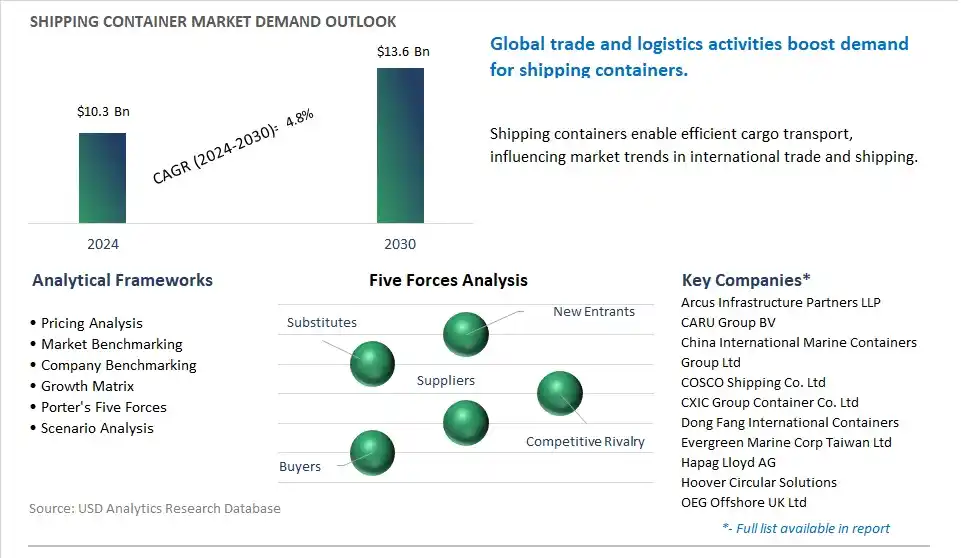
The global Shipping Container Market is poised to register a 4.8% CAGR from $10.3 Billion in 2024 to $13.6 Billion in 2030.
The global Shipping Container Market Study analyzes and forecasts the market size across 6 regions and 24 countries for diverse segments -By Container Size (Small Containers (20 feet), Large Containers (40 feet), High Cube Containers (40 feet) ), By Product (Dry Storage Containers, Flat Rack Containers, Refrigerated Containers, Special Purpose Containers, Others), By End-User (Food & Beverages, Consumer Goods, Healthcare, Industrial Products, Vehicle Transport, Others).
An Introduction to Global Shipping Container Market in 2024
The shipping container market is undergoing transformation driven by global trade dynamics, technological advancements, and sustainability imperatives. Key trends shaping the future of the industry include the adoption of standardized container sizes, such as ISO 20-foot and 40-foot containers, to streamline logistics operations and optimize containerized cargo transportation efficiency. Moreover, innovations in container design, materials, and construction techniques, such as lightweight composite materials, collapsible containers, and refrigerated containers with advanced temperature control systems, are improving container performance, durability, and energy efficiency while reducing environmental impact. Additionally, the integration of IoT-enabled tracking and monitoring technologies in shipping containers enables real-time cargo visibility, inventory management, and supply chain optimization, enhancing operational transparency and security. Furthermore, the growing focus on sustainability and circular economy principles is driving initiatives to repurpose retired shipping containers for alternative uses such as affordable housing, modular offices, and retail spaces, creating new market opportunities and reducing waste. As stakeholders collaborate to address challenges such as container shortages, port congestion, and carbon emissions, the shipping container market is poised for continued growth and innovation as a linchpin of global trade and logistics infrastructure.
Shipping Container Market Competitive Landscape
The market report analyses the leading companies in the industry including Arcus Infrastructure Partners LLP, CARU Group BV, China International Marine Containers Group Ltd, COSCO Shipping Co. Ltd, CXIC Group Container Co. Ltd, Dong Fang International Containers, Evergreen Marine Corp Taiwan Ltd, Hapag Lloyd AG, Hoover Circular Solutions, OEG Offshore UK Ltd, PODS Enterprises LLC, Retveyraaj Cargo Shipping Containers, Sea Box Inc, SHARKCAGE Inc, Singamas Container Holdings Ltd, TLS Offshore Containers, Valisons and Co., W and K Containers Inc, YMC Container Solutions.
Shipping Container Market Dynamics
Shipping Container Market Trend: Increased Demand for Sustainable and Modular Solutions
A prominent trend in the shipping container market is the increased demand for sustainable and modular solutions. With growing concerns about environmental sustainability and the need for flexible, adaptable infrastructure, there is a rising interest in repurposing shipping containers for various applications beyond transportation and storage. Shipping containers are being transformed into eco-friendly housing, retail spaces, offices, and even art installations, offering cost-effective, durable, and modular building solutions. This trend towards sustainable and modular construction reflects a broader shift towards eco-friendly building practices, circular economy principles, and innovative reuse of materials in architecture and design.
Shipping Container Market Driver: Globalization and Growth in International Trade
A key driver for the shipping container market is globalization and growth in international trade. As global trade volumes continue to rise, driven by economic growth, consumer demand, and e-commerce, there is a growing need for efficient and cost-effective transportation and logistics solutions. Shipping containers serve as essential units for the transport of goods by sea, land, and rail, providing secure, standardized, and intermodal cargo handling capabilities. The expansion of global supply chains, the rise of containerized shipping, and the increasing containerization of cargo contribute to the demand for shipping containers worldwide.
Shipping Container Market Opportunity: Diversification into Modular Construction and Prefabricated Buildings
An opportunity within the shipping container market lies in diversification into modular construction and prefabricated buildings. With the versatility and adaptability of shipping containers, there is potential to expand beyond traditional transportation and storage applications into the construction industry. Shipping containers can be repurposed into prefabricated building modules for affordable housing, disaster relief shelters, educational facilities, and commercial structures. By offering modular construction solutions based on shipping containers, manufacturers can tap into the growing demand for sustainable, cost-effective, and rapidly deployable building solutions in urban and rural areas. Additionally, there is an opportunity to collaborate with architects, developers, and governments to design and implement innovative container-based building projects that address housing shortages, urbanization challenges, and infrastructure needs in diverse regions and markets.
Shipping Container Market Share Analysis: Large Containers (40 feet) segment generated the highest revenue in the industry
Large containers, specifically the standard 40-foot containers, stand out as the largest segment in the Shipping Container Market due to their versatility, capacity, and widespread use in global shipping and logistics operations. Large containers offer ample space to accommodate a wide range of goods and commodities, making them ideal for transporting bulk cargo, manufactured goods, machinery, and oversized items. These containers are the preferred choice for international shipping routes, as they provide a cost-effective and efficient means of transporting goods by sea, rail, and road. In addition, large containers are compatible with standard intermodal transportation systems, allowing for seamless transfer between different modes of transportation without the need for cargo handling or repackaging. Additionally, the standardization of large containers, particularly the 40-foot size, has led to their widespread adoption by shipping lines, logistics providers, and manufacturers worldwide, further solidifying their dominance in the market. As global trade continues to grow and supply chains become increasingly interconnected, the demand for large containers is expected to remain strong, positioning them as the largest segment in the shipping container market.
Shipping Container Market Share Analysis: Refrigerated Containers Segment is poised to register the fastest growth rate (CAGR) over the forecast period to 2030
Refrigerated containers emerge as the fastest-growing segment in the Shipping Container Market due to increasing demand for temperature-controlled shipping solutions to meet the growing requirements of perishable goods and cold chain logistics. Refrigerated containers, also known as reefer containers, provide a controlled environment for transporting temperature-sensitive cargo such as fresh produce, frozen foods, pharmaceuticals, and chemicals. With the expansion of global trade in perishable commodities and the rise of e-commerce platforms facilitating the international movement of fresh foods and groceries, there is a heightened need for reliable and efficient refrigerated shipping solutions. Reefer containers offer precise temperature control, humidity regulation, and insulation, ensuring the quality, freshness, and safety of perishable goods throughout the supply chain. In addition, advancements in refrigeration technology, such as integrated monitoring systems, remote temperature control, and energy-efficient designs, enhance the performance and reliability of refrigerated containers, further driving their adoption. Additionally, the COVID-19 pandemic has accelerated the demand for refrigerated containers to transport vaccines and medical supplies, highlighting their critical role in global health and pharmaceutical logistics. As industries prioritize food safety, quality assurance, and regulatory compliance, the demand for refrigerated containers is expected to experience rapid growth, positioning them as the fastest-growing segment in the shipping container market.
Shipping Container Market Share Analysis: Healthcare Segment is poised to register the fastest growth rate (CAGR) over the forecast period to 2030
The healthcare segment is the fastest-growing segment in the Shipping Container Market due to increasing demand for specialized shipping solutions to meet the unique requirements of the healthcare and pharmaceutical industries. Healthcare products, including vaccines, medicines, biologics, and medical devices, require stringent temperature control, humidity regulation, and security during transportation to maintain efficacy and safety. Additionally, the global distribution of vaccines and medical supplies, particularly in response to the COVID-19 pandemic, has underscored the critical need for reliable and efficient shipping containers capable of preserving product integrity and meeting regulatory standards. Specialized healthcare containers, such as refrigerated containers for temperature-sensitive vaccines and insulated containers for pharmaceuticals, are essential for ensuring the quality and efficacy of medical products throughout the supply chain. In addition, advancements in container technology, such as temperature monitoring systems, GPS tracking, and tamper-evident seals, further enhance the safety and security of healthcare shipments. As healthcare logistics become increasingly complex and globalized, the demand for specialized shipping containers tailored to the unique needs of the healthcare industry is expected to experience rapid growth, positioning the healthcare segment as the fastest-growing segment in the shipping container market.
Shipping Container Market Report Segmentation
By Container Size
Small Containers (20 feet)
Large Containers (40 feet)
High Cube Containers (40 feet)
By Product
Dry Storage Containers
Flat Rack Containers
Refrigerated Containers
Special Purpose Containers
Others
By End-User
Food & Beverages
Consumer Goods
Healthcare
Industrial Products
Vehicle Transport
Others
Regions Included
North America (US, Canada, Mexico)
Europe (Germany, UK, France, Spain, Italy, Russia, Rest of Europe)
Asia Pacific (China, India, Japan, South Korea, Australia, South East Asia, Rest of Asia)
South America (Brazil, Argentina, Rest of South America)
Middle East and Africa (Saudi Arabia, UAE, Rest of Middle East, South Africa, Egypt, Rest of Africa)
Shipping Container Companies Profiled in the Market Study
Arcus Infrastructure Partners LLP
CARU Group BV
China International Marine Containers Group Ltd
COSCO Shipping Co. Ltd
CXIC Group Container Co. Ltd
Dong Fang International Containers
Evergreen Marine Corp Taiwan Ltd
Hapag Lloyd AG
Hoover Circular Solutions
OEG Offshore UK Ltd
PODS Enterprises LLC
Retveyraaj Cargo Shipping Containers
Sea Box Inc
SHARKCAGE Inc
Singamas Container Holdings Ltd
TLS Offshore Containers
Valisons and Co.
W and K Containers Inc
YMC Container Solutions
*- List Not Exhaustive
TABLE OF CONTENTS
1 Introduction to 2024 Shipping Container Market
1.1 Market Overview
1.2 Quick Facts
1.3 Scope/Objective of the Study
1.4 Market Definition
1.5 Countries and Regions Covered
1.6 Units, Currency, and Conversions
1.7 Industry Value Chain
2 Research Methodology
2.1 Market Size Estimation
2.2 Sources and Research Methodology
2.3 Data Triangulation
2.4 Assumptions and Limitations
3 Executive Summary
3.1 Global Shipping Container Market Size Outlook, $ Million, 2021 to 2030
3.2 Shipping Container Market Outlook by Type, $ Million, 2021 to 2030
3.3 Shipping Container Market Outlook by Product, $ Million, 2021 to 2030
3.4 Shipping Container Market Outlook by Application, $ Million, 2021 to 2030
3.5 Shipping Container Market Outlook by Key Countries, $ Million, 2021 to 2030
4 Market Dynamics
4.1 Key Driving Forces of Shipping Container Industry
4.2 Key Market Trends in Shipping Container Industry
4.3 Potential Opportunities in Shipping Container Industry
4.4 Key Challenges in Shipping Container Industry
5 Market Factor Analysis
5.1 Value Chain Analysis
5.2 Competitive Landscape
5.2.1 Global Shipping Container Market Share by Company (%), 2023
5.2.2 Product Offerings by Company
5.3 Porter’s Five Forces Analysis
5.4 Pricing Analysis and Outlook
6 Growth Outlook Across Scenarios
6.1 Growth Analysis-Case Scenario Definitions
6.2 Low Growth Scenario Forecasts
6.3 Reference Growth Scenario Forecasts
6.4 High Growth Scenario Forecasts
7 Global Shipping Container Market Outlook by Segments
7.1 Shipping Container Market Outlook by Segments, $ Million, 2021- 2030
By Container Size
Small Containers (20 feet)
Large Containers (40 feet)
High Cube Containers (40 feet)
By Product
Dry Storage Containers
Flat Rack Containers
Refrigerated Containers
Special Purpose Containers
Others
By End-User
Food & Beverages
Consumer Goods
Healthcare
Industrial Products
Vehicle Transport
Others
8 North America Shipping Container Market Analysis and Outlook To 2030
8.1 Introduction to North America Shipping Container Markets in 2024
8.2 North America Shipping Container Market Size Outlook by Country, 2021-2030
8.2.1 United States
8.2.2 Canada
8.2.3 Mexico
8.3 North America Shipping Container Market size Outlook by Segments, 2021-2030
By Container Size
Small Containers (20 feet)
Large Containers (40 feet)
High Cube Containers (40 feet)
By Product
Dry Storage Containers
Flat Rack Containers
Refrigerated Containers
Special Purpose Containers
Others
By End-User
Food & Beverages
Consumer Goods
Healthcare
Industrial Products
Vehicle Transport
Others
9 Europe Shipping Container Market Analysis and Outlook To 2030
9.1 Introduction to Europe Shipping Container Markets in 2024
9.2 Europe Shipping Container Market Size Outlook by Country, 2021-2030
9.2.1 Germany
9.2.2 France
9.2.3 Spain
9.2.4 United Kingdom
9.2.4 Italy
9.2.5 Russia
9.2.6 Norway
9.2.7 Rest of Europe
9.3 Europe Shipping Container Market Size Outlook by Segments, 2021-2030
By Container Size
Small Containers (20 feet)
Large Containers (40 feet)
High Cube Containers (40 feet)
By Product
Dry Storage Containers
Flat Rack Containers
Refrigerated Containers
Special Purpose Containers
Others
By End-User
Food & Beverages
Consumer Goods
Healthcare
Industrial Products
Vehicle Transport
Others
10 Asia Pacific Shipping Container Market Analysis and Outlook To 2030
10.1 Introduction to Asia Pacific Shipping Container Markets in 2024
10.2 Asia Pacific Shipping Container Market Size Outlook by Country, 2021-2030
10.2.1 China
10.2.2 India
10.2.3 Japan
10.2.4 South Korea
10.2.5 Indonesia
10.2.6 Malaysia
10.2.7 Australia
10.2.8 Rest of Asia Pacific
10.3 Asia Pacific Shipping Container Market size Outlook by Segments, 2021-2030
By Container Size
Small Containers (20 feet)
Large Containers (40 feet)
High Cube Containers (40 feet)
By Product
Dry Storage Containers
Flat Rack Containers
Refrigerated Containers
Special Purpose Containers
Others
By End-User
Food & Beverages
Consumer Goods
Healthcare
Industrial Products
Vehicle Transport
Others
11 South America Shipping Container Market Analysis and Outlook To 2030
11.1 Introduction to South America Shipping Container Markets in 2024
11.2 South America Shipping Container Market Size Outlook by Country, 2021-2030
11.2.1 Brazil
11.2.2 Argentina
11.2.3 Rest of South America
11.3 South America Shipping Container Market size Outlook by Segments, 2021-2030
By Container Size
Small Containers (20 feet)
Large Containers (40 feet)
High Cube Containers (40 feet)
By Product
Dry Storage Containers
Flat Rack Containers
Refrigerated Containers
Special Purpose Containers
Others
By End-User
Food & Beverages
Consumer Goods
Healthcare
Industrial Products
Vehicle Transport
Others
12 Middle East and Africa Shipping Container Market Analysis and Outlook To 2030
12.1 Introduction to Middle East and Africa Shipping Container Markets in 2024
12.2 Middle East and Africa Shipping Container Market Size Outlook by Country, 2021-2030
12.2.1 Saudi Arabia
12.2.2 UAE
12.2.3 Oman
12.2.4 Rest of Middle East
12.2.5 Egypt
12.2.6 Nigeria
12.2.7 South Africa
12.2.8 Rest of Africa
12.3 Middle East and Africa Shipping Container Market size Outlook by Segments, 2021-2030
By Container Size
Small Containers (20 feet)
Large Containers (40 feet)
High Cube Containers (40 feet)
By Product
Dry Storage Containers
Flat Rack Containers
Refrigerated Containers
Special Purpose Containers
Others
By End-User
Food & Beverages
Consumer Goods
Healthcare
Industrial Products
Vehicle Transport
Others
13 Company Profiles
13.1 Company Snapshot
13.2 SWOT Profiles
13.3 Products and Services
13.4 Recent Developments
13.5 Financial Profile
Arcus Infrastructure Partners LLP
CARU Group BV
China International Marine Containers Group Ltd
COSCO Shipping Co. Ltd
CXIC Group Container Co. Ltd
Dong Fang International Containers
Evergreen Marine Corp Taiwan Ltd
Hapag Lloyd AG
Hoover Circular Solutions
OEG Offshore UK Ltd
PODS Enterprises LLC
Retveyraaj Cargo Shipping Containers
Sea Box Inc
SHARKCAGE Inc
Singamas Container Holdings Ltd
TLS Offshore Containers
Valisons and Co.
W and K Containers Inc
YMC Container Solutions
14 Appendix
14.1 Customization Offerings
14.2 Subscription Services
14.3 Related Reports
14.4 Publisher Expertise
By Container Size
Small Containers (20 feet)
Large Containers (40 feet)
High Cube Containers (40 feet)
By Product
Dry Storage Containers
Flat Rack Containers
Refrigerated Containers
Special Purpose Containers
Others
By End-User
Food & Beverages
Consumer Goods
Healthcare
Industrial Products
Vehicle Transport
Others
Countries Analyzed
North America (US, Canada, Mexico)
Europe (Germany, UK, France, Spain, Italy, Russia, Rest of Europe)
Asia Pacific (China, India, Japan, South Korea, Australia, South East Asia, Rest of Asia)
South America (Brazil, Argentina, Rest of South America)
Middle East and Africa (Saudi Arabia, UAE, Rest of Middle East, South Africa, Egypt, Rest of Africa)
