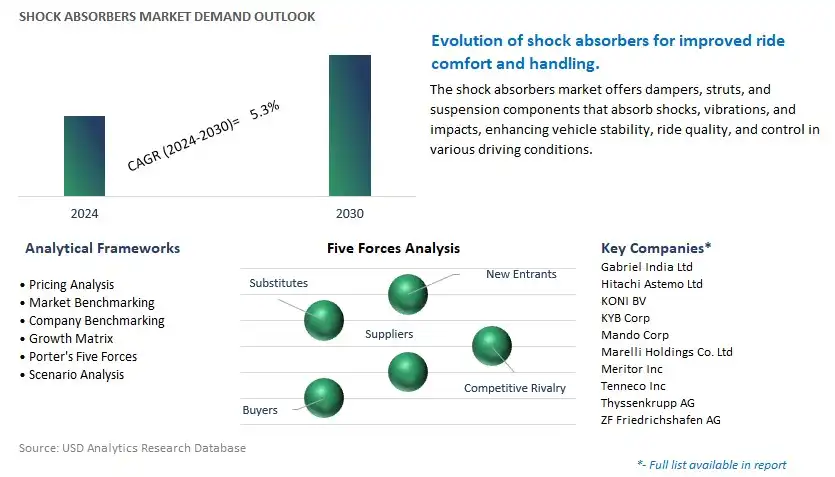
Shock Absorbers Market is estimated to increase at a growth rate of 5.3% CAGR over the forecast period from 2024 to 2030.
The global Shock Absorbers Market study analyzes and forecasts the market size across 6 regions and 24 countries for diverse segments including By Design (Twin Tube, Mono Tube), By Type (Hydraulic, Pneumatic), By Technology (Damping, Vibration, Gas Spring), By Sales Channel (OEM, Aftermarket), By Vehicle (Passenger Vehicle, Commercial Vehicle).
An Introduction to Global Shock Absorbers Market, 2024
The Shock Absorbers Market in 2024 remains a critical segment within the automotive industry, providing essential components that contribute to vehicle stability, comfort, and safety. Shock absorbers, also known as dampers, are integral parts of a vehicle's suspension system, dampening the effects of road irregularities and vibrations to ensure smooth and controlled ride quality. With consumers placing a premium on driving comfort and handling performance, manufacturers in this market continue to innovate with advanced shock absorber technologies. These include monotube, twin-tube, and electronically controlled dampers designed to provide optimal damping characteristics across a range of driving conditions. Additionally, advancements in materials, such as lightweight alloys and composite structures, contribute to improved shock absorber efficiency and longevity. Furthermore, customization options such as adjustable damping settings and vehicle-specific tuning cater to diverse vehicle platforms and driver preferences. As automotive manufacturers strive to enhance vehicle dynamics and ride comfort, the Shock Absorbers Market remains pivotal in delivering solutions that optimize driving experiences while ensuring safety and performance on the road.
Shock Absorbers Competitive Landscape
The global Shock Absorbers market is highly competitive with a large number of companies focusing on niche market segments. Amidst intense competitive conditions, Shock Absorbers Companies are investing in new product launches and strengthening distribution channels. Key companies operating in the Shock Absorbers Market Industry include- Gabriel India Ltd, Hitachi Astemo Ltd, KONI BV, KYB Corp, Mando Corp, Marelli Holdings Co. Ltd, Meritor Inc, Tenneco Inc, Thyssenkrupp AG, ZF Friedrichshafen AG.
Shock Absorbers Market Trend: Adoption of Advanced Technologies for Improved Performance and Comfort
A prominent trend in the Shock Absorbers market is the widespread adoption of advanced technologies to enhance performance, comfort, and durability. Manufacturers are incorporating innovations such as adaptive damping systems, electronic control modules, and variable damping rates to optimize suspension dynamics and responsiveness across a variety of driving conditions. Additionally, there's a growing trend towards lightweight materials, such as aluminum alloys and composite components, to reduce unsprung weight and improve suspension efficiency. These advancements in technology are reshaping the shock absorbers market, with a focus on delivering superior ride quality, handling precision, and vehicle stability for both passenger and commercial vehicles.
Shock Absorbers Market Driver: Increasing Vehicle Sales and Demand for Comfortable Ride Experience
A key driver for the Shock Absorbers market is the increasing sales of vehicles globally, coupled with the growing demand for a comfortable ride experience among consumers. As the automotive industry experiences steady growth and expansion, there's a corresponding rise in demand for suspension systems that can provide smooth and controlled vehicle dynamics across diverse road surfaces and driving conditions. Shock absorbers play a critical role in maintaining vehicle stability, reducing vibrations, and minimizing road shocks, thereby enhancing passenger comfort and safety. Moreover, the growing preference for SUVs, trucks, and crossover vehicles, which often require robust suspension systems to accommodate varying payloads and towing capacities, further drives the demand for high-performance shock absorbers. This driver is fueled by factors such as increasing disposable income, changing consumer preferences towards premium vehicles, and advancements in automotive technology that prioritize comfort and safety, driving the adoption and growth of shock absorbers in the global automotive market.
Shock Absorbers Market Opportunity: Expansion into Electric and Autonomous Vehicle Segments
An emerging opportunity within the Shock Absorbers market lies in the expansion into electric and autonomous vehicle segments, offering new avenues for growth, innovation, and market penetration. With the rise of electric vehicles (EVs) and autonomous driving technologies, there's a growing need for suspension systems that can address the unique requirements and challenges of these emerging vehicle platforms. Electric vehicles, with their high torque outputs and regenerative braking systems, demand shock absorbers capable of efficiently managing dynamic loads and optimizing energy recovery during braking and acceleration. Similarly, autonomous vehicles require suspension systems that can provide precise control and stability to ensure passenger comfort and safety in self-driving mode. Manufacturers of shock absorbers can capitalize on this opportunity by developing specialized solutions tailored to electric and autonomous vehicle platforms, leveraging expertise in adaptive damping, sensor integration, and vehicle dynamics control. Additionally, there's potential for collaboration with EV and autonomous vehicle manufacturers, technology suppliers, and research institutions to co-develop innovative suspension solutions that meet the unique performance and safety requirements of next-generation vehicles. By embracing this opportunity, manufacturers can position themselves as leaders in the rapidly evolving market for electric and autonomous vehicle suspension systems, driving growth and differentiation in the shock absorbers market. This opportunity is fueled by factors such as increasing investment in electric and autonomous vehicle development, government incentives for electric vehicle adoption, and the growing consumer interest in advanced automotive technologies, driving the expansion of the shock absorbers market into new vehicle segments and applications.
Shock Absorbers Market Segmentation
By Design
Twin Tube
Mono Tube
By Type
Hydraulic
Pneumatic
By Technology
Damping
Vibration
Gas Spring
By Sales Channel
OEM
Aftermarket
By Vehicle
Passenger Vehicle
Commercial VehicleGeographical Analysis
North America (United States, Canada, Mexico)
Europe (Germany, France, United Kingdom, Spain, Italy, Rest of Europe)
Asia Pacific (China, India, Japan, South Korea, Rest of Asia Pacific)
South America (Brazil, Argentina, Rest of South America)
Middle East and Africa (Saudi Arabia, UAE, Rest of Middle East, South Africa, Egypt, Rest of Africa
Shock Absorbers Companies
Gabriel India Ltd
Hitachi Astemo Ltd
KONI BV
KYB Corp
Mando Corp
Marelli Holdings Co. Ltd
Meritor Inc
Tenneco Inc
Thyssenkrupp AG
ZF Friedrichshafen AG
*- List not Exhaustive
TABLE OF CONTENTS
1 Introduction to 2024 Shock Absorbers Market
1.1 Market Overview
1.2 Quick Facts
1.3 Scope/Objective of the Study
1.4 Market Definition
1.5 Countries and Regions Analyzed
1.6 Units, Currency, and Conversions
1.7 Industry Value Chain
2 Research Methodology
2.1 Market Size Estimation
2.2 Sources and Research Methodology
2.3 Data Triangulation
2.4 Assumptions and Limitations
3 Executive Summary
3.1 Global Shock Absorbers Market Size Outlook, $ Million, 2021 to 2030
3.2 Shock Absorbers Market Outlook by Type, $ Million, 2021 to 2030
3.3 Shock Absorbers Market Outlook by Product, $ Million, 2021 to 2030
3.4 Shock Absorbers Market Outlook by Application, $ Million, 2021 to 2030
3.5 Shock Absorbers Market Outlook by Key Countries, $ Million, 2021 to 2030
4 Market Dynamics
4.1 Key Driving Forces of Shock Absorbers Industry
4.2 Key Market Trends in Shock Absorbers Industry
4.3 Potential Opportunities in Shock Absorbers Industry
4.4 Key Challenges in Shock Absorbers Industry
5 Market Factor Analysis
5.1 Value Chain Analysis
5.2 Competitive Landscape
5.2.1 Global Shock Absorbers Market Share by Company (%), 2023
5.2.2 Product Offerings by Company
5.3 Porter’s Five Forces Analysis
5.4 Pricing Analysis and Outlook
6 Growth Outlook Across Scenarios
6.1 Growth Analysis-Case Scenario Definitions
6.2 Low Growth Scenario Forecasts
6.3 Reference Growth Scenario Forecasts
6.4 High Growth Scenario Forecasts
7 Global Shock Absorbers Market Outlook by Segments
7.1 Shock Absorbers Market Outlook by Segments, $ Million, 2021- 2030
By Design
Twin Tube
Mono Tube
By Type
Hydraulic
Pneumatic
By Technology
Damping
Vibration
Gas Spring
By Sales Channel
OEM
Aftermarket
By Vehicle
Passenger Vehicle
Commercial Vehicle
8 North America Shock Absorbers Market Analysis and Outlook To 2030
8.1 Introduction to North America Shock Absorbers Markets in 2024
8.2 North America Shock Absorbers Market Size Outlook by Country, 2021-2030
8.2.1 United States
8.2.2 Canada
8.2.3 Mexico
8.3 North America Shock Absorbers Market size Outlook by Segments, 2021-2030
By Design
Twin Tube
Mono Tube
By Type
Hydraulic
Pneumatic
By Technology
Damping
Vibration
Gas Spring
By Sales Channel
OEM
Aftermarket
By Vehicle
Passenger Vehicle
Commercial Vehicle
9 Europe Shock Absorbers Market Analysis and Outlook To 2030
9.1 Introduction to Europe Shock Absorbers Markets in 2024
9.2 Europe Shock Absorbers Market Size Outlook by Country, 2021-2030
9.2.1 Germany
9.2.2 France
9.2.3 Spain
9.2.4 United Kingdom
9.2.4 Italy
9.2.5 Russia
9.2.6 Norway
9.2.7 Rest of Europe
9.3 Europe Shock Absorbers Market Size Outlook by Segments, 2021-2030
By Design
Twin Tube
Mono Tube
By Type
Hydraulic
Pneumatic
By Technology
Damping
Vibration
Gas Spring
By Sales Channel
OEM
Aftermarket
By Vehicle
Passenger Vehicle
Commercial Vehicle
10 Asia Pacific Shock Absorbers Market Analysis and Outlook To 2030
10.1 Introduction to Asia Pacific Shock Absorbers Markets in 2024
10.2 Asia Pacific Shock Absorbers Market Size Outlook by Country, 2021-2030
10.2.1 China
10.2.2 India
10.2.3 Japan
10.2.4 South Korea
10.2.5 Indonesia
10.2.6 Malaysia
10.2.7 Australia
10.2.8 Rest of Asia Pacific
10.3 Asia Pacific Shock Absorbers Market size Outlook by Segments, 2021-2030
By Design
Twin Tube
Mono Tube
By Type
Hydraulic
Pneumatic
By Technology
Damping
Vibration
Gas Spring
By Sales Channel
OEM
Aftermarket
By Vehicle
Passenger Vehicle
Commercial Vehicle
11 South America Shock Absorbers Market Analysis and Outlook To 2030
11.1 Introduction to South America Shock Absorbers Markets in 2024
11.2 South America Shock Absorbers Market Size Outlook by Country, 2021-2030
11.2.1 Brazil
11.2.2 Argentina
11.2.3 Rest of South America
11.3 South America Shock Absorbers Market size Outlook by Segments, 2021-2030
By Design
Twin Tube
Mono Tube
By Type
Hydraulic
Pneumatic
By Technology
Damping
Vibration
Gas Spring
By Sales Channel
OEM
Aftermarket
By Vehicle
Passenger Vehicle
Commercial Vehicle
12 Middle East and Africa Shock Absorbers Market Analysis and Outlook To 2030
12.1 Introduction to Middle East and Africa Shock Absorbers Markets in 2024
12.2 Middle East and Africa Shock Absorbers Market Size Outlook by Country, 2021-2030
12.2.1 Saudi Arabia
12.2.2 UAE
12.2.3 Oman
12.2.4 Rest of Middle East
12.2.5 Egypt
12.2.6 Nigeria
12.2.7 South Africa
12.2.8 Rest of Africa
12.3 Middle East and Africa Shock Absorbers Market size Outlook by Segments, 2021-2030
By Design
Twin Tube
Mono Tube
By Type
Hydraulic
Pneumatic
By Technology
Damping
Vibration
Gas Spring
By Sales Channel
OEM
Aftermarket
By Vehicle
Passenger Vehicle
Commercial Vehicle
13 Company Profiles
13.1 Company Snapshot
13.2 SWOT Profiles
13.3 Products and Services
13.4 Recent Developments
13.5 Financial Profile
List of Companies
Gabriel India Ltd
Hitachi Astemo Ltd
KONI BV
KYB Corp
Mando Corp
Marelli Holdings Co. Ltd
Meritor Inc
Tenneco Inc
Thyssenkrupp AG
ZF Friedrichshafen AG
14 Appendix
14.1 Customization Offerings
14.2 Subscription Services
14.3 Related Reports
14.4 Publisher Expertise
By Design
Twin Tube
Mono Tube
By Type
Hydraulic
Pneumatic
By Technology
Damping
Vibration
Gas Spring
By Sales Channel
OEM
Aftermarket
By Vehicle
Passenger Vehicle
Commercial Vehicle
