
The Sickle Cell Treatment Market study analyzes and forecasts the market size across 6 regions and 24 countries for diverse segments- By Treatment Modality (Blood Transfusion, Bone Marrow Transplant, Pharmacotherapy), By End-User (Hospitals, Specialty Clinics, Others).
The market for sickle cell treatment remains a critical area of focus in 2024, aiming to improve outcomes and quality of life for individuals affected by sickle cell disease (SCD), a genetic blood disorder characterized by abnormal hemoglobin and red blood cell morphology. Sickle cell treatment encompasses a multidisciplinary approach that includes disease-modifying therapies, symptom management, and supportive care interventions. With advancements in pharmacotherapy, including hydroxyurea, disease-modifying agents, and novel therapeutics targeting the underlying pathophysiology of SCD, treatment options offer opportunities to reduce vaso-occlusive crises, prevent complications such as acute chest syndrome and stroke, and improve overall survival. Moreover, the market is influenced by initiatives to increase access to comprehensive care services, genetic counseling, and disease screening programs, as well as efforts to promote research and innovation in SCD treatment, including gene therapy, hematopoietic stem cell transplantation, and targeted pharmacotherapies. Additionally, advocacy efforts seek to raise awareness of SCD, address disparities in healthcare access, and advance policies that support equitable and holistic care for individuals living with this chronic and complex condition.
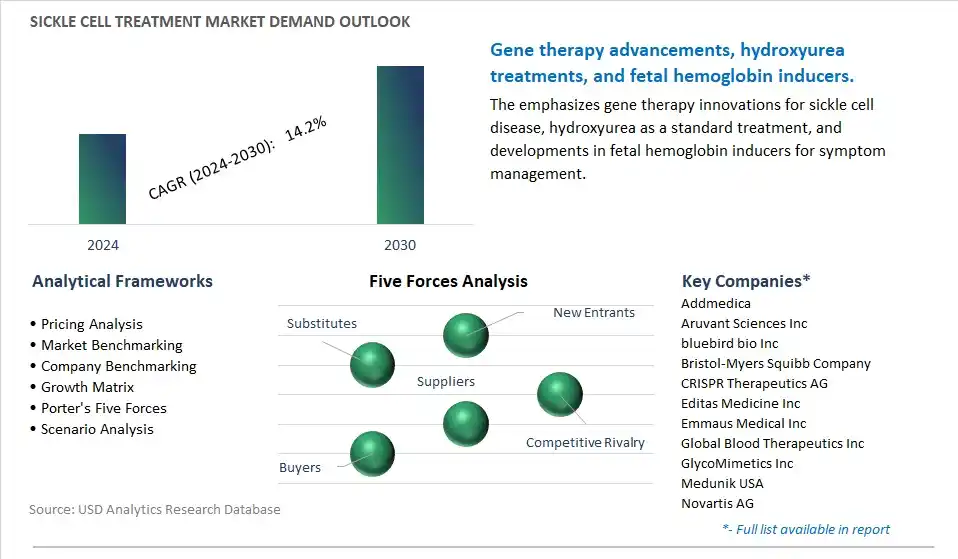
A significant trend in the sickle cell treatment market is the rapid advancements in gene therapy and the development of novel treatment approaches. Sickle cell disease (SCD) is a complex genetic disorder characterized by the abnormal shape and function of red blood cells, leading to chronic anemia, vaso-occlusive crises, and organ damage. In recent years, there has been remarkable progress in understanding the underlying molecular mechanisms of SCD and exploring innovative therapeutic strategies targeting disease pathophysiology at the genetic level. Gene therapy, including gene editing techniques such as CRISPR-Cas9 and lentiviral vector-mediated gene transfer, holds promise for correcting the underlying genetic defect responsible for SCD and providing a potential cure for affected individuals. Additionally, novel treatment modalities such as fetal hemoglobin inducers, anti-adhesion molecules, and targeted therapies are being investigated for their potential to alleviate symptoms, prevent complications, and improve quality of life in patients with SCD. This trend towards breakthrough innovations in SCD treatment reflects a paradigm shift towards personalized, precision medicine approaches that offer hope for transformative outcomes and improved disease management for individuals affected by SCD.
A primary driver propelling the sickle cell treatment market forward is the unmet medical need and the growing awareness of sickle cell disease. SCD affects millions of people worldwide, particularly those of African, Mediterranean, Middle Eastern, and South Asian descent, yet it remains a largely underserved and overlooked condition in many healthcare systems. Patients with SCD often experience significant pain, complications, and reduced life expectancy, highlighting the urgent need for effective treatments that address the underlying pathophysiology of the disease and improve long-term outcomes. With increasing advocacy efforts, public awareness campaigns, and initiatives aimed at raising the profile of SCD on the global health agenda, there is a growing recognition of the need to prioritize research, innovation, and investment in SCD treatment and care. This driver underscores the critical importance of addressing the unmet medical needs of individuals living with SCD, driving market demand for innovative therapies, and catalyzing efforts to advance the field of sickle cell treatment.
An opportunity within the sickle cell treatment market lies in collaboration and partnership in drug development and access programs. Given the complexity and multifaceted nature of SCD, successful treatment strategies often require interdisciplinary collaboration among pharmaceutical companies, academic institutions, government agencies, healthcare providers, patient advocacy organizations, and community stakeholders. Collaborative efforts spanning drug discovery, preclinical and clinical development, regulatory approval, and post-market access initiatives can accelerate the translation of promising research findings into effective therapies, streamline drug development processes, and improve patient access to innovative treatments. Additionally, partnerships focused on education, training, and capacity-building initiatives can enhance healthcare infrastructure, promote equitable access to care, and empower healthcare professionals to deliver comprehensive, evidence-based care for patients with SCD. By fostering collaboration and partnership across the sickle cell treatment ecosystem, stakeholders can leverage collective expertise, resources, and networks to address the complex challenges associated with SCD and drive positive impact on patient outcomes and quality of life. This opportunity for collaboration presents a pathway for advancing the field of sickle cell treatment, overcoming barriers to access, and ultimately improving the lives of individuals affected by this debilitating condition.
The fastest-growing segment in the Sickle Cell Treatment Market is Pharmacotherapy. This growth is driven by advancements in pharmaceutical research and the development of novel drugs and therapies specifically targeted at treating sickle cell disease. Pharmacotherapy offers a non-invasive and accessible treatment option for patients, leading to increased adoption and demand. Additionally, the focus on personalized medicine and the development of targeted therapies tailored to individual patients' genetic profiles are further driving growth in this segment. Increased awareness about sickle cell disease and its management among healthcare providers and patients also contribute to the growth of pharmacotherapy as a preferred treatment modality.
The market research study provides in-depth insights into leading companies including the SWOT analyses, product profile, financial details, and recent developments acrossAddmedica, Aruvant Sciences Inc, bluebird bio Inc, Bristol-Myers Squibb Company, CRISPR Therapeutics AG, Editas Medicine Inc, Emmaus Medical Inc, Global Blood Therapeutics Inc, GlycoMimetics Inc, Medunik USA, Novartis AG, Pfizer Inc, Sanofi SA
By Treatment Modality
Blood Transfusion
Bone Marrow Transplant
Pharmacotherapy
By End-User
Hospitals
Specialty Clinics
Others
Geographical Analysis
North America (United States, Canada, Mexico)
Europe (Germany, France, United Kingdom, Spain, Italy, Rest of Europe)
Asia Pacific (China, India, Japan, South Korea, Rest of Asia Pacific)
South America (Brazil, Argentina, Rest of South America)
Middle East and Africa (Saudi Arabia, UAE, Rest of Middle East, South Africa, Egypt, Rest of Africa)
Addmedica
Aruvant Sciences Inc
bluebird bio Inc
Bristol-Myers Squibb Company
CRISPR Therapeutics AG
Editas Medicine Inc
Emmaus Medical Inc
Global Blood Therapeutics Inc
GlycoMimetics Inc
Medunik USA
Novartis AG
Pfizer Inc
Sanofi SA
• Deepen your industry insights and navigate uncertainties for strategy formulation, CAPEX, and Operational decisions
• Gain access to detailed insights on the Sickle Cell Treatment Market, encompassing current market size, growth trends, and forecasts till 2030.
• Access detailed competitor analysis, enabling competitive advantage through a thorough understanding of market players, strategies, and potential differentiation opportunities
• Stay ahead of the curve with insights on technological advancements, innovations, and upcoming trends
• Identify lucrative investment avenues and expansion opportunities within the Sickle Cell Treatment Market industry, guided by robust, data-backed analysis.
• Understand regional and global markets through country-wise analysis, regional market potential, regulatory nuances, and dynamics
• Execute strategies with confidence and speed through information, analytics, and insights on the industry value chain
• Corporate leaders, strategists, financial experts, shareholders, asset managers, and governmental representatives can make long-term planning scenarios and build an integrated and timely understanding of market dynamics
• Benefit from tailored solutions and expert consultation based on report insights, providing personalized strategies aligned with specific business needs.
TABLE OF CONTENTS
1 Introduction to 2024 Sickle Cell Treatment Market
1.1 Market Overview
1.2 Quick Facts
1.3 Scope/Objective of the Study
1.4 Market Definition
1.5 Countries and Regions Covered
1.6 Units, Currency, and Conversions
1.7 Industry Value Chain
2 Research Methodology
2.1 Market Size Estimation
2.2 Sources and Research Methodology
2.3 Data Triangulation
2.4 Assumptions and Limitations
3 Executive Summary
3.1 Global Sickle Cell Treatment Market Size Outlook, $ Million, 2021 to 2030
3.2 Sickle Cell Treatment Market Outlook by Type, $ Million, 2021 to 2030
3.3 Sickle Cell Treatment Market Outlook by Product, $ Million, 2021 to 2030
3.4 Sickle Cell Treatment Market Outlook by Application, $ Million, 2021 to 2030
3.5 Sickle Cell Treatment Market Outlook by Key Countries, $ Million, 2021 to 2030
4 Market Dynamics
4.1 Key Driving Forces of Sickle Cell Treatment Industry
4.2 Key Market Trends in Sickle Cell Treatment Industry
4.3 Potential Opportunities in Sickle Cell Treatment Industry
4.4 Key Challenges in Sickle Cell Treatment Industry
5 Market Factor Analysis
5.1 Value Chain Analysis
5.2 Competitive Landscape
5.2.1 Global Sickle Cell Treatment Market Share by Company (%), 2023
5.2.2 Product Offerings by Company
5.3 Porter’s Five Forces Analysis
5.4 Pricing Analysis and Outlook
6 Growth Outlook Across Scenarios
6.1 Growth Analysis-Case Scenario Definitions
6.2 Low Growth Scenario Forecasts
6.3 Reference Growth Scenario Forecasts
6.4 High Growth Scenario Forecasts
7 Global Sickle Cell Treatment Market Outlook by Segments
7.1 Sickle Cell Treatment Market Outlook by Segments, $ Million, 2021- 2030
By Treatment Modality
Blood Transfusion
Bone Marrow Transplant
Pharmacotherapy
By End-User
Hospitals
Specialty Clinics
Others
8 North America Sickle Cell Treatment Market Analysis and Outlook To 2030
8.1 Introduction to North America Sickle Cell Treatment Markets in 2024
8.2 North America Sickle Cell Treatment Market Size Outlook by Country, 2021-2030
8.2.1 United States
8.2.2 Canada
8.2.3 Mexico
8.3 North America Sickle Cell Treatment Market size Outlook by Segments, 2021-2030
By Treatment Modality
Blood Transfusion
Bone Marrow Transplant
Pharmacotherapy
By End-User
Hospitals
Specialty Clinics
Others
9 Europe Sickle Cell Treatment Market Analysis and Outlook To 2030
9.1 Introduction to Europe Sickle Cell Treatment Markets in 2024
9.2 Europe Sickle Cell Treatment Market Size Outlook by Country, 2021-2030
9.2.1 Germany
9.2.2 France
9.2.3 Spain
9.2.4 United Kingdom
9.2.4 Italy
9.2.5 Russia
9.2.6 Norway
9.2.7 Rest of Europe
9.3 Europe Sickle Cell Treatment Market Size Outlook by Segments, 2021-2030
By Treatment Modality
Blood Transfusion
Bone Marrow Transplant
Pharmacotherapy
By End-User
Hospitals
Specialty Clinics
Others
10 Asia Pacific Sickle Cell Treatment Market Analysis and Outlook To 2030
10.1 Introduction to Asia Pacific Sickle Cell Treatment Markets in 2024
10.2 Asia Pacific Sickle Cell Treatment Market Size Outlook by Country, 2021-2030
10.2.1 China
10.2.2 India
10.2.3 Japan
10.2.4 South Korea
10.2.5 Indonesia
10.2.6 Malaysia
10.2.7 Australia
10.2.8 Rest of Asia Pacific
10.3 Asia Pacific Sickle Cell Treatment Market size Outlook by Segments, 2021-2030
By Treatment Modality
Blood Transfusion
Bone Marrow Transplant
Pharmacotherapy
By End-User
Hospitals
Specialty Clinics
Others
11 South America Sickle Cell Treatment Market Analysis and Outlook To 2030
11.1 Introduction to South America Sickle Cell Treatment Markets in 2024
11.2 South America Sickle Cell Treatment Market Size Outlook by Country, 2021-2030
11.2.1 Brazil
11.2.2 Argentina
11.2.3 Rest of South America
11.3 South America Sickle Cell Treatment Market size Outlook by Segments, 2021-2030
By Treatment Modality
Blood Transfusion
Bone Marrow Transplant
Pharmacotherapy
By End-User
Hospitals
Specialty Clinics
Others
12 Middle East and Africa Sickle Cell Treatment Market Analysis and Outlook To 2030
12.1 Introduction to Middle East and Africa Sickle Cell Treatment Markets in 2024
12.2 Middle East and Africa Sickle Cell Treatment Market Size Outlook by Country, 2021-2030
12.2.1 Saudi Arabia
12.2.2 UAE
12.2.3 Oman
12.2.4 Rest of Middle East
12.2.5 Egypt
12.2.6 Nigeria
12.2.7 South Africa
12.2.8 Rest of Africa
12.3 Middle East and Africa Sickle Cell Treatment Market size Outlook by Segments, 2021-2030
By Treatment Modality
Blood Transfusion
Bone Marrow Transplant
Pharmacotherapy
By End-User
Hospitals
Specialty Clinics
Others
13 Company Profiles
13.1 Company Snapshot
13.2 SWOT Profiles
13.3 Products and Services
13.4 Recent Developments
13.5 Financial Profile
List of Companies
Addmedica
Aruvant Sciences Inc
bluebird bio Inc
Bristol-Myers Squibb Company
CRISPR Therapeutics AG
Editas Medicine Inc
Emmaus Medical Inc
Global Blood Therapeutics Inc
GlycoMimetics Inc
Medunik USA
Novartis AG
Pfizer Inc
Sanofi SA
14 Appendix
14.1 Customization Offerings
14.2 Subscription Services
14.3 Related Reports
14.4 Publisher Expertise
By Treatment Modality
Blood Transfusion
Bone Marrow Transplant
Pharmacotherapy
By End-User
Hospitals
Specialty Clinics
Others
Countries Analyzed
North America (United States, Canada, Mexico)
Europe (Germany, France, United Kingdom, Spain, Italy, Rest of Europe)
Asia Pacific (China, India, Japan, South Korea, Rest of Asia Pacific)
South America (Brazil, Argentina, Rest of South America)
Middle East and Africa (Saudi Arabia, UAE, Rest of Middle East, South Africa, Egypt, Rest of Africa)
The global Sickle Cell Treatment Market is one of the lucrative growth markets, poised to register a 14.2% growth (CAGR) between 2024 and 2030.
Emerging Markets across Asia Pacific, Europe, and Americas present robust growth prospects.
Addmedica, Aruvant Sciences Inc, bluebird bio Inc, Bristol-Myers Squibb Company, CRISPR Therapeutics AG, Editas Medicine Inc, Emmaus Medical Inc, Global Blood Therapeutics Inc, GlycoMimetics Inc, Medunik USA, Novartis AG, Pfizer Inc, Sanofi SA
Base Year- 2023; Estimated Year- 2024; Historic Period- 2018-2023; Forecast period- 2024 to 2030; Currency: USD; Volume