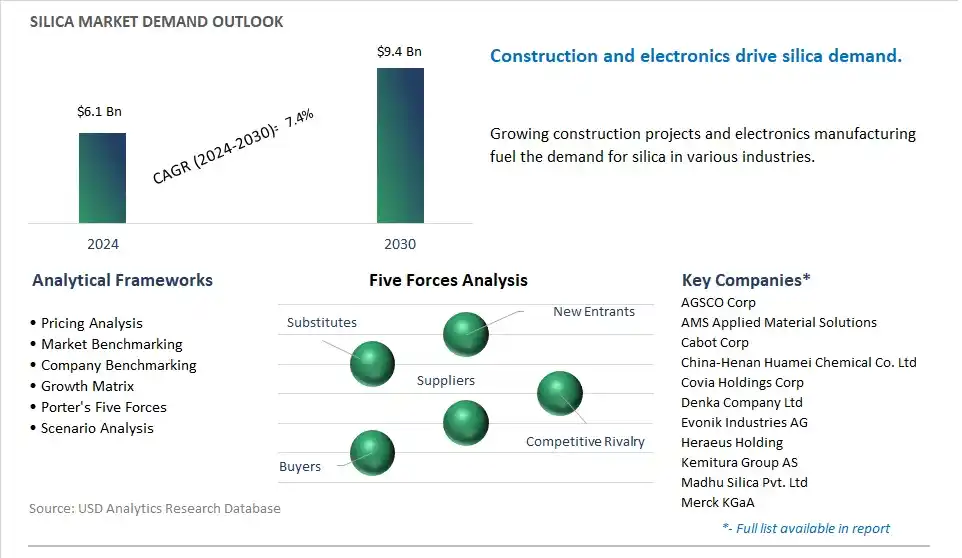
The global Silica Market is poised to register a 7.4% CAGR from $6.1 Billion in 2024 to $9.4 Billion in 2030.
The global Silica Market Study analyzes and forecasts the market size across 6 regions and 24 countries for diverse segments -By Type (Amorphous Crystalline ), By End-User (Building and Construction, Shale Oil and Gas, Glass Manufacturing, Water Treatment, Others).
An Introduction to Global Silica Market in 2024
The future of silica lies in its diverse applications across industries such as construction, electronics, and healthcare. Silica, a naturally occurring mineral composed of silicon and oxygen atoms, is used in various forms such as sand, quartz, and silica gel. In the construction industry, silica sand is a key component in concrete, mortar, and asphalt mixes, providing strength, durability, and abrasion resistance to building materials. Moreover, in electronics manufacturing, high-purity silica is essential for the production of silicon wafers used in semiconductor devices, solar panels, and electronic components. Additionally, silica gel, with its high adsorption capacity and moisture-absorbing properties, finds applications in desiccants, humidity control, and packaging materials to protect sensitive products from moisture damage. As industries continue to innovate and develop new technologies, silica will remain a vital raw material for a wide range of applications, driving demand and market growth in the global silica industry.
Silica Market Competitive Landscape
The market report analyses the leading companies in the industry including AGSCO Corp, AMS Applied Material Solutions, Cabot Corp, China-Henan Huamei Chemical Co. Ltd, Covia Holdings Corp, Denka Company Ltd, Evonik Industries AG, Heraeus Holding, Kemitura Group AS, Madhu Silica Pvt. Ltd, Merck KGaA, Mitsubishi Chemical Corp, Nouryon, OCI COMPANY Ltd, PPG Industries Inc, Sibelco, Tokuyama Corp, US Silica, Wacker Chemie AG, WR Grace & Co.
Silica Market Dynamics
Silica Market Trend: Increasing Demand for Silica in the Electronics and Semiconductor Industry
A significant trend in the market for silica is the increasing demand from the electronics and semiconductor industry. Silica, particularly in the form of high-purity silica nanoparticles and colloidal silica, plays a crucial role in various electronic applications such as semiconductor manufacturing, integrated circuits, optical fibers, and electronic packaging. With the rapid advancement of technology and the growing complexity of electronic devices, there is a rising need for silica materials with precise properties, including high purity, uniform particle size, and controlled surface characteristics. The trend towards miniaturization, high performance, and reliability in electronic components drives the demand for silica as a critical material in the electronics and semiconductor industry.
Silica Market Driver: Growth in the Construction and Infrastructure Sector
A primary driver for the market of silica is the growth in the construction and infrastructure sector. Silica, primarily in the form of silica sand, is a key ingredient in the production of concrete, mortar, asphalt, and other construction materials. It is used as a filler and binding agent to enhance the strength, durability, and workability of construction products. With increasing urbanization, population growth, and infrastructure development worldwide, there is a growing demand for silica in construction projects such as residential buildings, commercial complexes, highways, bridges, and tunnels. The construction industry's need for high-quality silica to meet stringent performance requirements and regulatory standards drives the demand for silica as a fundamental component in building and infrastructure construction.
Silica Market Opportunity: Expansion into High-Value Applications such as Nanotechnology and Renewable Energy
An opportunity in the market for silica lies in the expansion into high-value applications such as nanotechnology and renewable energy. Silica nanoparticles, silica aerogels, and silica-based materials are gaining traction in emerging sectors such as nanomedicine, catalysis, energy storage, and photovoltaics due to their unique properties and functionalities. Silica nanoparticles, for example, are used in drug delivery systems, imaging agents, and biosensors, while silica aerogels are employed in thermal insulation, energy-efficient windows, and aerospace applications. Additionally, silica-based materials are essential components in renewable energy technologies such as solar panels, lithium-ion batteries, and fuel cells. By focusing on innovation and developing tailored solutions for high-value applications, stakeholders in the silica market can capitalize on opportunities for growth and diversification beyond traditional markets.
Silica Market Share Analysis: Crystalline Silica generated the highest revenue in 2024
The largest segment in the Silica Market is Crystalline Silica. Crystalline silica dominates the market due to its widespread use across various industries and its unique properties. Crystalline silica exists in various crystalline forms, including quartz, cristobalite, and tridymite, and is known for its high purity, hardness, and thermal stability. It finds extensive applications in industries such as construction, glass manufacturing, electronics, foundry, and abrasives. In the construction sector, crystalline silica is a key ingredient in the production of concrete, cement, and mortar, providing strength and durability to structures. In glass manufacturing, it serves as a primary raw material for producing glass products with desirable optical and mechanical properties. Additionally, crystalline silica is used in electronics for the production of silicon wafers, semiconductors, and photovoltaic cells, owing to its electrical conductivity and thermal resistance. Its versatility, abundance, and essential role across multiple industries contribute to its dominance as the largest segment in the Silica Market.
Silica Market Share Analysis: Shale Oil and Gas segment is poised to register the fastest growth rate (CAGR) over the forecast period to 2030
The sector is experiencing significant growth in demand for silica due to its crucial role in hydraulic fracturing, also known as fracking, in the extraction of oil and gas from shale formations. Silica, particularly in the form of frac sand, is used as a proppant in the fracking process to keep fractures open and allow oil and gas to flow to the wellbore. With the expansion of shale oil and gas exploration and production activities, especially in regions such as the United States, Canada, and parts of Europe and Asia, the demand for silica for fracking operations has surged. Further, advancements in fracking technologies and techniques, such as horizontal drilling and multi-stage fracturing, require larger quantities of frac sand per well, further driving the demand for silica in the shale oil and gas industry. Accordingly, the Shale Oil and Gas segment emerge as the fastest-growing segment in the Silica Market.
Silica Market Report Segmentation
By Type
Amorphous
-Pyrogenic/Fumed
-Hydrated
Crystalline
-Quartz
-Tridymite
-Cristobalite
By End-User
Building and Construction
Shale Oil and Gas
Glass Manufacturing
Water Treatment
Others
Regions Included
North America (US, Canada, Mexico)
Europe (Germany, UK, France, Spain, Italy, Russia, Rest of Europe)
Asia Pacific (China, India, Japan, South Korea, Australia, South East Asia, Rest of Asia)
South America (Brazil, Argentina, Rest of South America)
Middle East and Africa (Saudi Arabia, UAE, Rest of Middle East, South Africa, Egypt, Rest of Africa)
Silica Companies Profiled in the Market Study
AGSCO Corp
AMS Applied Material Solutions
Cabot Corp
China-Henan Huamei Chemical Co. Ltd
Covia Holdings Corp
Denka Company Ltd
Evonik Industries AG
Heraeus Holding
Kemitura Group AS
Madhu Silica Pvt. Ltd
Merck KGaA
Mitsubishi Chemical Corp
Nouryon
OCI COMPANY Ltd
PPG Industries Inc
Sibelco
Tokuyama Corp
US Silica
Wacker Chemie AG
WR Grace & Co
*- List Not Exhaustive
TABLE OF CONTENTS
1 Introduction to 2024 Silica Market
1.1 Market Overview
1.2 Quick Facts
1.3 Scope/Objective of the Study
1.4 Market Definition
1.5 Countries and Regions Covered
1.6 Units, Currency, and Conversions
1.7 Industry Value Chain
2 Research Methodology
2.1 Market Size Estimation
2.2 Sources and Research Methodology
2.3 Data Triangulation
2.4 Assumptions and Limitations
3 Executive Summary
3.1 Global Silica Market Size Outlook, $ Million, 2021 to 2030
3.2 Silica Market Outlook by Type, $ Million, 2021 to 2030
3.3 Silica Market Outlook by Product, $ Million, 2021 to 2030
3.4 Silica Market Outlook by Application, $ Million, 2021 to 2030
3.5 Silica Market Outlook by Key Countries, $ Million, 2021 to 2030
4 Market Dynamics
4.1 Key Driving Forces of Silica Industry
4.2 Key Market Trends in Silica Industry
4.3 Potential Opportunities in Silica Industry
4.4 Key Challenges in Silica Industry
5 Market Factor Analysis
5.1 Value Chain Analysis
5.2 Competitive Landscape
5.2.1 Global Silica Market Share by Company (%), 2023
5.2.2 Product Offerings by Company
5.3 Porter’s Five Forces Analysis
5.4 Pricing Analysis and Outlook
6 Growth Outlook Across Scenarios
6.1 Growth Analysis-Case Scenario Definitions
6.2 Low Growth Scenario Forecasts
6.3 Reference Growth Scenario Forecasts
6.4 High Growth Scenario Forecasts
7 Global Silica Market Outlook by Segments
7.1 Silica Market Outlook by Segments, $ Million, 2021- 2030
By Type
Amorphous
-Pyrogenic/Fumed
-Hydrated
Crystalline
-Quartz
-Tridymite
-Cristobalite
By End-User
Building and Construction
Shale Oil and Gas
Glass Manufacturing
Water Treatment
Others
8 North America Silica Market Analysis and Outlook To 2030
8.1 Introduction to North America Silica Markets in 2024
8.2 North America Silica Market Size Outlook by Country, 2021-2030
8.2.1 United States
8.2.2 Canada
8.2.3 Mexico
8.3 North America Silica Market size Outlook by Segments, 2021-2030
By Type
Amorphous
-Pyrogenic/Fumed
-Hydrated
Crystalline
-Quartz
-Tridymite
-Cristobalite
By End-User
Building and Construction
Shale Oil and Gas
Glass Manufacturing
Water Treatment
Others
9 Europe Silica Market Analysis and Outlook To 2030
9.1 Introduction to Europe Silica Markets in 2024
9.2 Europe Silica Market Size Outlook by Country, 2021-2030
9.2.1 Germany
9.2.2 France
9.2.3 Spain
9.2.4 United Kingdom
9.2.4 Italy
9.2.5 Russia
9.2.6 Norway
9.2.7 Rest of Europe
9.3 Europe Silica Market Size Outlook by Segments, 2021-2030
By Type
Amorphous
-Pyrogenic/Fumed
-Hydrated
Crystalline
-Quartz
-Tridymite
-Cristobalite
By End-User
Building and Construction
Shale Oil and Gas
Glass Manufacturing
Water Treatment
Others
10 Asia Pacific Silica Market Analysis and Outlook To 2030
10.1 Introduction to Asia Pacific Silica Markets in 2024
10.2 Asia Pacific Silica Market Size Outlook by Country, 2021-2030
10.2.1 China
10.2.2 India
10.2.3 Japan
10.2.4 South Korea
10.2.5 Indonesia
10.2.6 Malaysia
10.2.7 Australia
10.2.8 Rest of Asia Pacific
10.3 Asia Pacific Silica Market size Outlook by Segments, 2021-2030
By Type
Amorphous
-Pyrogenic/Fumed
-Hydrated
Crystalline
-Quartz
-Tridymite
-Cristobalite
By End-User
Building and Construction
Shale Oil and Gas
Glass Manufacturing
Water Treatment
Others
11 South America Silica Market Analysis and Outlook To 2030
11.1 Introduction to South America Silica Markets in 2024
11.2 South America Silica Market Size Outlook by Country, 2021-2030
11.2.1 Brazil
11.2.2 Argentina
11.2.3 Rest of South America
11.3 South America Silica Market size Outlook by Segments, 2021-2030
By Type
Amorphous
-Pyrogenic/Fumed
-Hydrated
Crystalline
-Quartz
-Tridymite
-Cristobalite
By End-User
Building and Construction
Shale Oil and Gas
Glass Manufacturing
Water Treatment
Others
12 Middle East and Africa Silica Market Analysis and Outlook To 2030
12.1 Introduction to Middle East and Africa Silica Markets in 2024
12.2 Middle East and Africa Silica Market Size Outlook by Country, 2021-2030
12.2.1 Saudi Arabia
12.2.2 UAE
12.2.3 Oman
12.2.4 Rest of Middle East
12.2.5 Egypt
12.2.6 Nigeria
12.2.7 South Africa
12.2.8 Rest of Africa
12.3 Middle East and Africa Silica Market size Outlook by Segments, 2021-2030
By Type
Amorphous
-Pyrogenic/Fumed
-Hydrated
Crystalline
-Quartz
-Tridymite
-Cristobalite
By End-User
Building and Construction
Shale Oil and Gas
Glass Manufacturing
Water Treatment
Others
13 Company Profiles
13.1 Company Snapshot
13.2 SWOT Profiles
13.3 Products and Services
13.4 Recent Developments
13.5 Financial Profile
AGSCO Corp
AMS Applied Material Solutions
Cabot Corp
China-Henan Huamei Chemical Co. Ltd
Covia Holdings Corp
Denka Company Ltd
Evonik Industries AG
Heraeus Holding
Kemitura Group AS
Madhu Silica Pvt. Ltd
Merck KGaA
Mitsubishi Chemical Corp
Nouryon
OCI COMPANY Ltd
PPG Industries Inc
Sibelco
Tokuyama Corp
US Silica
Wacker Chemie AG
WR Grace & Co
14 Appendix
14.1 Customization Offerings
14.2 Subscription Services
14.3 Related Reports
14.4 Publisher Expertise
By Type
Amorphous
-Pyrogenic/Fumed
-Hydrated
Crystalline
-Quartz
-Tridymite
-Cristobalite
By End-User
Building and Construction
Shale Oil and Gas
Glass Manufacturing
Water Treatment
Others
Countries Analyzed
North America (US, Canada, Mexico)
Europe (Germany, UK, France, Spain, Italy, Russia, Rest of Europe)
Asia Pacific (China, India, Japan, South Korea, Australia, South East Asia, Rest of Asia)
South America (Brazil, Argentina, Rest of South America)
Middle East and Africa (Saudi Arabia, UAE, Rest of Middle East, South Africa, Egypt, Rest of Africa)
