
The global Skin Care Emulsion Market Study analyzes and forecasts the market size across 6 regions and 24 countries for diverse segments -By Distribution Channel (Offline, Online), By Product (Lotion, Skin cream).
The skin care emulsion market is experiencing significant growth driven by increasing consumer awareness of skincare routines and preferences for multifunctional and personalized products. Key trends shaping the future of the industry include the rising demand for skin care emulsions with added benefits such as hydration, sun protection, anti-aging, and pollution defense. Moreover, there's a growing emphasis on natural and organic ingredients in skin care formulations, driving the development of clean label emulsions free from harmful chemicals and allergens. Additionally, advancements in emulsion technology, including microencapsulation, nanotechnology, and biodegradable polymers, are driving innovation in skin care products, enabling manufacturers to offer advanced formulations with improved efficacy, stability, and sensory attributes, thereby fueling market growth and competitiveness in the global skin care emulsion market.
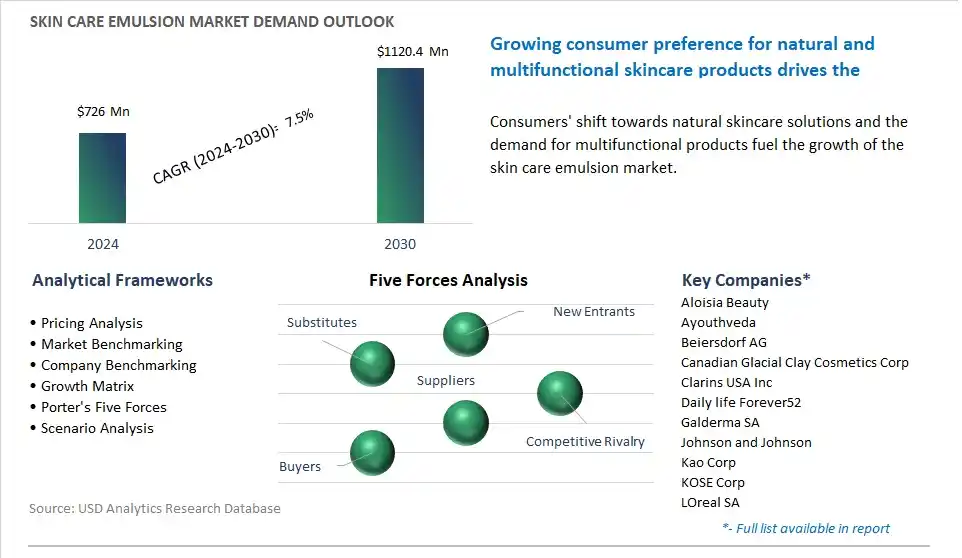
The market report analyses the leading companies in the industry including Aloisia Beauty, Ayouthveda, Beiersdorf AG, Canadian Glacial Clay Cosmetics Corp, Clarins USA Inc, Daily life Forever52, Galderma SA, Johnson and Johnson, Kao Corp, KOSE Corp, LOreal SA, Natura and Co Holding SA, Nutricare Holding Pty Ltd, Pechoin Inc, Shiseido Co. Ltd, Skeyndor S.L.U, The Estee Lauder Companies, The Procter and Gamble Co., Unilever PLC.
A prominent market trend in skin care emulsions is the increasing demand for multi-functional and customizable skincare formulations, driven by consumer preferences for personalized skincare solutions and products that offer multiple benefits in a single application. Skin care emulsions, which combine water and oil phases to create stable, creamy textures, serve as versatile bases for a wide range of skincare products, including moisturizers, serums, lotions, and creams. As consumers seek skincare products tailored to their specific skin concerns, such as hydration, anti-aging, brightening, and blemish control, there is a growing demand for emulsions that can accommodate various active ingredients, botanical extracts, vitamins, and specialty additives to address diverse skincare needs. Manufacturers are responding to this trend by developing innovative emulsion formulations that offer customizable textures, targeted delivery systems, and enhanced performance attributes, allowing consumers to personalize their skincare routines and achieve desired results effectively.
The market for skin care emulsions is being driven by increasing consumer awareness of skincare benefits and self-care practices, fueled by social media influence, beauty trends, and health-conscious lifestyles. With the rise of digital platforms and social media influencers promoting skincare routines, beauty tips, and product recommendations, consumers are becoming more knowledgeable about skincare ingredients, formulations, and product efficacy. Furthermore, the growing emphasis on self-care and wellness has led individuals to prioritize skincare as part of their daily rituals and holistic health routines. As a result, there is a heightened demand for high-quality skincare products that offer visible results, sensory indulgence, and therapeutic benefits, driving the adoption of skin care emulsions as preferred vehicles for delivering active ingredients and nourishing compounds to the skin. The consumer-driven demand for skincare emulsions is propelling market growth and innovation in the beauty and personal care industry, driving manufacturers to develop innovative formulations that cater to evolving consumer preferences and lifestyle trends.
A potential opportunity for the skin care emulsion market lies in the development of eco-friendly and sustainable emulsion formulations that align with consumer preferences for clean beauty, environmental responsibility, and ethical sourcing practices. As sustainability becomes a key consideration for consumers when choosing skincare products, there is a growing demand for emulsions that utilize environmentally friendly ingredients, biodegradable materials, and eco-conscious packaging solutions. Manufacturers can capitalize on this opportunity by incorporating natural and organic ingredients, renewable resources, and eco-certified emulsifiers into their formulations to create sustainable skincare products with minimal environmental impact. Additionally, there is an opportunity to explore innovative packaging designs, refillable containers, and recyclable materials to reduce waste and carbon footprint throughout the product lifecycle. By offering eco-friendly skin care emulsions, companies can appeal to environmentally conscious consumers, differentiate their brands in the competitive skincare market, and contribute to sustainability efforts in the beauty industry.
The Offline distribution channel segment is the largest in the Skin Care Emulsion Market. offline distribution channels, such as brick-and-mortar stores, pharmacies, department stores, and specialty beauty retailers, have traditionally been the primary retail outlets for skincare products. Consumers often prefer to purchase skincare emulsions in physical stores where they can see, touch, and test the products before making a purchase. Additionally, offline channels offer personalized assistance from sales representatives or beauty consultants who can provide product recommendations, skincare advice, and demonstrations, enhancing the shopping experience and building consumer trust and loyalty. Further, offline channels provide immediate gratification, allowing consumers to take home their purchases immediately without waiting for shipping or delivery. Furthermore, established retail networks, extensive store presence, and strategic partnerships with beauty retailers contribute to the widespread availability and visibility of skincare emulsions in offline channels, driving their dominance in the market. Over the forecast period, the convenience, accessibility, personalized service, and immediate availability offered by offline distribution channels position them as the largest segment in the Skin Care Emulsion Market.
The Skin cream segment is the fastest-growing segment in the Skin Care Emulsion Market. skin creams offer a richer and more nourishing texture compared to lotions, making them increasingly popular among consumers seeking intensive hydration and moisturization for their skin. Skin creams often contain higher concentrations of emollients, humectants, and occlusive agents, which help to lock in moisture, repair the skin barrier, and provide long-lasting hydration. Additionally, skin creams include additional active ingredients such as antioxidants, vitamins, peptides, and botanical extracts, targeting specific skin concerns such as aging, dryness, hyperpigmentation, and sensitivity. Further, the growing demand for multifunctional skincare products that offer multiple benefits in a single formulation drives the adoption of skin creams with added features such as sun protection, anti-aging, brightening, and firming properties. Furthermore, advancements in skincare formulation technologies, including the development of lightweight and non-greasy textures, enhance the appeal and usability of skin creams for a wider range of consumers, including those with oily or combination skin types. Additionally, the rising consumer interest in self-care, wellness, and skincare routines further fuels the demand for indulgent and effective skincare products like skin creams. Over the forecast period, the combination of rich formulations, targeted ingredients, multifunctionality, and consumer preferences for luxurious skincare experiences positions the Skin cream segment as the fastest-growing segment in the Skin Care Emulsion Market.
By Distribution Channel
Offline
Online
By Product
Lotion
Skin cream
Regions Included
North America (US, Canada, Mexico)
Europe (Germany, UK, France, Spain, Italy, Russia, Rest of Europe)
Asia Pacific (China, India, Japan, South Korea, Australia, South East Asia, Rest of Asia)
South America (Brazil, Argentina, Rest of South America)
Middle East and Africa (Saudi Arabia, UAE, Rest of Middle East, South Africa, Egypt, Rest of Africa)
Aloisia Beauty
Ayouthveda
Beiersdorf AG
Canadian Glacial Clay Cosmetics Corp
Clarins USA Inc
Daily life Forever52
Galderma SA
Johnson and Johnson
Kao Corp
KOSE Corp
LOreal SA
Natura and Co Holding SA
Nutricare Holding Pty Ltd
Pechoin Inc
Shiseido Co. Ltd
Skeyndor S.L.U
The Estee Lauder Companies
The Procter and Gamble Co.
Unilever PLC
*- List Not Exhaustive
TABLE OF CONTENTS
1 Introduction to 2024 Skin Care Emulsion Market
1.1 Market Overview
1.2 Quick Facts
1.3 Scope/Objective of the Study
1.4 Market Definition
1.5 Countries and Regions Covered
1.6 Units, Currency, and Conversions
1.7 Industry Value Chain
2 Research Methodology
2.1 Market Size Estimation
2.2 Sources and Research Methodology
2.3 Data Triangulation
2.4 Assumptions and Limitations
3 Executive Summary
3.1 Global Skin Care Emulsion Market Size Outlook, $ Million, 2021 to 2030
3.2 Skin Care Emulsion Market Outlook by Type, $ Million, 2021 to 2030
3.3 Skin Care Emulsion Market Outlook by Product, $ Million, 2021 to 2030
3.4 Skin Care Emulsion Market Outlook by Application, $ Million, 2021 to 2030
3.5 Skin Care Emulsion Market Outlook by Key Countries, $ Million, 2021 to 2030
4 Market Dynamics
4.1 Key Driving Forces of Skin Care Emulsion Industry
4.2 Key Market Trends in Skin Care Emulsion Industry
4.3 Potential Opportunities in Skin Care Emulsion Industry
4.4 Key Challenges in Skin Care Emulsion Industry
5 Market Factor Analysis
5.1 Value Chain Analysis
5.2 Competitive Landscape
5.2.1 Global Skin Care Emulsion Market Share by Company (%), 2023
5.2.2 Product Offerings by Company
5.3 Porter’s Five Forces Analysis
5.4 Pricing Analysis and Outlook
6 Growth Outlook Across Scenarios
6.1 Growth Analysis-Case Scenario Definitions
6.2 Low Growth Scenario Forecasts
6.3 Reference Growth Scenario Forecasts
6.4 High Growth Scenario Forecasts
7 Global Skin Care Emulsion Market Outlook by Segments
7.1 Skin Care Emulsion Market Outlook by Segments, $ Million, 2021- 2030
By Distribution Channel
Offline
Online
By Product
Lotion
Skin cream
8 North America Skin Care Emulsion Market Analysis and Outlook To 2030
8.1 Introduction to North America Skin Care Emulsion Markets in 2024
8.2 North America Skin Care Emulsion Market Size Outlook by Country, 2021-2030
8.2.1 United States
8.2.2 Canada
8.2.3 Mexico
8.3 North America Skin Care Emulsion Market size Outlook by Segments, 2021-2030
By Distribution Channel
Offline
Online
By Product
Lotion
Skin cream
9 Europe Skin Care Emulsion Market Analysis and Outlook To 2030
9.1 Introduction to Europe Skin Care Emulsion Markets in 2024
9.2 Europe Skin Care Emulsion Market Size Outlook by Country, 2021-2030
9.2.1 Germany
9.2.2 France
9.2.3 Spain
9.2.4 United Kingdom
9.2.4 Italy
9.2.5 Russia
9.2.6 Norway
9.2.7 Rest of Europe
9.3 Europe Skin Care Emulsion Market Size Outlook by Segments, 2021-2030
By Distribution Channel
Offline
Online
By Product
Lotion
Skin cream
10 Asia Pacific Skin Care Emulsion Market Analysis and Outlook To 2030
10.1 Introduction to Asia Pacific Skin Care Emulsion Markets in 2024
10.2 Asia Pacific Skin Care Emulsion Market Size Outlook by Country, 2021-2030
10.2.1 China
10.2.2 India
10.2.3 Japan
10.2.4 South Korea
10.2.5 Indonesia
10.2.6 Malaysia
10.2.7 Australia
10.2.8 Rest of Asia Pacific
10.3 Asia Pacific Skin Care Emulsion Market size Outlook by Segments, 2021-2030
By Distribution Channel
Offline
Online
By Product
Lotion
Skin cream
11 South America Skin Care Emulsion Market Analysis and Outlook To 2030
11.1 Introduction to South America Skin Care Emulsion Markets in 2024
11.2 South America Skin Care Emulsion Market Size Outlook by Country, 2021-2030
11.2.1 Brazil
11.2.2 Argentina
11.2.3 Rest of South America
11.3 South America Skin Care Emulsion Market size Outlook by Segments, 2021-2030
By Distribution Channel
Offline
Online
By Product
Lotion
Skin cream
12 Middle East and Africa Skin Care Emulsion Market Analysis and Outlook To 2030
12.1 Introduction to Middle East and Africa Skin Care Emulsion Markets in 2024
12.2 Middle East and Africa Skin Care Emulsion Market Size Outlook by Country, 2021-2030
12.2.1 Saudi Arabia
12.2.2 UAE
12.2.3 Oman
12.2.4 Rest of Middle East
12.2.5 Egypt
12.2.6 Nigeria
12.2.7 South Africa
12.2.8 Rest of Africa
12.3 Middle East and Africa Skin Care Emulsion Market size Outlook by Segments, 2021-2030
By Distribution Channel
Offline
Online
By Product
Lotion
Skin cream
13 Company Profiles
13.1 Company Snapshot
13.2 SWOT Profiles
13.3 Products and Services
13.4 Recent Developments
13.5 Financial Profile
Aloisia Beauty
Ayouthveda
Beiersdorf AG
Canadian Glacial Clay Cosmetics Corp
Clarins USA Inc
Daily life Forever52
Galderma SA
Johnson and Johnson
Kao Corp
KOSE Corp
LOreal SA
Natura and Co Holding SA
Nutricare Holding Pty Ltd
Pechoin Inc
Shiseido Co. Ltd
Skeyndor S.L.U
The Estee Lauder Companies
The Procter and Gamble Co.
Unilever PLC
14 Appendix
14.1 Customization Offerings
14.2 Subscription Services
14.3 Related Reports
14.4 Publisher Expertise
By Distribution Channel
Offline
Online
By Product
Lotion
Skin cream
Countries Analyzed
North America (US, Canada, Mexico)
Europe (Germany, UK, France, Spain, Italy, Russia, Rest of Europe)
Asia Pacific (China, India, Japan, South Korea, Australia, South East Asia, Rest of Asia)
South America (Brazil, Argentina, Rest of South America)
Middle East and Africa (Saudi Arabia, UAE, Rest of Middle East, South Africa, Egypt, Rest of Africa)
Global Skin Care Emulsion is forecast to reach $1120.4 Million in 2030 from $726 Million in 2024, registering a CAGR of 7.5%
Emerging Markets across Asia Pacific, Europe, and Americas present robust growth prospects.
Aloisia Beauty, Ayouthveda, Beiersdorf AG, Canadian Glacial Clay Cosmetics Corp, Clarins USA Inc, Daily life Forever52, Galderma SA, Johnson and Johnson, Kao Corp, KOSE Corp, LOreal SA, Natura and Co Holding SA, Nutricare Holding Pty Ltd, Pechoin Inc, Shiseido Co. Ltd, Skeyndor S.L.U, The Estee Lauder Companies, The Procter and Gamble Co., Unilever PLC
Base Year- 2023; Estimated Year- 2024; Historic Period- 2018-2023; Forecast period- 2024 to 2030; Currency: Revenue (USD); Volume