
The global Smart Wearable Healthcare Devices Market Study analyzes and forecasts the market size across 6 regions and 24 countries for diverse segments including By Product (Fitness band, Smart watches, Smart glasses), By Distribution Channel (Online, Offline).
The Smart Wearable Healthcare Devices Market comprises wearable sensors, activity trackers, fitness monitors, smartwatches, and health monitoring devices used for remote patient monitoring, health tracking, and wellness management in personal health, chronic disease management, and healthcare delivery settings. Smart wearable devices measure physiological parameters, activity levels, vital signs, sleep patterns, and fitness metrics, empowering individuals to monitor health trends, receive health alerts, and engage in proactive health management behaviors. Market trends include wearable health technology integration, AI-driven analytics, remote patient monitoring platforms, and data-driven insights for personalized healthcare interventions and lifestyle interventions.
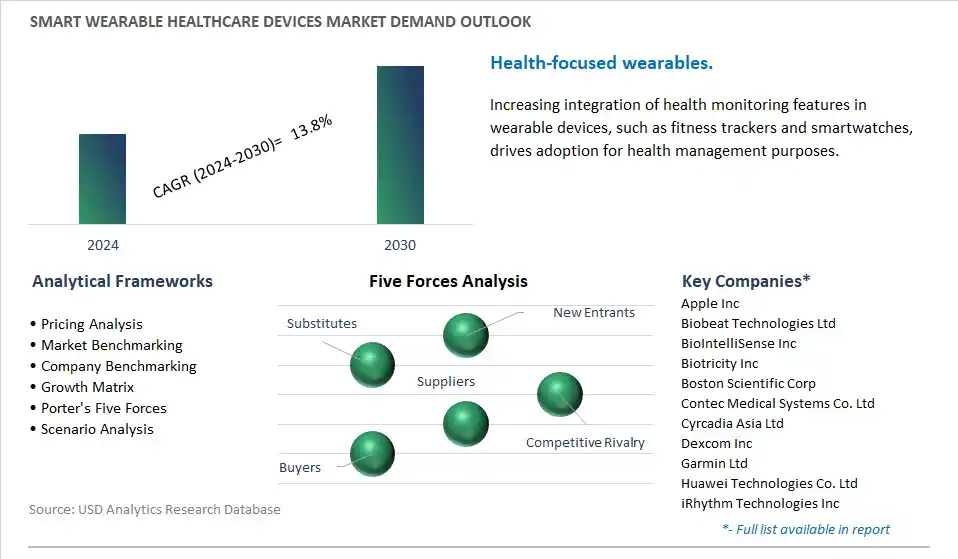
The global Smart Wearable Healthcare Devices Industry is highly competitive with a large number of companies focusing on niche market segments. Amidst intense competitive conditions, Smart Wearable Healthcare Devices Companies are investing in new product launches and strengthening distribution channels. Key companies operating in the Smart Wearable Healthcare Devices Industry include- Apple Inc, Biobeat Technologies Ltd, BioIntelliSense Inc, Biotricity Inc, Boston Scientific Corp, Contec Medical Systems Co. Ltd, Cyrcadia Asia Ltd, Dexcom Inc, Garmin Ltd, Huawei Technologies Co. Ltd, iRhythm Technologies Inc, Koninklijke Philips N.V., Masimo Corp, Nokia Corp, OMRON Corp, Polar Electro Oy, Samsung Electronics Co. Ltd, ten3T Healthcare, VitalConnect Inc.
A prominent trend in the Smart Wearable Healthcare Devices market is the integration of artificial intelligence (AI) and machine learning (ML) algorithms to enhance device functionality and data analysis capabilities. Smart wearable devices are increasingly leveraging AI and ML technologies to provide personalized health insights, predictive analytics, and real-time health monitoring. These advanced algorithms can analyze biometric data collected by wearables, such as heart rate, activity levels, sleep patterns, and physiological parameters, to detect anomalies, identify trends, and offer actionable recommendations for improving health and wellness. Moreover, AI-powered wearable devices can adapt to individual user preferences, optimize performance, and continuously evolve based on user feedback, driving innovation and differentiation in the smart wearable healthcare market.
The primary driver for the Smart Wearable Healthcare Devices market is the increasing focus on preventive healthcare and remote monitoring solutions, fueled by rising healthcare costs, aging populations, and the growing prevalence of chronic diseases. Smart wearable devices offer convenient, non-invasive tools for individuals to monitor their health metrics, track fitness goals, and proactively manage chronic conditions in real time. Additionally, healthcare providers are leveraging wearable technologies for remote patient monitoring, enabling continuous health surveillance, early detection of health issues, and timely interventions. With the shift towards value-based care and population health management, there's a growing demand for wearable devices that can empower individuals to take charge of their health, improve adherence to treatment regimens, and reduce the burden on healthcare systems by preventing disease progression and hospital admissions.
An opportunity exists in the expansion of smart wearable healthcare devices into remote patient monitoring (RPM) and telehealth integration, facilitating virtual care delivery and improving access to healthcare services. With the rapid adoption of telemedicine platforms and remote monitoring solutions, wearable devices can serve as valuable tools for capturing real-time health data, facilitating virtual consultations, and enabling proactive interventions by healthcare providers. By integrating wearable device data with electronic health records (EHRs), telemedicine platforms, and population health management systems, healthcare organizations can gain actionable insights into patient health status, facilitate care coordination, and optimize treatment outcomes. Moreover, wearable devices can support remote health monitoring for chronic disease management, post-operative care, and aging in place initiatives, enabling patients to receive high-quality care from the comfort of their homes while reducing the need for in-person healthcare visits. By embracing opportunities in remote patient monitoring and telehealth integration, manufacturers of smart wearable healthcare devices can expand their market reach, drive innovation, and contribute to the transformation of healthcare delivery models.
Among smart wearable healthcare devices, smart watches emerge as the fastest-growing segment. These devices integrate advanced health monitoring features such as heart rate tracking, activity tracking, sleep monitoring, and even electrocardiogram (ECG) capabilities. Smart watches provide users with real-time insights into their health and fitness metrics, empowering them to make informed decisions about their well-being. With the increasing focus on preventive healthcare and the rising trend of individuals taking a proactive approach to managing their health, the demand for smart watches has surged significantly. Additionally, the integration of smart watches with smartphone applications and cloud-based platforms enables users to store and analyze their health data over time, facilitating personalized health management and remote monitoring. The convenience, accessibility, and multifunctionality of smart watches make them a preferred choice for individuals seeking to track and improve their health and fitness levels. As a result, the smart watch segment is witnessing rapid growth, particularly through online distribution channels, catering to the evolving needs of health-conscious consumers.
By Product
Fitness band
Smart watches
Smart glasses
By Distribution Channel
Online
Offline
Geographical Analysis
North America (United States, Canada, Mexico)
Europe (Germany, France, United Kingdom, Spain, Italy, Rest of Europe)
Asia Pacific (China, India, Japan, South Korea, Rest of Asia Pacific)
South America (Brazil, Argentina, Rest of South America)
Middle East and Africa (Saudi Arabia, UAE, Rest of Middle East, South Africa, Egypt, Rest of Africa)
Apple Inc
Biobeat Technologies Ltd
BioIntelliSense Inc
Biotricity Inc
Boston Scientific Corp
Contec Medical Systems Co. Ltd
Cyrcadia Asia Ltd
Dexcom Inc
Garmin Ltd
Huawei Technologies Co. Ltd
iRhythm Technologies Inc
Koninklijke Philips N.V.
Masimo Corp
Nokia Corp
OMRON Corp
Polar Electro Oy
Samsung Electronics Co. Ltd
ten3T Healthcare
VitalConnect Inc
* List not Exhaustive
• Deepen your industry insights and navigate uncertainties for strategy formulation, CAPEX, and Operational decisions
• Gain access to detailed insights on the Smart Wearable Healthcare Devices Market, encompassing current market size, growth trends, and forecasts till 2030.
• Access detailed competitor analysis, enabling competitive advantage through a thorough understanding of market players, strategies, and potential differentiation opportunities
• Stay ahead of the curve with insights on technological advancements, innovations, and upcoming trends
• Identify lucrative investment avenues and expansion opportunities within the Smart Wearable Healthcare Devices Industry, guided by robust, data-backed analysis.
• Understand regional and global markets through country-wise analysis, regional market potential, regulatory nuances, and dynamics
• Execute strategies with confidence and speed through information, analytics, and insights on the industry value chain
• Corporate leaders, strategists, financial experts, shareholders, asset managers, and governmental representatives can make long-term planning scenarios and build an integrated and timely understanding of market dynamics
• Benefit from tailored solutions and expert consultation based on report insights, providing personalized strategies aligned with specific business needs.
TABLE OF CONTENTS
1 Introduction to 2024 Smart Wearable Healthcare Devices Market
1.1 Market Overview
1.2 Quick Facts
1.3 Scope/Objective of the Study
1.4 Market Definition
1.5 Countries and Regions Analyzed
1.6 Units, Currency, and Conversions
1.7 Industry Value Chain
2 Research Methodology
2.1 Market Size Estimation
2.2 Sources and Research Methodology
2.3 Data Triangulation
2.4 Assumptions and Limitations
3 Executive Summary
3.1 Global Smart Wearable Healthcare Devices Market Size Outlook, $ Million, 2021 to 2030
3.2 Smart Wearable Healthcare Devices Market Outlook by Type, $ Million, 2021 to 2030
3.3 Smart Wearable Healthcare Devices Market Outlook by Product, $ Million, 2021 to 2030
3.4 Smart Wearable Healthcare Devices Market Outlook by Application, $ Million, 2021 to 2030
3.5 Smart Wearable Healthcare Devices Market Outlook by Key Countries, $ Million, 2021 to 2030
4 Market Dynamics
4.1 Key Driving Forces of Smart Wearable Healthcare Devices Industry
4.2 Key Market Trends in Smart Wearable Healthcare Devices Industry
4.3 Potential Opportunities in Smart Wearable Healthcare Devices Industry
4.4 Key Challenges in Smart Wearable Healthcare Devices Industry
5 Market Factor Analysis
5.1 Value Chain Analysis
5.2 Competitive Landscape
5.2.1 Global Smart Wearable Healthcare Devices Market Share by Company (%), 2023
5.2.2 Product Offerings by Company
5.3 Porter’s Five Forces Analysis
5.4 Pricing Analysis and Outlook
6 Growth Outlook Across Scenarios
6.1 Growth Analysis-Case Scenario Definitions
6.2 Low Growth Scenario Forecasts
6.3 Reference Growth Scenario Forecasts
6.4 High Growth Scenario Forecasts
7 Global Smart Wearable Healthcare Devices Market Outlook by Segments
7.1 Smart Wearable Healthcare Devices Market Outlook by Segments, $ Million, 2021- 2030
By Product
Fitness band
Smart watches
Smart glasses
By Distribution Channel
Online
Offline
8 North America Smart Wearable Healthcare Devices Market Analysis and Outlook To 2030
8.1 Introduction to North America Smart Wearable Healthcare Devices Markets in 2024
8.2 North America Smart Wearable Healthcare Devices Market Size Outlook by Country, 2021-2030
8.2.1 United States
8.2.2 Canada
8.2.3 Mexico
8.3 North America Smart Wearable Healthcare Devices Market size Outlook by Segments, 2021-2030
By Product
Fitness band
Smart watches
Smart glasses
By Distribution Channel
Online
Offline
9 Europe Smart Wearable Healthcare Devices Market Analysis and Outlook To 2030
9.1 Introduction to Europe Smart Wearable Healthcare Devices Markets in 2024
9.2 Europe Smart Wearable Healthcare Devices Market Size Outlook by Country, 2021-2030
9.2.1 Germany
9.2.2 France
9.2.3 Spain
9.2.4 United Kingdom
9.2.4 Italy
9.2.5 Russia
9.2.6 Norway
9.2.7 Rest of Europe
9.3 Europe Smart Wearable Healthcare Devices Market Size Outlook by Segments, 2021-2030
By Product
Fitness band
Smart watches
Smart glasses
By Distribution Channel
Online
Offline
10 Asia Pacific Smart Wearable Healthcare Devices Market Analysis and Outlook To 2030
10.1 Introduction to Asia Pacific Smart Wearable Healthcare Devices Markets in 2024
10.2 Asia Pacific Smart Wearable Healthcare Devices Market Size Outlook by Country, 2021-2030
10.2.1 China
10.2.2 India
10.2.3 Japan
10.2.4 South Korea
10.2.5 Indonesia
10.2.6 Malaysia
10.2.7 Australia
10.2.8 Rest of Asia Pacific
10.3 Asia Pacific Smart Wearable Healthcare Devices Market size Outlook by Segments, 2021-2030
By Product
Fitness band
Smart watches
Smart glasses
By Distribution Channel
Online
Offline
11 South America Smart Wearable Healthcare Devices Market Analysis and Outlook To 2030
11.1 Introduction to South America Smart Wearable Healthcare Devices Markets in 2024
11.2 South America Smart Wearable Healthcare Devices Market Size Outlook by Country, 2021-2030
11.2.1 Brazil
11.2.2 Argentina
11.2.3 Rest of South America
11.3 South America Smart Wearable Healthcare Devices Market size Outlook by Segments, 2021-2030
By Product
Fitness band
Smart watches
Smart glasses
By Distribution Channel
Online
Offline
12 Middle East and Africa Smart Wearable Healthcare Devices Market Analysis and Outlook To 2030
12.1 Introduction to Middle East and Africa Smart Wearable Healthcare Devices Markets in 2024
12.2 Middle East and Africa Smart Wearable Healthcare Devices Market Size Outlook by Country, 2021-2030
12.2.1 Saudi Arabia
12.2.2 UAE
12.2.3 Oman
12.2.4 Rest of Middle East
12.2.5 Egypt
12.2.6 Nigeria
12.2.7 South Africa
12.2.8 Rest of Africa
12.3 Middle East and Africa Smart Wearable Healthcare Devices Market size Outlook by Segments, 2021-2030
By Product
Fitness band
Smart watches
Smart glasses
By Distribution Channel
Online
Offline
13 Company Profiles
13.1 Company Snapshot
13.2 SWOT Profiles
13.3 Products and Services
13.4 Recent Developments
13.5 Financial Profile
List of Companies
Apple Inc
Biobeat Technologies Ltd
BioIntelliSense Inc
Biotricity Inc
Boston Scientific Corp
Contec Medical Systems Co. Ltd
Cyrcadia Asia Ltd
Dexcom Inc
Garmin Ltd
Huawei Technologies Co. Ltd
iRhythm Technologies Inc
Koninklijke Philips N.V.
Masimo Corp
Nokia Corp
OMRON Corp
Polar Electro Oy
Samsung Electronics Co. Ltd
ten3T Healthcare
VitalConnect Inc
14 Appendix
14.1 Customization Offerings
14.2 Subscription Services
14.3 Related Reports
14.4 Publisher Expertise
By Product
Fitness band
Smart watches
Smart glasses
By Distribution Channel
Online
Offline
The global Smart Wearable Healthcare Devices Market is one of the lucrative growth markets, poised to register a 13.8% growth (CAGR) between 2024 and 2030.
Emerging Markets across Asia Pacific, Europe, and Americas present robust growth prospects.
Apple Inc, Biobeat Technologies Ltd, BioIntelliSense Inc, Biotricity Inc, Boston Scientific Corp, Contec Medical Systems Co. Ltd, Cyrcadia Asia Ltd, Dexcom Inc, Garmin Ltd, Huawei Technologies Co. Ltd, iRhythm Technologies Inc, Koninklijke Philips N.V., Masimo Corp, Nokia Corp, OMRON Corp, Polar Electro Oy, Samsung Electronics Co. Ltd, ten3T Healthcare, VitalConnect Inc
Base Year- 2023; Estimated Year- 2024; Historic Period- 2018-2023; Forecast period- 2024 to 2030; Currency: USD; Volume