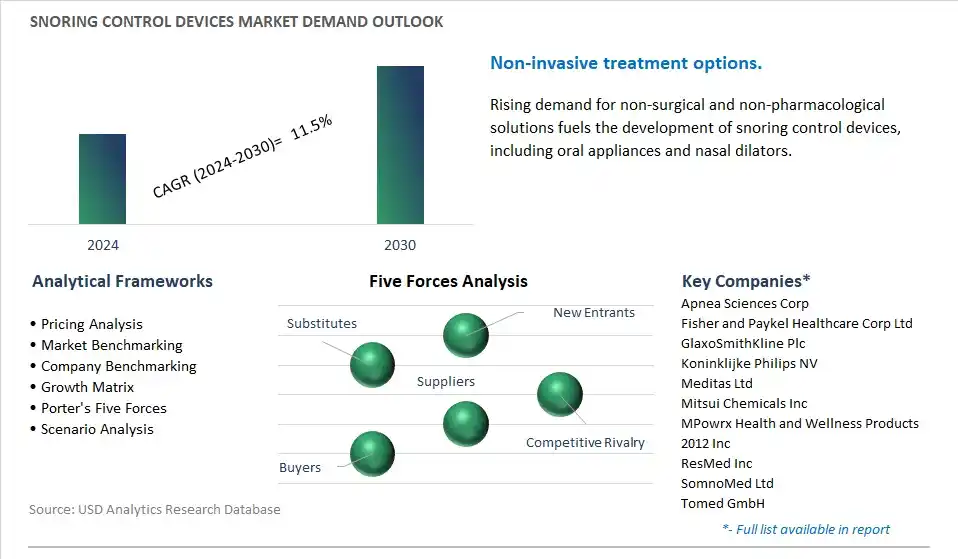
Snoring Control Devices Market is estimated to increase at a growth rate of 11.5% CAGR over the forecast period from 2024 to 2030.
The global Snoring Control Devices Market Study analyzes and forecasts the market size across 6 regions and 24 countries for diverse segments including By Product (Mandibular Advancement Devices, Tongue Stabilizing Devices, Nasal Devices, Chin Straps, Others), By End-User (Homecare, Others).
An Introduction to Snoring Control Devices Market in 2024
The Snoring Control Devices Market includes oral appliances, mandibular advancement devices (MADs), nasal dilators, chin straps, positional therapy devices, and snoring control aids used in the management of snoring, sleep-disordered breathing, and obstructive sleep apnea (OSA). Snoring control devices aim to reduce snoring intensity, improve airflow, and promote restful sleep by addressing airway obstruction, tongue positioning, and upper airway patency during sleep. Market dynamics encompass anti-snoring device innovations, patient compliance solutions, sleep medicine interventions, and collaborative care models for snoring and OSA management to enhance sleep quality and overall health outcomes.
Snoring Control Devices Market Competitive Landscape
The global Snoring Control Devices Industry is highly competitive with a large number of companies focusing on niche market segments. Amidst intense competitive conditions, Snoring Control Devices Companies are investing in new product launches and strengthening distribution channels. Key companies operating in the Snoring Control Devices Industry include- Apnea Sciences Corp, Fisher and Paykel Healthcare Corp Ltd, GlaxoSmithKline Plc, Koninklijke Philips NV, Meditas Ltd, Mitsui Chemicals Inc, MPowrx Health and Wellness Products 2012 Inc, ResMed Inc, SomnoMed Ltd, Tomed GmbH.
Snoring Control Devices Market Trend: Growing Awareness and Demand for Non-Invasive Solutions
A significant trend in the Snoring Control Devices market is the increasing awareness and demand for non-invasive solutions to address snoring and sleep-related breathing disorders. Snoring control devices, such as oral appliances and nasal dilators, offer alternative options to traditional treatments like surgery or continuous positive airway pressure (CPAP) therapy. These devices aim to improve airflow, reduce airway obstruction, and alleviate snoring without the need for invasive procedures or cumbersome equipment. As individuals seek more comfortable and convenient ways to manage snoring and sleep apnea, the demand for non-invasive snoring control devices is expected to grow, driving innovation in product design, materials, and effectiveness.
Snoring Control Devices Market Driver: Prevalence of Sleep Disorders and Obstructive Sleep Apnea
The primary driver for the Snoring Control Devices market is the high prevalence of sleep disorders, particularly obstructive sleep apnea (OSA), which contributes to snoring and other respiratory disturbances during sleep. According to the American Sleep Apnea Association, approximately 22 million Americans suffer from sleep apnea, with many cases going undiagnosed. As awareness of the health risks associated with untreated sleep apnea grows, there is a heightened demand for effective interventions to manage snoring and improve sleep quality. Snoring control devices offer a non-invasive and accessible solution for individuals with mild to moderate sleep apnea or primary snoring, providing relief from symptoms and reducing the risk of complications such as cardiovascular disease, hypertension, and daytime fatigue.
Snoring Control Devices Market Opportunity: Expansion into Home Sleep Testing and Telemedicine
An opportunity exists in the expansion of snoring control devices into home sleep testing (HST) and telemedicine platforms, enabling convenient and accessible diagnostic and treatment options for individuals with sleep-related breathing disorders. By integrating snoring control devices with HST devices or smartphone applications, individuals can monitor their sleep patterns, track snoring intensity, and assess the effectiveness of treatment interventions from the comfort of their homes. Moreover, telemedicine platforms can facilitate virtual consultations with sleep specialists, allowing for remote assessment, diagnosis, and personalized treatment recommendations. By embracing opportunities in home-based sleep testing and telemedicine integration, manufacturers of snoring control devices can expand their market reach, improve patient access to care, and contribute to the early detection and management of sleep disorders.
Snoring Control Devices Market Share Analysis: Mandibular Advancement Devices is the fastest growing market segment over the forecast period to 2030
Mandibular advancement devices (MADs) stand out as the fastest-growing segment among snoring control devices. MADs are oral appliances designed to alleviate snoring and mild to moderate obstructive sleep apnea (OSA) by advancing the lower jaw forward during sleep, thus enlarging the upper airway and preventing airway collapse. These devices are increasingly preferred by individuals seeking non-invasive and convenient solutions for snoring and sleep-related breathing disorders. MADs offer several advantages, including ease of use, portability, and effectiveness in reducing snoring and improving sleep quality. Moreover, the growing awareness about the adverse health effects of snoring, such as daytime fatigue, cardiovascular risks, and impaired cognitive function, has fueled the demand for MADs as an accessible and cost-effective treatment option. With the rising prevalence of snoring and sleep apnea globally, coupled with the growing preference for non-surgical interventions, the market for mandibular advancement devices is experiencing rapid expansion, particularly among homecare users. This trend underscores the significance of MADs in addressing sleep-related breathing disorders and improving overall sleep health.
Snoring Control Devices Market Segmentation
By Product
Mandibular Advancement Devices
Tongue Stabilizing Devices
Nasal Devices
Chin Straps
Others
By End-User
Homecare
Others
Geographical Analysis
North America (United States, Canada, Mexico)
Europe (Germany, France, United Kingdom, Spain, Italy, Rest of Europe)
Asia Pacific (China, India, Japan, South Korea, Rest of Asia Pacific)
South America (Brazil, Argentina, Rest of South America)
Middle East and Africa (Saudi Arabia, UAE, Rest of Middle East, South Africa, Egypt, Rest of Africa)
Snoring Control Devices Companies
Apnea Sciences Corp
Fisher and Paykel Healthcare Corp Ltd
GlaxoSmithKline Plc
Koninklijke Philips NV
Meditas Ltd
Mitsui Chemicals Inc
MPowrx Health and Wellness Products 2012 Inc
ResMed Inc
SomnoMed Ltd
Tomed GmbH
* List not Exhaustive
Reasons to Buy the Snoring Control Devices Market Study
• Deepen your industry insights and navigate uncertainties for strategy formulation, CAPEX, and Operational decisions
• Gain access to detailed insights on the Snoring Control Devices Market, encompassing current market size, growth trends, and forecasts till 2030.
• Access detailed competitor analysis, enabling competitive advantage through a thorough understanding of market players, strategies, and potential differentiation opportunities
• Stay ahead of the curve with insights on technological advancements, innovations, and upcoming trends
• Identify lucrative investment avenues and expansion opportunities within the Snoring Control Devices Industry, guided by robust, data-backed analysis.
• Understand regional and global markets through country-wise analysis, regional market potential, regulatory nuances, and dynamics
• Execute strategies with confidence and speed through information, analytics, and insights on the industry value chain
• Corporate leaders, strategists, financial experts, shareholders, asset managers, and governmental representatives can make long-term planning scenarios and build an integrated and timely understanding of market dynamics
• Benefit from tailored solutions and expert consultation based on report insights, providing personalized strategies aligned with specific business needs.
TABLE OF CONTENTS
1 Introduction to 2024 Snoring Control Devices Market
1.1 Market Overview
1.2 Quick Facts
1.3 Scope/Objective of the Study
1.4 Market Definition
1.5 Countries and Regions Analyzed
1.6 Units, Currency, and Conversions
1.7 Industry Value Chain
2 Research Methodology
2.1 Market Size Estimation
2.2 Sources and Research Methodology
2.3 Data Triangulation
2.4 Assumptions and Limitations
3 Executive Summary
3.1 Global Snoring Control Devices Market Size Outlook, $ Million, 2021 to 2030
3.2 Snoring Control Devices Market Outlook by Type, $ Million, 2021 to 2030
3.3 Snoring Control Devices Market Outlook by Product, $ Million, 2021 to 2030
3.4 Snoring Control Devices Market Outlook by Application, $ Million, 2021 to 2030
3.5 Snoring Control Devices Market Outlook by Key Countries, $ Million, 2021 to 2030
4 Market Dynamics
4.1 Key Driving Forces of Snoring Control Devices Industry
4.2 Key Market Trends in Snoring Control Devices Industry
4.3 Potential Opportunities in Snoring Control Devices Industry
4.4 Key Challenges in Snoring Control Devices Industry
5 Market Factor Analysis
5.1 Value Chain Analysis
5.2 Competitive Landscape
5.2.1 Global Snoring Control Devices Market Share by Company (%), 2023
5.2.2 Product Offerings by Company
5.3 Porter’s Five Forces Analysis
5.4 Pricing Analysis and Outlook
6 Growth Outlook Across Scenarios
6.1 Growth Analysis-Case Scenario Definitions
6.2 Low Growth Scenario Forecasts
6.3 Reference Growth Scenario Forecasts
6.4 High Growth Scenario Forecasts
7 Global Snoring Control Devices Market Outlook by Segments
7.1 Snoring Control Devices Market Outlook by Segments, $ Million, 2021- 2030
By Product
Mandibular Advancement Devices
Tongue Stabilizing Devices
Nasal Devices
Chin Straps
Others
By End-User
Homecare
Others
8 North America Snoring Control Devices Market Analysis and Outlook To 2030
8.1 Introduction to North America Snoring Control Devices Markets in 2024
8.2 North America Snoring Control Devices Market Size Outlook by Country, 2021-2030
8.2.1 United States
8.2.2 Canada
8.2.3 Mexico
8.3 North America Snoring Control Devices Market size Outlook by Segments, 2021-2030
By Product
Mandibular Advancement Devices
Tongue Stabilizing Devices
Nasal Devices
Chin Straps
Others
By End-User
Homecare
Others
9 Europe Snoring Control Devices Market Analysis and Outlook To 2030
9.1 Introduction to Europe Snoring Control Devices Markets in 2024
9.2 Europe Snoring Control Devices Market Size Outlook by Country, 2021-2030
9.2.1 Germany
9.2.2 France
9.2.3 Spain
9.2.4 United Kingdom
9.2.4 Italy
9.2.5 Russia
9.2.6 Norway
9.2.7 Rest of Europe
9.3 Europe Snoring Control Devices Market Size Outlook by Segments, 2021-2030
By Product
Mandibular Advancement Devices
Tongue Stabilizing Devices
Nasal Devices
Chin Straps
Others
By End-User
Homecare
Others
10 Asia Pacific Snoring Control Devices Market Analysis and Outlook To 2030
10.1 Introduction to Asia Pacific Snoring Control Devices Markets in 2024
10.2 Asia Pacific Snoring Control Devices Market Size Outlook by Country, 2021-2030
10.2.1 China
10.2.2 India
10.2.3 Japan
10.2.4 South Korea
10.2.5 Indonesia
10.2.6 Malaysia
10.2.7 Australia
10.2.8 Rest of Asia Pacific
10.3 Asia Pacific Snoring Control Devices Market size Outlook by Segments, 2021-2030
By Product
Mandibular Advancement Devices
Tongue Stabilizing Devices
Nasal Devices
Chin Straps
Others
By End-User
Homecare
Others
11 South America Snoring Control Devices Market Analysis and Outlook To 2030
11.1 Introduction to South America Snoring Control Devices Markets in 2024
11.2 South America Snoring Control Devices Market Size Outlook by Country, 2021-2030
11.2.1 Brazil
11.2.2 Argentina
11.2.3 Rest of South America
11.3 South America Snoring Control Devices Market size Outlook by Segments, 2021-2030
By Product
Mandibular Advancement Devices
Tongue Stabilizing Devices
Nasal Devices
Chin Straps
Others
By End-User
Homecare
Others
12 Middle East and Africa Snoring Control Devices Market Analysis and Outlook To 2030
12.1 Introduction to Middle East and Africa Snoring Control Devices Markets in 2024
12.2 Middle East and Africa Snoring Control Devices Market Size Outlook by Country, 2021-2030
12.2.1 Saudi Arabia
12.2.2 UAE
12.2.3 Oman
12.2.4 Rest of Middle East
12.2.5 Egypt
12.2.6 Nigeria
12.2.7 South Africa
12.2.8 Rest of Africa
12.3 Middle East and Africa Snoring Control Devices Market size Outlook by Segments, 2021-2030
By Product
Mandibular Advancement Devices
Tongue Stabilizing Devices
Nasal Devices
Chin Straps
Others
By End-User
Homecare
Others
13 Company Profiles
13.1 Company Snapshot
13.2 SWOT Profiles
13.3 Products and Services
13.4 Recent Developments
13.5 Financial Profile
List of Companies
Apnea Sciences Corp
Fisher and Paykel Healthcare Corp Ltd
GlaxoSmithKline Plc
Koninklijke Philips NV
Meditas Ltd
Mitsui Chemicals Inc
MPowrx Health and Wellness Products 2012 Inc
ResMed Inc
SomnoMed Ltd
Tomed GmbH
14 Appendix
14.1 Customization Offerings
14.2 Subscription Services
14.3 Related Reports
14.4 Publisher Expertise
