The global Sodium Lauryl Ether Sulfate Market is poised to register a 4.5% CAGR from $1.28 Billion in 2024 to $1.7 Billion in 2030.
The global Sodium Lauryl Ether Sulfate Market Study analyzes and forecasts the market size across 6 regions and 24 countries for diverse segments -By Type (Cosmetic Grade, Industrial Grade, Pharmaceutical Grade, Others), By Application (Detergents and Cleaners, Personal Care Products, Agrochemicals, Medical Chemicals, Others).
An Introduction to Global Sodium Lauryl Ether Sulfate Market in 2024
The sodium lauryl ether sulfate (SLES) market is witnessing robust growth driven by its extensive usage as a surfactant in personal care products, detergents, and household cleaners. Key trends shaping the future of the industry include increasing demand for SLES in emerging markets due to urbanization, rising disposable incomes, and changing lifestyles driving demand for personal hygiene and cleaning products. Moreover, there's a growing emphasis on sustainability and eco-friendly formulations in the consumer goods industry, leading to the development of bio-based and renewable SLES derivatives. Additionally, regulatory compliance and quality standards are becoming increasingly important, influencing market dynamics and competitive strategies in the global sodium lauryl ether sulfate market as manufacturers focus on product innovation, quality assurance, and supply chain optimization to meet customer expectations and regulatory requirements while ensuring market growth and competitiveness.
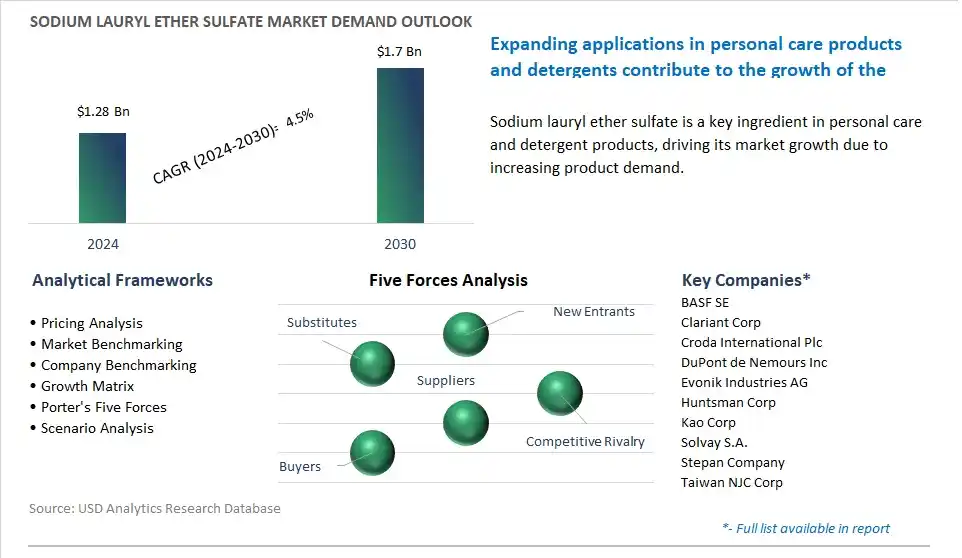
Sodium Lauryl Ether Sulfate Market Competitive Landscape
The market report analyses the leading companies in the industry including BASF SE, Clariant Corp, Croda International Plc, DuPont de Nemours Inc, Evonik Industries AG, Huntsman Corp, Kao Corp, Solvay S.A., Stepan Company, Taiwan NJC Corp.
Sodium Lauryl Ether Sulfate Market Dynamics
Sodium Lauryl Ether Sulfate Market Trend: Increasing Demand for Sulfate-Free and Mild Surfactants in Personal Care Products
A prominent market trend in sodium lauryl ether sulfate (SLES) is the increasing demand for sulfate-free and mild surfactants in personal care products, driven by consumer preferences for gentler and skin-friendly formulations. SLES, a widely used surfactant in cosmetics, shampoos, and personal care products, is known for its foaming and cleansing properties. However, concerns about potential skin irritation, dryness, and sensitivity associated with traditional sulfate-based surfactants have led to a shift towards milder alternatives. As consumers become more discerning about ingredient transparency and product safety, there is a growing demand for sulfate-free formulations that offer effective cleansing without compromising skin health. Manufacturers are responding to this trend by reformulating their products with sulfate-free surfactants, including SLES alternatives such as sulfosuccinates, betaines, and alkyl polyglucosides, to meet the needs of consumers seeking gentle and non-irritating personal care solutions.
Sodium Lauryl Ether Sulfate Market Driver: Growth in Personal Care and Cosmetic Industry Worldwide
The market for sodium lauryl ether sulfate is being driven by the growth in the personal care and cosmetic industry worldwide, fueled by factors such as population growth, rising disposable incomes, and increasing consumer awareness of grooming and hygiene practices. SLES, as a versatile and cost-effective surfactant, finds widespread application in various personal care products, including shampoos, body washes, facial cleansers, and toothpaste. With the expanding middle-class population in emerging economies and the growing influence of beauty and wellness trends globally, there is a surge in demand for personal care products and cosmetics across diverse demographics and geographic regions. As a result, the demand for surfactants such as SLES is expected to remain strong, driven by the need for effective cleansing, foaming, and emulsifying agents in a wide range of skincare, haircare, and oral care formulations.
Sodium Lauryl Ether Sulfate Market Opportunity: Development of Green and Sustainable Surfactant Solutions
A potential opportunity for the sodium lauryl ether sulfate market lies in the development of green and sustainable surfactant solutions that address environmental concerns and meet regulatory requirements for eco-friendly formulations. With growing emphasis on sustainability, biodegradability, and eco-conscious manufacturing practices, there is a rising demand for surfactants derived from renewable resources, with minimal environmental impact and toxicity. Manufacturers can capitalize on this opportunity by investing in research and development to produce SLES from renewable feedstocks, such as palm oil derivatives, coconut oil, or bio-based sources, using environmentally friendly processes such as green chemistry and enzymatic catalysis. Additionally, there is an opportunity to explore alternative production methods, such as bio-based synthesis or microbial fermentation, to reduce carbon emissions and resource consumption in surfactant manufacturing. By offering green and sustainable SLES formulations, companies can align with consumer preferences for environmentally responsible products, differentiate their brands in the market, and contribute to sustainability efforts in the personal care industry.
Sodium Lauryl Ether Sulfate (SLES) Market Share Analysis: The Cosmetic Grade segment generated the highest revenue in 2024
The Cosmetic Grade segment is the largest in the Sodium Lauryl Ether Sulfate (SLES) Market. Sodium Lauryl Ether Sulfate (SLES) is extensively used in the cosmetics and personal care industry as a surfactant, foaming agent, and cleansing agent in various skincare, haircare, and bath products such as shampoos, body washes, facial cleansers, and toothpaste. Cosmetic-grade SLES is formulated to meet strict quality and safety standards mandated by regulatory authorities and industry organizations to ensure its suitability for use in personal care formulations. Additionally, cosmetic-grade SLES offers excellent foaming properties, mild cleansing action, and compatibility with other ingredients commonly used in cosmetic formulations, making it a preferred choice for formulators and manufacturers seeking high-quality ingredients for their products. Further, the growing demand for skincare and haircare products, driven by factors such as increasing consumer awareness of personal hygiene, grooming routines, and beauty trends, contributes to the widespread use of cosmetic-grade SLES in the cosmetics industry. Furthermore, the versatility and versatility of cosmetic-grade SLES enable its incorporation into a wide range of cosmetic formulations, catering to diverse consumer preferences, skin types, and product functionalities. Over the forecast period, the combination of performance, safety, compatibility, and market demand positions the Cosmetic Grade segment as the largest segment in the Sodium Lauryl Ether Sulfate (SLES) Market.
Sodium Lauryl Ether Sulfate (SLES) Market Share Analysis: The Personal Care Products segment is poised to register the fastest growth rate (CAGR) over the forecast period to 2030
The fastest-growing segment in the Sodium Lauryl Ether Sulfate (SLES) Market is the Personal Care Products segment. Sodium Lauryl Ether Sulfate (SLES) is extensively used in the formulation of personal care products such as shampoos, body washes, facial cleansers, and liquid soaps due to its excellent foaming properties, mild cleansing action, and ability to create rich lather. As consumer awareness of personal hygiene and grooming routines continues to increase globally, the demand for personal care products is rising steadily. Additionally, SLES is a versatile ingredient that can be used in a wide range of personal care formulations catering to various skin and hair types, preferences, and needs. Further, the growing trend towards natural and organic personal care products has spurred the development of SLES formulations with natural or plant-derived surfactants, offering consumers more choices in the market. Furthermore, advancements in formulation technologies and the introduction of innovative product concepts such as sulfate-free and mild cleansing formulations drive the adoption of SLES in personal care applications. Additionally, the rising disposable income levels, changing lifestyle patterns, and increasing urbanization contribute to the growing demand for personal care products containing SLES across demographic segments. Over the forecast period, the combination of consumer preferences for effective, convenient, and indulgent personal care products, coupled with the versatility and efficacy of SLES, positions the Personal Care Products segment as the fastest-growing segment in the Sodium Lauryl Ether Sulfate (SLES) Market.
Sodium Lauryl Ether Sulfate Market Report Segmentation
By Type
Cosmetic Grade
Industrial Grade
Pharmaceutical Grade
Others
By Application
Detergents and Cleaners
Personal Care Products
Agrochemicals
Medical Chemicals
Others
Regions Included
North America (US, Canada, Mexico)
Europe (Germany, UK, France, Spain, Italy, Russia, Rest of Europe)
Asia Pacific (China, India, Japan, South Korea, Australia, South East Asia, Rest of Asia)
South America (Brazil, Argentina, Rest of South America)
Middle East and Africa (Saudi Arabia, UAE, Rest of Middle East, South Africa, Egypt, Rest of Africa)
Sodium Lauryl Ether Sulfate Companies Profiled in the Market Study
BASF SE
Clariant Corp
Croda International Plc
DuPont de Nemours Inc
Evonik Industries AG
Huntsman Corp
Kao Corp
Solvay S.A.
Stepan Company
Taiwan NJC Corp
*- List Not Exhaustive
TABLE OF CONTENTS
1 Introduction to 2024 Sodium Lauryl Ether Sulfate Market
1.1 Market Overview
1.2 Quick Facts
1.3 Scope/Objective of the Study
1.4 Market Definition
1.5 Countries and Regions Covered
1.6 Units, Currency, and Conversions
1.7 Industry Value Chain
2 Research Methodology
2.1 Market Size Estimation
2.2 Sources and Research Methodology
2.3 Data Triangulation
2.4 Assumptions and Limitations
3 Executive Summary
3.1 Global Sodium Lauryl Ether Sulfate Market Size Outlook, $ Million, 2021 to 2030
3.2 Sodium Lauryl Ether Sulfate Market Outlook by Type, $ Million, 2021 to 2030
3.3 Sodium Lauryl Ether Sulfate Market Outlook by Product, $ Million, 2021 to 2030
3.4 Sodium Lauryl Ether Sulfate Market Outlook by Application, $ Million, 2021 to 2030
3.5 Sodium Lauryl Ether Sulfate Market Outlook by Key Countries, $ Million, 2021 to 2030
4 Market Dynamics
4.1 Key Driving Forces of Sodium Lauryl Ether Sulfate Industry
4.2 Key Market Trends in Sodium Lauryl Ether Sulfate Industry
4.3 Potential Opportunities in Sodium Lauryl Ether Sulfate Industry
4.4 Key Challenges in Sodium Lauryl Ether Sulfate Industry
5 Market Factor Analysis
5.1 Value Chain Analysis
5.2 Competitive Landscape
5.2.1 Global Sodium Lauryl Ether Sulfate Market Share by Company (%), 2023
5.2.2 Product Offerings by Company
5.3 Porter’s Five Forces Analysis
5.4 Pricing Analysis and Outlook
6 Growth Outlook Across Scenarios
6.1 Growth Analysis-Case Scenario Definitions
6.2 Low Growth Scenario Forecasts
6.3 Reference Growth Scenario Forecasts
6.4 High Growth Scenario Forecasts
7 Global Sodium Lauryl Ether Sulfate Market Outlook by Segments
7.1 Sodium Lauryl Ether Sulfate Market Outlook by Segments, $ Million, 2021- 2030
By Type
Cosmetic Grade
Industrial Grade
Pharmaceutical Grade
Others
By Application
Detergents and Cleaners
Personal Care Products
Agrochemicals
Medical Chemicals
Others
8 North America Sodium Lauryl Ether Sulfate Market Analysis and Outlook To 2030
8.1 Introduction to North America Sodium Lauryl Ether Sulfate Markets in 2024
8.2 North America Sodium Lauryl Ether Sulfate Market Size Outlook by Country, 2021-2030
8.2.1 United States
8.2.2 Canada
8.2.3 Mexico
8.3 North America Sodium Lauryl Ether Sulfate Market size Outlook by Segments, 2021-2030
By Type
Cosmetic Grade
Industrial Grade
Pharmaceutical Grade
Others
By Application
Detergents and Cleaners
Personal Care Products
Agrochemicals
Medical Chemicals
Others
9 Europe Sodium Lauryl Ether Sulfate Market Analysis and Outlook To 2030
9.1 Introduction to Europe Sodium Lauryl Ether Sulfate Markets in 2024
9.2 Europe Sodium Lauryl Ether Sulfate Market Size Outlook by Country, 2021-2030
9.2.1 Germany
9.2.2 France
9.2.3 Spain
9.2.4 United Kingdom
9.2.4 Italy
9.2.5 Russia
9.2.6 Norway
9.2.7 Rest of Europe
9.3 Europe Sodium Lauryl Ether Sulfate Market Size Outlook by Segments, 2021-2030
By Type
Cosmetic Grade
Industrial Grade
Pharmaceutical Grade
Others
By Application
Detergents and Cleaners
Personal Care Products
Agrochemicals
Medical Chemicals
Others
10 Asia Pacific Sodium Lauryl Ether Sulfate Market Analysis and Outlook To 2030
10.1 Introduction to Asia Pacific Sodium Lauryl Ether Sulfate Markets in 2024
10.2 Asia Pacific Sodium Lauryl Ether Sulfate Market Size Outlook by Country, 2021-2030
10.2.1 China
10.2.2 India
10.2.3 Japan
10.2.4 South Korea
10.2.5 Indonesia
10.2.6 Malaysia
10.2.7 Australia
10.2.8 Rest of Asia Pacific
10.3 Asia Pacific Sodium Lauryl Ether Sulfate Market size Outlook by Segments, 2021-2030
By Type
Cosmetic Grade
Industrial Grade
Pharmaceutical Grade
Others
By Application
Detergents and Cleaners
Personal Care Products
Agrochemicals
Medical Chemicals
Others
11 South America Sodium Lauryl Ether Sulfate Market Analysis and Outlook To 2030
11.1 Introduction to South America Sodium Lauryl Ether Sulfate Markets in 2024
11.2 South America Sodium Lauryl Ether Sulfate Market Size Outlook by Country, 2021-2030
11.2.1 Brazil
11.2.2 Argentina
11.2.3 Rest of South America
11.3 South America Sodium Lauryl Ether Sulfate Market size Outlook by Segments, 2021-2030
By Type
Cosmetic Grade
Industrial Grade
Pharmaceutical Grade
Others
By Application
Detergents and Cleaners
Personal Care Products
Agrochemicals
Medical Chemicals
Others
12 Middle East and Africa Sodium Lauryl Ether Sulfate Market Analysis and Outlook To 2030
12.1 Introduction to Middle East and Africa Sodium Lauryl Ether Sulfate Markets in 2024
12.2 Middle East and Africa Sodium Lauryl Ether Sulfate Market Size Outlook by Country, 2021-2030
12.2.1 Saudi Arabia
12.2.2 UAE
12.2.3 Oman
12.2.4 Rest of Middle East
12.2.5 Egypt
12.2.6 Nigeria
12.2.7 South Africa
12.2.8 Rest of Africa
12.3 Middle East and Africa Sodium Lauryl Ether Sulfate Market size Outlook by Segments, 2021-2030
By Type
Cosmetic Grade
Industrial Grade
Pharmaceutical Grade
Others
By Application
Detergents and Cleaners
Personal Care Products
Agrochemicals
Medical Chemicals
Others
13 Company Profiles
13.1 Company Snapshot
13.2 SWOT Profiles
13.3 Products and Services
13.4 Recent Developments
13.5 Financial Profile
BASF SE
Clariant Corp
Croda International Plc
DuPont de Nemours Inc
Evonik Industries AG
Huntsman Corp
Kao Corp
Solvay S.A.
Stepan Company
Taiwan NJC Corp
14 Appendix
14.1 Customization Offerings
14.2 Subscription Services
14.3 Related Reports
14.4 Publisher Expertise
By Type
Cosmetic Grade
Industrial Grade
Pharmaceutical Grade
Others
By Application
Detergents and Cleaners
Personal Care Products
Agrochemicals
Medical Chemicals
Others
Countries Analyzed
North America (US, Canada, Mexico)
Europe (Germany, UK, France, Spain, Italy, Russia, Rest of Europe)
Asia Pacific (China, India, Japan, South Korea, Australia, South East Asia, Rest of Asia)
South America (Brazil, Argentina, Rest of South America)
Middle East and Africa (Saudi Arabia, UAE, Rest of Middle East, South Africa, Egypt, Rest of Africa)
