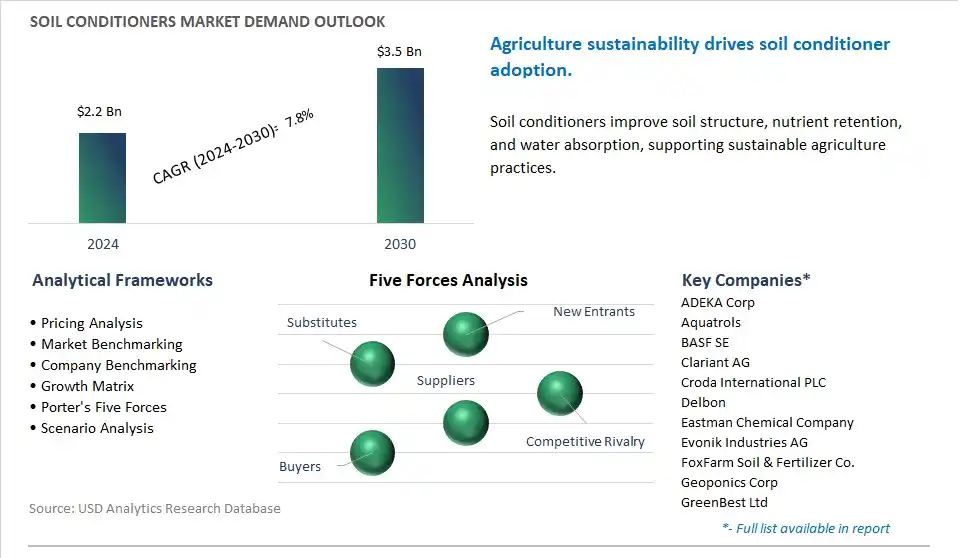
The global Soil Conditioners Market is poised to register a 7.8% CAGR from $2.2 Billion in 2024 to $3.5 Billion in 2030.
The global Soil Conditioners Market Study analyzes and forecasts the market size across 6 regions and 24 countries for diverse segments -By Type (Gypsum, Surfactants, Super absorbent polymers, Others), By Form (Dry, Liquid), By Application (Agriculture, Construction & mining, Others), By Soil (Sand, Silt, Clay, Loam), By Crop (Cereals & grains, Oilseeds & pulses, Fruits & vegetables, Others).
An Introduction to Global Soil Conditioners Market in 2024
The future of soil conditioners is influenced by trends in agriculture, sustainable farming practices, and soil health management, driven by the need to improve soil fertility, structure, and productivity for sustainable food production and environmental stewardship. Soil conditioners are materials added to soil to enhance its physical, chemical, and biological properties, improving water retention, nutrient availability, and root development for optimal plant growth and yield. With the increasing pressure to feed a growing global population while minimizing environmental impact, soil conditioners play a crucial role in promoting soil conservation, reducing erosion, and enhancing ecosystem resilience in agricultural landscapes. Moreover, as farmers and agronomists adopt regenerative farming practices such as conservation tillage, cover cropping, and crop rotation, there is growing interest in soil conditioners that support soil health and biodiversity, such as organic compost, biochar, and microbial inoculants, enhancing soil fertility and resilience to drought, disease, and climate variability. Additionally, advancements in soil science, agronomy, and precision agriculture enable farmers to assess soil health parameters such as organic matter content, pH level, and microbial activity, optimizing soil conditioner applications for site-specific conditions and crop requirements. Furthermore, as consumers prioritize food quality, safety, and sustainability, there is increasing demand for crops grown in soils enriched with natural and organic soil conditioners, supporting environmentally friendly and socially responsible agricultural practices. As farmers, researchers, and policymakers collaborate to address the challenges of soil degradation, nutrient depletion, and climate change in agriculture, soil conditioners will play an increasingly important role in building resilient and productive soils, driving growth and innovation in the global agriculture and agrochemicals industry.
Soil Conditioners Market Competitive Landscape
The market report analyses the leading companies in the industry including ADEKA Corp, Aquatrols, BASF SE, Clariant AG, Croda International PLC, Delbon, Eastman Chemical Company, Evonik Industries AG, FoxFarm Soil & Fertilizer Co., Geoponics Corp, GreenBest Ltd, Grow More Inc, Humintech GmbH, Novozymes A/S, Omnia Specialities Australia, Rallis India Ltd, Solvay S.A., Syngenta AG, UPL Ltd, Vantage Specialty Chemicals.
Soil Conditioners Market Dynamics
Soil Conditioners Market Trend: Growing Adoption of Organic Farming Practices
A prominent trend in the soil conditioners market is the increasing adoption of organic farming practices, driving the demand for natural and sustainable soil amendments. As consumers become more conscious of the environmental and health impacts of conventional farming methods, there's a shift towards organic cultivation techniques. Soil conditioners play a crucial role in organic farming by improving soil structure, enhancing nutrient availability, and promoting microbial activity without relying on synthetic chemicals. The trend is fueled by rising consumer demand for organic produce, stringent regulations on chemical usage, and a growing awareness of soil health and biodiversity conservation. As organic farming continues to gain traction globally, the demand for soil conditioners derived from organic and natural sources is expected to escalate.
Soil Conditioners Market Driver: Intensification of Agriculture and Need for Soil Health Management
The intensification of agriculture and the need for sustainable soil health management serve as significant drivers for the soil conditioners market. With increasing pressure to meet rising food demands amid limited arable land availability, farmers are adopting intensive farming practices that often lead to soil degradation and nutrient depletion. Soil conditioners offer a solution by replenishing soil nutrients, improving water retention, and mitigating soil erosion, thereby enhancing agricultural productivity and sustainability. Additionally, the emphasis on soil health management is driven by concerns over long-term soil fertility and resilience to climate change impacts. Governments, agricultural organizations, and farmers alike are recognizing the importance of maintaining healthy soils for food security and environmental sustainability, driving the demand for soil conditioners as essential tools for soil restoration and management.
Soil Conditioners Market Opportunity: Expansion into Urban Agriculture and Land Remediation Projects
An emerging opportunity within the soil conditioners market lies in the expansion into urban agriculture and land remediation projects. With rapid urbanization and increasing land degradation in urban areas, there's a growing interest in utilizing vacant lots, rooftops, and brownfield sites for agricultural purposes. Soil conditioners play a crucial role in urban agriculture by revitalizing degraded soils, improving nutrient content, and promoting plant growth in constrained urban environments. Additionally, soil conditioners are being increasingly used in land reclamation and remediation projects to rehabilitate contaminated sites and restore soil fertility for future use. By tapping into the urban agriculture and land remediation sectors, stakeholders in the soil conditioners market can access new markets, address environmental challenges, and contribute to sustainable urban development initiatives.
Soil Conditioners Market Share Analysis: gypsum generated the highest revenue in 2024
The largest segment in the Soil Conditioners Market is gypsum. Gypsum holds this position due to its wide range of benefits and applications in soil conditioning. Gypsum, a natural mineral composed of calcium sulfate dihydrate, is known for its ability to improve soil structure, enhance water infiltration and drainage, and reduce soil erosion. It helps to break up heavy clay soils, allowing for better root penetration and aeration, which promotes healthier plant growth. Additionally, gypsum can help to neutralize soil pH, making it more suitable for a broader range of crops. Its affordability and availability also contribute to its popularity among farmers and agricultural professionals. Furthermore, gypsum is often used in conjunction with other soil amendments and fertilizers to maximize soil health and productivity, further solidifying its dominance in the soil conditioners market.
Soil Conditioners Market Share Analysis: liquid form segment is poised to register the fastest growth rate (CAGR) over the forecast period to 2030
The fastest-growing segment in the Soil Conditioners Market is the liquid form. liquid soil conditioners offer ease of application and uniform distribution compared to dry formulations. Liquid conditioners can be easily mixed with water and applied directly to the soil using irrigation systems, sprayers, or fertigation methods, allowing for efficient and precise application across large agricultural areas. Additionally, liquid soil conditioners often contain additional nutrients, organic matter, and microbial inoculants, providing a comprehensive solution for improving soil health and fertility. Further, liquid formulations are preferred in regions with limited rainfall or drought conditions, as they can penetrate the soil more effectively and provide immediate benefits to plants. Furthermore, the growing adoption of precision agriculture techniques and sustainable farming practices drives the demand for liquid soil conditioners, as they allow farmers to optimize resource use, minimize environmental impact, and achieve higher crop yields. Accordingly, the liquid form is experiencing rapid growth in the soil conditioners market.
Soil Conditioners Market Share Analysis: agriculture sector segment is poised to register the fastest growth rate (CAGR) over the forecast period to 2030
The fastest-growing segment in the Soil Conditioners Market is the agriculture sector. as the global population continues to grow, there is an increasing demand for food production to feed the expanding population. Soil conditioners play a crucial role in agriculture by improving soil structure, enhancing water retention and drainage, and promoting nutrient availability to plants, ultimately leading to higher crop yields and improved crop quality. Additionally, the adoption of sustainable farming practices and organic agriculture further drives the demand for soil conditioners as farmers seek to improve soil health and reduce reliance on synthetic fertilizers and pesticides. Further, the effects of climate change, such as extreme weather events and soil degradation, highlight the importance of soil management practices, including the use of soil conditioners, to mitigate these challenges and ensure long-term agricultural productivity. Furthermore, government initiatives and subsidies aimed at promoting soil conservation and sustainable agriculture practices contribute to the growth of the agriculture segment in the soil conditioners market.
Soil Conditioners Market Report Segmentation
By Type
Gypsum
Surfactants
Super absorbent polymers
Others
By Form
Dry
Liquid
By Application
Agriculture
Construction & mining
Others
By Soil
Sand
Silt
Clay
Loam
By Crop
Cereals & grains
Oilseeds & pulses
Fruits & vegetables
Others
Regions Included
North America (US, Canada, Mexico)
Europe (Germany, UK, France, Spain, Italy, Russia, Rest of Europe)
Asia Pacific (China, India, Japan, South Korea, Australia, South East Asia, Rest of Asia)
South America (Brazil, Argentina, Rest of South America)
Middle East and Africa (Saudi Arabia, UAE, Rest of Middle East, South Africa, Egypt, Rest of Africa)
Soil Conditioners Companies Profiled in the Market Study
ADEKA Corp
Aquatrols
BASF SE
Clariant AG
Croda International PLC
Delbon
Eastman Chemical Company
Evonik Industries AG
FoxFarm Soil & Fertilizer Co.
Geoponics Corp
GreenBest Ltd
Grow More Inc
Humintech GmbH
Novozymes A/S
Omnia Specialities Australia
Rallis India Ltd
Solvay S.A.
Syngenta AG
UPL Ltd
Vantage Specialty Chemicals
*- List Not Exhaustive
TABLE OF CONTENTS
1 Introduction to 2024 Soil Conditioners Market
1.1 Market Overview
1.2 Quick Facts
1.3 Scope/Objective of the Study
1.4 Market Definition
1.5 Countries and Regions Covered
1.6 Units, Currency, and Conversions
1.7 Industry Value Chain
2 Research Methodology
2.1 Market Size Estimation
2.2 Sources and Research Methodology
2.3 Data Triangulation
2.4 Assumptions and Limitations
3 Executive Summary
3.1 Global Soil Conditioners Market Size Outlook, $ Million, 2021 to 2030
3.2 Soil Conditioners Market Outlook by Type, $ Million, 2021 to 2030
3.3 Soil Conditioners Market Outlook by Product, $ Million, 2021 to 2030
3.4 Soil Conditioners Market Outlook by Application, $ Million, 2021 to 2030
3.5 Soil Conditioners Market Outlook by Key Countries, $ Million, 2021 to 2030
4 Market Dynamics
4.1 Key Driving Forces of Soil Conditioners Industry
4.2 Key Market Trends in Soil Conditioners Industry
4.3 Potential Opportunities in Soil Conditioners Industry
4.4 Key Challenges in Soil Conditioners Industry
5 Market Factor Analysis
5.1 Value Chain Analysis
5.2 Competitive Landscape
5.2.1 Global Soil Conditioners Market Share by Company (%), 2023
5.2.2 Product Offerings by Company
5.3 Porter’s Five Forces Analysis
5.4 Pricing Analysis and Outlook
6 Growth Outlook Across Scenarios
6.1 Growth Analysis-Case Scenario Definitions
6.2 Low Growth Scenario Forecasts
6.3 Reference Growth Scenario Forecasts
6.4 High Growth Scenario Forecasts
7 Global Soil Conditioners Market Outlook by Segments
7.1 Soil Conditioners Market Outlook by Segments, $ Million, 2021- 2030
By Type
Gypsum
Surfactants
Super absorbent polymers
Others
By Form
Dry
Liquid
By Application
Agriculture
Construction & mining
Others
By Soil
Sand
Silt
Clay
Loam
By Crop
Cereals & grains
Oilseeds & pulses
Fruits & vegetables
Others
8 North America Soil Conditioners Market Analysis and Outlook To 2030
8.1 Introduction to North America Soil Conditioners Markets in 2024
8.2 North America Soil Conditioners Market Size Outlook by Country, 2021-2030
8.2.1 United States
8.2.2 Canada
8.2.3 Mexico
8.3 North America Soil Conditioners Market size Outlook by Segments, 2021-2030
By Type
Gypsum
Surfactants
Super absorbent polymers
Others
By Form
Dry
Liquid
By Application
Agriculture
Construction & mining
Others
By Soil
Sand
Silt
Clay
Loam
By Crop
Cereals & grains
Oilseeds & pulses
Fruits & vegetables
Others
9 Europe Soil Conditioners Market Analysis and Outlook To 2030
9.1 Introduction to Europe Soil Conditioners Markets in 2024
9.2 Europe Soil Conditioners Market Size Outlook by Country, 2021-2030
9.2.1 Germany
9.2.2 France
9.2.3 Spain
9.2.4 United Kingdom
9.2.4 Italy
9.2.5 Russia
9.2.6 Norway
9.2.7 Rest of Europe
9.3 Europe Soil Conditioners Market Size Outlook by Segments, 2021-2030
By Type
Gypsum
Surfactants
Super absorbent polymers
Others
By Form
Dry
Liquid
By Application
Agriculture
Construction & mining
Others
By Soil
Sand
Silt
Clay
Loam
By Crop
Cereals & grains
Oilseeds & pulses
Fruits & vegetables
Others
10 Asia Pacific Soil Conditioners Market Analysis and Outlook To 2030
10.1 Introduction to Asia Pacific Soil Conditioners Markets in 2024
10.2 Asia Pacific Soil Conditioners Market Size Outlook by Country, 2021-2030
10.2.1 China
10.2.2 India
10.2.3 Japan
10.2.4 South Korea
10.2.5 Indonesia
10.2.6 Malaysia
10.2.7 Australia
10.2.8 Rest of Asia Pacific
10.3 Asia Pacific Soil Conditioners Market size Outlook by Segments, 2021-2030
By Type
Gypsum
Surfactants
Super absorbent polymers
Others
By Form
Dry
Liquid
By Application
Agriculture
Construction & mining
Others
By Soil
Sand
Silt
Clay
Loam
By Crop
Cereals & grains
Oilseeds & pulses
Fruits & vegetables
Others
11 South America Soil Conditioners Market Analysis and Outlook To 2030
11.1 Introduction to South America Soil Conditioners Markets in 2024
11.2 South America Soil Conditioners Market Size Outlook by Country, 2021-2030
11.2.1 Brazil
11.2.2 Argentina
11.2.3 Rest of South America
11.3 South America Soil Conditioners Market size Outlook by Segments, 2021-2030
By Type
Gypsum
Surfactants
Super absorbent polymers
Others
By Form
Dry
Liquid
By Application
Agriculture
Construction & mining
Others
By Soil
Sand
Silt
Clay
Loam
By Crop
Cereals & grains
Oilseeds & pulses
Fruits & vegetables
Others
12 Middle East and Africa Soil Conditioners Market Analysis and Outlook To 2030
12.1 Introduction to Middle East and Africa Soil Conditioners Markets in 2024
12.2 Middle East and Africa Soil Conditioners Market Size Outlook by Country, 2021-2030
12.2.1 Saudi Arabia
12.2.2 UAE
12.2.3 Oman
12.2.4 Rest of Middle East
12.2.5 Egypt
12.2.6 Nigeria
12.2.7 South Africa
12.2.8 Rest of Africa
12.3 Middle East and Africa Soil Conditioners Market size Outlook by Segments, 2021-2030
By Type
Gypsum
Surfactants
Super absorbent polymers
Others
By Form
Dry
Liquid
By Application
Agriculture
Construction & mining
Others
By Soil
Sand
Silt
Clay
Loam
By Crop
Cereals & grains
Oilseeds & pulses
Fruits & vegetables
Others
13 Company Profiles
13.1 Company Snapshot
13.2 SWOT Profiles
13.3 Products and Services
13.4 Recent Developments
13.5 Financial Profile
ADEKA Corp
Aquatrols
BASF SE
Clariant AG
Croda International PLC
Delbon
Eastman Chemical Company
Evonik Industries AG
FoxFarm Soil & Fertilizer Co.
Geoponics Corp
GreenBest Ltd
Grow More Inc
Humintech GmbH
Novozymes A/S
Omnia Specialities Australia
Rallis India Ltd
Solvay S.A.
Syngenta AG
UPL Ltd
Vantage Specialty Chemicals
14 Appendix
14.1 Customization Offerings
14.2 Subscription Services
14.3 Related Reports
14.4 Publisher Expertise
By Type
Gypsum
Surfactants
Super absorbent polymers
Others
By Form
Dry
Liquid
By Application
Agriculture
Construction & mining
Others
By Soil
Sand
Silt
Clay
Loam
By Crop
Cereals & grains
Oilseeds & pulses
Fruits & vegetables
Others
Countries Analyzed
North America (US, Canada, Mexico)
Europe (Germany, UK, France, Spain, Italy, Russia, Rest of Europe)
Asia Pacific (China, India, Japan, South Korea, Australia, South East Asia, Rest of Asia)
South America (Brazil, Argentina, Rest of South America)
Middle East and Africa (Saudi Arabia, UAE, Rest of Middle East, South Africa, Egypt, Rest of Africa)
