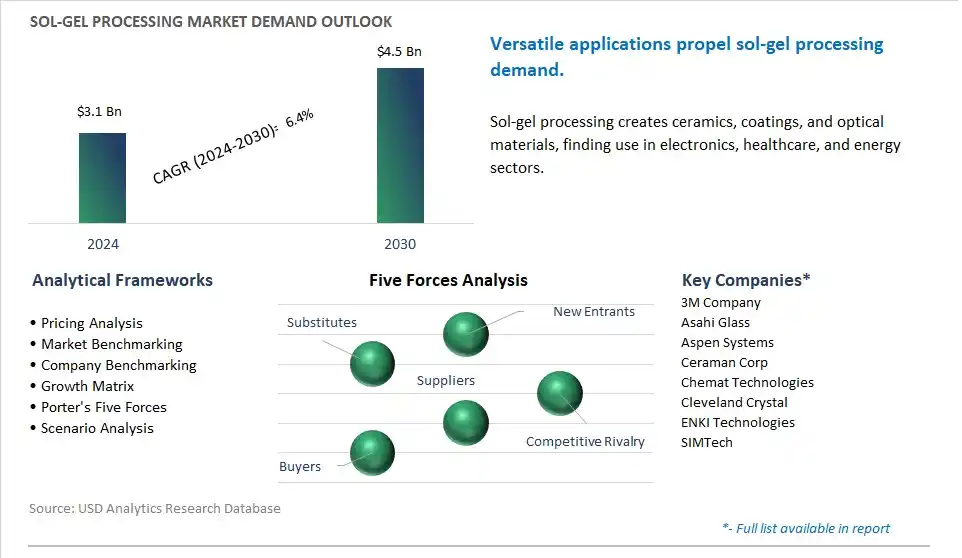
The global Sol-Gel Processing Market is poised to register a 6.4% CAGR from $3.1 Billion in 2024 to $4.5 Billion in 2030.
The global Sol-Gel Processing Market Study analyzes and forecasts the market size across 6 regions and 24 countries for diverse segments -By Application (Protective Coatings, Thin Films and Fibers, Nano-Scale Powders, Optomechanical, Medicine), By Type (Rotational Coating, Immersion Coating).
An Introduction to Global Sol Gel Processing Market in 2024
The future of sol-gel processing is influenced by trends in materials science, nanotechnology, and advanced manufacturing, driven by the unique properties and applications of sol-gel derived materials in diverse industries such as electronics, optics, energy, and biomedical engineering. Sol-gel processing is a versatile and cost-effective technique for synthesizing inorganic and hybrid organic-inorganic materials from liquid precursors through sol-gel transition, followed by gelation, drying, and heat treatment processes, resulting in materials with tailored composition, structure, and properties for specific applications. With the increasing demand for functional materials that offer high performance, durability, and versatility, sol-gel derived materials find applications in various advanced technologies and emerging markets, including microelectronics, photovoltaics, sensors, catalysis, and biomedical devices. Moreover, as industries strive to develop sustainable and eco-friendly solutions for energy generation, storage, and conversion, there is growing interest in sol-gel processed materials such as perovskite solar cells, solid electrolytes, and photocatalysts, which offer enhanced efficiency, stability, and scalability compared to traditional materials and fabrication techniques. Additionally, advancements in nanotechnology, additive manufacturing, and 3D printing enable the precise control and customization of sol-gel derived materials at the micro and nanoscale, opening up new opportunities for designing multifunctional and hierarchical architectures with tailored properties and performance characteristics. Furthermore, as researchers, engineers, and manufacturers collaborate to push the boundaries of sol-gel processing and materials design, the potential applications and impact of sol-gel derived materials will continue to expand, driving innovation and market growth in the global materials science and engineering industry.
Sol-Gel Processing Market Competitive Landscape
The market report analyses the leading companies in the industry including 3M Company, Asahi Glass, Aspen Systems, Ceraman Corp, Chemat Technologies, Cleveland Crystal, ENKI Technologies, SIMTech.
Sol-Gel Processing Market Dynamics
Sol Gel Processing Market Trend: Increasing Demand for High-Performance Functional Coatings
A prominent trend in the sol-gel processing market is the rising demand for high-performance functional coatings across various industries. Sol-gel processing offers a versatile and cost-effective method for producing thin films and coatings with tailored properties such as optical transparency, corrosionresistance, and thermal stability. This is driven by growing applications in sectors such as electronics, automotive, aerospace, and healthcare, where advanced coatings are required to enhance product performance, durability, and functionality. From anti-reflective coatings for optical devices to protective coatings for metal substrates, sol-gel processing is increasingly favored for its ability to deliver precise and customizable coatings that meet stringent industry requirements. As industries continue to seek innovative solutions for surface protection, enhancement, and functionalization, the demand for sol-gel processing is expected to experience steady growth.
Sol Gel Processing Market Driver: Advancements in Material Science and Nanotechnology
The primary driver behind the sol-gel processing market's growth is the continuous advancements in material science and nanotechnology. Sol-gel techniques enable the synthesis of nanostructured materials with unique properties and functionalities, offering unprecedented opportunities for innovation in coatings, composites, and nanodevices. Researchers and industry players are exploring novel sol-gel formulations, hybrid materials, and nanostructured architectures to develop next-generation coatings and functional materials with enhanced performance and versatility. Additionally, advancements in characterization techniques and process optimization are facilitating the precise control of film thickness, morphology, and composition, further expanding the applicability of sol-gel processing in various industries. With ongoing research and development efforts driving breakthroughs in nanomaterial synthesis and processing, sol-gel technology is poised to remain at the forefront of materials innovation and industrial applications.
Sol Gel Processing Market Opportunity: Penetration into Emerging Markets and Sustainable Applications
An attractive opportunity within the sol-gel processing market lies in penetrating emerging markets and exploring sustainable applications. As economies develop and infrastructure projects proliferate in emerging markets, there's a growing demand for advanced coatings and functional materials to meet infrastructure, construction, and manufacturing needs. Sol-gel processing offers a viable solution for providing durable, high-performance coatings that withstand harsh environmental conditions and contribute to the longevity of infrastructure assets. Moreover, there's increasing interest in utilizing sol-gel coatings for sustainable applications such as energy-efficient windows, self-cleaning surfaces, and anti-fouling coatings, which align with global efforts towards environmental conservation and energy efficiency. By tapping into emerging markets and promoting the adoption of sustainable sol-gel solutions, manufacturers can capitalize on new growth opportunities while addressing pressing societal and environmental challenges.
Sol-Gel Processing Market Share Analysis: protective coatings generated the highest revenue in 2024
The largest segment in the Sol-Gel Processing Market is protective coatings. protective coatings produced through sol-gel processing offer a wide range of benefits, including corrosion resistance, wear resistance, thermal insulation, and weatherproofing. These coatings are extensively used in various industries such as automotive, aerospace, construction, and electronics to protect surfaces from environmental degradation, chemical attack, and mechanical damage, thereby extending the lifespan of coated materials and structures. Additionally, sol-gel coatings can be applied to diverse substrates, including metals, glass, ceramics, and polymers, making them versatile and suitable for a broad range of applications. Further, advancements in sol-gel processing techniques and formulations have led to the development of high-performance coatings with enhanced durability, adhesion, and optical properties, further driving their adoption in industrial and commercial sectors. Furthermore, the increasing emphasis on sustainability and environmental protection fuels the demand for eco-friendly coating solutions derived from sol-gel processing, contributing to the dominance of the protective coatings segment in the sol-gel processing market.
Sol-Gel Processing Market Share Analysis: rotational coating segment is poised to register the fastest growth rate (CAGR) over the forecast period to 2030
The fastest-growing segment in the Sol-Gel Processing Market is rotational coating. rotational coating offers potential advantages over immersion coating in terms of uniformity, control, and efficiency in applying sol-gel coatings to complex three-dimensional surfaces. Rotational coating, also known as spin coating, involves spinning the substrate at high speeds while applying the sol-gel solution, resulting in a thin, uniform layer of coating that conforms to the substrate's contours. This method is particularly well-suited for coating small, intricate parts and components used in electronics, optics, and microelectronics, where precise thickness control and uniform coverage are critical. Additionally, rotational coating allows for rapid processing and high throughput, making it cost-effective for large-scale production applications. Further, advancements in rotational coating equipment and process optimization techniques have further improved its performance and versatility, driving its increasing adoption in various industries. Furthermore, the demand for advanced functional coatings with tailored properties, such as optical transparency, electrical conductivity, and chemical resistance, further fuels the growth of rotational coating in the sol-gel processing market as it enables the fabrication of high-quality, multifunctional coatings to meet diverse application requirements.
Sol-Gel Processing Market Report Segmentation
By Application
Protective Coatings
Thin Films and Fibers
Nano-Scale Powders
Optomechanical
Medicine
By Type
Rotational Coating
Immersion Coating
Regions Included
North America (US, Canada, Mexico)
Europe (Germany, UK, France, Spain, Italy, Russia, Rest of Europe)
Asia Pacific (China, India, Japan, South Korea, Australia, South East Asia, Rest of Asia)
South America (Brazil, Argentina, Rest of South America)
Middle East and Africa (Saudi Arabia, UAE, Rest of Middle East, South Africa, Egypt, Rest of Africa)
Sol-Gel Processing Companies Profiled in the Market Study
3M Company
Asahi Glass
Aspen Systems
Ceraman Corp
Chemat Technologies
Cleveland Crystal
ENKI Technologies
SIMTech
*- List Not Exhaustive
TABLE OF CONTENTS
1 Introduction to 2024 Sol-Gel Processing Market
1.1 Market Overview
1.2 Quick Facts
1.3 Scope/Objective of the Study
1.4 Market Definition
1.5 Countries and Regions Covered
1.6 Units, Currency, and Conversions
1.7 Industry Value Chain
2 Research Methodology
2.1 Market Size Estimation
2.2 Sources and Research Methodology
2.3 Data Triangulation
2.4 Assumptions and Limitations
3 Executive Summary
3.1 Global Sol-Gel Processing Market Size Outlook, $ Million, 2021 to 2030
3.2 Sol-Gel Processing Market Outlook by Type, $ Million, 2021 to 2030
3.3 Sol-Gel Processing Market Outlook by Product, $ Million, 2021 to 2030
3.4 Sol-Gel Processing Market Outlook by Application, $ Million, 2021 to 2030
3.5 Sol-Gel Processing Market Outlook by Key Countries, $ Million, 2021 to 2030
4 Market Dynamics
4.1 Key Driving Forces of Sol-Gel Processing Industry
4.2 Key Market Trends in Sol-Gel Processing Industry
4.3 Potential Opportunities in Sol-Gel Processing Industry
4.4 Key Challenges in Sol-Gel Processing Industry
5 Market Factor Analysis
5.1 Value Chain Analysis
5.2 Competitive Landscape
5.2.1 Global Sol-Gel Processing Market Share by Company (%), 2023
5.2.2 Product Offerings by Company
5.3 Porter’s Five Forces Analysis
5.4 Pricing Analysis and Outlook
6 Growth Outlook Across Scenarios
6.1 Growth Analysis-Case Scenario Definitions
6.2 Low Growth Scenario Forecasts
6.3 Reference Growth Scenario Forecasts
6.4 High Growth Scenario Forecasts
7 Global Sol-Gel Processing Market Outlook by Segments
7.1 Sol-Gel Processing Market Outlook by Segments, $ Million, 2021- 2030
By Application
Protective Coatings
Thin Films and Fibers
Nano-Scale Powders
Optomechanical
Medicine
By Type
Rotational Coating
Immersion Coating
8 North America Sol-Gel Processing Market Analysis and Outlook To 2030
8.1 Introduction to North America Sol-Gel Processing Markets in 2024
8.2 North America Sol-Gel Processing Market Size Outlook by Country, 2021-2030
8.2.1 United States
8.2.2 Canada
8.2.3 Mexico
8.3 North America Sol-Gel Processing Market size Outlook by Segments, 2021-2030
By Application
Protective Coatings
Thin Films and Fibers
Nano-Scale Powders
Optomechanical
Medicine
By Type
Rotational Coating
Immersion Coating
9 Europe Sol-Gel Processing Market Analysis and Outlook To 2030
9.1 Introduction to Europe Sol-Gel Processing Markets in 2024
9.2 Europe Sol-Gel Processing Market Size Outlook by Country, 2021-2030
9.2.1 Germany
9.2.2 France
9.2.3 Spain
9.2.4 United Kingdom
9.2.4 Italy
9.2.5 Russia
9.2.6 Norway
9.2.7 Rest of Europe
9.3 Europe Sol-Gel Processing Market Size Outlook by Segments, 2021-2030
By Application
Protective Coatings
Thin Films and Fibers
Nano-Scale Powders
Optomechanical
Medicine
By Type
Rotational Coating
Immersion Coating
10 Asia Pacific Sol-Gel Processing Market Analysis and Outlook To 2030
10.1 Introduction to Asia Pacific Sol-Gel Processing Markets in 2024
10.2 Asia Pacific Sol-Gel Processing Market Size Outlook by Country, 2021-2030
10.2.1 China
10.2.2 India
10.2.3 Japan
10.2.4 South Korea
10.2.5 Indonesia
10.2.6 Malaysia
10.2.7 Australia
10.2.8 Rest of Asia Pacific
10.3 Asia Pacific Sol-Gel Processing Market size Outlook by Segments, 2021-2030
By Application
Protective Coatings
Thin Films and Fibers
Nano-Scale Powders
Optomechanical
Medicine
By Type
Rotational Coating
Immersion Coating
11 South America Sol-Gel Processing Market Analysis and Outlook To 2030
11.1 Introduction to South America Sol-Gel Processing Markets in 2024
11.2 South America Sol-Gel Processing Market Size Outlook by Country, 2021-2030
11.2.1 Brazil
11.2.2 Argentina
11.2.3 Rest of South America
11.3 South America Sol-Gel Processing Market size Outlook by Segments, 2021-2030
By Application
Protective Coatings
Thin Films and Fibers
Nano-Scale Powders
Optomechanical
Medicine
By Type
Rotational Coating
Immersion Coating
12 Middle East and Africa Sol-Gel Processing Market Analysis and Outlook To 2030
12.1 Introduction to Middle East and Africa Sol-Gel Processing Markets in 2024
12.2 Middle East and Africa Sol-Gel Processing Market Size Outlook by Country, 2021-2030
12.2.1 Saudi Arabia
12.2.2 UAE
12.2.3 Oman
12.2.4 Rest of Middle East
12.2.5 Egypt
12.2.6 Nigeria
12.2.7 South Africa
12.2.8 Rest of Africa
12.3 Middle East and Africa Sol-Gel Processing Market size Outlook by Segments, 2021-2030
By Application
Protective Coatings
Thin Films and Fibers
Nano-Scale Powders
Optomechanical
Medicine
By Type
Rotational Coating
Immersion Coating
13 Company Profiles
13.1 Company Snapshot
13.2 SWOT Profiles
13.3 Products and Services
13.4 Recent Developments
13.5 Financial Profile
3M Company
Asahi Glass
Aspen Systems
Ceraman Corp
Chemat Technologies
Cleveland Crystal
ENKI Technologies
SIMTech
14 Appendix
14.1 Customization Offerings
14.2 Subscription Services
14.3 Related Reports
14.4 Publisher Expertise
By Application
Protective Coatings
Thin Films and Fibers
Nano-Scale Powders
Optomechanical
Medicine
By Type
Rotational Coating
Immersion Coating
Countries Analyzed
North America (US, Canada, Mexico)
Europe (Germany, UK, France, Spain, Italy, Russia, Rest of Europe)
Asia Pacific (China, India, Japan, South Korea, Australia, South East Asia, Rest of Asia)
South America (Brazil, Argentina, Rest of South America)
Middle East and Africa (Saudi Arabia, UAE, Rest of Middle East, South Africa, Egypt, Rest of Africa)
