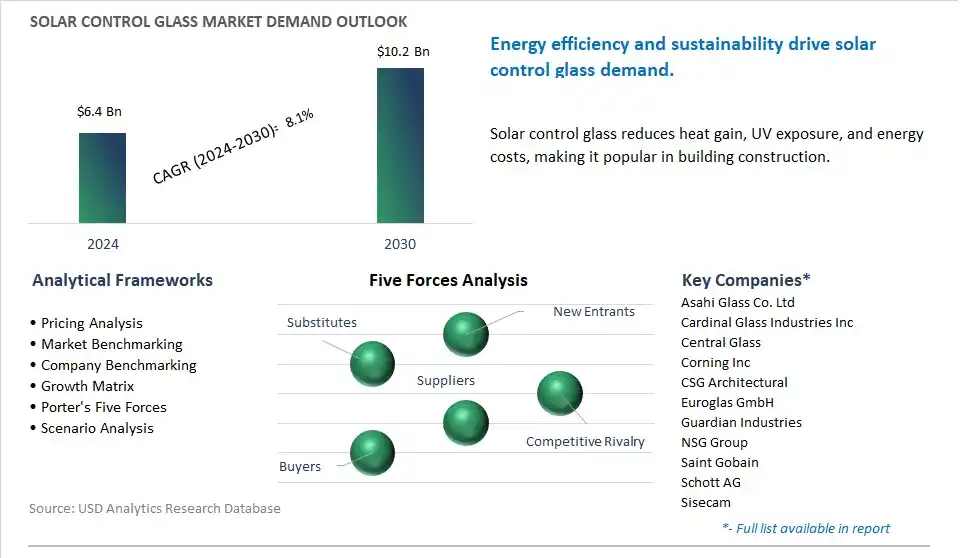
The global Solar Control Glass Market is poised to register a 8.1% CAGR from $6.4 Billion in 2024 to $10.2 Billion in 2030.
The global Solar Control Glass Market Study analyzes and forecasts the market size across 6 regions and 24 countries for diverse segments -By Type (Tempered Glass, Laminated Glass, Float Glass, Heat Strengthened Glass, Others), By Coating (Hard Coated, Soft Coated ), By Nature (Electrochromic, Photochromic, Gasochromic, Others), By Application (Residential, Commercial, Automotive).
An Introduction to Global Solar Control Glass Market in 2024
The future of solar control glass is shaped by trends in energy efficiency, sustainability, and smart building technologies, driven by the need to mitigate solar heat gain, reduce glare, and optimize natural lighting in buildings for occupant comfort and energy savings. Solar control glass, also known as low-emissivity (low-e) glass or energy-efficient glass, incorporates advanced coatings and technologies that selectively reflect or absorb solar radiation while allowing visible light to pass through, providing thermal insulation, UV protection, and daylighting benefits to buildings. With the increasing focus on reducing energy consumption, carbon emissions, and operating costs in buildings, solar control glass plays a critical role in improving building envelope performance, enhancing indoor comfort, and minimizing reliance on mechanical heating, cooling, and lighting systems. Moreover, as governments and industries implement energy efficiency standards, green building codes, and sustainability certifications, there is growing demand for high-performance glazing solutions that meet stringent performance criteria and contribute to achieving net-zero energy and carbon-neutral building goals. Additionally, advancements in glass manufacturing technology, such as magnetron sputtering, pyrolytic coating, and vacuum deposition, enable the production of customizable and durable solar control glass products with a wide range of optical and thermal properties, tailored to specific climatic conditions, architectural designs, and building applications. Furthermore, as buildings become more connected, automated, and intelligent with the integration of building automation systems, smart glass technologies, and IoT sensors, solar control glass will play an increasingly important role in smart building design, enabling dynamic control of solar heat gain, glare, and daylighting in response to changing environmental conditions and occupant preferences. As architects, developers, and building owners embrace solar control glass as a key component of sustainable and resilient building design, the demand for energy-efficient glazing solutions is expected to grow, driving innovation and market expansion in the global glass and building materials industry.
Solar Control Glass Market Competitive Landscape
The market report analyses the leading companies in the industry including Asahi Glass Co. Ltd, Cardinal Glass Industries Inc, Central Glass, Corning Inc, CSG Architectural, Euroglas GmbH, Guardian Industries, NSG Group, Saint Gobain, Schott AG, Sisecam, Xinyi Auto.
Solar Control Glass Market Dynamics
Solar Control Glass Market Trend: Increasing Emphasis on Energy Efficiency and Sustainability in Buildings
A prominent trend in the solar control glass market is the growing emphasis on energy efficiency and sustainability in buildings. As concerns over climate change and energy consumption rise, there's a heightened demand for building materials and solutions that reduce energy usage and environmental impact. Solar control glass, with its ability to manage solar heat gain and enhance natural lighting while reducing the need for artificial heating and cooling, has gained significant traction in the construction industry. Architects, developers, and building owners are incorporating solar control glass into their designs to achieve green building certifications, comply with energy efficiency regulations, and create healthier and more comfortable indoor environments. The trend is expected to continue as sustainability becomes a top priority in building design and construction practices globally.
Solar Control Glass Market Driver: Urbanization and Growing Demand for Sustainable Building Solutions
The primary driver behind the solar control glass market's growth is urbanization and the increasing demand for sustainable building solutions. Rapid urbanization has led to the proliferation of high-rise buildings and urban developments, intensifying the need for efficient energy management and climate control systems. Solar control glass addresses this need by reducing solar heat gain, minimizing glare, and optimizing natural daylighting, thereby enhancing occupant comfort and reducing reliance on mechanical heating and cooling systems. Additionally, growing awareness of the environmental and economic benefits of sustainable buildings is driving the adoption of solar control glass as a key component of energy-efficient building envelopes. As urban populations continue to grow and cities prioritize sustainable development initiatives, the demand for solar control glass is expected to escalate, propelling market growth.
Solar Control Glass Market Opportunity: Expansion into Emerging Markets and Retrofitting Projects
An attractive opportunity within the solar control glass market lies in expanding into emerging markets and retrofitting projects. Emerging economies are experiencing rapid urbanization and infrastructure development, presenting significant opportunities for the adoption of solar control glass in new construction projects. By entering these markets and partnering with local developers and construction firms, solar control glass manufacturers can capitalize on the increasing demand for sustainable building materials and technologies. Furthermore, retrofitting existing buildings with solar control glass presents a lucrative opportunity to enhance energy efficiency and indoor comfort without the need for extensive renovations. With governments implementing energy efficiency mandates and incentives to promote building retrofits, there's a growing market for upgrading older structures with energy-saving technologies like solar control glass. By leveraging these opportunities, solar control glass suppliers can expand their market reach and contribute to sustainable urban development initiatives worldwide.
Solar Control Glass Market Share Analysis: float glass generated the highest revenue in 2024
The largest segment in the Solar Control Glass Market is float glass. float glass is the most widely used type of glass in the construction industry for various applications, including windows, doors, facades, and curtain walls. Float glass is manufactured using the float glass process, which involves floating molten glass on a bed of molten tin to produce a flat, uniform sheet of glass with consistent thickness and optical quality. This method results in high-quality glass with excellent clarity, transparency, and surface smoothness, making it ideal for architectural applications where aesthetics and visual appeal are essential. Additionally, float glass can be easily coated or treated with solar control coatings to improve its energy efficiency and performance in reducing heat gain and glare from sunlight while allowing visible light transmission. Further, float glass is readily available in a wide range of thicknesses, sizes, and colors to meet the diverse design and functional requirements of building projects, further contributing to its popularity and dominance in the solar control glass market. Furthermore, advancements in float glass manufacturing technologies, such as low-emissivity (low-e) coatings and spectrally selective coatings, enhance its solar control properties and enable compliance with energy efficiency standards and green building certifications, driving its continued growth in the market.
Solar Control Glass Market Share Analysis: soft-coated glass segment is poised to register the fastest growth rate (CAGR) over the forecast period to 2030
The fastest-growing segment in the Solar Control Glass Market is soft-coated glass. soft-coated glass offers superior solar control properties compared to hard-coated glass, making it more effective in reducing solar heat gain and glare while allowing for maximum visible light transmission. Soft-coated glass consists of multiple layers of thin films deposited onto the glass surface using vacuum deposition techniques, allowing for precise control over the optical properties of the glass. Additionally, soft-coated glass can be customized to provide specific performance characteristics such as high solar heat rejection, low emissivity, and enhanced durability, making it suitable for a wide range of architectural applications, including commercial buildings, residential homes, and automotive glazing. Further, advancements in soft-coated glass technology have led to the development of energy-efficient and environmentally friendly glass solutions that help reduce heating, cooling, and lighting costs in buildings while improving occupant comfort and well-being. Furthermore, the increasing emphasis on sustainable building design and energy conservation drives the demand for soft-coated glass as a key component of green building strategies and initiatives, further fueling its rapid growth in the solar control glass market.
Solar Control Glass Market Share Analysis: electrochromic glass segment is poised to register the fastest growth rate (CAGR) over the forecast period to 2030
The fastest-growing segment in the Solar Control Glass Market is electrochromic glass. electrochromic glass offers dynamic control over solar heat gain and glare by changing its tint in response to external stimuli such as sunlight intensity, temperature, or user preferences. This allows occupants to adjust the transparency of the glass in real-time, providing optimal daylighting and thermal comfort while reducing the need for artificial lighting and air conditioning. Additionally, electrochromic glass offers superior optical clarity and color neutrality compared to other types of smart glass technologies, making it ideal for architectural applications where aesthetics and visibility are crucial. Further, advancements in electrochromic glass technology have led to the development of high-performance and energy-efficient glass solutions that meet stringent performance standards and building codes, driving their adoption in commercial, residential, and automotive sectors. Furthermore, the growing demand for sustainable building materials and smart technologies that enhance energy efficiency and occupant comfort further fuels the rapid growth of electrochromic glass in the solar control glass market.
Solar Control Glass Market Report Segmentation
By Type
Tempered Glass
Laminated Glass
Float Glass
Heat Strengthened Glass
Others
By Coating Method
Hard Coated
Soft Coated
By Nature
Electrochromic
Photochromic
Gasochromic
Others
By Application
Residential
Commercial
Automotive
Regions Included
North America (US, Canada, Mexico)
Europe (Germany, UK, France, Spain, Italy, Russia, Rest of Europe)
Asia Pacific (China, India, Japan, South Korea, Australia, South East Asia, Rest of Asia)
South America (Brazil, Argentina, Rest of South America)
Middle East and Africa (Saudi Arabia, UAE, Rest of Middle East, South Africa, Egypt, Rest of Africa)
Solar Control Glass Companies Profiled in the Market Study
Asahi Glass Co. Ltd
Cardinal Glass Industries Inc
Central Glass
Corning Inc
CSG Architectural
Euroglas GmbH
Guardian Industries
NSG Group
Saint Gobain
Schott AG
Sisecam
Xinyi Auto
*- List Not Exhaustive
TABLE OF CONTENTS
1 Introduction to 2024 Solar Control Glass Market
1.1 Market Overview
1.2 Quick Facts
1.3 Scope/Objective of the Study
1.4 Market Definition
1.5 Countries and Regions Covered
1.6 Units, Currency, and Conversions
1.7 Industry Value Chain
2 Research Methodology
2.1 Market Size Estimation
2.2 Sources and Research Methodology
2.3 Data Triangulation
2.4 Assumptions and Limitations
3 Executive Summary
3.1 Global Solar Control Glass Market Size Outlook, $ Million, 2021 to 2030
3.2 Solar Control Glass Market Outlook by Type, $ Million, 2021 to 2030
3.3 Solar Control Glass Market Outlook by Product, $ Million, 2021 to 2030
3.4 Solar Control Glass Market Outlook by Application, $ Million, 2021 to 2030
3.5 Solar Control Glass Market Outlook by Key Countries, $ Million, 2021 to 2030
4 Market Dynamics
4.1 Key Driving Forces of Solar Control Glass Industry
4.2 Key Market Trends in Solar Control Glass Industry
4.3 Potential Opportunities in Solar Control Glass Industry
4.4 Key Challenges in Solar Control Glass Industry
5 Market Factor Analysis
5.1 Value Chain Analysis
5.2 Competitive Landscape
5.2.1 Global Solar Control Glass Market Share by Company (%), 2023
5.2.2 Product Offerings by Company
5.3 Porter’s Five Forces Analysis
5.4 Pricing Analysis and Outlook
6 Growth Outlook Across Scenarios
6.1 Growth Analysis-Case Scenario Definitions
6.2 Low Growth Scenario Forecasts
6.3 Reference Growth Scenario Forecasts
6.4 High Growth Scenario Forecasts
7 Global Solar Control Glass Market Outlook by Segments
7.1 Solar Control Glass Market Outlook by Segments, $ Million, 2021- 2030
By Type
Tempered Glass
Laminated Glass
Float Glass
Heat Strengthened Glass
Others
By Coating Method
Hard Coated
Soft Coated
By Nature
Electrochromic
Photochromic
Gasochromic
Others
By Application
Residential
Commercial
Automotive
8 North America Solar Control Glass Market Analysis and Outlook To 2030
8.1 Introduction to North America Solar Control Glass Markets in 2024
8.2 North America Solar Control Glass Market Size Outlook by Country, 2021-2030
8.2.1 United States
8.2.2 Canada
8.2.3 Mexico
8.3 North America Solar Control Glass Market size Outlook by Segments, 2021-2030
By Type
Tempered Glass
Laminated Glass
Float Glass
Heat Strengthened Glass
Others
By Coating Method
Hard Coated
Soft Coated
By Nature
Electrochromic
Photochromic
Gasochromic
Others
By Application
Residential
Commercial
Automotive
9 Europe Solar Control Glass Market Analysis and Outlook To 2030
9.1 Introduction to Europe Solar Control Glass Markets in 2024
9.2 Europe Solar Control Glass Market Size Outlook by Country, 2021-2030
9.2.1 Germany
9.2.2 France
9.2.3 Spain
9.2.4 United Kingdom
9.2.4 Italy
9.2.5 Russia
9.2.6 Norway
9.2.7 Rest of Europe
9.3 Europe Solar Control Glass Market Size Outlook by Segments, 2021-2030
By Type
Tempered Glass
Laminated Glass
Float Glass
Heat Strengthened Glass
Others
By Coating Method
Hard Coated
Soft Coated
By Nature
Electrochromic
Photochromic
Gasochromic
Others
By Application
Residential
Commercial
Automotive
10 Asia Pacific Solar Control Glass Market Analysis and Outlook To 2030
10.1 Introduction to Asia Pacific Solar Control Glass Markets in 2024
10.2 Asia Pacific Solar Control Glass Market Size Outlook by Country, 2021-2030
10.2.1 China
10.2.2 India
10.2.3 Japan
10.2.4 South Korea
10.2.5 Indonesia
10.2.6 Malaysia
10.2.7 Australia
10.2.8 Rest of Asia Pacific
10.3 Asia Pacific Solar Control Glass Market size Outlook by Segments, 2021-2030
By Type
Tempered Glass
Laminated Glass
Float Glass
Heat Strengthened Glass
Others
By Coating Method
Hard Coated
Soft Coated
By Nature
Electrochromic
Photochromic
Gasochromic
Others
By Application
Residential
Commercial
Automotive
11 South America Solar Control Glass Market Analysis and Outlook To 2030
11.1 Introduction to South America Solar Control Glass Markets in 2024
11.2 South America Solar Control Glass Market Size Outlook by Country, 2021-2030
11.2.1 Brazil
11.2.2 Argentina
11.2.3 Rest of South America
11.3 South America Solar Control Glass Market size Outlook by Segments, 2021-2030
By Type
Tempered Glass
Laminated Glass
Float Glass
Heat Strengthened Glass
Others
By Coating Method
Hard Coated
Soft Coated
By Nature
Electrochromic
Photochromic
Gasochromic
Others
By Application
Residential
Commercial
Automotive
12 Middle East and Africa Solar Control Glass Market Analysis and Outlook To 2030
12.1 Introduction to Middle East and Africa Solar Control Glass Markets in 2024
12.2 Middle East and Africa Solar Control Glass Market Size Outlook by Country, 2021-2030
12.2.1 Saudi Arabia
12.2.2 UAE
12.2.3 Oman
12.2.4 Rest of Middle East
12.2.5 Egypt
12.2.6 Nigeria
12.2.7 South Africa
12.2.8 Rest of Africa
12.3 Middle East and Africa Solar Control Glass Market size Outlook by Segments, 2021-2030
By Type
Tempered Glass
Laminated Glass
Float Glass
Heat Strengthened Glass
Others
By Coating Method
Hard Coated
Soft Coated
By Nature
Electrochromic
Photochromic
Gasochromic
Others
By Application
Residential
Commercial
Automotive
13 Company Profiles
13.1 Company Snapshot
13.2 SWOT Profiles
13.3 Products and Services
13.4 Recent Developments
13.5 Financial Profile
Asahi Glass Co. Ltd
Cardinal Glass Industries Inc
Central Glass
Corning Inc
CSG Architectural
Euroglas GmbH
Guardian Industries
NSG Group
Saint Gobain
Schott AG
Sisecam
Xinyi Auto
14 Appendix
14.1 Customization Offerings
14.2 Subscription Services
14.3 Related Reports
14.4 Publisher Expertise
By Type
Tempered Glass
Laminated Glass
Float Glass
Heat Strengthened Glass
Others
By Coating Method
Hard Coated
Soft Coated
By Nature
Electrochromic
Photochromic
Gasochromic
Others
By Application
Residential
Commercial
Automotive
Countries Analyzed
North America (US, Canada, Mexico)
Europe (Germany, UK, France, Spain, Italy, Russia, Rest of Europe)
Asia Pacific (China, India, Japan, South Korea, Australia, South East Asia, Rest of Asia)
South America (Brazil, Argentina, Rest of South America)
Middle East and Africa (Saudi Arabia, UAE, Rest of Middle East, South Africa, Egypt, Rest of Africa)
