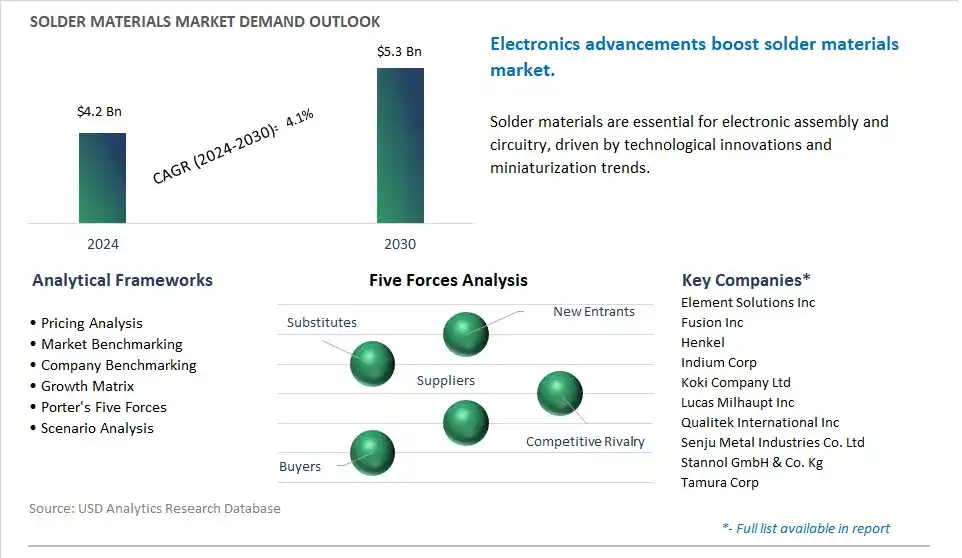
The global Solder Materials Market is poised to register a 4.1% CAGR from $4.2 Billion in 2024 to $5.3 Billion in 2030.
The global Solder Materials Market Study analyzes and forecasts the market size across 6 regions and 24 countries for diverse segments -By Type (With Lead, Lead-Free), By Product (Wire, Bar, Paste, Flux, Others), By Process (Wave/reflow, Screen Printing, Laser, Robotic), By End-User (Consumer Electronics, Automotive, Industrial, Building, Others).
An Introduction to Global Solder Materials Market in 2024
The future of solder materials is influenced by trends in electronics manufacturing, miniaturization, and lead-free soldering technology, driven by the need for reliable and environmentally friendly soldering solutions for electronic assembly and packaging. Solder materials are alloys or compositions used to join electronic components and circuitry on printed circuit boards (PCBs), semiconductor devices, and electronic assemblies through a process called soldering, where molten solder forms a metallurgical bond between metal surfaces. With the increasing demand for smaller, lighter, and more complex electronic devices such as smartphones, laptops, and wearable technologies, solder materials play a critical role in enabling high-density packaging, fine-pitch interconnections, and reliable electrical performance in electronic assemblies. Moreover, as environmental regulations restrict the use of hazardous substances such as lead (Pb) in electronic products and manufacturing processes, there is growing interest in lead-free solder materials such as tin-silver-copper (Sn-Ag-Cu) alloys, bismuth-based alloys, and indium-containing alloys, which offer comparable soldering performance and reliability while minimizing environmental impact and health risks. Additionally, advancements in soldering technology, such as reflow soldering, wave soldering, and selective soldering, enable precise control and optimization of solder joint formation, wetting behavior, and thermal management, ensuring robust and defect-free assembly processes for complex electronic systems. Furthermore, as industries adopt advanced packaging technologies such as chip-scale packaging (CSP), ball grid array (BGA), and 3D packaging, solder materials will continue to evolve to meet the challenges of miniaturization, thermal management, and reliability in high-performance electronic devices and systems. As electronics manufacturers and suppliers strive to meet the demands of the rapidly evolving electronics market, the demand for innovative solder materials and assembly solutions is expected to grow, driving technological advancement and market expansion in the global electronics and semiconductor industry.
Solder Materials Market Competitive Landscape
The market report analyses the leading companies in the industry including Element Solutions Inc, Fusion Inc, Henkel, Indium Corp, Koki Company Ltd, Lucas Milhaupt Inc, Qualitek International Inc, Senju Metal Industries Co. Ltd, Stannol GmbH & Co. Kg, Tamura Corp.
Solder Materials Market Dynamics
Solder Materials Market Trend: Transition towards Lead-Free Solder Materials
A prominent trend in the solder materials market is the transition towards lead-free solder materials driven by regulatory and environmental concerns. With increasing awareness of the health and environmental risks associated with lead-based solder, governments worldwide are implementing stringent regulations to restrict the use of lead in electronics manufacturing. Accordingly, there's a significant shift towards lead-free solder materials across various industries, including electronics, automotive, and aerospace. Lead-free solder materials offer comparable performance to traditional lead-based solder while complying with environmental regulations and ensuring product safety. Manufacturers and suppliers are investing in research and development to innovate lead-free solder formulations that meet industry standards and address specific application requirements. The trend is expected to continue as the electronics industry moves towards sustainable and environmentally friendly manufacturing practices.
Solder Materials Market Driver: Technological Advancements and Miniaturization in Electronics
The primary driver behind the solder materials market's growth is technological advancements and miniaturization trends in the electronics industry. With the ongoing evolution of electronic devices towards smaller, lighter, and more complex designs, there's a growing demand for solder materials that can meet the challenges of miniaturization and ensure reliable electrical connections. Advanced solder materials, such as lead-free alloys, fluxes, and pastes, are engineered to provide superior performance in terms of thermal conductivity, mechanical strength, and solder joint reliability. Additionally, innovations in surface mount technology (SMT), flip-chip packaging, and ball grid array (BGA) assembly techniques are driving the need for solder materials with finer particle sizes, improved wetting characteristics, and enhanced solderability. As electronics manufacturers strive to meet consumer demands for smaller and more powerful devices, the demand for high-performance solder materials is expected to increase, stimulating market growth.
Solder Materials Market Opportunity: Expansion into Emerging Markets and Application Niches
An attractive opportunity within the solder materials market lies in expanding into emerging markets and application niches. Emerging economies are witnessing rapid industrialization and infrastructure development, leading to increased demand for electronic products and components. By entering these markets and establishing partnerships with local manufacturers and distributors, solder materials suppliers can capitalize on the growing demand for solder materials in electronics assembly and manufacturing. Furthermore, there are opportunities to explore niche applications such as renewable energy systems, medical devices, and wearable electronics, where specialized solder materials tailored to specific performance requirements are needed. By diversifying their product offerings and targeting niche markets, solder materials suppliers can unlock new revenue streams and position themselves for sustained growth in the dynamic electronics industry.
Solder Materials Market Share Analysis: lead generated the highest revenue in 2024
The largest segment in the Solder Materials Market is solder materials with lead. This dominance is primarily due to historical usage and familiarity within various industries. Lead-based solder materials have been widely used for decades in electronics manufacturing, plumbing, automotive, and other applications due to their low cost, ease of use, and reliable performance. Additionally, lead-based solder materials offer excellent wetting and flow characteristics, which are essential for achieving strong and reliable solder joints in electronic assemblies and plumbing connections. Despite concerns about the environmental and health impacts of lead, lead-based solder materials continue to be prevalent in many industries, especially in regions where regulations governing their use are less stringent or where alternatives are not widely adopted. Furthermore, the established infrastructure for lead-based solder materials, including manufacturing processes, supply chains, and technical expertise, further contributes to their dominance in the solder materials market. However, with increasing regulatory restrictions on the use of lead and growing awareness of its hazards, the demand for lead-free solder materials is expected to increase gradually, but lead-based solder materials still maintain their dominant position in the market for now.
Solder Materials Market Share Analysis: solder paste segment is poised to register the fastest growth rate (CAGR) over the forecast period to 2030
The fastest-growing segment in the Solder Materials Market is solder paste. solder paste is a critical material used in surface mount technology (SMT) assembly processes, which are widely employed in the electronics manufacturing industry for the assembly of printed circuit boards (PCBs) and electronic devices. Solder paste consists of solder alloy particles suspended in a flux medium, making it convenient for stencil printing onto PCBs to deposit precise amounts of solder onto component pads before reflow soldering. This method offers advantages such as high throughput, excellent repeatability, and compatibility with miniaturized components and high-density PCB designs. Additionally, the shift towards smaller form factors, increased component density, and higher levels of integration in electronic devices drive the demand for solder paste with finer particle sizes and enhanced rheological properties to ensure reliable solder joint formation. Further, advancements in solder paste formulations, including the development of low-temperature and lead-free alloys, as well as halogen-free and no-clean flux formulations, address environmental and regulatory concerns while meeting performance requirements. Furthermore, the increasing adoption of advanced packaging technologies such as flip-chip, ball grid array (BGA), and chip-scale packages (CSPs) further drives the demand for solder paste as these techniques require precise and reliable soldering processes. Accordingly, solder paste is the fastest-growing segment in the solder materials market.
Solder Materials Market Share Analysis: robotic soldering process segment is poised to register the fastest growth rate (CAGR) over the forecast period to 2030
The fastest-growing segment in the Solder Materials Market is the robotic soldering process. robotic soldering offers precise and repeatable soldering processes, making it ideal for applications requiring high-quality solder joints with tight tolerances. Robotic soldering systems can be programmed to perform complex soldering tasks with high accuracy, making them suitable for a wide range of industries, including electronics manufacturing, automotive, aerospace, and medical devices. Additionally, robotic soldering systems can handle various soldering methods, including wave soldering, reflow soldering, selective soldering, and point-to-point soldering, providing flexibility and versatility in meeting diverse production requirements. Further, advancements in robotic soldering technology, such as improved soldering tips, vision systems, and control algorithms, enhance system performance, reliability, and ease of use, further driving their adoption in manufacturing environments. Furthermore, the increasing demand for automation and smart manufacturing solutions to improve productivity, quality, and efficiency in production processes accelerates the growth of robotic soldering in the solder materials market. Accordingly, the robotic soldering process is the fastest-growing segment in the solder materials market.
Solder Materials Market Report Segmentation
By Type
With Lead
Lead-Free
By Product
Wire
Bar
Paste
Flux
Others
By Process
Wave/reflow
Screen Printing
Laser
Robotic
By End-User
Consumer Electronics
Automotive
Industrial
Building
Others
Regions Included
North America (US, Canada, Mexico)
Europe (Germany, UK, France, Spain, Italy, Russia, Rest of Europe)
Asia Pacific (China, India, Japan, South Korea, Australia, South East Asia, Rest of Asia)
South America (Brazil, Argentina, Rest of South America)
Middle East and Africa (Saudi Arabia, UAE, Rest of Middle East, South Africa, Egypt, Rest of Africa)
Solder Materials Companies Profiled in the Market Study
Element Solutions Inc
Fusion Inc
Henkel
Indium Corp
Koki Company Ltd
Lucas Milhaupt Inc
Qualitek International Inc
Senju Metal Industries Co. Ltd
Stannol GmbH & Co. Kg
Tamura Corp
*- List Not Exhaustive
TABLE OF CONTENTS
1 Introduction to 2024 Solder Materials Market
1.1 Market Overview
1.2 Quick Facts
1.3 Scope/Objective of the Study
1.4 Market Definition
1.5 Countries and Regions Covered
1.6 Units, Currency, and Conversions
1.7 Industry Value Chain
2 Research Methodology
2.1 Market Size Estimation
2.2 Sources and Research Methodology
2.3 Data Triangulation
2.4 Assumptions and Limitations
3 Executive Summary
3.1 Global Solder Materials Market Size Outlook, $ Million, 2021 to 2030
3.2 Solder Materials Market Outlook by Type, $ Million, 2021 to 2030
3.3 Solder Materials Market Outlook by Product, $ Million, 2021 to 2030
3.4 Solder Materials Market Outlook by Application, $ Million, 2021 to 2030
3.5 Solder Materials Market Outlook by Key Countries, $ Million, 2021 to 2030
4 Market Dynamics
4.1 Key Driving Forces of Solder Materials Industry
4.2 Key Market Trends in Solder Materials Industry
4.3 Potential Opportunities in Solder Materials Industry
4.4 Key Challenges in Solder Materials Industry
5 Market Factor Analysis
5.1 Value Chain Analysis
5.2 Competitive Landscape
5.2.1 Global Solder Materials Market Share by Company (%), 2023
5.2.2 Product Offerings by Company
5.3 Porter’s Five Forces Analysis
5.4 Pricing Analysis and Outlook
6 Growth Outlook Across Scenarios
6.1 Growth Analysis-Case Scenario Definitions
6.2 Low Growth Scenario Forecasts
6.3 Reference Growth Scenario Forecasts
6.4 High Growth Scenario Forecasts
7 Global Solder Materials Market Outlook by Segments
7.1 Solder Materials Market Outlook by Segments, $ Million, 2021- 2030
By Type
With Lead
Lead-Free
By Product
Wire
Bar
Paste
Flux
Others
By Process
Wave/reflow
Screen Printing
Laser
Robotic
By End-User
Consumer Electronics
Automotive
Industrial
Building
Others
8 North America Solder Materials Market Analysis and Outlook To 2030
8.1 Introduction to North America Solder Materials Markets in 2024
8.2 North America Solder Materials Market Size Outlook by Country, 2021-2030
8.2.1 United States
8.2.2 Canada
8.2.3 Mexico
8.3 North America Solder Materials Market size Outlook by Segments, 2021-2030
By Type
With Lead
Lead-Free
By Product
Wire
Bar
Paste
Flux
Others
By Process
Wave/reflow
Screen Printing
Laser
Robotic
By End-User
Consumer Electronics
Automotive
Industrial
Building
Others
9 Europe Solder Materials Market Analysis and Outlook To 2030
9.1 Introduction to Europe Solder Materials Markets in 2024
9.2 Europe Solder Materials Market Size Outlook by Country, 2021-2030
9.2.1 Germany
9.2.2 France
9.2.3 Spain
9.2.4 United Kingdom
9.2.4 Italy
9.2.5 Russia
9.2.6 Norway
9.2.7 Rest of Europe
9.3 Europe Solder Materials Market Size Outlook by Segments, 2021-2030
By Type
With Lead
Lead-Free
By Product
Wire
Bar
Paste
Flux
Others
By Process
Wave/reflow
Screen Printing
Laser
Robotic
By End-User
Consumer Electronics
Automotive
Industrial
Building
Others
10 Asia Pacific Solder Materials Market Analysis and Outlook To 2030
10.1 Introduction to Asia Pacific Solder Materials Markets in 2024
10.2 Asia Pacific Solder Materials Market Size Outlook by Country, 2021-2030
10.2.1 China
10.2.2 India
10.2.3 Japan
10.2.4 South Korea
10.2.5 Indonesia
10.2.6 Malaysia
10.2.7 Australia
10.2.8 Rest of Asia Pacific
10.3 Asia Pacific Solder Materials Market size Outlook by Segments, 2021-2030
By Type
With Lead
Lead-Free
By Product
Wire
Bar
Paste
Flux
Others
By Process
Wave/reflow
Screen Printing
Laser
Robotic
By End-User
Consumer Electronics
Automotive
Industrial
Building
Others
11 South America Solder Materials Market Analysis and Outlook To 2030
11.1 Introduction to South America Solder Materials Markets in 2024
11.2 South America Solder Materials Market Size Outlook by Country, 2021-2030
11.2.1 Brazil
11.2.2 Argentina
11.2.3 Rest of South America
11.3 South America Solder Materials Market size Outlook by Segments, 2021-2030
By Type
With Lead
Lead-Free
By Product
Wire
Bar
Paste
Flux
Others
By Process
Wave/reflow
Screen Printing
Laser
Robotic
By End-User
Consumer Electronics
Automotive
Industrial
Building
Others
12 Middle East and Africa Solder Materials Market Analysis and Outlook To 2030
12.1 Introduction to Middle East and Africa Solder Materials Markets in 2024
12.2 Middle East and Africa Solder Materials Market Size Outlook by Country, 2021-2030
12.2.1 Saudi Arabia
12.2.2 UAE
12.2.3 Oman
12.2.4 Rest of Middle East
12.2.5 Egypt
12.2.6 Nigeria
12.2.7 South Africa
12.2.8 Rest of Africa
12.3 Middle East and Africa Solder Materials Market size Outlook by Segments, 2021-2030
By Type
With Lead
Lead-Free
By Product
Wire
Bar
Paste
Flux
Others
By Process
Wave/reflow
Screen Printing
Laser
Robotic
By End-User
Consumer Electronics
Automotive
Industrial
Building
Others
13 Company Profiles
13.1 Company Snapshot
13.2 SWOT Profiles
13.3 Products and Services
13.4 Recent Developments
13.5 Financial Profile
Element Solutions Inc
Fusion Inc
Henkel
Indium Corp
Koki Company Ltd
Lucas Milhaupt Inc
Qualitek International Inc
Senju Metal Industries Co. Ltd
Stannol GmbH & Co. Kg
Tamura Corp
14 Appendix
14.1 Customization Offerings
14.2 Subscription Services
14.3 Related Reports
14.4 Publisher Expertise
By Type
With Lead
Lead-Free
By Product
Wire
Bar
Paste
Flux
Others
By Process
Wave/reflow
Screen Printing
Laser
Robotic
By End-User
Consumer Electronics
Automotive
Industrial
Building
Others
Countries Analyzed
North America (US, Canada, Mexico)
Europe (Germany, UK, France, Spain, Italy, Russia, Rest of Europe)
Asia Pacific (China, India, Japan, South Korea, Australia, South East Asia, Rest of Asia)
South America (Brazil, Argentina, Rest of South America)
Middle East and Africa (Saudi Arabia, UAE, Rest of Middle East, South Africa, Egypt, Rest of Africa)
