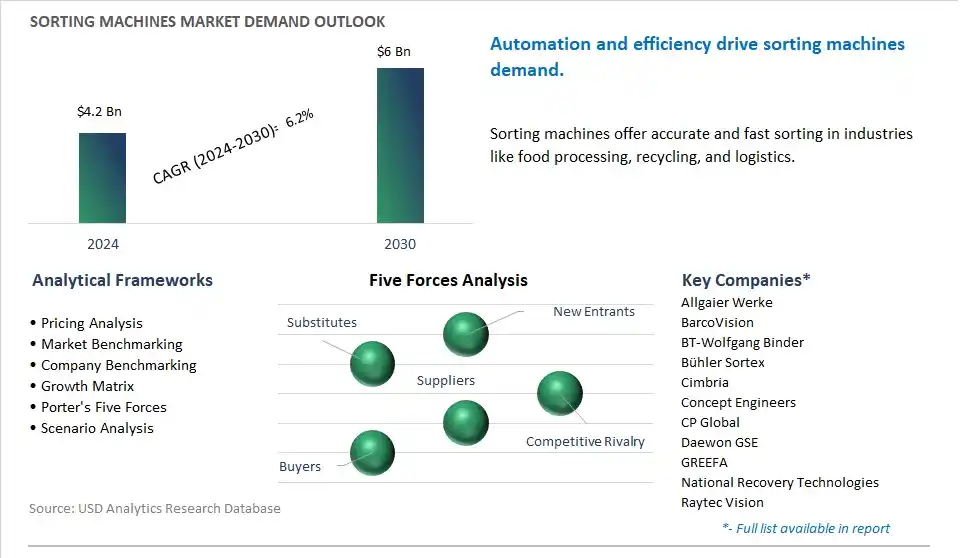
The global Sorting Machines Market is poised to register a 6.2% CAGR from $4.2 Billion in 2024 to $6 Billion in 2030.
The global Sorting Machines Market Study analyzes and forecasts the market size across 6 regions and 24 countries for diverse segments -By Product (Optical Sorter, Weight/Gravity Sorter, Others), By End-User (Food & Beverage Industry, Pharmaceutical, Waste Recycling, Mining, Others).
An Introduction to Global Sorting Machines Market in 2024
The future of sorting machines is shaped by trends in automation, digitalization, and sustainability, driven by the need for efficient and reliable sorting solutions for recycling, waste management, and material recovery facilities (MRFs) worldwide. Sorting machines, also known as sorters or separators, are automated systems that use various technologies such as optical sensors, NIR (near-infrared) spectroscopy, X-ray transmission, and AI (artificial intelligence) algorithms to identify, categorize, and separate different types of materials based on their physical, optical, or chemical properties. With the increasing volumes of municipal solid waste (MSW), construction and demolition (C&D) debris, and industrial waste generated globally, sorting machines play a critical role in recovering valuable resources such as metals, plastics, paper, and glass from mixed waste streams, diverting them from landfills and incineration and promoting a circular economy. Moreover, as governments, municipalities, and waste management companies implement regulations and sustainability targets to reduce waste generation, increase recycling rates, and minimize environmental pollution, there is growing demand for advanced sorting technologies that offer higher throughput, accuracy, and flexibility in handling diverse and evolving waste streams. Additionally, advancements in sensor technology, machine learning, and robotics enable sorting machines to adapt to changing market conditions, contamination levels, and material compositions, optimizing sorting efficiency and resource recovery rates while minimizing operational costs and downtime. Furthermore, as stakeholders across the recycling value chain collaborate to improve collection systems, sorting infrastructure, and end-market demand for recycled materials, sorting machines will play an increasingly important role in closing the loop on material resources, driving growth and innovation in the global waste management and recycling industry.
Sorting Machines Market Competitive Landscape
The market report analyses the leading companies in the industry including Allgaier Werke, BarcoVision, BT-Wolfgang Binder, Bühler Sortex, Cimbria, Concept Engineers, CP Global, Daewon GSE, GREEFA, National Recovery Technologies, Raytec Vision, Satake Corp, Sesotec, TOMRA.
Sorting Machines Market Dynamics
Sorting Machines Market Trend: Adoption of Automated Sorting Technologies in Various Industries
A prominent trend in the sorting machines market is the widespread adoption of automated sorting technologies across various industries. With advancements in artificial intelligence, machine learning, and robotics, sorting machines have become more sophisticated and capable of handling a diverse range of sorting tasks efficiently and accurately. Industries such as recycling, food and beverage, logistics, and pharmaceuticals are increasingly leveraging automated sorting machines to streamline operations, improve productivity, and ensure product quality and safety. This is driven by the need for faster processing speeds, higher throughput, and greater precision in sorting tasks, as well as the need to reduce labor costs and minimize human error. As automation continues to revolutionize industrial processes, the demand for advanced sorting machines equipped with intelligent sorting algorithms and robotic systems is expected to grow.
Sorting Machines Market Driver: Regulatory Requirements and Quality Standards in Manufacturing and Recycling
The primary driver behind the sorting machines market's growth is regulatory requirements and quality standards in manufacturing and recycling industries. Governments and regulatory bodies worldwide are imposing stringent regulations and standards on product quality, safety, and environmental sustainability, driving the need for efficient sorting and quality control measures. In industries such as recycling, where the sorting of various materials is essential for achieving recycling targets and minimizing waste, sorting machines play a crucial role in ensuring compliance with regulatory requirements. Additionally, manufacturers in sectors such as food and beverage, automotive, and electronics rely on sorting machines to remove defective products, detect contaminants, and ensure product traceability and compliance with industry standards. As regulatory scrutiny intensifies and quality standards become more stringent, the demand for sorting machines equipped with advanced sensing, imaging, and sorting technologies is expected to increase.
Sorting Machines Market Opportunity: Expansion into Emerging Markets and Industry Verticals
An attractive opportunity within the sorting machines market lies in the expansion into emerging markets and industry verticals. Emerging economies experiencing rapid industrialization and urbanization are seeking advanced sorting solutions to optimize production processes, improve efficiency, and meet evolving consumer demands. Additionally, there are opportunities to penetrate new industry verticals beyond traditional applications such as recycling and manufacturing. For example, the rise of e-commerce and online retailing has created a demand for sorting machines in logistics and warehouse management for parcel sorting and order fulfillment. Similarly, the healthcare industry presents opportunities for sorting machines in medical device manufacturing, pharmaceutical packaging, and specimen sorting. By diversifying their market presence and targeting emerging applications, sorting machine manufacturers can capitalize on new growth opportunities and expand their market reach globally.
Sorting Machines Market Share Analysis: optical sorter generated the highest revenue in 2024
The largest segment in the Sorting Machines Market is the optical sorter. optical sorters are highly versatile and widely used in various industries for sorting and quality control applications. Optical sorting technology utilizes advanced sensors, cameras, and imaging systems to identify and categorize objects based on their optical properties such as color, shape, size, and texture. This allows optical sorters to accurately and efficiently separate a wide range of materials including food products, grains, seeds, recyclables, minerals, and pharmaceuticals. Additionally, optical sorters offer high-speed processing capabilities, enabling rapid and precise sorting of large volumes of materials with minimal downtime. Further, optical sorters can be easily integrated into existing production lines and automated systems, enhancing productivity and operational efficiency in manufacturing and processing facilities. Furthermore, advancements in optical sorting technology, including improvements in sensor sensitivity, image processing algorithms, and sorting accuracy, further contribute to the dominance of optical sorters in the sorting machines market. Accordingly, the optical sorter segment is the largest in the sorting machines market.
Sorting Machines Market Share Analysis: waste recycling industry segment is poised to register the fastest growth rate (CAGR) over the forecast period to 2030
The fastest-growing segment in the Sorting Machines Market is the waste recycling industry. There is a global emphasis on sustainability and environmental conservation, leading to increased efforts to reduce waste and promote recycling initiatives. Sorting machines play a crucial role in waste recycling operations by automating the process of sorting and separating recyclable materials such as plastics, paper, glass, metals, and organic waste from mixed waste streams. Additionally, advancements in sorting machine technologies, including optical sorting, near-infrared (NIR) sorting, and sensor-based sorting systems, enable more efficient and accurate identification and segregation of recyclable materials, leading to higher recovery rates and quality of recycled materials. Further, stringent regulations and waste management policies aimed at reducing landfill waste and promoting recycling further drive the demand for sorting machines in the waste recycling industry. Furthermore, increasing public awareness and consumer preferences for eco-friendly products and packaging contribute to the growing need for efficient waste sorting and recycling solutions. Accordingly, the waste recycling segment is the fastest-growing segment in the sorting machines market.
Sorting Machines Market Report Segmentation
By Product
Optical Sorter
Weight/Gravity Sorter
Others
By End-User
Food & Beverage Industry
Pharmaceutical
Waste Recycling
Mining
Others
Regions Included
North America (US, Canada, Mexico)
Europe (Germany, UK, France, Spain, Italy, Russia, Rest of Europe)
Asia Pacific (China, India, Japan, South Korea, Australia, South East Asia, Rest of Asia)
South America (Brazil, Argentina, Rest of South America)
Middle East and Africa (Saudi Arabia, UAE, Rest of Middle East, South Africa, Egypt, Rest of Africa)
Sorting Machines Companies Profiled in the Market Study
Allgaier Werke
BarcoVision
BT-Wolfgang Binder
Bühler Sortex
Cimbria
Concept Engineers
CP Global
Daewon GSE
GREEFA
National Recovery Technologies
Raytec Vision
Satake Corp
Sesotec
TOMRA
*- List Not Exhaustive
TABLE OF CONTENTS
1 Introduction to 2024 Sorting Machines Market
1.1 Market Overview
1.2 Quick Facts
1.3 Scope/Objective of the Study
1.4 Market Definition
1.5 Countries and Regions Covered
1.6 Units, Currency, and Conversions
1.7 Industry Value Chain
2 Research Methodology
2.1 Market Size Estimation
2.2 Sources and Research Methodology
2.3 Data Triangulation
2.4 Assumptions and Limitations
3 Executive Summary
3.1 Global Sorting Machines Market Size Outlook, $ Million, 2021 to 2030
3.2 Sorting Machines Market Outlook by Type, $ Million, 2021 to 2030
3.3 Sorting Machines Market Outlook by Product, $ Million, 2021 to 2030
3.4 Sorting Machines Market Outlook by Application, $ Million, 2021 to 2030
3.5 Sorting Machines Market Outlook by Key Countries, $ Million, 2021 to 2030
4 Market Dynamics
4.1 Key Driving Forces of Sorting Machines Industry
4.2 Key Market Trends in Sorting Machines Industry
4.3 Potential Opportunities in Sorting Machines Industry
4.4 Key Challenges in Sorting Machines Industry
5 Market Factor Analysis
5.1 Value Chain Analysis
5.2 Competitive Landscape
5.2.1 Global Sorting Machines Market Share by Company (%), 2023
5.2.2 Product Offerings by Company
5.3 Porter’s Five Forces Analysis
5.4 Pricing Analysis and Outlook
6 Growth Outlook Across Scenarios
6.1 Growth Analysis-Case Scenario Definitions
6.2 Low Growth Scenario Forecasts
6.3 Reference Growth Scenario Forecasts
6.4 High Growth Scenario Forecasts
7 Global Sorting Machines Market Outlook by Segments
7.1 Sorting Machines Market Outlook by Segments, $ Million, 2021- 2030
By Product
Optical Sorter
Weight/Gravity Sorter
Others
By End-User
Food & Beverage Industry
Pharmaceutical
Waste Recycling
Mining
Others
8 North America Sorting Machines Market Analysis and Outlook To 2030
8.1 Introduction to North America Sorting Machines Markets in 2024
8.2 North America Sorting Machines Market Size Outlook by Country, 2021-2030
8.2.1 United States
8.2.2 Canada
8.2.3 Mexico
8.3 North America Sorting Machines Market size Outlook by Segments, 2021-2030
By Product
Optical Sorter
Weight/Gravity Sorter
Others
By End-User
Food & Beverage Industry
Pharmaceutical
Waste Recycling
Mining
Others
9 Europe Sorting Machines Market Analysis and Outlook To 2030
9.1 Introduction to Europe Sorting Machines Markets in 2024
9.2 Europe Sorting Machines Market Size Outlook by Country, 2021-2030
9.2.1 Germany
9.2.2 France
9.2.3 Spain
9.2.4 United Kingdom
9.2.4 Italy
9.2.5 Russia
9.2.6 Norway
9.2.7 Rest of Europe
9.3 Europe Sorting Machines Market Size Outlook by Segments, 2021-2030
By Product
Optical Sorter
Weight/Gravity Sorter
Others
By End-User
Food & Beverage Industry
Pharmaceutical
Waste Recycling
Mining
Others
10 Asia Pacific Sorting Machines Market Analysis and Outlook To 2030
10.1 Introduction to Asia Pacific Sorting Machines Markets in 2024
10.2 Asia Pacific Sorting Machines Market Size Outlook by Country, 2021-2030
10.2.1 China
10.2.2 India
10.2.3 Japan
10.2.4 South Korea
10.2.5 Indonesia
10.2.6 Malaysia
10.2.7 Australia
10.2.8 Rest of Asia Pacific
10.3 Asia Pacific Sorting Machines Market size Outlook by Segments, 2021-2030
By Product
Optical Sorter
Weight/Gravity Sorter
Others
By End-User
Food & Beverage Industry
Pharmaceutical
Waste Recycling
Mining
Others
11 South America Sorting Machines Market Analysis and Outlook To 2030
11.1 Introduction to South America Sorting Machines Markets in 2024
11.2 South America Sorting Machines Market Size Outlook by Country, 2021-2030
11.2.1 Brazil
11.2.2 Argentina
11.2.3 Rest of South America
11.3 South America Sorting Machines Market size Outlook by Segments, 2021-2030
By Product
Optical Sorter
Weight/Gravity Sorter
Others
By End-User
Food & Beverage Industry
Pharmaceutical
Waste Recycling
Mining
Others
12 Middle East and Africa Sorting Machines Market Analysis and Outlook To 2030
12.1 Introduction to Middle East and Africa Sorting Machines Markets in 2024
12.2 Middle East and Africa Sorting Machines Market Size Outlook by Country, 2021-2030
12.2.1 Saudi Arabia
12.2.2 UAE
12.2.3 Oman
12.2.4 Rest of Middle East
12.2.5 Egypt
12.2.6 Nigeria
12.2.7 South Africa
12.2.8 Rest of Africa
12.3 Middle East and Africa Sorting Machines Market size Outlook by Segments, 2021-2030
By Product
Optical Sorter
Weight/Gravity Sorter
Others
By End-User
Food & Beverage Industry
Pharmaceutical
Waste Recycling
Mining
Others
13 Company Profiles
13.1 Company Snapshot
13.2 SWOT Profiles
13.3 Products and Services
13.4 Recent Developments
13.5 Financial Profile
Allgaier Werke
BarcoVision
BT-Wolfgang Binder
Bühler Sortex
Cimbria
Concept Engineers
CP Global
Daewon GSE
GREEFA
National Recovery Technologies
Raytec Vision
Satake Corp
Sesotec
TOMRA
14 Appendix
14.1 Customization Offerings
14.2 Subscription Services
14.3 Related Reports
14.4 Publisher Expertise
By Product
Optical Sorter
Weight/Gravity Sorter
Others
By End-User
Food & Beverage Industry
Pharmaceutical
Waste Recycling
Mining
Others
Countries Analyzed
North America (US, Canada, Mexico)
Europe (Germany, UK, France, Spain, Italy, Russia, Rest of Europe)
Asia Pacific (China, India, Japan, South Korea, Australia, South East Asia, Rest of Asia)
South America (Brazil, Argentina, Rest of South America)
Middle East and Africa (Saudi Arabia, UAE, Rest of Middle East, South Africa, Egypt, Rest of Africa)
