The global Soybean Oil-based Lubricants Market is poised to register a 6.8% CAGR from $1.3 Billion in 2024 to $1.9 Billion in 2030.
The global Soybean Oil-based Lubricants Market Study analyzes and forecasts the market size across 6 regions and 24 countries for diverse segments -By Product (Type I, Type II), By Type (Epoxidation Method, Hydrogenated Method, Transesterification Method), By Application (Engine Oils, Metalworking Fluids, Process Oils, Hydraulic Fluids, Food Grade Lubricants, Others).
An Introduction to Global Soybean Oil based Lubricants Market in 2024
The future of soybean oil-based lubricants is influenced by trends in sustainability, bio-based materials, and industrial lubrication, driven by the need for environmentally friendly and high-performance lubrication solutions across various industries. Soybean oil, derived from soybeans, is a renewable and biodegradable resource that has gained attention as a potential feedstock for lubricants due to its excellent lubricity, thermal stability, and oxidative stability. With the increasing emphasis on reducing dependence on fossil fuels, minimizing carbon footprint, and mitigating environmental impact, soybean oil-based lubricants offer advantages such as biodegradability, low toxicity, and renewability compared to conventional petroleum-based lubricants. Moreover, as industries seek to comply with regulations and standards for environmental protection and workplace safety, there is growing interest in bio-based lubricants derived from renewable sources such as soybean oil, which offer comparable or superior performance characteristics while reducing environmental risks and health hazards associated with conventional lubricants. Additionally, advancements in lubricant formulation, additive technology, and performance testing enable the development of soybean oil-based lubricants tailored to specific applications and operating conditions, including automotive, industrial machinery, marine, and agriculture. Furthermore, as consumers, manufacturers, and governments prioritize sustainable procurement practices and green technologies, soybean oil-based lubricants will play an increasingly important role in meeting the growing demand for eco-friendly and high-performance lubrication solutions, driving innovation and market growth in the global lubricants industry.
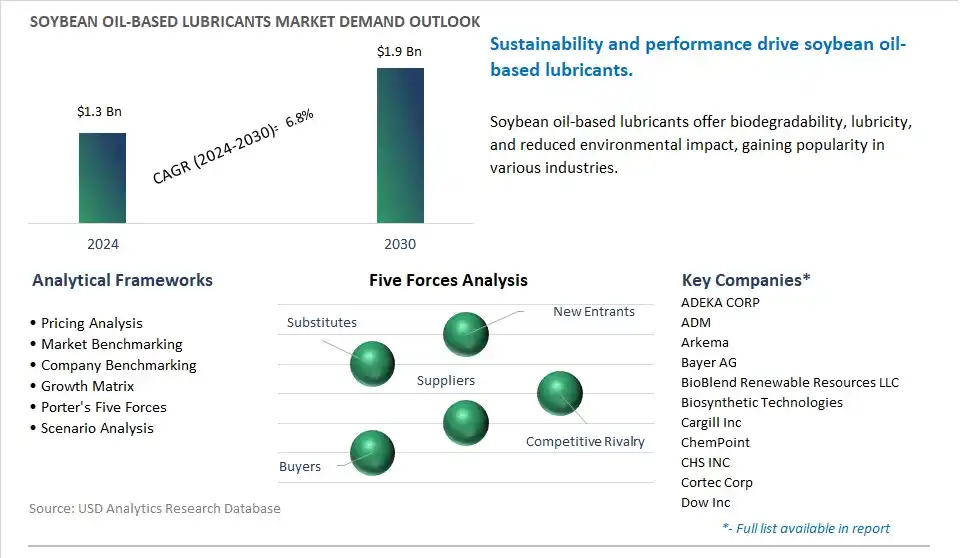
Soybean Oil-based Lubricants Market Competitive Landscape
The market report analyses the leading companies in the industry including ADEKA CORP, ADM, Arkema, Bayer AG, BioBlend Renewable Resources LLC, Biosynthetic Technologies, Cargill Inc, ChemPoint, CHS INC, Cortec Corp, Dow Inc, Elevance Renewable Sciences, Environmental Lubricants Manufacturing Inc, Gemtek Technology Co. Ltd, Linnaeus Plant Sciences, Pioneer, Plews Inc, Renewable Lubricants.
Soybean Oil-based Lubricants Market Dynamics
Soybean Oil based Lubricants Market Trend: Shift towards Environmentally Friendly and Biodegradable Lubricants
A prominent trend in the soybean oil-based lubricants market is the shift towards environmentally friendly and biodegradable lubricants. With increasing environmental awareness and regulations aimed at reducing the use of petroleum-based products, there's a growing demand for lubricants derived from renewable and sustainable sources such as soybean oil. Soybean oil-based lubricants offer several environmental benefits, including biodegradability, low toxicity, and reduced carbon footprint compared to conventional lubricants. This is driven by the need to minimize environmental impact and comply with sustainability initiatives across various industries, including automotive, industrial, and marine. As companies prioritize green procurement practices and seek alternatives to fossil fuel-derived lubricants, the demand for soybean oil-based lubricants is expected to rise.
Soybean Oil based Lubricants Market Driver: Growing Emphasis on Renewable Resources and Sustainable Manufacturing
The primary driver behind the soybean oil-based lubricants market's growth is the growing emphasis on renewable resources and sustainable manufacturing practices. With concerns over climate change, resource depletion, and pollution, industries are increasingly seeking alternatives to petroleum-based lubricants that rely on finite fossil fuel reserves and contribute to environmental degradation. Soybean oil-based lubricants offer a renewable and sustainable alternative, sourced from soybeans, which are abundant and annually renewable crops. Additionally, soybean oil production can be optimized for sustainability through practices such as crop rotation, soil conservation, and reduced chemical inputs. This driver is significant as it aligns with global efforts towards transitioning to a low-carbon economy and promoting sustainable development across industries.
Soybean Oil based Lubricants Market Opportunity: Expansion into New Applications and Markets
An attractive opportunity within the soybean oil-based lubricants market lies in the expansion into new applications and markets. While soybean oil-based lubricants are commonly used in automotive and industrial applications, there are opportunities to explore new markets and niche applications where biodegradable and environmentally friendly lubricants are in demand. For example, there's potential for soybean oil-based lubricants in agriculture for equipment maintenance and machinery lubrication, where environmental concerns and worker safety are paramount. Similarly, the aerospace and marine industries present opportunities for soybean oil-based lubricants due to their biodegradability and compatibility with environmentally sensitive ecosystems. By diversifying their product offerings and targeting new applications, soybean oil-based lubricant manufacturers can tap into new revenue streams and expand their market presence globally.
Soybean Oil-based Lubricants Market Share Analysis: Type I lubricants generated the highest revenue in 2024
The largest segment in the Soybean Oil-based Lubricants Market is Type I lubricants. Type I lubricants are refined soybean oil-based lubricants that undergo further processing and formulation to meet specific performance requirements for various industrial applications. They are extensively used in automotive, manufacturing, construction, and other industries due to their excellent lubricating properties, high viscosity index, thermal stability, and biodegradability. Additionally, Type I lubricants offer advantages such as compatibility with seals and gaskets, resistance to oxidation and corrosion, and environmental friendliness, making them suitable for a wide range of applications. Further, soybean oil-based lubricants have gained popularity as sustainable alternatives to petroleum-based lubricants due to concerns about environmental pollution, resource depletion, and regulatory restrictions on the use of conventional lubricants. Furthermore, advancements in soybean oil processing technologies and lubricant formulations have improved the performance and reliability of Type I lubricants, further driving their adoption in various industries. Accordingly, Type I lubricants emerge as the largest segment in the soybean oil-based lubricants market.
Soybean Oil-based Lubricants Market Share Analysis: hydrogenated segment is poised to register the fastest growth rate (CAGR) over the forecast period to 2030
The fastest-growing segment in the Soybean Oil-based Lubricants Market is the hydrogenated method. The hydrogenation process involves the addition of hydrogen to soybean oil under high pressure and temperature conditions, resulting in the saturation of double bonds and the conversion of unsaturated fatty acids into saturated fatty acids. This modification improves the oxidative stability, thermal stability, and viscosity properties of soybean oil, making it more suitable for lubricant applications where high temperatures, heavy loads, and oxidative environments are encountered. Additionally, hydrogenated soybean oil-based lubricants exhibit enhanced lubricity, film strength, and wear resistance, making them ideal for demanding industrial applications such as automotive engines, hydraulic systems, metalworking fluids, and gear oils. Further, hydrogenated soybean oil-based lubricants offer environmental benefits such as biodegradability, low toxicity, and reduced environmental impact compared to petroleum-based lubricants, aligning with sustainability goals and regulatory requirements for green and eco-friendly products. Furthermore, advancements in hydrogenation technology and process optimization have improved the efficiency, yield, and cost-effectiveness of producing hydrogenated soybean oil-based lubricants, further driving their adoption and market growth. Accordingly, the hydrogenated method segment is the fastest-growing segment in the soybean oil-based lubricants market.
Soybean Oil-based Lubricants Market Share Analysis: metalworking fluids application segment is poised to register the fastest growth rate (CAGR) over the forecast period to 2030
The fastest-growing segment in the Soybean Oil-based Lubricants Market is the metalworking fluids application sector. metalworking fluids play a critical role in machining, cutting, and forming operations in industries such as automotive manufacturing, aerospace, machinery, and metal fabrication. Soybean oil-based metalworking fluids offer potential advantages over conventional petroleum-based fluids, including better lubricity, enhanced cooling properties, improved surface finish, and lower environmental impact. Additionally, soybean oil-based metalworking fluids are biodegradable, renewable, and non-toxic, making them more environmentally friendly and safer for workers compared to petroleum-based alternatives. Further, the growing emphasis on sustainability, worker safety, and regulatory compliance drives the adoption of soybean oil-based metalworking fluids in industrial applications. Furthermore, advancements in soybean oil processing technology and lubricant formulation techniques have improved the performance and stability of metalworking fluids, further fueling their demand and market growth. Accordingly, the metalworking fluids application segment is the fastest-growing segment in the soybean oil-based lubricants market.
Soybean Oil-based Lubricants Market Report Segmentation
By Product
Type I
Type II
By Type
Epoxidation Method
Hydrogenated Method
Transesterification Method
By Application
Engine Oils
Metalworking Fluids
Process Oils
Hydraulic Fluids
Food Grade Lubricants
Others
Regions Included
North America (US, Canada, Mexico)
Europe (Germany, UK, France, Spain, Italy, Russia, Rest of Europe)
Asia Pacific (China, India, Japan, South Korea, Australia, South East Asia, Rest of Asia)
South America (Brazil, Argentina, Rest of South America)
Middle East and Africa (Saudi Arabia, UAE, Rest of Middle East, South Africa, Egypt, Rest of Africa)
Soybean Oil-based Lubricants Companies Profiled in the Market Study
ADEKA CORP
ADM
Arkema
Bayer AG
BioBlend Renewable Resources LLC
Biosynthetic Technologies
Cargill Inc
ChemPoint
CHS INC
Cortec Corp
Dow Inc
Elevance Renewable Sciences
Environmental Lubricants Manufacturing Inc
Gemtek Technology Co. Ltd
Linnaeus Plant Sciences
Pioneer
Plews Inc
Renewable Lubricants
*- List Not Exhaustive
TABLE OF CONTENTS
1 Introduction to 2024 Soybean Oil-based Lubricants Market
1.1 Market Overview
1.2 Quick Facts
1.3 Scope/Objective of the Study
1.4 Market Definition
1.5 Countries and Regions Covered
1.6 Units, Currency, and Conversions
1.7 Industry Value Chain
2 Research Methodology
2.1 Market Size Estimation
2.2 Sources and Research Methodology
2.3 Data Triangulation
2.4 Assumptions and Limitations
3 Executive Summary
3.1 Global Soybean Oil-based Lubricants Market Size Outlook, $ Million, 2021 to 2030
3.2 Soybean Oil-based Lubricants Market Outlook by Type, $ Million, 2021 to 2030
3.3 Soybean Oil-based Lubricants Market Outlook by Product, $ Million, 2021 to 2030
3.4 Soybean Oil-based Lubricants Market Outlook by Application, $ Million, 2021 to 2030
3.5 Soybean Oil-based Lubricants Market Outlook by Key Countries, $ Million, 2021 to 2030
4 Market Dynamics
4.1 Key Driving Forces of Soybean Oil-based Lubricants Industry
4.2 Key Market Trends in Soybean Oil-based Lubricants Industry
4.3 Potential Opportunities in Soybean Oil-based Lubricants Industry
4.4 Key Challenges in Soybean Oil-based Lubricants Industry
5 Market Factor Analysis
5.1 Value Chain Analysis
5.2 Competitive Landscape
5.2.1 Global Soybean Oil-based Lubricants Market Share by Company (%), 2023
5.2.2 Product Offerings by Company
5.3 Porter’s Five Forces Analysis
5.4 Pricing Analysis and Outlook
6 Growth Outlook Across Scenarios
6.1 Growth Analysis-Case Scenario Definitions
6.2 Low Growth Scenario Forecasts
6.3 Reference Growth Scenario Forecasts
6.4 High Growth Scenario Forecasts
7 Global Soybean Oil-based Lubricants Market Outlook by Segments
7.1 Soybean Oil-based Lubricants Market Outlook by Segments, $ Million, 2021- 2030
By Product
Type I
Type II
By Type
Epoxidation Method
Hydrogenated Method
Transesterification Method
By Application
Engine Oils
Metalworking Fluids
Process Oils
Hydraulic Fluids
Food Grade Lubricants
Others
8 North America Soybean Oil-based Lubricants Market Analysis and Outlook To 2030
8.1 Introduction to North America Soybean Oil-based Lubricants Markets in 2024
8.2 North America Soybean Oil-based Lubricants Market Size Outlook by Country, 2021-2030
8.2.1 United States
8.2.2 Canada
8.2.3 Mexico
8.3 North America Soybean Oil-based Lubricants Market size Outlook by Segments, 2021-2030
By Product
Type I
Type II
By Type
Epoxidation Method
Hydrogenated Method
Transesterification Method
By Application
Engine Oils
Metalworking Fluids
Process Oils
Hydraulic Fluids
Food Grade Lubricants
Others
9 Europe Soybean Oil-based Lubricants Market Analysis and Outlook To 2030
9.1 Introduction to Europe Soybean Oil-based Lubricants Markets in 2024
9.2 Europe Soybean Oil-based Lubricants Market Size Outlook by Country, 2021-2030
9.2.1 Germany
9.2.2 France
9.2.3 Spain
9.2.4 United Kingdom
9.2.4 Italy
9.2.5 Russia
9.2.6 Norway
9.2.7 Rest of Europe
9.3 Europe Soybean Oil-based Lubricants Market Size Outlook by Segments, 2021-2030
By Product
Type I
Type II
By Type
Epoxidation Method
Hydrogenated Method
Transesterification Method
By Application
Engine Oils
Metalworking Fluids
Process Oils
Hydraulic Fluids
Food Grade Lubricants
Others
10 Asia Pacific Soybean Oil-based Lubricants Market Analysis and Outlook To 2030
10.1 Introduction to Asia Pacific Soybean Oil-based Lubricants Markets in 2024
10.2 Asia Pacific Soybean Oil-based Lubricants Market Size Outlook by Country, 2021-2030
10.2.1 China
10.2.2 India
10.2.3 Japan
10.2.4 South Korea
10.2.5 Indonesia
10.2.6 Malaysia
10.2.7 Australia
10.2.8 Rest of Asia Pacific
10.3 Asia Pacific Soybean Oil-based Lubricants Market size Outlook by Segments, 2021-2030
By Product
Type I
Type II
By Type
Epoxidation Method
Hydrogenated Method
Transesterification Method
By Application
Engine Oils
Metalworking Fluids
Process Oils
Hydraulic Fluids
Food Grade Lubricants
Others
11 South America Soybean Oil-based Lubricants Market Analysis and Outlook To 2030
11.1 Introduction to South America Soybean Oil-based Lubricants Markets in 2024
11.2 South America Soybean Oil-based Lubricants Market Size Outlook by Country, 2021-2030
11.2.1 Brazil
11.2.2 Argentina
11.2.3 Rest of South America
11.3 South America Soybean Oil-based Lubricants Market size Outlook by Segments, 2021-2030
By Product
Type I
Type II
By Type
Epoxidation Method
Hydrogenated Method
Transesterification Method
By Application
Engine Oils
Metalworking Fluids
Process Oils
Hydraulic Fluids
Food Grade Lubricants
Others
12 Middle East and Africa Soybean Oil-based Lubricants Market Analysis and Outlook To 2030
12.1 Introduction to Middle East and Africa Soybean Oil-based Lubricants Markets in 2024
12.2 Middle East and Africa Soybean Oil-based Lubricants Market Size Outlook by Country, 2021-2030
12.2.1 Saudi Arabia
12.2.2 UAE
12.2.3 Oman
12.2.4 Rest of Middle East
12.2.5 Egypt
12.2.6 Nigeria
12.2.7 South Africa
12.2.8 Rest of Africa
12.3 Middle East and Africa Soybean Oil-based Lubricants Market size Outlook by Segments, 2021-2030
By Product
Type I
Type II
By Type
Epoxidation Method
Hydrogenated Method
Transesterification Method
By Application
Engine Oils
Metalworking Fluids
Process Oils
Hydraulic Fluids
Food Grade Lubricants
Others
13 Company Profiles
13.1 Company Snapshot
13.2 SWOT Profiles
13.3 Products and Services
13.4 Recent Developments
13.5 Financial Profile
ADEKA CORP
ADM
Arkema
Bayer AG
BioBlend Renewable Resources LLC
Biosynthetic Technologies
Cargill Inc
ChemPoint
CHS INC
Cortec Corp
Dow Inc
Elevance Renewable Sciences
Environmental Lubricants Manufacturing Inc
Gemtek Technology Co. Ltd
Linnaeus Plant Sciences
Pioneer
Plews Inc
Renewable Lubricants
14 Appendix
14.1 Customization Offerings
14.2 Subscription Services
14.3 Related Reports
14.4 Publisher Expertise
By Product
Type I
Type II
By Type
Epoxidation Method
Hydrogenated Method
Transesterification Method
By Application
Engine Oils
Metalworking Fluids
Process Oils
Hydraulic Fluids
Food Grade Lubricants
Others
Countries Analyzed
North America (US, Canada, Mexico)
Europe (Germany, UK, France, Spain, Italy, Russia, Rest of Europe)
Asia Pacific (China, India, Japan, South Korea, Australia, South East Asia, Rest of Asia)
South America (Brazil, Argentina, Rest of South America)
Middle East and Africa (Saudi Arabia, UAE, Rest of Middle East, South Africa, Egypt, Rest of Africa)
