
The global Spray Drying Equipment Market Study analyzes and forecasts the market size across 6 regions and 24 countries for diverse segments -By Product (Rotary Atomizer, Nozzle Atomizer, Fluidized, Centrifugal, Others), By Cycle Type (Open Cycle, Closed Cycle), By Drying Stage (Single Stage, Two-Stage, Multi-Stage), By Flow Type (Co-Current, Counter Current, Mixed), By Capacity (Low Capacity, Medium Capacity, High Capacity), By Operating Principle (Direct Heating, Indirect Heating), By Application (Food & Beverages, Pharmaceuticals, Chemicals, Animal Feed, Others).
The future of spray drying equipment is driven by trends in food processing, pharmaceuticals, and industrial manufacturing, influenced by the demand for efficient, scalable, and customizable drying solutions for converting liquid and semi-liquid feedstocks into powdered or granular products. Spray drying is a versatile drying technique that involves atomizing a liquid feedstock into fine droplets and then rapidly drying them using hot air or gas, resulting in dried particles with controlled size, shape, and moisture content. With the increasing demand for powdered ingredients, functional additives, and instant foods, spray drying equipment plays a crucial role in producing a wide range of products such as powdered milk, coffee, flavors, pharmaceuticals, and detergents. Moreover, as industries seek to optimize process efficiency, product quality, and energy consumption, there is growing interest in spray drying equipment that offers advantages such as high throughput, uniform particle size distribution, and low operating costs. Additionally, advancements in spray drying technology, including nozzle design, airflow control, and process monitoring, enable the development of spray dryers that are versatile, reliable, and easy to maintain, meeting the diverse needs of manufacturers and processors in various sectors. Furthermore, as industries innovate to address emerging challenges such as clean label formulations, functional ingredients, and sustainable manufacturing practices, spray drying equipment will continue to play a key role in enabling product innovation, process optimization, and market competitiveness, driving growth and innovation in the global drying technology industry.
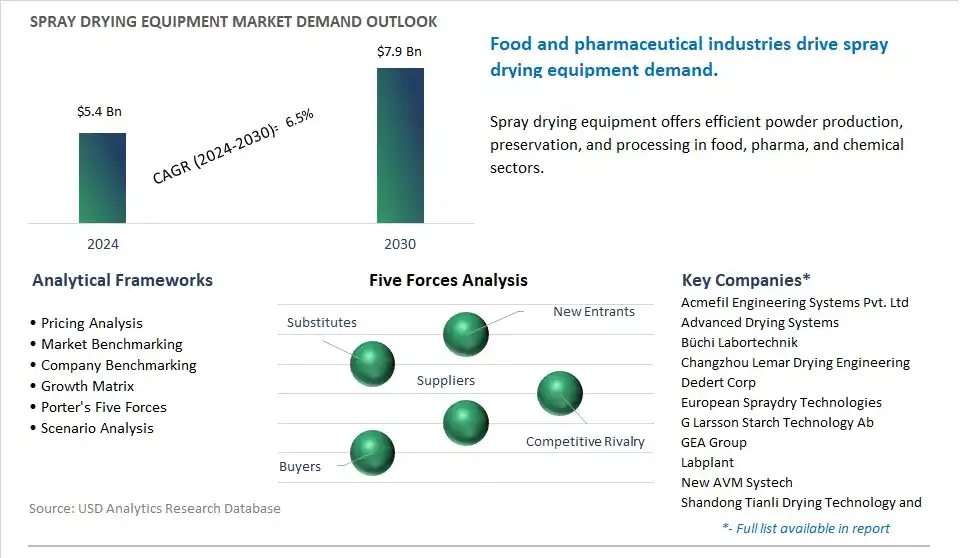
The market report analyses the leading companies in the industry including Acmefil Engineering Systems Pvt. Ltd, Advanced Drying Systems, Büchi Labortechnik, Changzhou Lemar Drying Engineering, Dedert Corp, European Spraydry Technologies, G Larsson Starch Technology Ab, GEA Group, Labplant, New AVM Systech, Shandong Tianli Drying Technology and Equipment, SPX Flow, Swenson Technology Inc, Tetra Pak International S.A, Yamato Scientific America.
A prominent trend in the spray drying equipment market is the growing demand for powdered and dried products across various industries. Spray drying is a widely used method for converting liquid or slurry materials into dried powders or granules, offering advantages such as extended shelf life, easier storage and transportation, and enhanced product stability. This is driven by the increasing popularity of powdered products in industries such as food and beverages, pharmaceuticals, chemicals, and dairy products. As manufacturers seek efficient and scalable solutions for producing powdered ingredients, additives, flavors, and functional compounds, the demand for spray drying equipment is expected to rise.
The primary driver behind the spray drying equipment market's growth is technological advancements in spray drying processes and equipment. Manufacturers are continually innovating to improve the efficiency, flexibility, and productivity of spray drying systems. Advances in nozzle design, atomization techniques, drying chamber configurations, and control systems enable precise control over drying parameters such as temperature, airflow, and particle size distribution. Additionally, innovations in energy-efficient drying technologies, such as fluidized bed drying and vacuum spray drying, help reduce operating costs and environmental impact. This driver is significant as it drives product innovation, enhances process efficiency, and expands the applicability of spray drying equipment across a wide range of industries and applications.
An attractive opportunity within the spray drying equipment market lies in the expansion into emerging markets and specialty applications. Emerging economies experiencing rapid industrialization and urbanization present untapped opportunities for spray drying equipment manufacturers to expand their market presence and customer base. Additionally, there's potential to develop specialized spray drying solutions for niche applications such as nutraceuticals, cosmetics, ceramics, and biotechnology. By leveraging their expertise in spray drying technology, process engineering, and application development, manufacturers can capitalize on emerging market trends, address unmet needs in specialized applications, and establish themselves as key players in the global spray drying equipment market.
The largest segment in the Spray Drying Equipment Market is the Rotary Atomizer. rotary atomizers are widely used in spray drying processes across various industries such as food and beverages, pharmaceuticals, chemicals, and ceramics due to their versatility, efficiency, and reliability. Rotary atomizers utilize centrifugal force to disperse liquid feed into fine droplets, which are then dried into powder particles through evaporation in a heated chamber. This method allows for precise control over particle size, moisture content, and product quality, making rotary atomizers suitable for producing a wide range of powders with consistent characteristics. Additionally, rotary atomizers can handle a broad spectrum of feed materials, including heat-sensitive substances, sticky liquids, and abrasive slurries, making them adaptable to diverse production requirements and applications. Furthermore, advancements in rotary atomizer technology, such as improved design, materials, and automation features, have further enhanced their performance, productivity, and ease of operation. As a result of these factors, the Rotary Atomizer segment remains the largest in the Spray Drying Equipment Market, catering to the growing demand for high-quality powdered products across industries.
The fastest-growing segment in the Spray Drying Equipment Market is the Closed Cycle type. closed-cycle spray drying systems offer significant advantages in terms of product quality, process efficiency, and environmental sustainability compared to open-cycle systems. In closed-cycle spray drying, the drying medium (usually air or nitrogen) is circulated within a closed loop, minimizing heat loss, contamination, and environmental emissions. This results in higher energy efficiency, reduced operating costs, and improved control over process parameters such as temperature, humidity, and airflow. Additionally, closed-cycle systems allow for better control of product characteristics such as particle size, density, and moisture content, resulting in higher product yields and consistent quality. Furthermore, closed-cycle spray drying is particularly well-suited for processing heat-sensitive materials and volatile compounds, as it minimizes exposure to oxygen and moisture, thereby preserving product integrity and stability. As industries increasingly prioritize sustainability, energy efficiency, and product quality in their manufacturing processes, the demand for closed-cycle spray drying equipment is expected to continue growing rapidly.
The fastest-growing segment in the Spray Drying Equipment Market is the Multi-Stage drying stage. multi-stage spray drying systems offer enhanced efficiency, flexibility, and versatility compared to single or two-stage systems. In multi-stage drying, the drying process is divided into multiple stages, each with its specific temperature, airflow, and residence time conditions, allowing for precise control over product moisture content and quality. This enables manufacturers to optimize drying parameters for different feed materials and product specifications, resulting in higher yields, improved product consistency, and reduced energy consumption. Additionally, multi-stage drying systems are well-suited for processing complex formulations, sensitive materials, and high-value products that require gentle handling and precise control over drying kinetics. Furthermore, advancements in spray drying technology, such as innovative nozzle designs, fluid dynamics modeling, and process automation, have contributed to the increased efficiency and performance of multi-stage drying systems. As industries continue to seek cost-effective and sustainable solutions for powder production, the demand for multi-stage spray drying equipment is expected to grow rapidly.
By Product
Rotary Atomizer
Nozzle Atomizer
Fluidized
Centrifugal
Others
By Cycle Type
Open Cycle
Closed Cycle
By Drying Stage
Single Stage
Two-Stage
Multi-Stage
By Flow Type
Co-Current
Counter Current
Mixed
By Capacity
Low Capacity
Medium Capacity
High Capacity
By Operating Principle
Direct Heating
Indirect Heating
By Application
Food & Beverages
Pharmaceuticals
Chemicals
Animal Feed
Others
Regions Included
North America (US, Canada, Mexico)
Europe (Germany, UK, France, Spain, Italy, Russia, Rest of Europe)
Asia Pacific (China, India, Japan, South Korea, Australia, South East Asia, Rest of Asia)
South America (Brazil, Argentina, Rest of South America)
Middle East and Africa (Saudi Arabia, UAE, Rest of Middle East, South Africa, Egypt, Rest of Africa)
Acmefil Engineering Systems Pvt. Ltd
Advanced Drying Systems
Büchi Labortechnik
Changzhou Lemar Drying Engineering
Dedert Corp
European Spraydry Technologies
G Larsson Starch Technology Ab
GEA Group
Labplant
New AVM Systech
Shandong Tianli Drying Technology and Equipment
SPX Flow
Swenson Technology Inc
Tetra Pak International S.A
Yamato Scientific America
*- List Not Exhaustive
TABLE OF CONTENTS
1 Introduction to 2024 Spray Drying Equipment Market
1.1 Market Overview
1.2 Quick Facts
1.3 Scope/Objective of the Study
1.4 Market Definition
1.5 Countries and Regions Covered
1.6 Units, Currency, and Conversions
1.7 Industry Value Chain
2 Research Methodology
2.1 Market Size Estimation
2.2 Sources and Research Methodology
2.3 Data Triangulation
2.4 Assumptions and Limitations
3 Executive Summary
3.1 Global Spray Drying Equipment Market Size Outlook, $ Million, 2021 to 2030
3.2 Spray Drying Equipment Market Outlook by Type, $ Million, 2021 to 2030
3.3 Spray Drying Equipment Market Outlook by Product, $ Million, 2021 to 2030
3.4 Spray Drying Equipment Market Outlook by Application, $ Million, 2021 to 2030
3.5 Spray Drying Equipment Market Outlook by Key Countries, $ Million, 2021 to 2030
4 Market Dynamics
4.1 Key Driving Forces of Spray Drying Equipment Industry
4.2 Key Market Trends in Spray Drying Equipment Industry
4.3 Potential Opportunities in Spray Drying Equipment Industry
4.4 Key Challenges in Spray Drying Equipment Industry
5 Market Factor Analysis
5.1 Value Chain Analysis
5.2 Competitive Landscape
5.2.1 Global Spray Drying Equipment Market Share by Company (%), 2023
5.2.2 Product Offerings by Company
5.3 Porter’s Five Forces Analysis
5.4 Pricing Analysis and Outlook
6 Growth Outlook Across Scenarios
6.1 Growth Analysis-Case Scenario Definitions
6.2 Low Growth Scenario Forecasts
6.3 Reference Growth Scenario Forecasts
6.4 High Growth Scenario Forecasts
7 Global Spray Drying Equipment Market Outlook by Segments
7.1 Spray Drying Equipment Market Outlook by Segments, $ Million, 2021- 2030
By Product
Rotary Atomizer
Nozzle Atomizer
Fluidized
Centrifugal
Others
By Cycle Type
Open Cycle
Closed Cycle
By Drying Stage
Single Stage
Two-Stage
Multi-Stage
By Flow Type
Co-Current
Counter Current
Mixed
By Capacity
Low Capacity
Medium Capacity
High Capacity
By Operating Principle
Direct Heating
Indirect Heating
By Application
Food & Beverages
Pharmaceuticals
Chemicals
Animal Feed
Others
8 North America Spray Drying Equipment Market Analysis and Outlook To 2030
8.1 Introduction to North America Spray Drying Equipment Markets in 2024
8.2 North America Spray Drying Equipment Market Size Outlook by Country, 2021-2030
8.2.1 United States
8.2.2 Canada
8.2.3 Mexico
8.3 North America Spray Drying Equipment Market size Outlook by Segments, 2021-2030
By Product
Rotary Atomizer
Nozzle Atomizer
Fluidized
Centrifugal
Others
By Cycle Type
Open Cycle
Closed Cycle
By Drying Stage
Single Stage
Two-Stage
Multi-Stage
By Flow Type
Co-Current
Counter Current
Mixed
By Capacity
Low Capacity
Medium Capacity
High Capacity
By Operating Principle
Direct Heating
Indirect Heating
By Application
Food & Beverages
Pharmaceuticals
Chemicals
Animal Feed
Others
9 Europe Spray Drying Equipment Market Analysis and Outlook To 2030
9.1 Introduction to Europe Spray Drying Equipment Markets in 2024
9.2 Europe Spray Drying Equipment Market Size Outlook by Country, 2021-2030
9.2.1 Germany
9.2.2 France
9.2.3 Spain
9.2.4 United Kingdom
9.2.4 Italy
9.2.5 Russia
9.2.6 Norway
9.2.7 Rest of Europe
9.3 Europe Spray Drying Equipment Market Size Outlook by Segments, 2021-2030
By Product
Rotary Atomizer
Nozzle Atomizer
Fluidized
Centrifugal
Others
By Cycle Type
Open Cycle
Closed Cycle
By Drying Stage
Single Stage
Two-Stage
Multi-Stage
By Flow Type
Co-Current
Counter Current
Mixed
By Capacity
Low Capacity
Medium Capacity
High Capacity
By Operating Principle
Direct Heating
Indirect Heating
By Application
Food & Beverages
Pharmaceuticals
Chemicals
Animal Feed
Others
10 Asia Pacific Spray Drying Equipment Market Analysis and Outlook To 2030
10.1 Introduction to Asia Pacific Spray Drying Equipment Markets in 2024
10.2 Asia Pacific Spray Drying Equipment Market Size Outlook by Country, 2021-2030
10.2.1 China
10.2.2 India
10.2.3 Japan
10.2.4 South Korea
10.2.5 Indonesia
10.2.6 Malaysia
10.2.7 Australia
10.2.8 Rest of Asia Pacific
10.3 Asia Pacific Spray Drying Equipment Market size Outlook by Segments, 2021-2030
By Product
Rotary Atomizer
Nozzle Atomizer
Fluidized
Centrifugal
Others
By Cycle Type
Open Cycle
Closed Cycle
By Drying Stage
Single Stage
Two-Stage
Multi-Stage
By Flow Type
Co-Current
Counter Current
Mixed
By Capacity
Low Capacity
Medium Capacity
High Capacity
By Operating Principle
Direct Heating
Indirect Heating
By Application
Food & Beverages
Pharmaceuticals
Chemicals
Animal Feed
Others
11 South America Spray Drying Equipment Market Analysis and Outlook To 2030
11.1 Introduction to South America Spray Drying Equipment Markets in 2024
11.2 South America Spray Drying Equipment Market Size Outlook by Country, 2021-2030
11.2.1 Brazil
11.2.2 Argentina
11.2.3 Rest of South America
11.3 South America Spray Drying Equipment Market size Outlook by Segments, 2021-2030
By Product
Rotary Atomizer
Nozzle Atomizer
Fluidized
Centrifugal
Others
By Cycle Type
Open Cycle
Closed Cycle
By Drying Stage
Single Stage
Two-Stage
Multi-Stage
By Flow Type
Co-Current
Counter Current
Mixed
By Capacity
Low Capacity
Medium Capacity
High Capacity
By Operating Principle
Direct Heating
Indirect Heating
By Application
Food & Beverages
Pharmaceuticals
Chemicals
Animal Feed
Others
12 Middle East and Africa Spray Drying Equipment Market Analysis and Outlook To 2030
12.1 Introduction to Middle East and Africa Spray Drying Equipment Markets in 2024
12.2 Middle East and Africa Spray Drying Equipment Market Size Outlook by Country, 2021-2030
12.2.1 Saudi Arabia
12.2.2 UAE
12.2.3 Oman
12.2.4 Rest of Middle East
12.2.5 Egypt
12.2.6 Nigeria
12.2.7 South Africa
12.2.8 Rest of Africa
12.3 Middle East and Africa Spray Drying Equipment Market size Outlook by Segments, 2021-2030
By Product
Rotary Atomizer
Nozzle Atomizer
Fluidized
Centrifugal
Others
By Cycle Type
Open Cycle
Closed Cycle
By Drying Stage
Single Stage
Two-Stage
Multi-Stage
By Flow Type
Co-Current
Counter Current
Mixed
By Capacity
Low Capacity
Medium Capacity
High Capacity
By Operating Principle
Direct Heating
Indirect Heating
By Application
Food & Beverages
Pharmaceuticals
Chemicals
Animal Feed
Others
13 Company Profiles
13.1 Company Snapshot
13.2 SWOT Profiles
13.3 Products and Services
13.4 Recent Developments
13.5 Financial Profile
Acmefil Engineering Systems Pvt. Ltd
Advanced Drying Systems
Büchi Labortechnik
Changzhou Lemar Drying Engineering
Dedert Corp
European Spraydry Technologies
G Larsson Starch Technology Ab
GEA Group
Labplant
New AVM Systech
Shandong Tianli Drying Technology and Equipment
SPX Flow
Swenson Technology Inc
Tetra Pak International S.A
Yamato Scientific America
14 Appendix
14.1 Customization Offerings
14.2 Subscription Services
14.3 Related Reports
14.4 Publisher Expertise
By Product
Rotary Atomizer
Nozzle Atomizer
Fluidized
Centrifugal
Others
By Cycle Type
Open Cycle
Closed Cycle
By Drying Stage
Single Stage
Two-Stage
Multi-Stage
By Flow Type
Co-Current
Counter Current
Mixed
By Capacity
Low Capacity
Medium Capacity
High Capacity
By Operating Principle
Direct Heating
Indirect Heating
By Application
Food & Beverages
Pharmaceuticals
Chemicals
Animal Feed
Others
Countries Analyzed
North America (US, Canada, Mexico)
Europe (Germany, UK, France, Spain, Italy, Russia, Rest of Europe)
Asia Pacific (China, India, Japan, South Korea, Australia, South East Asia, Rest of Asia)
South America (Brazil, Argentina, Rest of South America)
Middle East and Africa (Saudi Arabia, UAE, Rest of Middle East, South Africa, Egypt, Rest of Africa)
Global Spray Drying Equipment is forecast to reach $7.9 Billion in 2030 from $5.4 Billion in 2024, registering a CAGR of 6.5%
Emerging Markets across Asia Pacific, Europe, and Americas present robust growth prospects.
Acmefil Engineering Systems Pvt. Ltd, Advanced Drying Systems, Büchi Labortechnik, Changzhou Lemar Drying Engineering, Dedert Corp, European Spraydry Technologies, G Larsson Starch Technology Ab, GEA Group, Labplant, New AVM Systech, Shandong Tianli Drying Technology and Equipment, SPX Flow, Swenson Technology Inc, Tetra Pak International S.A, Yamato Scientific America
Base Year- 2023; Estimated Year- 2024; Historic Period- 2018-2023; Forecast period- 2024 to 2030; Currency: Revenue (USD); Volume