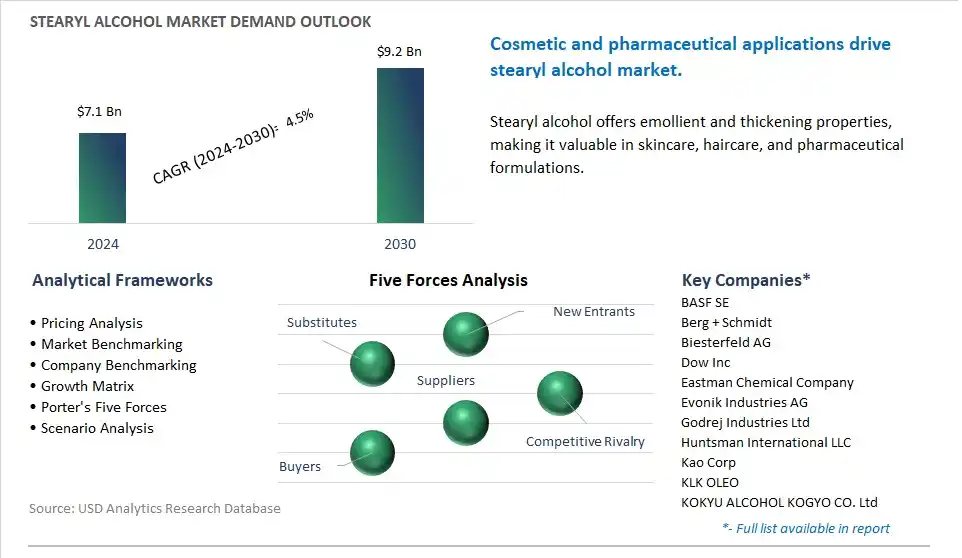
The global Stearyl Alcohol Market is poised to register a 4.5% CAGR from $7.1 Billion in 2024 to $9.2 Billion in 2030.
The global Stearyl Alcohol Market Study analyzes and forecasts the market size across 6 regions and 24 countries for diverse segments -By Testing Type (Physical, Chemical, Microbiological), By Application (Emulsion Stabilizer, Fragrance Ingredient, Emulsifying Agent, Foam Booster, Viscosity Modifier, Emollient), By Grade (Regular Grade, High Purity Grade), By End-User (Personal Care and Cosmetics, Pharmaceutical Industry, Food and Beverage Industry, Others), By Form (Liquid, Waxy Solid).
An Introduction to Global Stearyl Alcohol Market in 2024
Stearyl alcohol, a fatty alcohol derived from natural sources such as coconut oil and palm oil, is witnessing increasing demand across various industries including personal care, pharmaceuticals, and industrial applications. One of the key trends shaping the future of the stearyl alcohol market is the rising preference for natural and sustainable ingredients in consumer products. Manufacturers are responding to this demand by offering stearyl alcohol derived from renewable plant sources, free from animal-derived ingredients and synthetic additives. Additionally, advancements in processing technologies, such as molecular distillation and fractionation, are enabling the production of high-purity stearyl alcohol with improved sensory properties and performance characteristics, enhancing its suitability for use in premium formulations. Moreover, the versatility of stearyl alcohol as an emollient, emulsifier, and viscosity modifier is driving its adoption in a wide range of applications, from skincare creams and lotions to hair care products and pharmaceutical formulations.
Stearyl Alcohol Market Competitive Landscape
The market report analyses the leading companies in the industry including BASF SE, Berg + Schmidt, Biesterfeld AG, Dow Inc, Eastman Chemical Company, Evonik Industries AG, Godrej Industries Ltd, Huntsman International LLC, Kao Corp, KLK OLEO, KOKYU ALCOHOL KOGYO CO. Ltd, Merck KGaA, New Japan Chemical Co. Ltd, Oleon NV, Procter & Gamble, SABIC, Triveni Chemicals, VVF Group.
Stearyl Alcohol Market Dynamics
Stearyl Alcohol Market Trend: Increasing Demand for Natural and Sustainable Ingredients in Personal Care Products
A prominent trend in the stearyl alcohol market is the increasing demand for natural and sustainable ingredients in personal care products. Stearyl alcohol, derived from natural sources such as coconut oil or palm oil, is widely used in skincare, haircare, and cosmetics formulations for its emollient properties and ability to enhance product texture and stability. With growing consumer awareness of environmental sustainability and health-consciousness, there's a rising preference for products formulated with natural ingredients like stearyl alcohol. This is driven by shifting consumer preferences, regulatory initiatives promoting green formulations, and the need for safer and eco-friendly alternatives in personal care products.
Stearyl Alcohol Market Driver: Growth in the Cosmetic and Pharmaceutical Industries
The primary driver behind the stearyl alcohol market's growth is the expansion of the cosmetic and pharmaceutical industries. Stearyl alcohol serves as a versatile ingredient in the formulation of creams, lotions, ointments, and pharmaceutical products due to its moisturizing and emulsifying properties. As the demand for skincare, haircare, and pharmaceutical products continues to rise globally, driven by factors such as population growth, aging demographics, and increasing disposable incomes, there's a corresponding increase in the demand for stearyl alcohol as a key raw material. This driver is significant as it fuels market demand, encourages product innovation, and creates opportunities for suppliers and manufacturers of stearyl alcohol to cater to the growing needs of these industries.
Stearyl Alcohol Market Opportunity: Expansion into Sustainable Packaging Solutions
An attractive opportunity within the stearyl alcohol market lies in the expansion into sustainable packaging solutions. While stearyl alcohol is primarily used as an ingredient in personal care and pharmaceutical products, there's potential to explore its applications in sustainable packaging materials. Stearyl alcohol derivatives can be utilized in the production of biodegradable packaging films, coatings, and materials, offering an environmentally friendly alternative to traditional plastic packaging. By leveraging its emulsifying and barrier properties, stearyl alcohol can contribute to the development of sustainable packaging solutions that reduce environmental impact, support circular economy initiatives, and meet consumer demand for eco-friendly packaging options. This opportunity allows stearyl alcohol manufacturers to diversify their product offerings, enter new market segments, and contribute to sustainability efforts in the packaging industry.
Stearyl Alcohol Market Share Analysis: Physical Testing generated the highest revenue in 2024
physical testing is essential for evaluating the physical properties of stearyl alcohol, including its appearance, texture, melting point, and solubility. These properties are crucial for determining the suitability of stearyl alcohol for various applications, such as in cosmetics, pharmaceuticals, and personal care products. Additionally, physical testing ensures that stearyl alcohol meets the required standards and specifications set by regulatory authorities and industry standards organizations. Furthermore, physical testing plays a vital role in quality control and product development processes, helping manufacturers maintain consistency and uniformity in their stearyl alcohol products. As a result of these factors, the Physical Testing Type segment remains the largest in the Stearyl Alcohol Market, reflecting its importance in ensuring the quality and performance of stearyl alcohol for diverse industrial applications.
Stearyl Alcohol Market Share Analysis: Emulsion Stabilizer application segment is poised to register the fastest growth rate (CAGR) over the forecast period to 2030
emulsion stabilizers play a crucial role in the formulation of various cosmetic and personal care products, including lotions, creams, serums, and moisturizers. Stearyl alcohol, with its emulsifying properties, helps to stabilize oil-in-water emulsions by preventing the separation of oil and water phases and maintaining the uniformity and stability of the product. Additionally, the demand for emulsion stabilizers is driven by the growing consumer preference for stable and long-lasting cosmetic formulations that provide hydration, nourishment, and protection to the skin. Furthermore, as manufacturers increasingly focus on developing advanced formulations with improved sensory attributes, such as smooth texture, luxurious feel, and fast absorption, the demand for stearyl alcohol as an emulsion stabilizer is expected to continue growing rapidly. As a result of these factors, the Emulsion Stabilizer application segment is experiencing significant growth in the Stearyl Alcohol Market, driven by its essential role in cosmetic and personal care product formulations and the evolving needs of consumers for high-quality skincare products.
Stearyl Alcohol Market Share Analysis: High Purity Grade segment is poised to register the fastest growth rate (CAGR) over the forecast period to 2030
high purity grade stearyl alcohol is increasingly sought after in industries such as pharmaceuticals, personal care, and food processing, where stringent quality and safety standards are paramount. High purity grade stearyl alcohol undergoes additional refining and purification processes to remove impurities, contaminants, and residual chemicals, resulting in a product with superior purity, consistency, and performance. Additionally, high purity grade stearyl alcohol offers advantages such as improved stability, compatibility, and efficacy in formulations, making it ideal for use in sensitive applications such as pharmaceuticals and food additives. Furthermore, the growing demand for natural and sustainable ingredients in consumer products is driving the adoption of high purity grade stearyl alcohol derived from vegetable-based sources such as palm oil, coconut oil, and shea butter. As manufacturers and consumers prioritize product quality, safety, and sustainability, the demand for high purity grade stearyl alcohol is expected to continue growing rapidly, making it the fastest-growing segment in the Stearyl Alcohol Market.
Stearyl Alcohol Market Report Segmentation
By Testing Type
Physical
Chemical
Microbiological
By Application
Emulsion Stabilizer
Fragrance Ingredient
Emulsifying Agent
Foam Booster
Viscosity Modifier
Emollient
By Grade
Regular Grade
High Purity Grade
By End-User
Personal Care and Cosmetics
Pharmaceutical Industry
Food and Beverage Industry
Others
By Form
Liquid
Waxy Solid
Regions Included
North America (US, Canada, Mexico)
Europe (Germany, UK, France, Spain, Italy, Russia, Rest of Europe)
Asia Pacific (China, India, Japan, South Korea, Australia, South East Asia, Rest of Asia)
South America (Brazil, Argentina, Rest of South America)
Middle East and Africa (Saudi Arabia, UAE, Rest of Middle East, South Africa, Egypt, Rest of Africa)
Stearyl Alcohol Companies Profiled in the Market Study
BASF SE
Berg + Schmidt
Biesterfeld AG
Dow Inc
Eastman Chemical Company
Evonik Industries AG
Godrej Industries Ltd
Huntsman International LLC
Kao Corp
KLK OLEO
KOKYU ALCOHOL KOGYO CO. Ltd
Merck KGaA
New Japan Chemical Co. Ltd
Oleon NV
Procter & Gamble
SABIC
Triveni Chemicals
VVF Group
*- List Not Exhaustive
TABLE OF CONTENTS
1 Introduction to 2024 Stearyl Alcohol Market
1.1 Market Overview
1.2 Quick Facts
1.3 Scope/Objective of the Study
1.4 Market Definition
1.5 Countries and Regions Covered
1.6 Units, Currency, and Conversions
1.7 Industry Value Chain
2 Research Methodology
2.1 Market Size Estimation
2.2 Sources and Research Methodology
2.3 Data Triangulation
2.4 Assumptions and Limitations
3 Executive Summary
3.1 Global Stearyl Alcohol Market Size Outlook, $ Million, 2021 to 2030
3.2 Stearyl Alcohol Market Outlook by Type, $ Million, 2021 to 2030
3.3 Stearyl Alcohol Market Outlook by Product, $ Million, 2021 to 2030
3.4 Stearyl Alcohol Market Outlook by Application, $ Million, 2021 to 2030
3.5 Stearyl Alcohol Market Outlook by Key Countries, $ Million, 2021 to 2030
4 Market Dynamics
4.1 Key Driving Forces of Stearyl Alcohol Industry
4.2 Key Market Trends in Stearyl Alcohol Industry
4.3 Potential Opportunities in Stearyl Alcohol Industry
4.4 Key Challenges in Stearyl Alcohol Industry
5 Market Factor Analysis
5.1 Value Chain Analysis
5.2 Competitive Landscape
5.2.1 Global Stearyl Alcohol Market Share by Company (%), 2023
5.2.2 Product Offerings by Company
5.3 Porter’s Five Forces Analysis
5.4 Pricing Analysis and Outlook
6 Growth Outlook Across Scenarios
6.1 Growth Analysis-Case Scenario Definitions
6.2 Low Growth Scenario Forecasts
6.3 Reference Growth Scenario Forecasts
6.4 High Growth Scenario Forecasts
7 Global Stearyl Alcohol Market Outlook by Segments
7.1 Stearyl Alcohol Market Outlook by Segments, $ Million, 2021- 2030
By Testing Type
Physical
Chemical
Microbiological
By Application
Emulsion Stabilizer
Fragrance Ingredient
Emulsifying Agent
Foam Booster
Viscosity Modifier
Emollient
By Grade
Regular Grade
High Purity Grade
By End-User
Personal Care and Cosmetics
Pharmaceutical Industry
Food and Beverage Industry
Others
By Form
Liquid
Waxy Solid
8 North America Stearyl Alcohol Market Analysis and Outlook To 2030
8.1 Introduction to North America Stearyl Alcohol Markets in 2024
8.2 North America Stearyl Alcohol Market Size Outlook by Country, 2021-2030
8.2.1 United States
8.2.2 Canada
8.2.3 Mexico
8.3 North America Stearyl Alcohol Market size Outlook by Segments, 2021-2030
By Testing Type
Physical
Chemical
Microbiological
By Application
Emulsion Stabilizer
Fragrance Ingredient
Emulsifying Agent
Foam Booster
Viscosity Modifier
Emollient
By Grade
Regular Grade
High Purity Grade
By End-User
Personal Care and Cosmetics
Pharmaceutical Industry
Food and Beverage Industry
Others
By Form
Liquid
Waxy Solid
9 Europe Stearyl Alcohol Market Analysis and Outlook To 2030
9.1 Introduction to Europe Stearyl Alcohol Markets in 2024
9.2 Europe Stearyl Alcohol Market Size Outlook by Country, 2021-2030
9.2.1 Germany
9.2.2 France
9.2.3 Spain
9.2.4 United Kingdom
9.2.4 Italy
9.2.5 Russia
9.2.6 Norway
9.2.7 Rest of Europe
9.3 Europe Stearyl Alcohol Market Size Outlook by Segments, 2021-2030
By Testing Type
Physical
Chemical
Microbiological
By Application
Emulsion Stabilizer
Fragrance Ingredient
Emulsifying Agent
Foam Booster
Viscosity Modifier
Emollient
By Grade
Regular Grade
High Purity Grade
By End-User
Personal Care and Cosmetics
Pharmaceutical Industry
Food and Beverage Industry
Others
By Form
Liquid
Waxy Solid
10 Asia Pacific Stearyl Alcohol Market Analysis and Outlook To 2030
10.1 Introduction to Asia Pacific Stearyl Alcohol Markets in 2024
10.2 Asia Pacific Stearyl Alcohol Market Size Outlook by Country, 2021-2030
10.2.1 China
10.2.2 India
10.2.3 Japan
10.2.4 South Korea
10.2.5 Indonesia
10.2.6 Malaysia
10.2.7 Australia
10.2.8 Rest of Asia Pacific
10.3 Asia Pacific Stearyl Alcohol Market size Outlook by Segments, 2021-2030
By Testing Type
Physical
Chemical
Microbiological
By Application
Emulsion Stabilizer
Fragrance Ingredient
Emulsifying Agent
Foam Booster
Viscosity Modifier
Emollient
By Grade
Regular Grade
High Purity Grade
By End-User
Personal Care and Cosmetics
Pharmaceutical Industry
Food and Beverage Industry
Others
By Form
Liquid
Waxy Solid
11 South America Stearyl Alcohol Market Analysis and Outlook To 2030
11.1 Introduction to South America Stearyl Alcohol Markets in 2024
11.2 South America Stearyl Alcohol Market Size Outlook by Country, 2021-2030
11.2.1 Brazil
11.2.2 Argentina
11.2.3 Rest of South America
11.3 South America Stearyl Alcohol Market size Outlook by Segments, 2021-2030
By Testing Type
Physical
Chemical
Microbiological
By Application
Emulsion Stabilizer
Fragrance Ingredient
Emulsifying Agent
Foam Booster
Viscosity Modifier
Emollient
By Grade
Regular Grade
High Purity Grade
By End-User
Personal Care and Cosmetics
Pharmaceutical Industry
Food and Beverage Industry
Others
By Form
Liquid
Waxy Solid
12 Middle East and Africa Stearyl Alcohol Market Analysis and Outlook To 2030
12.1 Introduction to Middle East and Africa Stearyl Alcohol Markets in 2024
12.2 Middle East and Africa Stearyl Alcohol Market Size Outlook by Country, 2021-2030
12.2.1 Saudi Arabia
12.2.2 UAE
12.2.3 Oman
12.2.4 Rest of Middle East
12.2.5 Egypt
12.2.6 Nigeria
12.2.7 South Africa
12.2.8 Rest of Africa
12.3 Middle East and Africa Stearyl Alcohol Market size Outlook by Segments, 2021-2030
By Testing Type
Physical
Chemical
Microbiological
By Application
Emulsion Stabilizer
Fragrance Ingredient
Emulsifying Agent
Foam Booster
Viscosity Modifier
Emollient
By Grade
Regular Grade
High Purity Grade
By End-User
Personal Care and Cosmetics
Pharmaceutical Industry
Food and Beverage Industry
Others
By Form
Liquid
Waxy Solid
13 Company Profiles
13.1 Company Snapshot
13.2 SWOT Profiles
13.3 Products and Services
13.4 Recent Developments
13.5 Financial Profile
BASF SE
Berg + Schmidt
Biesterfeld AG
Dow Inc
Eastman Chemical Company
Evonik Industries AG
Godrej Industries Ltd
Huntsman International LLC
Kao Corp
KLK OLEO
KOKYU ALCOHOL KOGYO CO. Ltd
Merck KGaA
New Japan Chemical Co. Ltd
Oleon NV
Procter & Gamble
SABIC
Triveni Chemicals
VVF Group
14 Appendix
14.1 Customization Offerings
14.2 Subscription Services
14.3 Related Reports
14.4 Publisher Expertise
By Testing Type
Physical
Chemical
Microbiological
By Application
Emulsion Stabilizer
Fragrance Ingredient
Emulsifying Agent
Foam Booster
Viscosity Modifier
Emollient
By Grade
Regular Grade
High Purity Grade
By End-User
Personal Care and Cosmetics
Pharmaceutical Industry
Food and Beverage Industry
Others
By Form
Liquid
Waxy Solid
Countries Analyzed
North America (US, Canada, Mexico)
Europe (Germany, UK, France, Spain, Italy, Russia, Rest of Europe)
Asia Pacific (China, India, Japan, South Korea, Australia, South East Asia, Rest of Asia)
South America (Brazil, Argentina, Rest of South America)
Middle East and Africa (Saudi Arabia, UAE, Rest of Middle East, South Africa, Egypt, Rest of Africa)
