The Global Steel Rebars Market Size is estimated at $257.7 Billion in 2025 and is forecast to register an annual growth rate (CAGR) of 4.7% to reach $389.6 Billion by 2034.
The global Steel Rebars Market Study analyzes and forecasts the market size across 6 regions and 24 countries for diverse segments -By Type (Deformed, Mild), By End-User (Residential, Commercial, Institutional, Others).
An Introduction to Global Steel Rebars Market in 2025
The steel rebars market is witnessing steady growth driven by increasing construction activities, infrastructure development, and urbanization worldwide. Key trends shaping the future of the industry include the rising demand for high-strength and corrosion-resistant rebars to meet stringent building codes, safety standards, and durability requirements in seismic-prone regions and coastal areas. Moreover, there's a growing emphasis on sustainable construction practices, driving the adoption of recycled steel scrap and low-carbon steel production technologies to reduce environmental impact and carbon footprint. Additionally, advancements in rebar manufacturing processes, including thermomechanical treatment, microalloying, and surface coatings, are driving innovation and product differentiation, enabling manufacturers to offer tailored solutions for diverse construction applications and engineering specifications, thereby fueling market growth and competitiveness in the global steel rebars market.
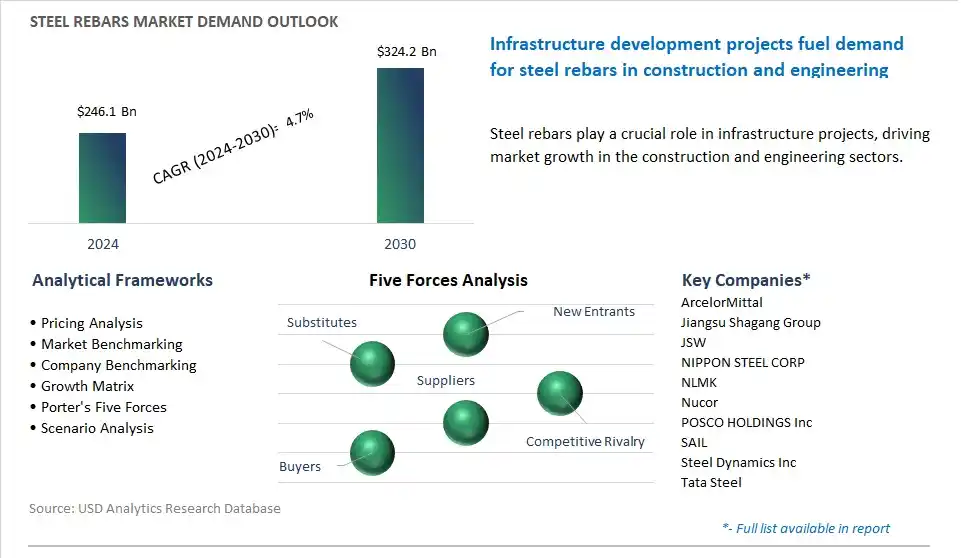
Steel Rebars Market Competitive Landscape
The market report analyses the leading companies in the industry including ArcelorMittal, Jiangsu Shagang Group, JSW, NIPPON STEEL CORP, NLMK, Nucor, POSCO HOLDINGS Inc, SAIL, Steel Dynamics Inc, Tata Steel.
Steel Rebars Market Dynamics
Steel Rebars Market Trend: Increasing Demand for Reinforced Concrete Structures
The most prominent market trend for steel rebars is the increasing demand for reinforced concrete structures worldwide. As urbanization accelerates and infrastructure projects expand, there's a growing need for durable and resilient construction materials to support the construction of buildings, bridges, highways, dams, and other civil engineering projects. Steel rebars, with their high tensile strength and ductility, play a crucial role in reinforcing concrete structures, enhancing their structural integrity, and mitigating the risk of collapse due to seismic activity, extreme weather conditions, or heavy loads. This trend is driven by the need for sustainable and long-lasting infrastructure solutions that can withstand the challenges of urbanization, population growth, and climate change.
Steel Rebars Market Driver: Growth in Construction and Infrastructure Development
A key market driver for steel rebars is the growth in construction and infrastructure development globally. As economies expand, governments invest in building and upgrading critical infrastructure such as transportation networks, utilities, housing, and public facilities to support economic growth and improve quality of life. Steel rebars are essential components in concrete construction, providing strength, stability, and durability to structural elements such as columns, beams, slabs, and foundations. The demand for steel rebars is particularly significant in emerging markets and developing regions, where rapid urbanization, population growth, and industrialization drive the need for new infrastructure projects and building construction.
Steel Rebars Market Opportunity: Innovation in High-Performance Rebar Technologies
An exciting opportunity in the steel rebars market lies in innovation in high-performance rebar technologies to meet the evolving needs of construction and engineering industries. While traditional rebars provide essential reinforcement for concrete structures, there's a growing demand for advanced rebar solutions with enhanced properties such as corrosion resistance, fatigue resistance, weldability, and ease of handling. Manufacturers can capitalize on this opportunity by developing innovative rebar formulations, coatings, and reinforcement techniques that address the challenges of harsh environments, aggressive chemicals, and prolonged exposure to moisture. Additionally, the integration of digital technologies such as sensors, IoT, and blockchain into rebar manufacturing and supply chains offers opportunities for enhanced quality control, traceability, and performance monitoring. By investing in research and development, collaboration with industry stakeholders, and market-driven innovation, steel rebar manufacturers can position themselves as leaders in providing high-performance reinforcement solutions for the construction industry, driving growth and competitiveness in the marketplace.
Steel Rebars Market Share Analysis: The Deformed segment generated the highest revenue in 2024
the largest segment in the Steel Rebars Market is the Deformed category. deformed steel rebars are widely used in construction projects for reinforced concrete structures such as buildings, bridges, highways, and dams. Deformed rebars are preferred over mild rebars due to their enhanced mechanical properties, including higher tensile strength, improved bonding with concrete, and better resistance to bending and shear forces. Additionally, deformed rebars feature ribs, lugs, or indentations on their surface, which provide better adhesion with concrete and prevent slippage, ensuring structural stability and integrity in reinforced concrete elements. Further, deformed rebars comply with international standards and specifications, ensuring quality, consistency, and performance in construction applications. Furthermore, the manufacturing process for deformed rebars is well-established, allowing for efficient production and cost-effective manufacturing, contributing to their widespread adoption. Accordingly, the Deformed segment maintains its position as the largest segment in the Steel Rebars Market, with continued growth anticipated due to the consistent demand for these critical construction materials.
Steel Rebars Market Share Analysis: The Residential segment is poised to register the fastest growth rate (CAGR) over the forecast period to 2034
The fastest growing segment in the Steel Rebars Market is the Residential sector. residential construction activities, including the construction of single-family homes, multi-family dwellings, and residential complexes, are on the rise globally due to population growth, urbanization, and increased disposable incomes. As more people move to urban areas and seek housing solutions, there is a growing demand for residential buildings and infrastructure, driving investments in residential construction projects. Additionally, government initiatives aimed at addressing housing shortages, promoting affordable housing, and improving living standards further stimulate residential construction activities. Further, the adoption of building codes and standards that require the use of reinforced concrete in residential structures for safety and durability purposes drives demand for steel rebars in this sector. Furthermore, the recovery of the global economy from economic downturns, low-interest rates, and favorable demographic trends contribute to the growth of the residential construction market, leading to increased demand for steel rebars. Accordingly, the Residential segment is witnessing rapid growth in the Steel Rebars Market, with continued expansion expected as residential construction activities continue to proliferate worldwide.
Steel Rebars Market Report Segmentation
By Type
Deformed
Mild
By End-User
Residential
Commercial
Institutional
Others
Regions Included
North America (US, Canada, Mexico)
Europe (Germany, UK, France, Spain, Italy, Russia, Rest of Europe)
Asia Pacific (China, India, Japan, South Korea, Australia, South East Asia, Rest of Asia)
South America (Brazil, Argentina, Rest of South America)
Middle East and Africa (Saudi Arabia, UAE, Rest of Middle East, South Africa, Egypt, Rest of Africa)
Steel Rebars Companies Profiled in the Market Study
ArcelorMittal
Jiangsu Shagang Group
JSW
NIPPON STEEL CORP
NLMK
Nucor
POSCO HOLDINGS Inc
SAIL
Steel Dynamics Inc
Tata Steel
*- List Not Exhaustive
TABLE OF CONTENTS
1 Introduction to 2025 Steel Rebars Market
1.1 Market Overview
1.2 Quick Facts
1.3 Scope/Objective of the Study
1.4 Market Definition
1.5 Countries and Regions Covered
1.6 Units, Currency, and Conversions
1.7 Industry Value Chain
2 Research Methodology
2.1 Market Size Estimation
2.2 Sources and Research Methodology
2.3 Data Triangulation
2.4 Assumptions and Limitations
3 Executive Summary
3.1 Global Steel Rebars Market Size Outlook, $ Million, 2021 to 2034
3.2 Steel Rebars Market Outlook by Type, $ Million, 2021 to 2034
3.3 Steel Rebars Market Outlook by Product, $ Million, 2021 to 2034
3.4 Steel Rebars Market Outlook by Application, $ Million, 2021 to 2034
3.5 Steel Rebars Market Outlook by Key Countries, $ Million, 2021 to 2034
4 Market Dynamics
4.1 Key Driving Forces of Steel Rebars Industry
4.2 Key Market Trends in Steel Rebars Industry
4.3 Potential Opportunities in Steel Rebars Industry
4.4 Key Challenges in Steel Rebars Industry
5 Market Factor Analysis
5.1 Value Chain Analysis
5.2 Competitive Landscape
5.2.1 Global Steel Rebars Market Share by Company (%), 2025
5.2.2 Product Offerings by Company
5.3 Porter’s Five Forces Analysis
5.4 Pricing Analysis and Outlook
6 Growth Outlook Across Scenarios
6.1 Growth Analysis-Case Scenario Definitions
6.2 Low Growth Scenario Forecasts
6.3 Reference Growth Scenario Forecasts
6.4 High Growth Scenario Forecasts
7 Global Steel Rebars Market Outlook by Segments
7.1 Steel Rebars Market Outlook by Segments, $ Million, 2021- 2034
By Type
Deformed
Mild
By End-User
Residential
Commercial
Institutional
Others
8 North America Steel Rebars Market Analysis and Outlook To 2030
8.1 Introduction to North America Steel Rebars Markets in 2024
8.2 North America Steel Rebars Market Size Outlook by Country, 2021-2034
8.2.1 United States
8.2.2 Canada
8.2.3 Mexico
8.3 North America Steel Rebars Market size Outlook by Segments, 2021-2034
By Type
Deformed
Mild
By End-User
Residential
Commercial
Institutional
Others
9 Europe Steel Rebars Market Analysis and Outlook To 2030
9.1 Introduction to Europe Steel Rebars Markets in 2024
9.2 Europe Steel Rebars Market Size Outlook by Country, 2021-2034
9.2.1 Germany
9.2.2 France
9.2.3 Spain
9.2.4 United Kingdom
9.2.4 Italy
9.2.5 Russia
9.2.6 Norway
9.2.7 Rest of Europe
9.3 Europe Steel Rebars Market Size Outlook by Segments, 2021-2034
By Type
Deformed
Mild
By End-User
Residential
Commercial
Institutional
Others
10 Asia Pacific Steel Rebars Market Analysis and Outlook To 2030
10.1 Introduction to Asia Pacific Steel Rebars Markets in 2024
10.2 Asia Pacific Steel Rebars Market Size Outlook by Country, 2021-2034
10.2.1 China
10.2.2 India
10.2.3 Japan
10.2.4 South Korea
10.2.5 Indonesia
10.2.6 Malaysia
10.2.7 Australia
10.2.8 Rest of Asia Pacific
10.3 Asia Pacific Steel Rebars Market size Outlook by Segments, 2021-2034
By Type
Deformed
Mild
By End-User
Residential
Commercial
Institutional
Others
11 South America Steel Rebars Market Analysis and Outlook To 2030
11.1 Introduction to South America Steel Rebars Markets in 2024
11.2 South America Steel Rebars Market Size Outlook by Country, 2021-2034
11.2.1 Brazil
11.2.2 Argentina
11.2.3 Rest of South America
11.3 South America Steel Rebars Market size Outlook by Segments, 2021-2034
By Type
Deformed
Mild
By End-User
Residential
Commercial
Institutional
Others
12 Middle East and Africa Steel Rebars Market Analysis and Outlook To 2030
12.1 Introduction to Middle East and Africa Steel Rebars Markets in 2024
12.2 Middle East and Africa Steel Rebars Market Size Outlook by Country, 2021-2034
12.2.1 Saudi Arabia
12.2.2 UAE
12.2.3 Oman
12.2.4 Rest of Middle East
12.2.5 Egypt
12.2.6 Nigeria
12.2.7 South Africa
12.2.8 Rest of Africa
12.3 Middle East and Africa Steel Rebars Market size Outlook by Segments, 2021-2034
By Type
Deformed
Mild
By End-User
Residential
Commercial
Institutional
Others
13 Company Profiles
13.1 Company Snapshot
13.2 SWOT Profiles
13.3 Products and Services
13.4 Recent Developments
13.5 Financial Profile
ArcelorMittal
Jiangsu Shagang Group
JSW
NIPPON STEEL CORP
NLMK
Nucor
POSCO HOLDINGS Inc
SAIL
Steel Dynamics Inc
Tata Steel
14 Appendix
14.1 Customization Offerings
14.2 Subscription Services
14.3 Related Reports
14.4 Publisher Expertise
By Type
Deformed
Mild
By End-User
Residential
Commercial
Institutional
Others
Countries Analyzed
North America (US, Canada, Mexico)
Europe (Germany, UK, France, Spain, Italy, Russia, Rest of Europe)
Asia Pacific (China, India, Japan, South Korea, Australia, South East Asia, Rest of Asia)
South America (Brazil, Argentina, Rest of South America)
Middle East and Africa (Saudi Arabia, UAE, Rest of Middle East, South Africa, Egypt, Rest of Africa)
