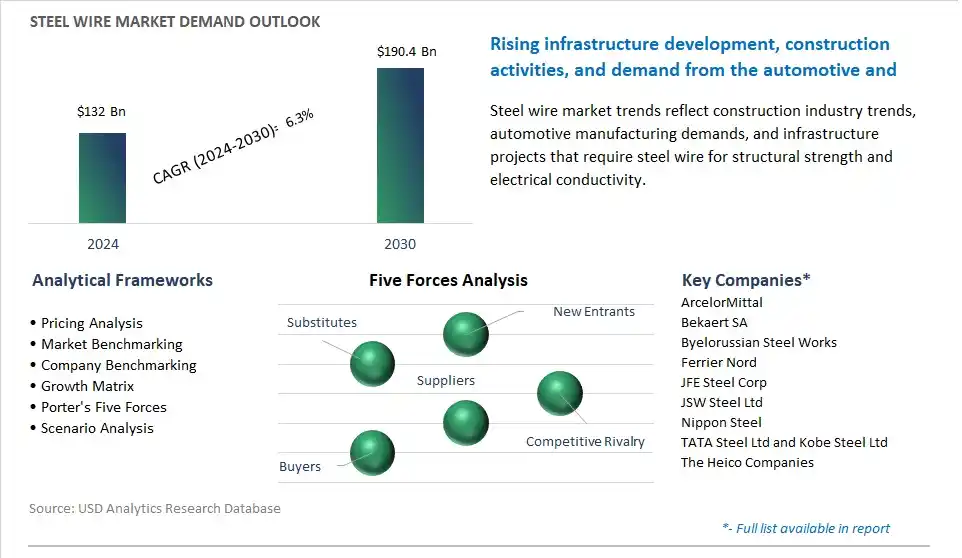
The global Steel Wire Market is poised to register a 6.3% CAGR from $132 Billion in 2024 to $190.4 Billion in 2030.
The global Steel Wire Market Study analyzes and forecasts the market size across 6 regions and 24 countries for diverse segments -By Form (Non-rope, Rope), By Type (Carbon Steel, Alloy Steel, Stainless Steel), By Thickness (0.01 to 0.8 mm, 0.8 to 1.6 mm, 1.6 to 4 mm, Above 4 mm), By End-User (Construction, Automotive, Energy, Agriculture, Industrial, Others).
An Introduction to Global Steel Wire Market in 2024
Steel wire is a versatile material with a wide range of applications across industries such as construction, automotive, manufacturing, and agriculture. The future of the steel wire market is influenced by several key trends, one of which is the growing demand for high-strength and lightweight wires to meet the requirements of advanced engineering applications. Manufacturers are investing in research and development to develop steel wire alloys with enhanced mechanical properties, such as tensile strength, ductility, and fatigue resistance, to support innovations in lightweighting and structural optimization in various industries. Additionally, advancements in wire drawing and coating technologies are enabling the production of steel wires with improved surface finish, corrosion resistance, and dimensional accuracy, expanding their utility in critical applications such as suspension systems, reinforcements, and wire ropes. Moreover, the increasing focus on sustainability and circular economy principles is driving initiatives to recycle and repurpose steel wire scrap, reducing material waste and environmental impact while ensuring a stable supply of raw materials for the industry. Furthermore, collaborations and partnerships between steel wire manufacturers and end-users are fostering innovation and driving the development of customized solutions to address specific performance requirements and market demands, driving the growth and competitiveness of the steel wire market.
Steel Wire Market Competitive Landscape
The market report analyses the leading companies in the industry including ArcelorMittal, Bekaert SA, Byelorussian Steel Works, Ferrier Nord, JFE Steel Corp, JSW Steel Ltd, Nippon Steel, TATA Steel Ltd and Kobe Steel Ltd, The Heico Companies.
Steel Wire Market Dynamics
Steel Wire Market Trend: Increasing Demand for Lightweight and High-Strength Materials in Automotive and Aerospace Industries
A prominent trend in the steel wire market is the increasing demand for lightweight and high-strength materials in the automotive and aerospace industries. As automotive manufacturers seek to improve fuel efficiency and reduce emissions, and aerospace companies aim to enhance aircraft performance and fuel economy, there's a growing preference for materials that offer high strength-to-weight ratios. Steel wire, known for its strength, durability, and versatility, is being utilized in lightweight applications such as automotive springs, cables, tire reinforcements, and aircraft components. This is driven by regulatory pressures, technological advancements, and consumer preferences for energy-efficient and environmentally friendly transportation solutions. As industries prioritize lightweighting strategies, the demand for steel wire in high-performance applications is expected to continue growing.
Steel Wire Market Driver: Expansion of Infrastructure and Construction Projects Globally
The primary driver behind the steel wire market's growth is the expansion of infrastructure and construction projects globally. Steel wire is a fundamental material used in various construction applications such as reinforcing concrete structures, fencing, wire mesh, and suspension bridges. With increasing urbanization, population growth, and economic development in emerging economies, there's a significant demand for new infrastructure projects, residential buildings, and commercial developments. Additionally, ongoing infrastructure maintenance and renovation projects in developed countries further drive the demand for steel wire products. This driver is significant as it creates a steady demand for steel wire in construction applications, supporting market growth and providing opportunities for manufacturers, suppliers, and distributors in the steel wire industry.
Steel Wire Market Opportunity: Development of Advanced Steel Wire Products for 3D Printing Applications
An attractive opportunity within the steel wire market lies in the development of advanced steel wire products for 3D printing applications. As additive manufacturing technologies continue to advance, there's increasing interest in utilizing metal wire feedstock for 3D printing of complex and customized metal components. Steel wire, with its excellent mechanical properties and suitability for high-temperature processes, holds potential for use in additive manufacturing applications across various industries, including automotive, aerospace, healthcare, and consumer goods. By investing in research and development, steel wire manufacturers can innovate and develop specialized wire products tailored for 3D printing processes, enabling the production of intricate and high-performance metal parts. This opportunity allows steel wire companies to enter new market segments, offer value-added solutions, and capitalize on the growing adoption of additive manufacturing technologies.
Steel Wire Market Share Analysis: Non-rope form generated the highest revenue in 2024
non-rope steel wire products are widely used across a diverse range of industries and applications, including construction, automotive, manufacturing, infrastructure, and consumer goods. Non-rope steel wires are available in various forms such as rods, bars, coils, sheets, and mesh, offering versatility and adaptability for different manufacturing processes and end-use applications. Additionally, non-rope steel wires are essential components in numerous products and structures, including reinforcement bars for concrete, springs for automotive suspension systems, cables for industrial machinery, wire mesh for fencing and construction, and wire ropes for lifting and rigging applications. Furthermore, non-rope steel wires are manufactured to meet stringent quality standards and specifications, ensuring consistent performance, reliability, and durability in demanding environments and applications. As a result of these factors, the Non-rope form segment remains the largest in the Steel Wire Market, serving as a foundational material for a wide range of industrial and commercial applications worldwide.
Steel Wire Market Share Analysis: Stainless Steel segment is poised to register the fastest growth rate (CAGR) over the forecast period to 2030
stainless steel wires offer superior corrosion resistance, durability, and aesthetic appeal compared to carbon steel and alloy steel wires. Stainless steel contains chromium, which forms a passive oxide layer on the surface of the material, providing protection against corrosion from moisture, chemicals, and environmental factors. This makes stainless steel wires ideal for applications in harsh and corrosive environments, such as marine, chemical processing, food and beverage, and architectural industries. Additionally, stainless steel wires are known for their high strength-to-weight ratio, thermal stability, and low maintenance requirements, making them suitable for a wide range of industrial and commercial applications. Furthermore, advancements in stainless steel manufacturing processes, including wire drawing, annealing, and surface treatments, have improved the quality, consistency, and performance of stainless steel wires, further driving their adoption in various markets. As industries continue to prioritize materials that offer superior performance, longevity, and aesthetics, the demand for stainless steel wires is expected to continue growing rapidly, making it the fastest-growing segment in the Steel Wire Market.
Steel Wire Market Share Analysis: 0. 01 to 0. 8 mm thickness segment is poised to register the fastest growth rate (CAGR) over the forecast period to 2030
there is a growing demand for thinner steel wires in industries such as electronics, automotive, telecommunications, and medical devices, where precision, miniaturization, and lightweight materials are essential. Thinner steel wires offer advantages such as flexibility, bendability, and ease of handling, making them suitable for intricate and delicate applications such as wiring harnesses, sensors, springs, and medical instruments. Additionally, advancements in wire drawing and manufacturing technologies have enabled the production of thinner steel wires with improved uniformity, surface finish, and mechanical properties, meeting the stringent requirements of modern manufacturing processes. Furthermore, the increasing adoption of automation, robotics, and smart technologies in various industries has driven the demand for thin steel wires for applications such as sensors, actuators, and electrical connectors. As industries continue to innovate and develop products that require smaller, lighter, and more efficient components, the demand for thin steel wires in the 0. 01 to 0. 8 mm thickness range is expected to continue growing rapidly, making it the fastest-growing segment in the Steel Wire Market.
Steel Wire Market Report Segmentation
By Form
Non-rope
Rope
By Type
Carbon Steel
Alloy Steel
Stainless Steel
By Thickness
0.01 to 0.8 mm
0.8 to 1.6 mm
1.6 to 4 mm
Above 4 mm
By End-User
Construction
Automotive
Energy
Agriculture
Industrial
Others
Regions Included
North America (US, Canada, Mexico)
Europe (Germany, UK, France, Spain, Italy, Russia, Rest of Europe)
Asia Pacific (China, India, Japan, South Korea, Australia, South East Asia, Rest of Asia)
South America (Brazil, Argentina, Rest of South America)
Middle East and Africa (Saudi Arabia, UAE, Rest of Middle East, South Africa, Egypt, Rest of Africa)
Steel Wire Companies Profiled in the Market Study
ArcelorMittal
Bekaert SA
Byelorussian Steel Works
Ferrier Nord
JFE Steel Corp
JSW Steel Ltd
Nippon Steel
TATA Steel Ltd and Kobe Steel Ltd
The Heico Companies
*- List Not Exhaustive
TABLE OF CONTENTS
1 Introduction to 2024 Steel Wire Market
1.1 Market Overview
1.2 Quick Facts
1.3 Scope/Objective of the Study
1.4 Market Definition
1.5 Countries and Regions Covered
1.6 Units, Currency, and Conversions
1.7 Industry Value Chain
2 Research Methodology
2.1 Market Size Estimation
2.2 Sources and Research Methodology
2.3 Data Triangulation
2.4 Assumptions and Limitations
3 Executive Summary
3.1 Global Steel Wire Market Size Outlook, $ Million, 2021 to 2030
3.2 Steel Wire Market Outlook by Type, $ Million, 2021 to 2030
3.3 Steel Wire Market Outlook by Product, $ Million, 2021 to 2030
3.4 Steel Wire Market Outlook by Application, $ Million, 2021 to 2030
3.5 Steel Wire Market Outlook by Key Countries, $ Million, 2021 to 2030
4 Market Dynamics
4.1 Key Driving Forces of Steel Wire Industry
4.2 Key Market Trends in Steel Wire Industry
4.3 Potential Opportunities in Steel Wire Industry
4.4 Key Challenges in Steel Wire Industry
5 Market Factor Analysis
5.1 Value Chain Analysis
5.2 Competitive Landscape
5.2.1 Global Steel Wire Market Share by Company (%), 2023
5.2.2 Product Offerings by Company
5.3 Porter’s Five Forces Analysis
5.4 Pricing Analysis and Outlook
6 Growth Outlook Across Scenarios
6.1 Growth Analysis-Case Scenario Definitions
6.2 Low Growth Scenario Forecasts
6.3 Reference Growth Scenario Forecasts
6.4 High Growth Scenario Forecasts
7 Global Steel Wire Market Outlook by Segments
7.1 Steel Wire Market Outlook by Segments, $ Million, 2021- 2030
By Form
Non-rope
Rope
By Type
Carbon Steel
Alloy Steel
Stainless Steel
By Thickness
0.01 to 0.8 mm
0.8 to 1.6 mm
1.6 to 4 mm
Above 4 mm
By End-User
Construction
Automotive
Energy
Agriculture
Industrial
Others
8 North America Steel Wire Market Analysis and Outlook To 2030
8.1 Introduction to North America Steel Wire Markets in 2024
8.2 North America Steel Wire Market Size Outlook by Country, 2021-2030
8.2.1 United States
8.2.2 Canada
8.2.3 Mexico
8.3 North America Steel Wire Market size Outlook by Segments, 2021-2030
By Form
Non-rope
Rope
By Type
Carbon Steel
Alloy Steel
Stainless Steel
By Thickness
0.01 to 0.8 mm
0.8 to 1.6 mm
1.6 to 4 mm
Above 4 mm
By End-User
Construction
Automotive
Energy
Agriculture
Industrial
Others
9 Europe Steel Wire Market Analysis and Outlook To 2030
9.1 Introduction to Europe Steel Wire Markets in 2024
9.2 Europe Steel Wire Market Size Outlook by Country, 2021-2030
9.2.1 Germany
9.2.2 France
9.2.3 Spain
9.2.4 United Kingdom
9.2.4 Italy
9.2.5 Russia
9.2.6 Norway
9.2.7 Rest of Europe
9.3 Europe Steel Wire Market Size Outlook by Segments, 2021-2030
By Form
Non-rope
Rope
By Type
Carbon Steel
Alloy Steel
Stainless Steel
By Thickness
0.01 to 0.8 mm
0.8 to 1.6 mm
1.6 to 4 mm
Above 4 mm
By End-User
Construction
Automotive
Energy
Agriculture
Industrial
Others
10 Asia Pacific Steel Wire Market Analysis and Outlook To 2030
10.1 Introduction to Asia Pacific Steel Wire Markets in 2024
10.2 Asia Pacific Steel Wire Market Size Outlook by Country, 2021-2030
10.2.1 China
10.2.2 India
10.2.3 Japan
10.2.4 South Korea
10.2.5 Indonesia
10.2.6 Malaysia
10.2.7 Australia
10.2.8 Rest of Asia Pacific
10.3 Asia Pacific Steel Wire Market size Outlook by Segments, 2021-2030
By Form
Non-rope
Rope
By Type
Carbon Steel
Alloy Steel
Stainless Steel
By Thickness
0.01 to 0.8 mm
0.8 to 1.6 mm
1.6 to 4 mm
Above 4 mm
By End-User
Construction
Automotive
Energy
Agriculture
Industrial
Others
11 South America Steel Wire Market Analysis and Outlook To 2030
11.1 Introduction to South America Steel Wire Markets in 2024
11.2 South America Steel Wire Market Size Outlook by Country, 2021-2030
11.2.1 Brazil
11.2.2 Argentina
11.2.3 Rest of South America
11.3 South America Steel Wire Market size Outlook by Segments, 2021-2030
By Form
Non-rope
Rope
By Type
Carbon Steel
Alloy Steel
Stainless Steel
By Thickness
0.01 to 0.8 mm
0.8 to 1.6 mm
1.6 to 4 mm
Above 4 mm
By End-User
Construction
Automotive
Energy
Agriculture
Industrial
Others
12 Middle East and Africa Steel Wire Market Analysis and Outlook To 2030
12.1 Introduction to Middle East and Africa Steel Wire Markets in 2024
12.2 Middle East and Africa Steel Wire Market Size Outlook by Country, 2021-2030
12.2.1 Saudi Arabia
12.2.2 UAE
12.2.3 Oman
12.2.4 Rest of Middle East
12.2.5 Egypt
12.2.6 Nigeria
12.2.7 South Africa
12.2.8 Rest of Africa
12.3 Middle East and Africa Steel Wire Market size Outlook by Segments, 2021-2030
By Form
Non-rope
Rope
By Type
Carbon Steel
Alloy Steel
Stainless Steel
By Thickness
0.01 to 0.8 mm
0.8 to 1.6 mm
1.6 to 4 mm
Above 4 mm
By End-User
Construction
Automotive
Energy
Agriculture
Industrial
Others
13 Company Profiles
13.1 Company Snapshot
13.2 SWOT Profiles
13.3 Products and Services
13.4 Recent Developments
13.5 Financial Profile
ArcelorMittal
Bekaert SA
Byelorussian Steel Works
Ferrier Nord
JFE Steel Corp
JSW Steel Ltd
Nippon Steel
TATA Steel Ltd and Kobe Steel Ltd
The Heico Companies
14 Appendix
14.1 Customization Offerings
14.2 Subscription Services
14.3 Related Reports
14.4 Publisher Expertise
By Form
Non-rope
Rope
By Type
Carbon Steel
Alloy Steel
Stainless Steel
By Thickness
0.01 to 0.8 mm
0.8 to 1.6 mm
1.6 to 4 mm
Above 4 mm
By End-User
Construction
Automotive
Energy
Agriculture
Industrial
Others
Countries Analyzed
North America (US, Canada, Mexico)
Europe (Germany, UK, France, Spain, Italy, Russia, Rest of Europe)
Asia Pacific (China, India, Japan, South Korea, Australia, South East Asia, Rest of Asia)
South America (Brazil, Argentina, Rest of South America)
Middle East and Africa (Saudi Arabia, UAE, Rest of Middle East, South Africa, Egypt, Rest of Africa)
