
The global Structural Heart Disease Treatment Devices Market Study analyzes and forecasts the market size across 6 regions and 24 countries for diverse segments including By Procedure (Replacement Procedures, Repair Procedures), By Product (Herat Valve Devices, Surgical Heart Valves, Transcatheter Heart Valves, Occluders and Delivery Systems, Annuloplasty Rings, Others).
The Structural Heart Disease Treatment Devices Market encompasses transcatheter heart valves, atrial septal defect (ASD) closure devices, patent foramen ovale (PFO) closure devices, left atrial appendage (LAA) closure devices, and structural heart interventions used in minimally invasive cardiac procedures for treating structural heart defects, valvular heart diseases, and congenital heart anomalies. Structural heart disease treatment devices offer alternatives to open-heart surgery, providing valve repair, valve replacement, and septal defect closure options with reduced procedural risks and faster recovery times for patients. Market trends include transcatheter heart valve innovations, hybrid surgical interventions, imaging-guided procedures, and patient-specific structural heart disease treatments for improved clinical outcomes and patient quality of life.
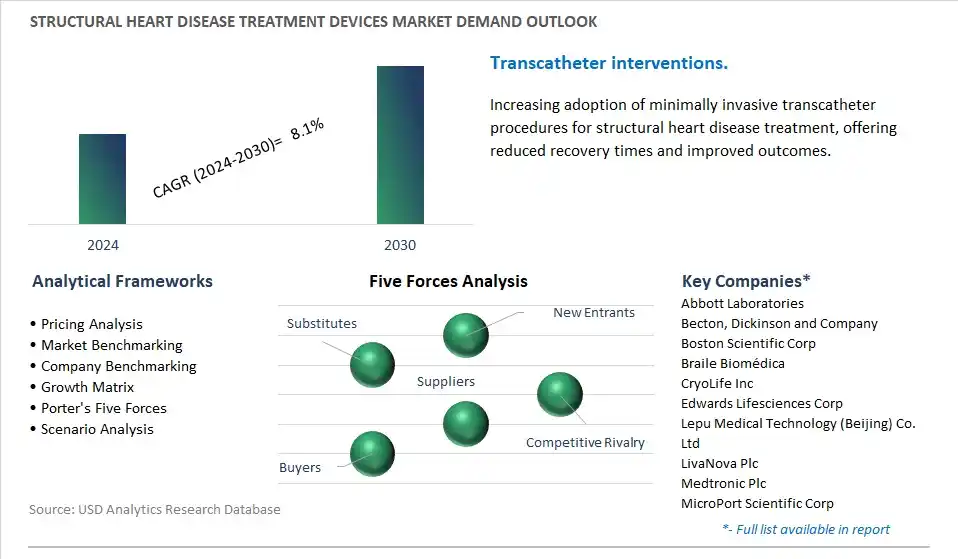
The global Structural Heart Disease Treatment Devices Industry is highly competitive with a large number of companies focusing on niche market segments. Amidst intense competitive conditions, Structural Heart Disease Treatment Devices Companies are investing in new product launches and strengthening distribution channels. Key companies operating in the Structural Heart Disease Treatment Devices Industry include- Abbott Laboratories, Becton, Dickinson and Company, Boston Scientific Corp, Braile Biomédica, CryoLife Inc, Edwards Lifesciences Corp, Lepu Medical Technology (Beijing) Co. Ltd, LivaNova Plc, Medtronic Plc, MicroPort Scientific Corp.
One prominent trend in the Structural Heart Disease Treatment Devices market is the increasing adoption of minimally invasive procedures for the treatment of structural heart conditions. Minimally invasive techniques, such as transcatheter interventions, offer several advantages over traditional open-heart surgeries, including shorter recovery times, reduced hospital stays, and lower complication rates. As advancements in medical technology continue to enable the development of innovative devices and techniques, healthcare providers are increasingly opting for minimally invasive approaches to treat structural heart diseases. This trend is driven by a growing preference for less invasive treatments among patients, along with the potential for improved clinical outcomes and cost-effectiveness associated with minimally invasive procedures.
The primary driver for the Structural Heart Disease Treatment Devices market is the aging population and the consequent increase in the prevalence of structural heart diseases. As the global population continues to age, the incidence of age-related structural heart conditions such as valvular heart disease, atrial fibrillation, and heart failure is on the rise. Additionally, lifestyle factors such as unhealthy diets, sedentary lifestyles, and increasing rates of obesity contribute to the growing burden of structural heart diseases worldwide. The rising disease burden places a significant demand on healthcare systems for effective treatment options, driving the adoption of structural heart disease treatment devices. Healthcare providers are seeking advanced medical devices and innovative therapies to address the complex needs of patients with structural heart conditions, fueling market growth for treatment devices.
An opportunity exists in leveraging technological advancements and personalized medicine approaches to enhance the effectiveness and customization of structural heart disease treatment devices. Emerging technologies such as 3D printing, computational modeling, and artificial intelligence enable the development of patient-specific devices tailored to individual anatomies and pathologies. By integrating patient-specific data from imaging modalities, genetic testing, and physiological assessments, clinicians can optimize treatment planning and device selection, leading to better outcomes and reduced procedural risks for patients. Furthermore, the shift towards value-based healthcare models emphasizes the importance of personalized medicine in improving patient outcomes and reducing healthcare costs. Collaborative efforts among medical device manufacturers, healthcare providers, and research institutions can drive innovation in personalized treatment approaches, creating opportunities to address unmet clinical needs and improve the quality of care for patients with structural heart diseases.
Among the segmented categories, Transcatheter Heart Valves emerge as the fast-growing product in the market for structural heart disease treatment devices. Transcatheter aortic valve replacement (TAVR) procedures, in particular, have witnessed significant growth due to their minimally invasive nature and favorable outcomes in treating severe aortic stenosis. As the aging population increases and the prevalence of structural heart diseases rises, there is a growing demand for innovative treatment options that offer less invasive approaches and faster recovery times. Transcatheter heart valves address these needs by providing a less invasive alternative to traditional surgical valve replacement procedures, allowing for valve implantation through catheter-based techniques rather than open-heart surgery. This approach reduces the risks associated with surgery and expands treatment options for patients who may not be suitable candidates for traditional surgery. Additionally, advancements in transcatheter heart valve technology, including improvements in valve design, delivery systems, and patient selection criteria, further contribute to the rapid growth of this segment. As healthcare providers and patients increasingly embrace minimally invasive interventions for structural heart diseases, the market for transcatheter heart valves is expected to continue its robust growth trajectory, revolutionizing the treatment landscape for these conditions.
By Procedure
Replacement Procedures
-TAVR Procedures
-SAVR Procedures
Repair Procedures
-Closure Procedures
-Annuloplasty
-Valvuloplasty
By Product
Herat Valve Devices
Surgical Heart Valves
Transcatheter Heart Valves
Occluders and Delivery Systems
Annuloplasty Rings
Others
Geographical Analysis
North America (United States, Canada, Mexico)
Europe (Germany, France, United Kingdom, Spain, Italy, Rest of Europe)
Asia Pacific (China, India, Japan, South Korea, Rest of Asia Pacific)
South America (Brazil, Argentina, Rest of South America)
Middle East and Africa (Saudi Arabia, UAE, Rest of Middle East, South Africa, Egypt, Rest of Africa)
Abbott Laboratories
Becton, Dickinson and Company
Boston Scientific Corp
Braile Biomédica
CryoLife Inc
Edwards Lifesciences Corp
Lepu Medical Technology (Beijing) Co. Ltd
LivaNova Plc
Medtronic Plc
MicroPort Scientific Corp
* List not Exhaustive
• Deepen your industry insights and navigate uncertainties for strategy formulation, CAPEX, and Operational decisions
• Gain access to detailed insights on the Structural Heart Disease Treatment Devices Market, encompassing current market size, growth trends, and forecasts till 2030.
• Access detailed competitor analysis, enabling competitive advantage through a thorough understanding of market players, strategies, and potential differentiation opportunities
• Stay ahead of the curve with insights on technological advancements, innovations, and upcoming trends
• Identify lucrative investment avenues and expansion opportunities within the Structural Heart Disease Treatment Devices Industry, guided by robust, data-backed analysis.
• Understand regional and global markets through country-wise analysis, regional market potential, regulatory nuances, and dynamics
• Execute strategies with confidence and speed through information, analytics, and insights on the industry value chain
• Corporate leaders, strategists, financial experts, shareholders, asset managers, and governmental representatives can make long-term planning scenarios and build an integrated and timely understanding of market dynamics
• Benefit from tailored solutions and expert consultation based on report insights, providing personalized strategies aligned with specific business needs.
TABLE OF CONTENTS
1 Introduction to 2024 Structural Heart Disease Treatment Devices Market
1.1 Market Overview
1.2 Quick Facts
1.3 Scope/Objective of the Study
1.4 Market Definition
1.5 Countries and Regions Analyzed
1.6 Units, Currency, and Conversions
1.7 Industry Value Chain
2 Research Methodology
2.1 Market Size Estimation
2.2 Sources and Research Methodology
2.3 Data Triangulation
2.4 Assumptions and Limitations
3 Executive Summary
3.1 Global Structural Heart Disease Treatment Devices Market Size Outlook, $ Million, 2021 to 2030
3.2 Structural Heart Disease Treatment Devices Market Outlook by Type, $ Million, 2021 to 2030
3.3 Structural Heart Disease Treatment Devices Market Outlook by Product, $ Million, 2021 to 2030
3.4 Structural Heart Disease Treatment Devices Market Outlook by Application, $ Million, 2021 to 2030
3.5 Structural Heart Disease Treatment Devices Market Outlook by Key Countries, $ Million, 2021 to 2030
4 Market Dynamics
4.1 Key Driving Forces of Structural Heart Disease Treatment Devices Industry
4.2 Key Market Trends in Structural Heart Disease Treatment Devices Industry
4.3 Potential Opportunities in Structural Heart Disease Treatment Devices Industry
4.4 Key Challenges in Structural Heart Disease Treatment Devices Industry
5 Market Factor Analysis
5.1 Value Chain Analysis
5.2 Competitive Landscape
5.2.1 Global Structural Heart Disease Treatment Devices Market Share by Company (%), 2023
5.2.2 Product Offerings by Company
5.3 Porter’s Five Forces Analysis
5.4 Pricing Analysis and Outlook
6 Growth Outlook Across Scenarios
6.1 Growth Analysis-Case Scenario Definitions
6.2 Low Growth Scenario Forecasts
6.3 Reference Growth Scenario Forecasts
6.4 High Growth Scenario Forecasts
7 Global Structural Heart Disease Treatment Devices Market Outlook by Segments
7.1 Structural Heart Disease Treatment Devices Market Outlook by Segments, $ Million, 2021- 2030
By Procedure
Replacement Procedures
-TAVR Procedures
-SAVR Procedures
Repair Procedures
-Closure Procedures
-Annuloplasty
-Valvuloplasty
By Product
Herat Valve Devices
Surgical Heart Valves
Transcatheter Heart Valves
Occluders and Delivery Systems
Annuloplasty Rings
Others
8 North America Structural Heart Disease Treatment Devices Market Analysis and Outlook To 2030
8.1 Introduction to North America Structural Heart Disease Treatment Devices Markets in 2024
8.2 North America Structural Heart Disease Treatment Devices Market Size Outlook by Country, 2021-2030
8.2.1 United States
8.2.2 Canada
8.2.3 Mexico
8.3 North America Structural Heart Disease Treatment Devices Market size Outlook by Segments, 2021-2030
By Procedure
Replacement Procedures
-TAVR Procedures
-SAVR Procedures
Repair Procedures
-Closure Procedures
-Annuloplasty
-Valvuloplasty
By Product
Herat Valve Devices
Surgical Heart Valves
Transcatheter Heart Valves
Occluders and Delivery Systems
Annuloplasty Rings
Others
9 Europe Structural Heart Disease Treatment Devices Market Analysis and Outlook To 2030
9.1 Introduction to Europe Structural Heart Disease Treatment Devices Markets in 2024
9.2 Europe Structural Heart Disease Treatment Devices Market Size Outlook by Country, 2021-2030
9.2.1 Germany
9.2.2 France
9.2.3 Spain
9.2.4 United Kingdom
9.2.4 Italy
9.2.5 Russia
9.2.6 Norway
9.2.7 Rest of Europe
9.3 Europe Structural Heart Disease Treatment Devices Market Size Outlook by Segments, 2021-2030
By Procedure
Replacement Procedures
-TAVR Procedures
-SAVR Procedures
Repair Procedures
-Closure Procedures
-Annuloplasty
-Valvuloplasty
By Product
Herat Valve Devices
Surgical Heart Valves
Transcatheter Heart Valves
Occluders and Delivery Systems
Annuloplasty Rings
Others
10 Asia Pacific Structural Heart Disease Treatment Devices Market Analysis and Outlook To 2030
10.1 Introduction to Asia Pacific Structural Heart Disease Treatment Devices Markets in 2024
10.2 Asia Pacific Structural Heart Disease Treatment Devices Market Size Outlook by Country, 2021-2030
10.2.1 China
10.2.2 India
10.2.3 Japan
10.2.4 South Korea
10.2.5 Indonesia
10.2.6 Malaysia
10.2.7 Australia
10.2.8 Rest of Asia Pacific
10.3 Asia Pacific Structural Heart Disease Treatment Devices Market size Outlook by Segments, 2021-2030
By Procedure
Replacement Procedures
-TAVR Procedures
-SAVR Procedures
Repair Procedures
-Closure Procedures
-Annuloplasty
-Valvuloplasty
By Product
Herat Valve Devices
Surgical Heart Valves
Transcatheter Heart Valves
Occluders and Delivery Systems
Annuloplasty Rings
Others
11 South America Structural Heart Disease Treatment Devices Market Analysis and Outlook To 2030
11.1 Introduction to South America Structural Heart Disease Treatment Devices Markets in 2024
11.2 South America Structural Heart Disease Treatment Devices Market Size Outlook by Country, 2021-2030
11.2.1 Brazil
11.2.2 Argentina
11.2.3 Rest of South America
11.3 South America Structural Heart Disease Treatment Devices Market size Outlook by Segments, 2021-2030
By Procedure
Replacement Procedures
-TAVR Procedures
-SAVR Procedures
Repair Procedures
-Closure Procedures
-Annuloplasty
-Valvuloplasty
By Product
Herat Valve Devices
Surgical Heart Valves
Transcatheter Heart Valves
Occluders and Delivery Systems
Annuloplasty Rings
Others
12 Middle East and Africa Structural Heart Disease Treatment Devices Market Analysis and Outlook To 2030
12.1 Introduction to Middle East and Africa Structural Heart Disease Treatment Devices Markets in 2024
12.2 Middle East and Africa Structural Heart Disease Treatment Devices Market Size Outlook by Country, 2021-2030
12.2.1 Saudi Arabia
12.2.2 UAE
12.2.3 Oman
12.2.4 Rest of Middle East
12.2.5 Egypt
12.2.6 Nigeria
12.2.7 South Africa
12.2.8 Rest of Africa
12.3 Middle East and Africa Structural Heart Disease Treatment Devices Market size Outlook by Segments, 2021-2030
By Procedure
Replacement Procedures
-TAVR Procedures
-SAVR Procedures
Repair Procedures
-Closure Procedures
-Annuloplasty
-Valvuloplasty
By Product
Herat Valve Devices
Surgical Heart Valves
Transcatheter Heart Valves
Occluders and Delivery Systems
Annuloplasty Rings
Others
13 Company Profiles
13.1 Company Snapshot
13.2 SWOT Profiles
13.3 Products and Services
13.4 Recent Developments
13.5 Financial Profile
List of Companies
Abbott Laboratories
Becton, Dickinson and Company
Boston Scientific Corp
Braile Biomédica
CryoLife Inc
Edwards Lifesciences Corp
Lepu Medical Technology (Beijing) Co. Ltd
LivaNova Plc
Medtronic Plc
MicroPort Scientific Corp
14 Appendix
14.1 Customization Offerings
14.2 Subscription Services
14.3 Related Reports
14.4 Publisher Expertise
By Procedure
Replacement Procedures
-TAVR Procedures
-SAVR Procedures
Repair Procedures
-Closure Procedures
-Annuloplasty
-Valvuloplasty
By Product
Herat Valve Devices
Surgical Heart Valves
Transcatheter Heart Valves
Occluders and Delivery Systems
Annuloplasty Rings
Others
The global Structural Heart Disease Treatment Devices Market is one of the lucrative growth markets, poised to register a 8.1% growth (CAGR) between 2024 and 2030.
Emerging Markets across Asia Pacific, Europe, and Americas present robust growth prospects.
Abbott Laboratories, Becton, Dickinson and Company, Boston Scientific Corp, Braile Biomédica, CryoLife Inc, Edwards Lifesciences Corp, Lepu Medical Technology (Beijing) Co. Ltd, LivaNova Plc, Medtronic Plc, MicroPort Scientific Corp
Base Year- 2023; Estimated Year- 2024; Historic Period- 2018-2023; Forecast period- 2024 to 2030; Currency: USD; Volume