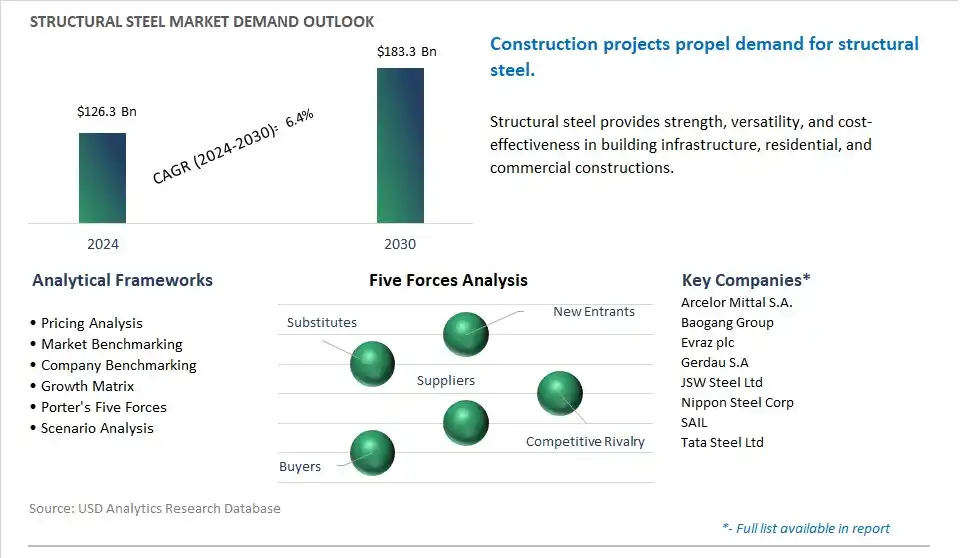
The global Structural Steel Market is poised to register a 6.4% CAGR from $126.3 Billion in 2024 to $183.3 Billion in 2030.
The global Structural Steel Market Study analyzes and forecasts the market size across 6 regions and 24 countries for diverse segments -By Product (Angles, Channels, Rounds, Squares, Beams), By Application (Residential, Non-residential).
An Introduction to Global Structural Steel Market in 2024
Structural steel plays a foundational role in modern construction, providing the framework for buildings, bridges, and infrastructure projects around the world. The future of the structural steel market is influenced by several key trends, including advancements in material science, digital design technologies, and sustainability initiatives. One significant trend is the development of high-strength and ultra-high-strength steel alloys with superior mechanical properties and corrosion resistance, enabling the construction of lighter and more durable structures that require less material and maintenance over their lifecycle. Manufacturers are investing in research and development to optimize steel compositions, processing techniques, and heat treatments to meet the evolving performance requirements of structural applications while minimizing environmental impact. Additionally, the integration of digital design tools such as Building Information Modeling (BIM) and computer-aided engineering (CAE) software is revolutionizing the way steel structures are designed, analyzed, and fabricated, enabling architects and engineers to optimize efficiency, sustainability, and cost-effectiveness in building projects. Moreover, the emphasis on sustainable construction practices and green building certifications is driving the adoption of recycled and locally sourced steel materials, as well as innovative construction methods such as modular construction and prefabrication, which reduce waste, energy consumption, and construction timelines. Furthermore, collaborations between steel producers, architects, and contractors are driving innovation and market growth by delivering integrated solutions that combine structural steel with advanced materials, systems, and technologies to address the challenges of urbanization, climate change, and resource scarcity in the built environment.
Structural Steel Market Competitive Landscape
The market report analyses the leading companies in the industry including Arcelor Mittal S.A., Baogang Group, Evraz plc, Gerdau S.A, JSW Steel Ltd, Nippon Steel Corp, SAIL, Tata Steel Ltd.
Structural Steel Market Dynamics
Structural Steel Market Trend: Adoption of Prefabricated and Modular Construction Techniques
A prominent trend in the structural steel market is the increasing adoption of prefabricated and modular construction techniques. Structural steel offers several advantages, including high strength-to-weight ratio, durability, and versatility, making it an ideal choice for building construction. With the growing need for faster project delivery, cost efficiency, and sustainable building practices, there's a growing interest in prefabricated and modular construction methods that leverage structural steel components. Prefabrication allows for the off-site fabrication of structural steel elements, such as beams, columns, and trusses, in controlled factory conditions, reducing construction time and improving quality control. Modular construction involves assembling pre-engineered steel modules or sections on-site, offering flexibility, scalability, and reduced construction waste. This is driven by factors such as urbanization, population growth, and the demand for innovative construction solutions that address the challenges of urban development, housing shortages, and infrastructure projects.
Structural Steel Market Driver: Infrastructure Development and Urbanization
The primary driver behind the structural steel market's growth is infrastructure development and urbanization. Structural steel plays a crucial role in the construction of various infrastructure projects, including commercial buildings, residential complexes, bridges, stadiums, and industrial facilities. With rapid urbanization and population growth in emerging economies, there's a significant demand for new infrastructure investments to support urban development, transportation networks, and public utilities. Structural steel offers advantages such as strength, durability, and adaptability, making it a preferred choice for large-scale construction projects. Additionally, government initiatives aimed at stimulating economic growth, improving connectivity, and enhancing urban livability further drive investments in infrastructure development, creating opportunities for the structural steel market to expand and thrive.
Structural Steel Market Opportunity: Integration with Sustainable Building Practices
An attractive opportunity within the structural steel market lies in the integration with sustainable building practices. As environmental concerns and climate change become increasingly pressing issues, there's a growing emphasis on sustainable construction methods and green building certifications. Structural steel manufacturers and construction companies have the opportunity to innovate and develop solutions that minimize environmental impact, reduce carbon emissions, and promote energy efficiency throughout the building lifecycle. This involves utilizing recycled steel materials, implementing energy-efficient designs, incorporating renewable energy technologies, and optimizing building performance through advanced structural engineering techniques. By embracing sustainable building practices and offering environmentally friendly solutions, the structural steel industry can position itself as a key player in the transition towards more sustainable and resilient built environments, thus unlocking new market opportunities and driving long-term growth.
Structural Steel Market Share Analysis: Beams generated the highest revenue in 2024
The largest segment in the Structural Steel Market is Beams. beams are essential structural components used in various construction applications, including building frames, bridges, and industrial structures. Beams provide crucial support and load-bearing capabilities, distributing weight and stress evenly across a structure. Additionally, beams offer versatility in design and application, with different beam profiles available to accommodate specific engineering requirements and architectural designs. Further, beams are highly durable and resistant to bending and deformation, ensuring the structural integrity and longevity of buildings and infrastructure. Furthermore, the widespread use of beams in large-scale construction projects, such as high-rise buildings and infrastructure development, contributes to their prominence in the Structural Steel Market. Accordingly, the beams segment is the largest in the market, driven by its essential role in construction and the diverse range of applications it serves.
Structural Steel Market Share Analysis: Non-residential application segment is poised to register the fastest growth rate (CAGR) over the forecast period to 2030
The fastest-growing segment in the Structural Steel Market is the Non-residential application. non-residential construction encompasses a wide range of structures, including commercial buildings, industrial facilities, institutional buildings, and infrastructure projects such as bridges and stadiums. These projects often require large quantities of structural steel for their construction due to the material's strength, durability, and versatility. Additionally, the increasing urbanization and industrialization in developing economies, coupled with infrastructure development initiatives in both developed and developing countries, are driving the demand for non-residential construction projects. Further, advancements in construction techniques and technologies have made structural steel more cost-effective and efficient compared to traditional building materials, further boosting its adoption in non-residential construction. Furthermore, the growing emphasis on sustainability and environmental regulations favor structural steel's recyclability and reduced carbon footprint, further driving its use in non-residential construction projects. Accordingly, the non-residential application segment is experiencing rapid growth in the Structural Steel Market, driven by the increasing demand for commercial and infrastructure construction worldwide.
Structural Steel Market Report Segmentation
By Product
Angles
Channels
Rounds
Squares
Beams
By Application
Residential
Non-residential
-Institutional
-Commercial
-Offices
-Others
Regions Included
North America (US, Canada, Mexico)
Europe (Germany, UK, France, Spain, Italy, Russia, Rest of Europe)
Asia Pacific (China, India, Japan, South Korea, Australia, South East Asia, Rest of Asia)
South America (Brazil, Argentina, Rest of South America)
Middle East and Africa (Saudi Arabia, UAE, Rest of Middle East, South Africa, Egypt, Rest of Africa)
Structural Steel Companies Profiled in the Market Study
Arcelor Mittal S.A.
Baogang Group
Evraz plc
Gerdau S.A
JSW Steel Ltd
Nippon Steel Corp
SAIL
Tata Steel Ltd
*- List Not Exhaustive
TABLE OF CONTENTS
1 Introduction to 2024 Structural Steel Market
1.1 Market Overview
1.2 Quick Facts
1.3 Scope/Objective of the Study
1.4 Market Definition
1.5 Countries and Regions Covered
1.6 Units, Currency, and Conversions
1.7 Industry Value Chain
2 Research Methodology
2.1 Market Size Estimation
2.2 Sources and Research Methodology
2.3 Data Triangulation
2.4 Assumptions and Limitations
3 Executive Summary
3.1 Global Structural Steel Market Size Outlook, $ Million, 2021 to 2030
3.2 Structural Steel Market Outlook by Type, $ Million, 2021 to 2030
3.3 Structural Steel Market Outlook by Product, $ Million, 2021 to 2030
3.4 Structural Steel Market Outlook by Application, $ Million, 2021 to 2030
3.5 Structural Steel Market Outlook by Key Countries, $ Million, 2021 to 2030
4 Market Dynamics
4.1 Key Driving Forces of Structural Steel Industry
4.2 Key Market Trends in Structural Steel Industry
4.3 Potential Opportunities in Structural Steel Industry
4.4 Key Challenges in Structural Steel Industry
5 Market Factor Analysis
5.1 Value Chain Analysis
5.2 Competitive Landscape
5.2.1 Global Structural Steel Market Share by Company (%), 2023
5.2.2 Product Offerings by Company
5.3 Porter’s Five Forces Analysis
5.4 Pricing Analysis and Outlook
6 Growth Outlook Across Scenarios
6.1 Growth Analysis-Case Scenario Definitions
6.2 Low Growth Scenario Forecasts
6.3 Reference Growth Scenario Forecasts
6.4 High Growth Scenario Forecasts
7 Global Structural Steel Market Outlook by Segments
7.1 Structural Steel Market Outlook by Segments, $ Million, 2021- 2030
By Product
Angles
Channels
Rounds
Squares
Beams
By Application
Residential
Non-residential
-Institutional
-Commercial
-Offices
-Others
8 North America Structural Steel Market Analysis and Outlook To 2030
8.1 Introduction to North America Structural Steel Markets in 2024
8.2 North America Structural Steel Market Size Outlook by Country, 2021-2030
8.2.1 United States
8.2.2 Canada
8.2.3 Mexico
8.3 North America Structural Steel Market size Outlook by Segments, 2021-2030
By Product
Angles
Channels
Rounds
Squares
Beams
By Application
Residential
Non-residential
-Institutional
-Commercial
-Offices
-Others
9 Europe Structural Steel Market Analysis and Outlook To 2030
9.1 Introduction to Europe Structural Steel Markets in 2024
9.2 Europe Structural Steel Market Size Outlook by Country, 2021-2030
9.2.1 Germany
9.2.2 France
9.2.3 Spain
9.2.4 United Kingdom
9.2.4 Italy
9.2.5 Russia
9.2.6 Norway
9.2.7 Rest of Europe
9.3 Europe Structural Steel Market Size Outlook by Segments, 2021-2030
By Product
Angles
Channels
Rounds
Squares
Beams
By Application
Residential
Non-residential
-Institutional
-Commercial
-Offices
-Others
10 Asia Pacific Structural Steel Market Analysis and Outlook To 2030
10.1 Introduction to Asia Pacific Structural Steel Markets in 2024
10.2 Asia Pacific Structural Steel Market Size Outlook by Country, 2021-2030
10.2.1 China
10.2.2 India
10.2.3 Japan
10.2.4 South Korea
10.2.5 Indonesia
10.2.6 Malaysia
10.2.7 Australia
10.2.8 Rest of Asia Pacific
10.3 Asia Pacific Structural Steel Market size Outlook by Segments, 2021-2030
By Product
Angles
Channels
Rounds
Squares
Beams
By Application
Residential
Non-residential
-Institutional
-Commercial
-Offices
-Others
11 South America Structural Steel Market Analysis and Outlook To 2030
11.1 Introduction to South America Structural Steel Markets in 2024
11.2 South America Structural Steel Market Size Outlook by Country, 2021-2030
11.2.1 Brazil
11.2.2 Argentina
11.2.3 Rest of South America
11.3 South America Structural Steel Market size Outlook by Segments, 2021-2030
By Product
Angles
Channels
Rounds
Squares
Beams
By Application
Residential
Non-residential
-Institutional
-Commercial
-Offices
-Others
12 Middle East and Africa Structural Steel Market Analysis and Outlook To 2030
12.1 Introduction to Middle East and Africa Structural Steel Markets in 2024
12.2 Middle East and Africa Structural Steel Market Size Outlook by Country, 2021-2030
12.2.1 Saudi Arabia
12.2.2 UAE
12.2.3 Oman
12.2.4 Rest of Middle East
12.2.5 Egypt
12.2.6 Nigeria
12.2.7 South Africa
12.2.8 Rest of Africa
12.3 Middle East and Africa Structural Steel Market size Outlook by Segments, 2021-2030
By Product
Angles
Channels
Rounds
Squares
Beams
By Application
Residential
Non-residential
-Institutional
-Commercial
-Offices
-Others
13 Company Profiles
13.1 Company Snapshot
13.2 SWOT Profiles
13.3 Products and Services
13.4 Recent Developments
13.5 Financial Profile
Arcelor Mittal S.A.
Baogang Group
Evraz plc
Gerdau S.A
JSW Steel Ltd
Nippon Steel Corp
SAIL
Tata Steel Ltd
14 Appendix
14.1 Customization Offerings
14.2 Subscription Services
14.3 Related Reports
14.4 Publisher Expertise
By Product
Angles
Channels
Rounds
Squares
Beams
By Application
Residential
Non-residential
-Institutional
-Commercial
-Offices
-Others
Countries Analyzed
North America (US, Canada, Mexico)
Europe (Germany, UK, France, Spain, Italy, Russia, Rest of Europe)
Asia Pacific (China, India, Japan, South Korea, Australia, South East Asia, Rest of Asia)
South America (Brazil, Argentina, Rest of South America)
Middle East and Africa (Saudi Arabia, UAE, Rest of Middle East, South Africa, Egypt, Rest of Africa)
