The global Styrenic Polymers Market is poised to register a 6.2% CAGR from $4.4 Billion in 2024 to $6.3 Billion in 2030.
The global Styrenic Polymers Market Study analyzes and forecasts the market size across 6 regions and 24 countries for diverse segments -By Type (Polystyrene (PS), Expandable polystyrene (EPS), Acrylonitrile butadiene styrene (ABS), Unsaturated polyester resins (UPR), Styrene-butadiene rubber (SBR)).
An Introduction to Global Styrenic Polymers Market in 2024
Styrenic polymers encompass a broad range of thermoplastic materials derived from styrene monomers, including polystyrene (PS), styrene acrylonitrile (SAN), and styrene butadiene rubber (SBR), each with unique properties and applications in industries such as packaging, construction, and consumer goods. The future of the styrenic polymers market is influenced by several key trends, including advancements in polymer science, sustainability initiatives, and market dynamics. One significant trend is the development of bio-based and recycled styrenic polymers derived from renewable feedstocks and post-consumer waste materials, addressing environmental concerns and reducing dependency on fossil fuels. Manufacturers are investing in research and development to explore alternative monomer sources and recycling technologies that enable the production of styrenic polymers with comparable performance and cost-effectiveness to conventional petroleum-based materials. Additionally, the integration of advanced additives and modifiers is enhancing the mechanical properties, heat resistance, and flame retardancy of styrenic polymers, expanding their utility in demanding applications such as food packaging, insulation, and automotive components. Moreover, the increasing demand for lightweight and sustainable materials in the packaging and automotive industries is driving innovations in styrenic polymer formulations and processing techniques that enable downgauging, material substitution, and recyclability without compromising performance or aesthetics. Furthermore, collaborations between polymer producers, compounders, and end-users are driving innovation and market growth by delivering customized solutions that meet the specific performance, regulatory, and sustainability requirements of diverse industries and applications, ensuring continued competitiveness and relevance in a rapidly evolving market landscape.
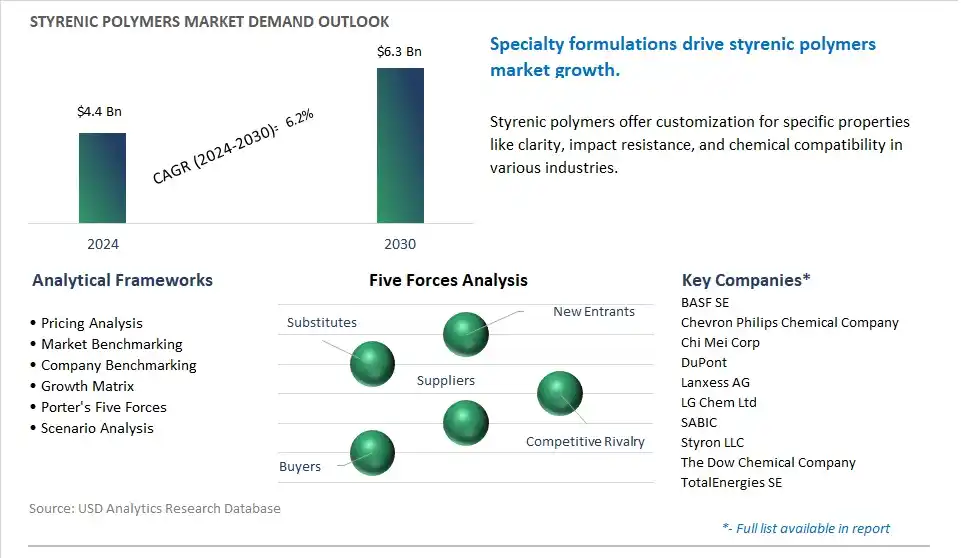
Styrenic Polymers Market Competitive Landscape
The market report analyses the leading companies in the industry including BASF SE, Chevron Philips Chemical Company, Chi Mei Corp, DuPont, Lanxess AG, LG Chem Ltd, SABIC, Styron LLC, The Dow Chemical Company, TotalEnergies SE.
Styrenic Polymers Market Dynamics
Styrenic Polymers Market Trend: Increasing Demand for Recyclable and Biodegradable Styrenic Polymers
A prominent trend in the styrenic polymers market is the increasing demand for recyclable and biodegradable alternatives. With growing environmental concerns and regulations aimed at reducing plastic waste, there's a growing interest in developing styrenic polymers that offer improved sustainability profiles. Manufacturers are exploring options such as bio-based styrenic polymers derived from renewable feedstocks and innovative formulations that facilitate easier recycling or biodegradation. This is driven by consumer preferences for eco-friendly products, corporate sustainability initiatives, and government regulations promoting the circular economy. As the focus on environmental sustainability intensifies, there's an opportunity for styrenic polymer manufacturers to invest in research and development of greener alternatives that meet market demands and regulatory requirements.
Styrenic Polymers Market Driver: Versatility and Wide Range of Applications
The primary driver behind the styrenic polymers market's growth is the material's versatility and wide range of applications across various industries. Styrenic polymers, including polystyrene (PS), acrylonitrile butadiene styrene (ABS), and styrene-butadiene rubber (SBR), are used in numerous applications such as packaging, consumer goods, automotive parts, construction materials, electronics, and healthcare products. The diverse properties of styrenic polymers, including transparency, impact resistance, thermal stability, and chemical resistance, make them suitable for a broad spectrum of end uses. As industries continue to innovate and develop new products and technologies, the demand for styrenic polymers remains strong, driven by their unique combination of properties and versatility in meeting diverse application requirements.
Styrenic Polymers Market Opportunity: Development of High-Performance Styrenic Polymer Blends
An attractive opportunity within the styrenic polymers market lies in the development of high-performance polymer blends that combine the advantages of different styrenic polymers. By blending different styrenic polymers or incorporating additives and modifiers, manufacturers can create customized materials with enhanced properties tailored to specific applications. For example, blending polystyrene with ABS or rubber modifiers can improve impact resistance and toughness, making it suitable for durable goods and automotive components. Additionally, incorporating flame retardants or UV stabilizers into styrenic polymer blends can enhance fire resistance and weatherability, expanding their use in construction and outdoor applications. By focusing on the development of innovative polymer blends, manufacturers can address evolving market needs, differentiate their products, and capture opportunities in high-value market segments across various industries.
Styrenic Polymers Market Share Analysis: Polystyrene (PS) generated the highest revenue in 2024
The largest segment in the Styrenic Polymers Market is Polystyrene (PS). polystyrene is one of the most widely produced and consumed plastics globally due to its versatility, affordability, and ease of processing. PS is used in a wide range of applications across various industries, including packaging, consumer goods, electronics, construction, and healthcare. Additionally, PS offers excellent properties such as transparency, rigidity, thermal insulation, and chemical resistance, making it suitable for diverse applications such as food packaging, disposable containers, insulation boards, and medical devices. Further, PS can be easily processed using injection molding, extrusion, and thermoforming techniques, allowing for efficient and cost-effective manufacturing of products with intricate shapes and designs. Furthermore, the growing demand for single-use and disposable packaging materials further drives the consumption of PS-based products. Accordingly, the PS segment is the largest in the Styrenic Polymers Market due to its widespread use, versatility, and established market presence across multiple industries.
Styrenic Polymers Market Report Segmentation
By Type
Polystyrene (PS)
Expandable polystyrene (EPS)
Acrylonitrile butadiene styrene (ABS)
Unsaturated polyester resins (UPR)
Styrene-butadiene rubber (SBR)
Regions Included
North America (US, Canada, Mexico)
Europe (Germany, UK, France, Spain, Italy, Russia, Rest of Europe)
Asia Pacific (China, India, Japan, South Korea, Australia, South East Asia, Rest of Asia)
South America (Brazil, Argentina, Rest of South America)
Middle East and Africa (Saudi Arabia, UAE, Rest of Middle East, South Africa, Egypt, Rest of Africa)
Styrenic Polymers Companies Profiled in the Market Study
BASF SE
Chevron Philips Chemical Company
Chi Mei Corp
DuPont
Lanxess AG
LG Chem Ltd
SABIC
Styron LLC
The Dow Chemical Company
TotalEnergies SE
*- List Not Exhaustive
TABLE OF CONTENTS
1 Introduction to 2024 Styrenic Polymers Market
1.1 Market Overview
1.2 Quick Facts
1.3 Scope/Objective of the Study
1.4 Market Definition
1.5 Countries and Regions Covered
1.6 Units, Currency, and Conversions
1.7 Industry Value Chain
2 Research Methodology
2.1 Market Size Estimation
2.2 Sources and Research Methodology
2.3 Data Triangulation
2.4 Assumptions and Limitations
3 Executive Summary
3.1 Global Styrenic Polymers Market Size Outlook, $ Million, 2021 to 2030
3.2 Styrenic Polymers Market Outlook by Type, $ Million, 2021 to 2030
3.3 Styrenic Polymers Market Outlook by Product, $ Million, 2021 to 2030
3.4 Styrenic Polymers Market Outlook by Application, $ Million, 2021 to 2030
3.5 Styrenic Polymers Market Outlook by Key Countries, $ Million, 2021 to 2030
4 Market Dynamics
4.1 Key Driving Forces of Styrenic Polymers Industry
4.2 Key Market Trends in Styrenic Polymers Industry
4.3 Potential Opportunities in Styrenic Polymers Industry
4.4 Key Challenges in Styrenic Polymers Industry
5 Market Factor Analysis
5.1 Value Chain Analysis
5.2 Competitive Landscape
5.2.1 Global Styrenic Polymers Market Share by Company (%), 2023
5.2.2 Product Offerings by Company
5.3 Porter’s Five Forces Analysis
5.4 Pricing Analysis and Outlook
6 Growth Outlook Across Scenarios
6.1 Growth Analysis-Case Scenario Definitions
6.2 Low Growth Scenario Forecasts
6.3 Reference Growth Scenario Forecasts
6.4 High Growth Scenario Forecasts
7 Global Styrenic Polymers Market Outlook by Segments
7.1 Styrenic Polymers Market Outlook by Segments, $ Million, 2021- 2030
By Type
Polystyrene (PS)
Expandable polystyrene (EPS)
Acrylonitrile butadiene styrene (ABS)
Unsaturated polyester resins (UPR)
Styrene-butadiene rubber (SBR)
8 North America Styrenic Polymers Market Analysis and Outlook To 2030
8.1 Introduction to North America Styrenic Polymers Markets in 2024
8.2 North America Styrenic Polymers Market Size Outlook by Country, 2021-2030
8.2.1 United States
8.2.2 Canada
8.2.3 Mexico
8.3 North America Styrenic Polymers Market size Outlook by Segments, 2021-2030
By Type
Polystyrene (PS)
Expandable polystyrene (EPS)
Acrylonitrile butadiene styrene (ABS)
Unsaturated polyester resins (UPR)
Styrene-butadiene rubber (SBR)
9 Europe Styrenic Polymers Market Analysis and Outlook To 2030
9.1 Introduction to Europe Styrenic Polymers Markets in 2024
9.2 Europe Styrenic Polymers Market Size Outlook by Country, 2021-2030
9.2.1 Germany
9.2.2 France
9.2.3 Spain
9.2.4 United Kingdom
9.2.4 Italy
9.2.5 Russia
9.2.6 Norway
9.2.7 Rest of Europe
9.3 Europe Styrenic Polymers Market Size Outlook by Segments, 2021-2030
By Type
Polystyrene (PS)
Expandable polystyrene (EPS)
Acrylonitrile butadiene styrene (ABS)
Unsaturated polyester resins (UPR)
Styrene-butadiene rubber (SBR)
10 Asia Pacific Styrenic Polymers Market Analysis and Outlook To 2030
10.1 Introduction to Asia Pacific Styrenic Polymers Markets in 2024
10.2 Asia Pacific Styrenic Polymers Market Size Outlook by Country, 2021-2030
10.2.1 China
10.2.2 India
10.2.3 Japan
10.2.4 South Korea
10.2.5 Indonesia
10.2.6 Malaysia
10.2.7 Australia
10.2.8 Rest of Asia Pacific
10.3 Asia Pacific Styrenic Polymers Market size Outlook by Segments, 2021-2030
By Type
Polystyrene (PS)
Expandable polystyrene (EPS)
Acrylonitrile butadiene styrene (ABS)
Unsaturated polyester resins (UPR)
Styrene-butadiene rubber (SBR)
11 South America Styrenic Polymers Market Analysis and Outlook To 2030
11.1 Introduction to South America Styrenic Polymers Markets in 2024
11.2 South America Styrenic Polymers Market Size Outlook by Country, 2021-2030
11.2.1 Brazil
11.2.2 Argentina
11.2.3 Rest of South America
11.3 South America Styrenic Polymers Market size Outlook by Segments, 2021-2030
By Type
Polystyrene (PS)
Expandable polystyrene (EPS)
Acrylonitrile butadiene styrene (ABS)
Unsaturated polyester resins (UPR)
Styrene-butadiene rubber (SBR)
12 Middle East and Africa Styrenic Polymers Market Analysis and Outlook To 2030
12.1 Introduction to Middle East and Africa Styrenic Polymers Markets in 2024
12.2 Middle East and Africa Styrenic Polymers Market Size Outlook by Country, 2021-2030
12.2.1 Saudi Arabia
12.2.2 UAE
12.2.3 Oman
12.2.4 Rest of Middle East
12.2.5 Egypt
12.2.6 Nigeria
12.2.7 South Africa
12.2.8 Rest of Africa
12.3 Middle East and Africa Styrenic Polymers Market size Outlook by Segments, 2021-2030
By Type
Polystyrene (PS)
Expandable polystyrene (EPS)
Acrylonitrile butadiene styrene (ABS)
Unsaturated polyester resins (UPR)
Styrene-butadiene rubber (SBR)
13 Company Profiles
13.1 Company Snapshot
13.2 SWOT Profiles
13.3 Products and Services
13.4 Recent Developments
13.5 Financial Profile
BASF SE
Chevron Philips Chemical Company
Chi Mei Corp
DuPont
Lanxess AG
LG Chem Ltd
SABIC
Styron LLC
The Dow Chemical Company
TotalEnergies SE
14 Appendix
14.1 Customization Offerings
14.2 Subscription Services
14.3 Related Reports
14.4 Publisher Expertise
By Type
Polystyrene (PS)
Expandable polystyrene (EPS)
Acrylonitrile butadiene styrene (ABS)
Unsaturated polyester resins (UPR)
Styrene-butadiene rubber (SBR)
Countries Analyzed
North America (US, Canada, Mexico)
Europe (Germany, UK, France, Spain, Italy, Russia, Rest of Europe)
Asia Pacific (China, India, Japan, South Korea, Australia, South East Asia, Rest of Asia)
South America (Brazil, Argentina, Rest of South America)
Middle East and Africa (Saudi Arabia, UAE, Rest of Middle East, South Africa, Egypt, Rest of Africa)
