
The global Subcutaneous Drug Delivery Devices Marketstudy analyzes and forecasts the market size across 6 regions and 24 countries for diverse segments including By Product (Prefilled syringes, Pen injectors, Auto-injectors, Wearable injectors, Needle-free injectors), By Distribution Channel (Hospital pharmacies, Retail pharmacies, Online pharmacies).
The subcutaneous drug delivery devices market is experiencing notable growth in 2024, driven by advancements in drug delivery technologies, the growing demand for patient-centric drug administration routes, and the expanding pipeline of biologics and specialty pharmaceuticals requiring subcutaneous administration. Subcutaneous drug delivery devices encompass a variety of injection systems such as prefilled syringes, autoinjectors, pen injectors, and wearable infusion pumps designed to deliver medications beneath the skin layer for systemic absorption, offering patients convenient, self-administrable, and pain-free alternatives to traditional parenteral routes. With innovations in needle-free injection systems, connected drug delivery devices, and long-acting drug formulations, the market is witnessing rapid expansion and adoption of subcutaneous drug delivery devices, offering healthcare providers, patients, and caregivers enhanced convenience, dosing accuracy, and therapeutic adherence in chronic disease management, driving advancements in biopharmaceutical delivery systems and patient-centered care models.
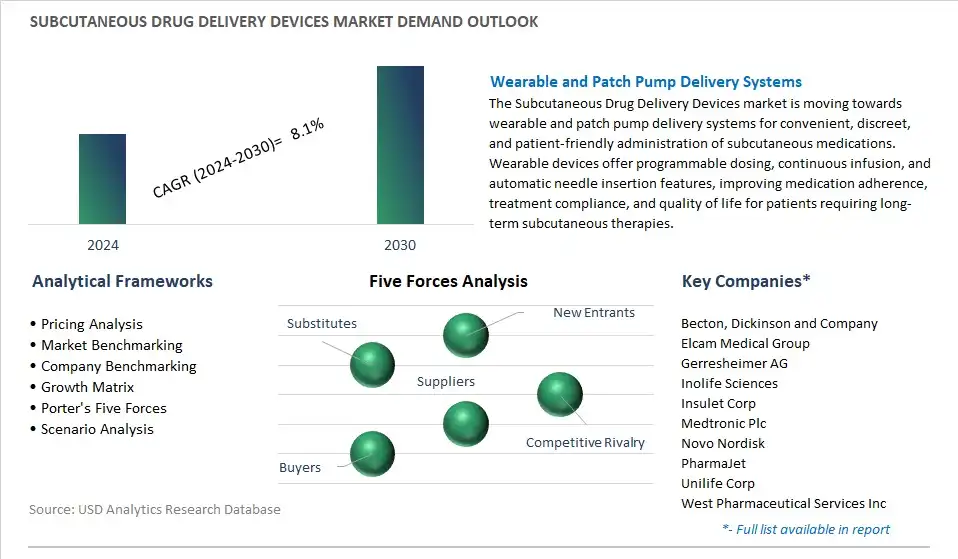
A significant trend in the Subcutaneous Drug Delivery Devices Market is the rise in patient preference for self-administration. With the increasing prevalence of chronic diseases requiring long-term medication, there's a growing demand for convenient and user-friendly drug delivery options that empower patients to self-administer medications at home. This trend is driven by the desire for improved treatment adherence, enhanced patient autonomy, and reduced healthcare costs, leading to the development of subcutaneous drug delivery devices that offer ease of use, portability, and customizable dosing options to meet the diverse needs of patients managing chronic conditions.
The expanding therapeutic applications and biologics pipeline serve as a major driver for the Subcutaneous Drug Delivery Devices Market. With the increasing adoption of biologic therapies for chronic diseases such as diabetes, autoimmune disorders, and cancer, there's a growing need for subcutaneous drug delivery devices capable of delivering large molecule drugs with precision and reliability. Subcutaneous administration offers advantages such as improved bioavailability, reduced immunogenicity, and enhanced patient comfort compared to other routes of drug delivery, driving market growth as pharmaceutical companies expand their biologics portfolios and develop novel therapies requiring subcutaneous administration.
An opportunity exists for market expansion through the integration of digital health technologies and connectivity features in subcutaneous drug delivery devices. With advancements in wearable sensors, mobile health apps, and wireless connectivity, there's potential to develop smart injection devices that enable remote monitoring, real-time data capture, and patient engagement in self-management of chronic conditions. By offering connected drug delivery solutions that track medication adherence, provide dosage reminders, and transmit health data to healthcare providers, manufacturers can enhance treatment outcomes, support medication management, and improve patient satisfaction, thus unlocking new growth opportunities in the subcutaneous drug delivery devices market. This strategic expansion aligns with the broader trend towards digital therapeutics and remote patient monitoring, addressing the evolving needs of patients for integrated solutions that combine drug delivery with digital health technologies to optimize therapy management and improve health outcomes in chronic disease management.
By Product
Prefilled syringes
Pen injectors
Auto-injectors
Wearable injectors
Needle-free injectors
By Distribution Channel
Hospital pharmacies
Retail pharmacies
Online pharmacies
Geographical Analysis
North America (United States, Canada, Mexico)
Europe (Germany, France, United Kingdom, Spain, Italy, Rest of Europe)
Asia Pacific (China, India, Japan, South Korea, Rest of Asia Pacific)
South America (Brazil, Argentina, Rest of South America)
Middle East and Africa (Saudi Arabia, UAE, Rest of Middle East, South Africa, Egypt, Rest of Africa)
Becton, Dickinson and Company
Elcam Medical Group
Gerresheimer AG
Inolife Sciences
Insulet Corp
Medtronic Plc
Novo Nordisk
PharmaJet
Unilife Corp
West Pharmaceutical Services Inc
Ypsomed AG
• Deepen your industry insights and navigate uncertainties for strategy formulation, CAPEX, and Operational decisions
• Gain access to detailed insights on the Subcutaneous Drug Delivery Devices Market, encompassing current market size, growth trends, and forecasts till 2030.
• Access detailed competitor analysis, enabling competitive advantage through a thorough understanding of market players, strategies, and potential differentiation opportunities
• Stay ahead of the curve with insights on technological advancements, innovations, and upcoming trends
• Identify lucrative investment avenues and expansion opportunities within the Subcutaneous Drug Delivery Devices Market industry, guided by robust, data-backed analysis.
• Understand regional and global markets through country-wise analysis, regional market potential, regulatory nuances, and dynamics
• Execute strategies with confidence and speed through information, analytics, and insights on the industry value chain
• Corporate leaders, strategists, financial experts, shareholders, asset managers, and governmental representatives can make long-term planning scenarios and build an integrated and timely understanding of market dynamics
• Benefit from tailored solutions and expert consultation based on report insights, providing personalized strategies aligned with specific business needs.
TABLE OF CONTENTS
1 Introduction to 2024 Subcutaneous Drug Delivery Devices Market
1.1 Market Overview
1.2 Quick Facts
1.3 Scope/Objective of the Study
1.4 Market Definition
1.5 Countries and Regions Analyzed
1.6 Units, Currency, and Conversions
1.7 Industry Value Chain
2 Research Methodology
2.1 Market Size Estimation
2.2 Sources and Research Methodology
2.3 Data Triangulation
2.4 Assumptions and Limitations
3 Executive Summary
3.1 Global Subcutaneous Drug Delivery Devices Market Size Outlook, $ Million, 2021 to 2030
3.2 Subcutaneous Drug Delivery Devices Market Outlook by Type, $ Million, 2021 to 2030
3.3 Subcutaneous Drug Delivery Devices Market Outlook by Product, $ Million, 2021 to 2030
3.4 Subcutaneous Drug Delivery Devices Market Outlook by Application, $ Million, 2021 to 2030
3.5 Subcutaneous Drug Delivery Devices Market Outlook by Key Countries, $ Million, 2021 to 2030
4 Market Dynamics
4.1 Key Driving Forces of Subcutaneous Drug Delivery Devices Industry
4.2 Key Market Trends in Subcutaneous Drug Delivery Devices Industry
4.3 Potential Opportunities in Subcutaneous Drug Delivery Devices Industry
4.4 Key Challenges in Subcutaneous Drug Delivery Devices Industry
5 Market Factor Analysis
5.1 Value Chain Analysis
5.2 Competitive Landscape
5.2.1 Global Subcutaneous Drug Delivery Devices Market Share by Company (%), 2023
5.2.2 Product Offerings by Company
5.3 Porter’s Five Forces Analysis
5.4 Pricing Analysis and Outlook
6 Growth Outlook Across Scenarios
6.1 Growth Analysis-Case Scenario Definitions
6.2 Low Growth Scenario Forecasts
6.3 Reference Growth Scenario Forecasts
6.4 High Growth Scenario Forecasts
7 Global Subcutaneous Drug Delivery Devices Market Outlook by Segments
7.1 Subcutaneous Drug Delivery Devices Market Outlook by Segments, $ Million, 2021- 2030
By Product
Prefilled syringes
Pen injectors
Auto-injectors
Wearable injectors
Needle-free injectors
By Distribution Channel
Hospital pharmacies
Retail pharmacies
Online pharmacies
8 North America Subcutaneous Drug Delivery Devices Market Analysis and Outlook To 2030
8.1 Introduction to North America Subcutaneous Drug Delivery Devices Markets in 2024
8.2 North America Subcutaneous Drug Delivery Devices Market Size Outlook by Country, 2021-2030
8.2.1 United States
8.2.2 Canada
8.2.3 Mexico
8.3 North America Subcutaneous Drug Delivery Devices Market size Outlook by Segments, 2021-2030
By Product
Prefilled syringes
Pen injectors
Auto-injectors
Wearable injectors
Needle-free injectors
By Distribution Channel
Hospital pharmacies
Retail pharmacies
Online pharmacies
9 Europe Subcutaneous Drug Delivery Devices Market Analysis and Outlook To 2030
9.1 Introduction to Europe Subcutaneous Drug Delivery Devices Markets in 2024
9.2 Europe Subcutaneous Drug Delivery Devices Market Size Outlook by Country, 2021-2030
9.2.1 Germany
9.2.2 France
9.2.3 Spain
9.2.4 United Kingdom
9.2.4 Italy
9.2.5 Russia
9.2.6 Norway
9.2.7 Rest of Europe
9.3 Europe Subcutaneous Drug Delivery Devices Market Size Outlook by Segments, 2021-2030
By Product
Prefilled syringes
Pen injectors
Auto-injectors
Wearable injectors
Needle-free injectors
By Distribution Channel
Hospital pharmacies
Retail pharmacies
Online pharmacies
10 Asia Pacific Subcutaneous Drug Delivery Devices Market Analysis and Outlook To 2030
10.1 Introduction to Asia Pacific Subcutaneous Drug Delivery Devices Markets in 2024
10.2 Asia Pacific Subcutaneous Drug Delivery Devices Market Size Outlook by Country, 2021-2030
10.2.1 China
10.2.2 India
10.2.3 Japan
10.2.4 South Korea
10.2.5 Indonesia
10.2.6 Malaysia
10.2.7 Australia
10.2.8 Rest of Asia Pacific
10.3 Asia Pacific Subcutaneous Drug Delivery Devices Market size Outlook by Segments, 2021-2030
By Product
Prefilled syringes
Pen injectors
Auto-injectors
Wearable injectors
Needle-free injectors
By Distribution Channel
Hospital pharmacies
Retail pharmacies
Online pharmacies
11 South America Subcutaneous Drug Delivery Devices Market Analysis and Outlook To 2030
11.1 Introduction to South America Subcutaneous Drug Delivery Devices Markets in 2024
11.2 South America Subcutaneous Drug Delivery Devices Market Size Outlook by Country, 2021-2030
11.2.1 Brazil
11.2.2 Argentina
11.2.3 Rest of South America
11.3 South America Subcutaneous Drug Delivery Devices Market size Outlook by Segments, 2021-2030
By Product
Prefilled syringes
Pen injectors
Auto-injectors
Wearable injectors
Needle-free injectors
By Distribution Channel
Hospital pharmacies
Retail pharmacies
Online pharmacies
12 Middle East and Africa Subcutaneous Drug Delivery Devices Market Analysis and Outlook To 2030
12.1 Introduction to Middle East and Africa Subcutaneous Drug Delivery Devices Markets in 2024
12.2 Middle East and Africa Subcutaneous Drug Delivery Devices Market Size Outlook by Country, 2021-2030
12.2.1 Saudi Arabia
12.2.2 UAE
12.2.3 Oman
12.2.4 Rest of Middle East
12.2.5 Egypt
12.2.6 Nigeria
12.2.7 South Africa
12.2.8 Rest of Africa
12.3 Middle East and Africa Subcutaneous Drug Delivery Devices Market size Outlook by Segments, 2021-2030
By Product
Prefilled syringes
Pen injectors
Auto-injectors
Wearable injectors
Needle-free injectors
By Distribution Channel
Hospital pharmacies
Retail pharmacies
Online pharmacies
13 Company Profiles
13.1 Company Snapshot
13.2 SWOT Profiles
13.3 Products and Services
13.4 Recent Developments
13.5 Financial Profile
List of Companies
Becton, Dickinson and Company
Elcam Medical Group
Gerresheimer AG
Inolife Sciences
Insulet Corp
Medtronic Plc
Novo Nordisk
PharmaJet
Unilife Corp
West Pharmaceutical Services Inc
Ypsomed AG
14 Appendix
14.1 Customization Offerings
14.2 Subscription Services
14.3 Related Reports
14.4 Publisher Expertise
By Product
Prefilled syringes
Pen injectors
Auto-injectors
Wearable injectors
Needle-free injectors
By Distribution Channel
Hospital pharmacies
Retail pharmacies
Online pharmacies
The global Subcutaneous Drug Delivery Devices Market is one of the lucrative growth markets, poised to register a 8.1% growth (CAGR) between 2024 and 2030.
Emerging Markets across Asia Pacific, Europe, and Americas present robust growth prospects.
Becton, Dickinson and Company, Elcam Medical Group, Gerresheimer AG, Inolife Sciences , Insulet Corp, Medtronic Plc, Novo Nordisk, PharmaJet, Unilife Corp, West Pharmaceutical Services Inc, Ypsomed AG
Base Year- 2023; Estimated Year- 2024; Historic Period- 2018-2023; Forecast period- 2024 to 2030; Currency: USD; Volume