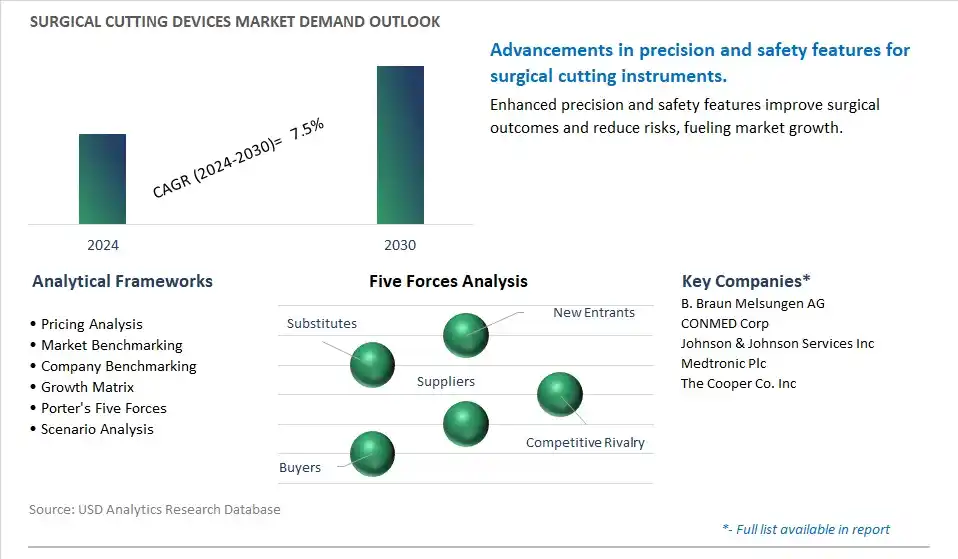
Surgical Cutting Devices Market is estimated to increase at a growth rate of 7.5% CAGR over the forecast period from 2024 to 2030.
The global Surgical Cutting Devices Market Study analyzes and forecasts the market size across 6 regions and 24 countries for diverse segments including By Type (Trocars, Scissors, Scalpel, Blades), By Category (Reusable, Disposable).
An Introduction to Surgical Cutting Devices Market in 2024
The Surgical Cutting Devices Market comprises surgical scalpels, surgical knives, electrosurgical scalpels, ultrasonic scalpels, and laser cutting tools used in surgical procedures for tissue incision, dissection, hemostasis, and surgical site preparation in various medical specialties such as general surgery, orthopedics, neurosurgery, and plastic surgery. Surgical cutting devices offer precision cutting, tissue sealing, and coagulation capabilities, supporting surgical precision, reduced blood loss, and enhanced surgical outcomes for patients. Market trends include safety scalpel designs, energy-based cutting technologies, ergonomic handle designs, and single-use cutting devices for surgical efficiency and patient safety.
Surgical Cutting Devices Market Competitive Landscape
The global Surgical Cutting Devices Industry is highly competitive with a large number of companies focusing on niche market segments. Amidst intense competitive conditions, Surgical Cutting Devices Companies are investing in new product launches and strengthening distribution channels. Key companies operating in the Surgical Cutting Devices Industry include- B. Braun Melsungen AG, CONMED Corp, Johnson & Johnson Services Inc, Medtronic Plc, The Cooper Co. Inc.
Surgical Cutting Devices Market Trend: Advancements in Minimally Invasive Techniques
One prominent trend in the Surgical Cutting Devices market is the continued advancement of minimally invasive surgical techniques. Minimally invasive surgeries offer several advantages over traditional open surgeries, including smaller incisions, reduced trauma to surrounding tissues, faster recovery times, and decreased post-operative pain. As a result, there's a growing preference for minimally invasive procedures across various surgical specialties. This trend is driving the development of surgical cutting devices that are specifically designed for use in minimally invasive surgeries. Manufacturers are focusing on creating cutting-edge tools that enable precise and controlled tissue dissection, excision, and manipulation through small incisions or natural orifices. Additionally, advancements in imaging technologies, such as laparoscopic and robotic-assisted surgery, are further driving the demand for specialized cutting devices that facilitate complex procedures with enhanced precision and efficiency.
Surgical Cutting Devices Market Driver: Rising Demand for Surgical Precision and Efficiency
The primary driver for the Surgical Cutting Devices market is the increasing demand for surgical instruments that offer superior precision, efficiency, and safety. Surgeons require cutting devices that allow for accurate tissue cutting and manipulation while minimizing the risk of unintended damage to surrounding structures. Additionally, there's a growing emphasis on reducing surgical time and improving patient outcomes, driving the need for cutting devices that enable faster and more efficient procedures. As surgical techniques become more sophisticated and complex, there's a corresponding demand for cutting-edge instruments that can meet the evolving needs of surgeons and healthcare facilities. Moreover, advancements in materials, manufacturing processes, and ergonomics are enabling the development of cutting devices that offer improved durability, performance, and user comfort, further fueling market growth.
Surgical Cutting Devices Market Opportunity: Innovation in Surgical Navigation and Robotics
An opportunity exists in the integration of surgical navigation and robotics technologies into cutting devices to enhance precision and workflow efficiency. Surgical navigation systems use real-time imaging and tracking techniques to provide surgeons with enhanced visualization and guidance during procedures, allowing for more accurate and targeted tissue manipulation. By incorporating navigation capabilities into cutting devices, manufacturers can offer surgeons greater control and accuracy, particularly in challenging anatomical areas or complex procedures. Additionally, robotics-assisted cutting devices enable surgeons to perform procedures with enhanced dexterity and control, leading to improved outcomes and reduced surgical complications. Collaborations between medical device companies, technology developers, and healthcare providers can drive innovation in navigation-enabled and robotic cutting devices, offering opportunities to advance surgical capabilities and improve patient care.
Surgical Cutting Devices Market Share Analysis: Trocars is the fastest growing market segment over the forecast period to 2030
Among the segmented categories, Trocars emerge as the fast-growing type in the market for surgical cutting devices. Trocars are specialized instruments used in minimally invasive surgical procedures to create access ports for the insertion of other instruments, such as laparoscopic cameras and surgical tools. The increasing adoption of minimally invasive techniques in various surgical specialties, including general surgery, gynecology, and urology, has propelled the demand for trocars. These devices offer advantages such as reduced trauma to surrounding tissues, faster recovery times, and shorter hospital stays for patients. Additionally, advancements in trocar design, such as ergonomic handles and enhanced safety features, contribute to their growing popularity among surgeons and healthcare facilities. With the ongoing trend towards minimally invasive surgery and the continuous innovation in trocar technology, the market for trocars is expected to experience rapid growth, catering to the increasing demand for efficient and patient-friendly surgical solutions.
Surgical Cutting Devices Market Segmentation
By Type
Trocars
Scissors
Scalpel
Blades
By Category
Reusable
Disposable
Geographical Analysis
North America (United States, Canada, Mexico)
Europe (Germany, France, United Kingdom, Spain, Italy, Rest of Europe)
Asia Pacific (China, India, Japan, South Korea, Rest of Asia Pacific)
South America (Brazil, Argentina, Rest of South America)
Middle East and Africa (Saudi Arabia, UAE, Rest of Middle East, South Africa, Egypt, Rest of Africa)
Surgical Cutting Devices Companies
B. Braun Melsungen AG
CONMED Corp
Johnson & Johnson Services Inc
Medtronic Plc
The Cooper Co. Inc
* List not Exhaustive
Reasons to Buy the Surgical Cutting Devices Market Study
• Deepen your industry insights and navigate uncertainties for strategy formulation, CAPEX, and Operational decisions
• Gain access to detailed insights on the Surgical Cutting Devices Market, encompassing current market size, growth trends, and forecasts till 2030.
• Access detailed competitor analysis, enabling competitive advantage through a thorough understanding of market players, strategies, and potential differentiation opportunities
• Stay ahead of the curve with insights on technological advancements, innovations, and upcoming trends
• Identify lucrative investment avenues and expansion opportunities within the Surgical Cutting Devices Industry, guided by robust, data-backed analysis.
• Understand regional and global markets through country-wise analysis, regional market potential, regulatory nuances, and dynamics
• Execute strategies with confidence and speed through information, analytics, and insights on the industry value chain
• Corporate leaders, strategists, financial experts, shareholders, asset managers, and governmental representatives can make long-term planning scenarios and build an integrated and timely understanding of market dynamics
• Benefit from tailored solutions and expert consultation based on report insights, providing personalized strategies aligned with specific business needs.
TABLE OF CONTENTS
1 Introduction to 2024 Surgical Cutting Devices Market
1.1 Market Overview
1.2 Quick Facts
1.3 Scope/Objective of the Study
1.4 Market Definition
1.5 Countries and Regions Analyzed
1.6 Units, Currency, and Conversions
1.7 Industry Value Chain
2 Research Methodology
2.1 Market Size Estimation
2.2 Sources and Research Methodology
2.3 Data Triangulation
2.4 Assumptions and Limitations
3 Executive Summary
3.1 Global Surgical Cutting Devices Market Size Outlook, $ Million, 2021 to 2030
3.2 Surgical Cutting Devices Market Outlook by Type, $ Million, 2021 to 2030
3.3 Surgical Cutting Devices Market Outlook by Product, $ Million, 2021 to 2030
3.4 Surgical Cutting Devices Market Outlook by Application, $ Million, 2021 to 2030
3.5 Surgical Cutting Devices Market Outlook by Key Countries, $ Million, 2021 to 2030
4 Market Dynamics
4.1 Key Driving Forces of Surgical Cutting Devices Industry
4.2 Key Market Trends in Surgical Cutting Devices Industry
4.3 Potential Opportunities in Surgical Cutting Devices Industry
4.4 Key Challenges in Surgical Cutting Devices Industry
5 Market Factor Analysis
5.1 Value Chain Analysis
5.2 Competitive Landscape
5.2.1 Global Surgical Cutting Devices Market Share by Company (%), 2023
5.2.2 Product Offerings by Company
5.3 Porter’s Five Forces Analysis
5.4 Pricing Analysis and Outlook
6 Growth Outlook Across Scenarios
6.1 Growth Analysis-Case Scenario Definitions
6.2 Low Growth Scenario Forecasts
6.3 Reference Growth Scenario Forecasts
6.4 High Growth Scenario Forecasts
7 Global Surgical Cutting Devices Market Outlook by Segments
7.1 Surgical Cutting Devices Market Outlook by Segments, $ Million, 2021- 2030
By Type
Trocars
Scissors
Scalpel
Blades
By Category
Reusable
Disposable
8 North America Surgical Cutting Devices Market Analysis and Outlook To 2030
8.1 Introduction to North America Surgical Cutting Devices Markets in 2024
8.2 North America Surgical Cutting Devices Market Size Outlook by Country, 2021-2030
8.2.1 United States
8.2.2 Canada
8.2.3 Mexico
8.3 North America Surgical Cutting Devices Market size Outlook by Segments, 2021-2030
By Type
Trocars
Scissors
Scalpel
Blades
By Category
Reusable
Disposable
9 Europe Surgical Cutting Devices Market Analysis and Outlook To 2030
9.1 Introduction to Europe Surgical Cutting Devices Markets in 2024
9.2 Europe Surgical Cutting Devices Market Size Outlook by Country, 2021-2030
9.2.1 Germany
9.2.2 France
9.2.3 Spain
9.2.4 United Kingdom
9.2.4 Italy
9.2.5 Russia
9.2.6 Norway
9.2.7 Rest of Europe
9.3 Europe Surgical Cutting Devices Market Size Outlook by Segments, 2021-2030
By Type
Trocars
Scissors
Scalpel
Blades
By Category
Reusable
Disposable
10 Asia Pacific Surgical Cutting Devices Market Analysis and Outlook To 2030
10.1 Introduction to Asia Pacific Surgical Cutting Devices Markets in 2024
10.2 Asia Pacific Surgical Cutting Devices Market Size Outlook by Country, 2021-2030
10.2.1 China
10.2.2 India
10.2.3 Japan
10.2.4 South Korea
10.2.5 Indonesia
10.2.6 Malaysia
10.2.7 Australia
10.2.8 Rest of Asia Pacific
10.3 Asia Pacific Surgical Cutting Devices Market size Outlook by Segments, 2021-2030
By Type
Trocars
Scissors
Scalpel
Blades
By Category
Reusable
Disposable
11 South America Surgical Cutting Devices Market Analysis and Outlook To 2030
11.1 Introduction to South America Surgical Cutting Devices Markets in 2024
11.2 South America Surgical Cutting Devices Market Size Outlook by Country, 2021-2030
11.2.1 Brazil
11.2.2 Argentina
11.2.3 Rest of South America
11.3 South America Surgical Cutting Devices Market size Outlook by Segments, 2021-2030
By Type
Trocars
Scissors
Scalpel
Blades
By Category
Reusable
Disposable
12 Middle East and Africa Surgical Cutting Devices Market Analysis and Outlook To 2030
12.1 Introduction to Middle East and Africa Surgical Cutting Devices Markets in 2024
12.2 Middle East and Africa Surgical Cutting Devices Market Size Outlook by Country, 2021-2030
12.2.1 Saudi Arabia
12.2.2 UAE
12.2.3 Oman
12.2.4 Rest of Middle East
12.2.5 Egypt
12.2.6 Nigeria
12.2.7 South Africa
12.2.8 Rest of Africa
12.3 Middle East and Africa Surgical Cutting Devices Market size Outlook by Segments, 2021-2030
By Type
Trocars
Scissors
Scalpel
Blades
By Category
Reusable
Disposable
13 Company Profiles
13.1 Company Snapshot
13.2 SWOT Profiles
13.3 Products and Services
13.4 Recent Developments
13.5 Financial Profile
List of Companies
B. Braun Melsungen AG
CONMED Corp
Johnson & Johnson Services Inc
Medtronic Plc
The Cooper Co. Inc
14 Appendix
14.1 Customization Offerings
14.2 Subscription Services
14.3 Related Reports
14.4 Publisher Expertise
