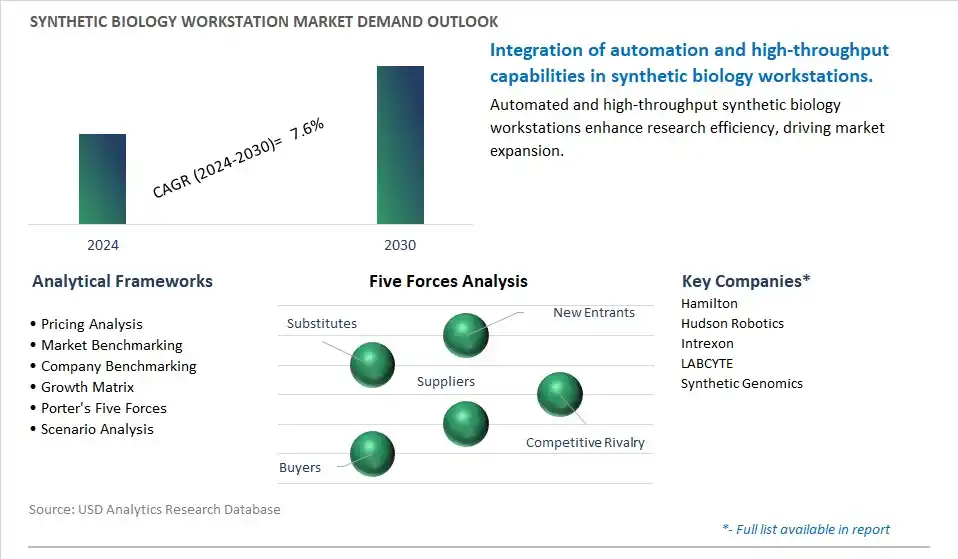
Synthetic Biology Workstation Market is estimated to increase at a growth rate of 7.6% CAGR over the forecast period from 2024 to 2030.
The global Synthetic Biology Workstation Market Study analyzes and forecasts the market size across 6 regions and 24 countries for diverse segments including By Type (Genome Engineering, NGS, Cloning and Sequencing), By Application (Pharmaceutical and Biotechnology, Food and Agriculture, Biochemical, Biofuels, Others).
An Introduction to Synthetic Biology Workstation Market in 2024
The Synthetic Biology Workstation Market comprises laboratory workstations, genetic engineering platforms, automated liquid handling systems, and synthetic biology tools used in molecular biology research, genetic engineering, and biotechnology applications for DNA synthesis, gene editing, protein engineering, and synthetic pathway design. Synthetic biology workstations offer modular configurations, integrated bioinformatics tools, and high-throughput capabilities for synthetic DNA construction, genetic circuit assembly, and metabolic pathway optimization in synthetic biology workflows. Market dynamics encompass genetic editing technologies, CRISPR-Cas systems, bioinformatics software, and synthetic biology workstation integration for innovative genetic engineering and bioproduction solutions.
Synthetic Biology Workstation Market Competitive Landscape
The global Synthetic Biology Workstation Industry is highly competitive with a large number of companies focusing on niche market segments. Amidst intense competitive conditions, Synthetic Biology Workstation Companies are investing in new product launches and strengthening distribution channels. Key companies operating in the Synthetic Biology Workstation Industry include- Hamilton, Hudson Robotics, Intrexon, LABCYTE, Synthetic Genomics.
Market Trend: Increasing Demand for Bioproduction
Synthetic biology workstations are witnessing a significant trend towards increased demand driven by the expanding field of bioproduction. With advancements in synthetic biology techniques, there's a growing need for workstations that can efficiently facilitate the design, construction, and testing of biological systems for industrial applications. This trend is fueled by the rising interest in sustainable production methods, such as bio-based manufacturing and biopharmaceutical production.
Market Driver: Technological Advancements
The primary driver for the synthetic biology workstation market is the continuous stream of technological advancements. These innovations include the development of high-throughput automation, CRISPR-based genome editing tools, and improved computational modeling software, enhancing the efficiency and capabilities of synthetic biology workflows. The convergence of various technologies is driving the adoption of synthetic biology workstations across research, pharmaceutical, and industrial sectors.
Synthetic Biology Workstation Market Opportunity:Customized Solutions for Specific Applications
An emerging opportunity lies in providing customized synthetic biology workstations tailored to specific applications or industries. Companies can capitalize on this by offering modular and flexible workstation solutions that can be easily adapted to different research or production needs. By understanding the unique requirements of various sectors, such as healthcare, agriculture, or renewable energy, manufacturers can seize opportunities to create specialized workstations optimized for specific tasks, ultimately expanding their market reach and competitiveness.
Synthetic Biology Workstation Market Share Analysis: Next-Generation Sequencing (NGS) is the fastest growing market segment over the forecast period to 2030
Among the segmented categories, Next-Generation Sequencing (NGS) emerges as the fast-growing type in the market for synthetic biology workstations. NGS technologies revolutionize genomic analysis by enabling rapid and cost-effective sequencing of DNA and RNA molecules. These workstations facilitate high-throughput sequencing, allowing researchers to analyze vast amounts of genetic information efficiently. In various applications such as pharmaceutical and biotechnology research, food and agriculture, biochemical studies, and biofuel development, NGS plays a pivotal role in elucidating complex biological systems and accelerating scientific discoveries. As the demand for comprehensive genomic analysis continues to increase across diverse fields, including personalized medicine, agricultural genomics, and environmental studies, the market for NGS workstations experiences rapid growth. Additionally, ongoing advancements in NGS technology, such as improved sequencing platforms, enhanced bioinformatics tools, and streamlined workflows, further fuel the adoption of NGS workstations, making them indispensable tools in modern biological research and innovation.
Synthetic Biology Workstation Market Segmentation
By Type
Genome Engineering
NGS
Cloning and Sequencing
By Application
Pharmaceutical and Biotechnology
Food and Agriculture
Biochemical
Biofuels
Others
Geographical Analysis
North America (United States, Canada, Mexico)
Europe (Germany, France, United Kingdom, Spain, Italy, Rest of Europe)
Asia Pacific (China, India, Japan, South Korea, Rest of Asia Pacific)
South America (Brazil, Argentina, Rest of South America)
Middle East and Africa (Saudi Arabia, UAE, Rest of Middle East, South Africa, Egypt, Rest of Africa)
Synthetic Biology Workstation Companies
Hamilton
Hudson Robotics
Intrexon
LABCYTE
Synthetic Genomics
* List not Exhaustive
Reasons to Buy the Synthetic Biology Workstation Market Study
• Deepen your industry insights and navigate uncertainties for strategy formulation, CAPEX, and Operational decisions
• Gain access to detailed insights on the Synthetic Biology Workstation Market, encompassing current market size, growth trends, and forecasts till 2030.
• Access detailed competitor analysis, enabling competitive advantage through a thorough understanding of market players, strategies, and potential differentiation opportunities
• Stay ahead of the curve with insights on technological advancements, innovations, and upcoming trends
• Identify lucrative investment avenues and expansion opportunities within the Synthetic Biology Workstation Industry, guided by robust, data-backed analysis.
• Understand regional and global markets through country-wise analysis, regional market potential, regulatory nuances, and dynamics
• Execute strategies with confidence and speed through information, analytics, and insights on the industry value chain
• Corporate leaders, strategists, financial experts, shareholders, asset managers, and governmental representatives can make long-term planning scenarios and build an integrated and timely understanding of market dynamics
• Benefit from tailored solutions and expert consultation based on report insights, providing personalized strategies aligned with specific business needs.
TABLE OF CONTENTS
1 Introduction to 2024 Synthetic Biology Workstation Market
1.1 Market Overview
1.2 Quick Facts
1.3 Scope/Objective of the Study
1.4 Market Definition
1.5 Countries and Regions Analyzed
1.6 Units, Currency, and Conversions
1.7 Industry Value Chain
2 Research Methodology
2.1 Market Size Estimation
2.2 Sources and Research Methodology
2.3 Data Triangulation
2.4 Assumptions and Limitations
3 Executive Summary
3.1 Global Synthetic Biology Workstation Market Size Outlook, $ Million, 2021 to 2030
3.2 Synthetic Biology Workstation Market Outlook by Type, $ Million, 2021 to 2030
3.3 Synthetic Biology Workstation Market Outlook by Product, $ Million, 2021 to 2030
3.4 Synthetic Biology Workstation Market Outlook by Application, $ Million, 2021 to 2030
3.5 Synthetic Biology Workstation Market Outlook by Key Countries, $ Million, 2021 to 2030
4 Market Dynamics
4.1 Key Driving Forces of Synthetic Biology Workstation Industry
4.2 Key Market Trends in Synthetic Biology Workstation Industry
4.3 Potential Opportunities in Synthetic Biology Workstation Industry
4.4 Key Challenges in Synthetic Biology Workstation Industry
5 Market Factor Analysis
5.1 Value Chain Analysis
5.2 Competitive Landscape
5.2.1 Global Synthetic Biology Workstation Market Share by Company (%), 2023
5.2.2 Product Offerings by Company
5.3 Porter’s Five Forces Analysis
5.4 Pricing Analysis and Outlook
6 Growth Outlook Across Scenarios
6.1 Growth Analysis-Case Scenario Definitions
6.2 Low Growth Scenario Forecasts
6.3 Reference Growth Scenario Forecasts
6.4 High Growth Scenario Forecasts
7 Global Synthetic Biology Workstation Market Outlook by Segments
7.1 Synthetic Biology Workstation Market Outlook by Segments, $ Million, 2021- 2030
By Type
Genome Engineering
NGS
Cloning and Sequencing
By Application
Pharmaceutical and Biotechnology
Food and Agriculture
Biochemical
Biofuels
Others
8 North America Synthetic Biology Workstation Market Analysis and Outlook To 2030
8.1 Introduction to North America Synthetic Biology Workstation Markets in 2024
8.2 North America Synthetic Biology Workstation Market Size Outlook by Country, 2021-2030
8.2.1 United States
8.2.2 Canada
8.2.3 Mexico
8.3 North America Synthetic Biology Workstation Market size Outlook by Segments, 2021-2030
By Type
Genome Engineering
NGS
Cloning and Sequencing
By Application
Pharmaceutical and Biotechnology
Food and Agriculture
Biochemical
Biofuels
Others
9 Europe Synthetic Biology Workstation Market Analysis and Outlook To 2030
9.1 Introduction to Europe Synthetic Biology Workstation Markets in 2024
9.2 Europe Synthetic Biology Workstation Market Size Outlook by Country, 2021-2030
9.2.1 Germany
9.2.2 France
9.2.3 Spain
9.2.4 United Kingdom
9.2.4 Italy
9.2.5 Russia
9.2.6 Norway
9.2.7 Rest of Europe
9.3 Europe Synthetic Biology Workstation Market Size Outlook by Segments, 2021-2030
By Type
Genome Engineering
NGS
Cloning and Sequencing
By Application
Pharmaceutical and Biotechnology
Food and Agriculture
Biochemical
Biofuels
Others
10 Asia Pacific Synthetic Biology Workstation Market Analysis and Outlook To 2030
10.1 Introduction to Asia Pacific Synthetic Biology Workstation Markets in 2024
10.2 Asia Pacific Synthetic Biology Workstation Market Size Outlook by Country, 2021-2030
10.2.1 China
10.2.2 India
10.2.3 Japan
10.2.4 South Korea
10.2.5 Indonesia
10.2.6 Malaysia
10.2.7 Australia
10.2.8 Rest of Asia Pacific
10.3 Asia Pacific Synthetic Biology Workstation Market size Outlook by Segments, 2021-2030
By Type
Genome Engineering
NGS
Cloning and Sequencing
By Application
Pharmaceutical and Biotechnology
Food and Agriculture
Biochemical
Biofuels
Others
11 South America Synthetic Biology Workstation Market Analysis and Outlook To 2030
11.1 Introduction to South America Synthetic Biology Workstation Markets in 2024
11.2 South America Synthetic Biology Workstation Market Size Outlook by Country, 2021-2030
11.2.1 Brazil
11.2.2 Argentina
11.2.3 Rest of South America
11.3 South America Synthetic Biology Workstation Market size Outlook by Segments, 2021-2030
By Type
Genome Engineering
NGS
Cloning and Sequencing
By Application
Pharmaceutical and Biotechnology
Food and Agriculture
Biochemical
Biofuels
Others
12 Middle East and Africa Synthetic Biology Workstation Market Analysis and Outlook To 2030
12.1 Introduction to Middle East and Africa Synthetic Biology Workstation Markets in 2024
12.2 Middle East and Africa Synthetic Biology Workstation Market Size Outlook by Country, 2021-2030
12.2.1 Saudi Arabia
12.2.2 UAE
12.2.3 Oman
12.2.4 Rest of Middle East
12.2.5 Egypt
12.2.6 Nigeria
12.2.7 South Africa
12.2.8 Rest of Africa
12.3 Middle East and Africa Synthetic Biology Workstation Market size Outlook by Segments, 2021-2030
By Type
Genome Engineering
NGS
Cloning and Sequencing
By Application
Pharmaceutical and Biotechnology
Food and Agriculture
Biochemical
Biofuels
Others
13 Company Profiles
13.1 Company Snapshot
13.2 SWOT Profiles
13.3 Products and Services
13.4 Recent Developments
13.5 Financial Profile
List of Companies
Hamilton
Hudson Robotics
Intrexon
LABCYTE
Synthetic Genomics
14 Appendix
14.1 Customization Offerings
14.2 Subscription Services
14.3 Related Reports
14.4 Publisher Expertise
