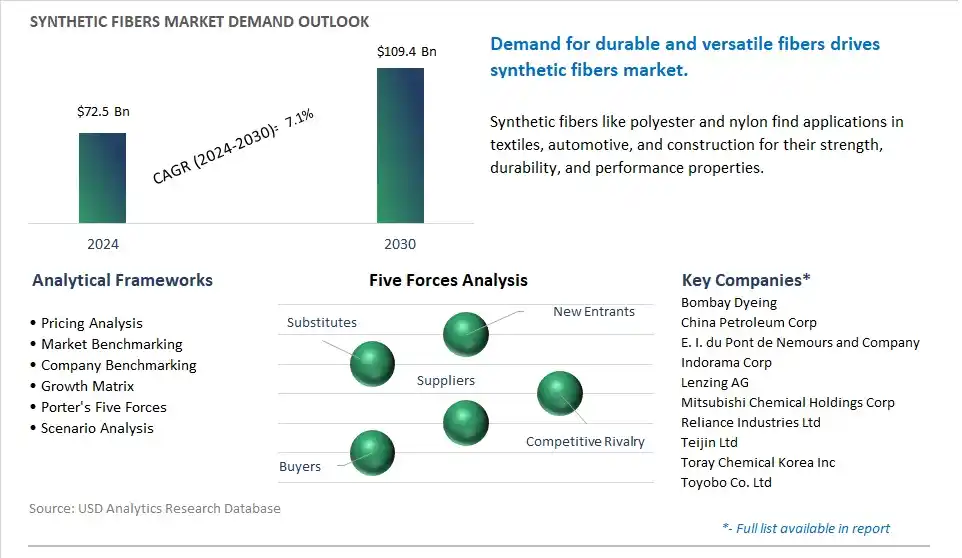
The global Synthetic Fibers Market is poised to register a 7.1% CAGR from $72.5 Billion in 2024 to $109.4 Billion in 2030.
The global Synthetic Fibers Market Study analyzes and forecasts the market size across 6 regions and 24 countries for diverse segments -By Type (Polyester, Nylon, Acrylics, Polyolefin, Others), By Application (Clothing, Home Furnishing, Automotive, Filtration, Others).
An Introduction to Global Synthetic Fibers Market in 2024
Synthetic fibers are man-made fibers produced through chemical synthesis or extrusion of polymers, offering a wide range of properties such as strength, durability, and resistance to chemicals and moisture. The future of synthetic fibers is influenced by several key trends, including advancements in material science, sustainability initiatives, and evolving consumer preferences. One significant trend is the development of sustainable and eco-friendly synthetic fibers derived from renewable sources or recycled materials, addressing concerns about environmental impact and plastic pollution. Manufacturers are investing in research and development to explore new polymer chemistries, recycling technologies, and production processes that minimize energy consumption, water usage, and greenhouse gas emissions throughout the lifecycle of synthetic fibers. Additionally, the integration of advanced textile manufacturing techniques such as melt-spinning, electrospinning, and nanofiber technology is driving innovations in fiber morphology, structure, and performance, enabling the production of functional textiles for diverse applications ranging from apparel and automotive interiors to medical devices and filtration systems. Moreover, the emphasis on performance attributes such as moisture management, UV protection, and antimicrobial properties is driving the development of specialty synthetic fibers with tailored functionalities, meeting the specific requirements of active wear, outdoor gear, and protective clothing. Furthermore, collaborations between fiber producers, textile manufacturers, and fashion brands are driving innovation and market growth by delivering customized solutions that meet the demands of sustainability-conscious consumers and industries, ensuring continued relevance and competitiveness in the global textile market.
Synthetic Fibers Market Competitive Landscape
The market report analyses the leading companies in the industry including Bombay Dyeing, China Petroleum Corp, E. I. du Pont de Nemours and Company, Indorama Corp, Lenzing AG, Mitsubishi Chemical Holdings Corp, Reliance Industries Ltd, Teijin Ltd, Toray Chemical Korea Inc, Toyobo Co. Ltd.
Synthetic Fibers Market Dynamics
Synthetic Fibers Market Trend: Increasing Demand for Sustainable and Eco-Friendly Synthetic Fibers
A prominent market trend in the synthetic fibers industry is the growing demand for sustainable and eco-friendly synthetic fibers. With rising awareness of environmental issues and concerns about the ecological impact of textile production, there is a shift towards synthetic fibers that are produced using sustainable processes, recycled materials, or biodegradable polymers. Consumers are seeking alternatives to conventional synthetic fibers derived from petroleum-based sources, opting instead for fibers made from renewable resources or recycled materials. This trend is driven by changing consumer preferences, regulatory pressures, and corporate sustainability initiatives aimed at reducing carbon footprint and promoting circular economy principles in the textile industry.
Synthetic Fibers Market Driver: Technological Advancements and Innovation in Fiber Production
A key driver behind the growth of the synthetic fibers market is technological advancements and innovation in fiber production processes. Manufacturers are continuously investing in research and development to improve the performance, durability, and sustainability of synthetic fibers through innovations in polymer chemistry, spinning technologies, and fiber finishing techniques. These advancements enable the development of synthetic fibers with enhanced properties such as moisture management, UV resistance, antimicrobial properties, and biodegradability, expanding their applicability across various industries including apparel, automotive, healthcare, and construction. The pursuit of innovation drives competition and stimulates market growth as manufacturers strive to meet evolving consumer needs and industry standards.
Synthetic Fibers Market Opportunity: Development of Next-Generation Sustainable Fibers and Smart Textiles
An opportunity exists for synthetic fiber manufacturers to develop next-generation sustainable fibers and smart textiles that offer advanced functionality and environmental benefits. Sustainable fibers such as biopolymers, regenerated cellulose fibers, and recycled synthetics present opportunities to meet growing demand for eco-friendly alternatives to conventional synthetic fibers. Additionally, there is opportunity to integrate smart technologies into synthetic fibers to create smart textiles with functionalities such as temperature regulation, moisture sensing, and energy harvesting. By investing in research and development of innovative fiber technologies and collaborating with industry partners to create value-added products, synthetic fiber manufacturers can capitalize on emerging market trends and position themselves as leaders in sustainable and smart textile solutions.
Synthetic Fibers Market Share Analysis: Polyester generated the highest revenue in 2024
Polyester is the largest segment in the Synthetic Fibers Market. Polyester fibers enjoy widespread popularity due to their versatility, durability, and affordability, making them a preferred choice across various end-use industries. In the textile sector, polyester fibers find extensive application in apparel, home furnishings, and technical textiles, owing to their excellent wrinkle resistance, color retention, and ease of care. Further, the growth of the global population, coupled with rising disposable incomes and changing consumer preferences, has spurred the demand for clothing and textiles, further bolstering the dominance of polyester in the market. Additionally, technological advancements in polymer chemistry have led to the development of high-performance polyester fibers with enhanced properties, such as moisture wicking, UV resistance, and antimicrobial properties, expanding their applications into specialized sectors like sportswear and outdoor gear. Furthermore, the sustainability initiatives undertaken by manufacturers to produce eco-friendly polyester fibers from recycled materials contribute to the continued growth of this segment in the Synthetic Fibers Market.
Synthetic Fibers Market Share Analysis: Filtration segment is poised to register the fastest growth rate (CAGR) over the forecast period to 2030
The Filtration segment is the fastest growing segment in the Synthetic Fibers Market. The increasing awareness regarding environmental pollution and the need for clean air and water has propelled the demand for high-performance filtration materials and solutions across various industries. Synthetic fibers offer distinct advantages in filtration applications due to their uniform structure, high surface area, and customizable properties. They exhibit excellent filtration efficiency, durability, and resistance to chemicals and microbial growth, making them ideal for use in air filters, water filtration systems, automotive filters, and industrial filtration applications. Further, the stringent regulations pertaining to air and water quality standards worldwide have prompted industries to invest in advanced filtration technologies, further driving the demand for synthetic fiber-based filtration media. Additionally, the ongoing research and development efforts aimed at enhancing the performance and sustainability of synthetic fibers for filtration applications are expected to fuel the growth of this segment in the Synthetic Fibers Market. As industries continue to prioritize environmental sustainability and regulatory compliance, the demand for innovative synthetic fiber-based filtration solutions is anticipated to witness robust growth in the coming years.
Synthetic Fibers Market Report Segmentation
By Type
Polyester
Nylon
Acrylics
Polyolefin
Others
By Application
Clothing
Home Furnishing
Automotive
Filtration
Others
Regions Included
North America (US, Canada, Mexico)
Europe (Germany, UK, France, Spain, Italy, Russia, Rest of Europe)
Asia Pacific (China, India, Japan, South Korea, Australia, South East Asia, Rest of Asia)
South America (Brazil, Argentina, Rest of South America)
Middle East and Africa (Saudi Arabia, UAE, Rest of Middle East, South Africa, Egypt, Rest of Africa)
Synthetic Fibers Companies Profiled in the Market Study
Bombay Dyeing
China Petroleum Corp
E. I. du Pont de Nemours and Company
Indorama Corp
Lenzing AG
Mitsubishi Chemical Holdings Corp
Reliance Industries Ltd
Teijin Ltd
Toray Chemical Korea Inc
Toyobo Co. Ltd
*- List Not Exhaustive
TABLE OF CONTENTS
1 Introduction to 2024 Synthetic Fibers Market
1.1 Market Overview
1.2 Quick Facts
1.3 Scope/Objective of the Study
1.4 Market Definition
1.5 Countries and Regions Covered
1.6 Units, Currency, and Conversions
1.7 Industry Value Chain
2 Research Methodology
2.1 Market Size Estimation
2.2 Sources and Research Methodology
2.3 Data Triangulation
2.4 Assumptions and Limitations
3 Executive Summary
3.1 Global Synthetic Fibers Market Size Outlook, $ Million, 2021 to 2030
3.2 Synthetic Fibers Market Outlook by Type, $ Million, 2021 to 2030
3.3 Synthetic Fibers Market Outlook by Product, $ Million, 2021 to 2030
3.4 Synthetic Fibers Market Outlook by Application, $ Million, 2021 to 2030
3.5 Synthetic Fibers Market Outlook by Key Countries, $ Million, 2021 to 2030
4 Market Dynamics
4.1 Key Driving Forces of Synthetic Fibers Industry
4.2 Key Market Trends in Synthetic Fibers Industry
4.3 Potential Opportunities in Synthetic Fibers Industry
4.4 Key Challenges in Synthetic Fibers Industry
5 Market Factor Analysis
5.1 Value Chain Analysis
5.2 Competitive Landscape
5.2.1 Global Synthetic Fibers Market Share by Company (%), 2023
5.2.2 Product Offerings by Company
5.3 Porter’s Five Forces Analysis
5.4 Pricing Analysis and Outlook
6 Growth Outlook Across Scenarios
6.1 Growth Analysis-Case Scenario Definitions
6.2 Low Growth Scenario Forecasts
6.3 Reference Growth Scenario Forecasts
6.4 High Growth Scenario Forecasts
7 Global Synthetic Fibers Market Outlook by Segments
7.1 Synthetic Fibers Market Outlook by Segments, $ Million, 2021- 2030
By Type
Polyester
Nylon
Acrylics
Polyolefin
Others
By Application
Clothing
Home Furnishing
Automotive
Filtration
Others
8 North America Synthetic Fibers Market Analysis and Outlook To 2030
8.1 Introduction to North America Synthetic Fibers Markets in 2024
8.2 North America Synthetic Fibers Market Size Outlook by Country, 2021-2030
8.2.1 United States
8.2.2 Canada
8.2.3 Mexico
8.3 North America Synthetic Fibers Market size Outlook by Segments, 2021-2030
By Type
Polyester
Nylon
Acrylics
Polyolefin
Others
By Application
Clothing
Home Furnishing
Automotive
Filtration
Others
9 Europe Synthetic Fibers Market Analysis and Outlook To 2030
9.1 Introduction to Europe Synthetic Fibers Markets in 2024
9.2 Europe Synthetic Fibers Market Size Outlook by Country, 2021-2030
9.2.1 Germany
9.2.2 France
9.2.3 Spain
9.2.4 United Kingdom
9.2.4 Italy
9.2.5 Russia
9.2.6 Norway
9.2.7 Rest of Europe
9.3 Europe Synthetic Fibers Market Size Outlook by Segments, 2021-2030
By Type
Polyester
Nylon
Acrylics
Polyolefin
Others
By Application
Clothing
Home Furnishing
Automotive
Filtration
Others
10 Asia Pacific Synthetic Fibers Market Analysis and Outlook To 2030
10.1 Introduction to Asia Pacific Synthetic Fibers Markets in 2024
10.2 Asia Pacific Synthetic Fibers Market Size Outlook by Country, 2021-2030
10.2.1 China
10.2.2 India
10.2.3 Japan
10.2.4 South Korea
10.2.5 Indonesia
10.2.6 Malaysia
10.2.7 Australia
10.2.8 Rest of Asia Pacific
10.3 Asia Pacific Synthetic Fibers Market size Outlook by Segments, 2021-2030
By Type
Polyester
Nylon
Acrylics
Polyolefin
Others
By Application
Clothing
Home Furnishing
Automotive
Filtration
Others
11 South America Synthetic Fibers Market Analysis and Outlook To 2030
11.1 Introduction to South America Synthetic Fibers Markets in 2024
11.2 South America Synthetic Fibers Market Size Outlook by Country, 2021-2030
11.2.1 Brazil
11.2.2 Argentina
11.2.3 Rest of South America
11.3 South America Synthetic Fibers Market size Outlook by Segments, 2021-2030
By Type
Polyester
Nylon
Acrylics
Polyolefin
Others
By Application
Clothing
Home Furnishing
Automotive
Filtration
Others
12 Middle East and Africa Synthetic Fibers Market Analysis and Outlook To 2030
12.1 Introduction to Middle East and Africa Synthetic Fibers Markets in 2024
12.2 Middle East and Africa Synthetic Fibers Market Size Outlook by Country, 2021-2030
12.2.1 Saudi Arabia
12.2.2 UAE
12.2.3 Oman
12.2.4 Rest of Middle East
12.2.5 Egypt
12.2.6 Nigeria
12.2.7 South Africa
12.2.8 Rest of Africa
12.3 Middle East and Africa Synthetic Fibers Market size Outlook by Segments, 2021-2030
By Type
Polyester
Nylon
Acrylics
Polyolefin
Others
By Application
Clothing
Home Furnishing
Automotive
Filtration
Others
13 Company Profiles
13.1 Company Snapshot
13.2 SWOT Profiles
13.3 Products and Services
13.4 Recent Developments
13.5 Financial Profile
Bombay Dyeing
China Petroleum Corp
E. I. du Pont de Nemours and Company
Indorama Corp
Lenzing AG
Mitsubishi Chemical Holdings Corp
Reliance Industries Ltd
Teijin Ltd
Toray Chemical Korea Inc
Toyobo Co. Ltd
14 Appendix
14.1 Customization Offerings
14.2 Subscription Services
14.3 Related Reports
14.4 Publisher Expertise
By Type
Polyester
Nylon
Acrylics
Polyolefin
Others
By Application
Clothing
Home Furnishing
Automotive
Filtration
Others
Countries Analyzed
North America (US, Canada, Mexico)
Europe (Germany, UK, France, Spain, Italy, Russia, Rest of Europe)
Asia Pacific (China, India, Japan, South Korea, Australia, South East Asia, Rest of Asia)
South America (Brazil, Argentina, Rest of South America)
Middle East and Africa (Saudi Arabia, UAE, Rest of Middle East, South Africa, Egypt, Rest of Africa)
