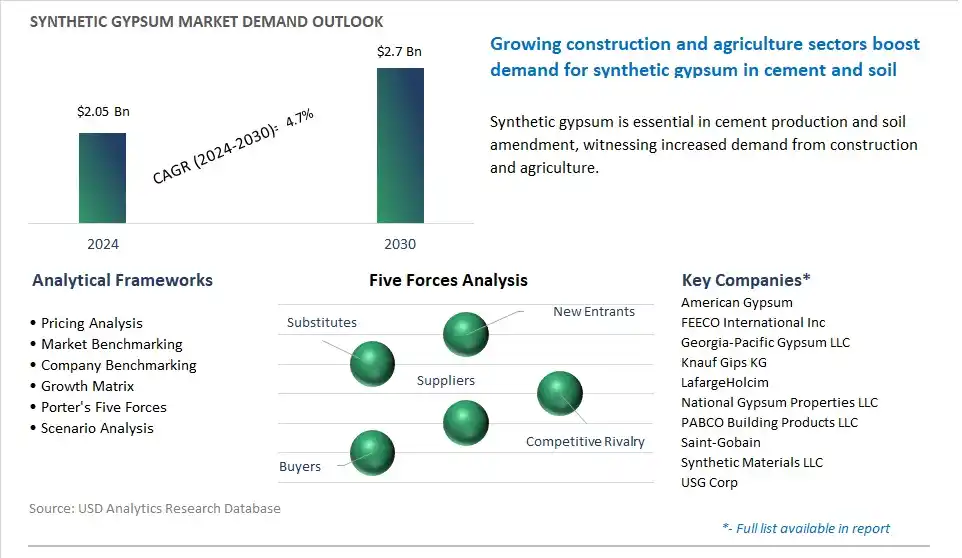
The global Synthetic Gypsum Market is poised to register a 4.7% CAGR from $2.05 Billion in 2024 to $2.7 Billion in 2030.
The global Synthetic Gypsum Market Study analyzes and forecasts the market size across 6 regions and 24 countries for diverse segments -By Type (Citrogypsum, Fluorogypsum, Phosphogypsum, Titanogypsum, Others), By Application (Cement, Plaster, Drywall, Glass Manufacturing, Soil Amendments), By End-User (Construction Industry, Agriculture Industry, Others).
An Introduction to Global Synthetic Gypsum Market in 2024
The synthetic gypsum market is witnessing significant growth driven by increasing demand in construction, agriculture, and industrial applications for its versatility, cost-effectiveness, and environmental benefits. Key trends shaping the future of the industry include the rising adoption of synthetic gypsum as a sustainable alternative to natural gypsum in gypsum board production, cement manufacturing, soil amendment, and waste stabilization applications. Moreover, there's a growing emphasis on resource efficiency and circular economy principles, driving research into gypsum recycling and byproduct utilization from coal-fired power plants, phosphoric acid production, and industrial processes. Additionally, advancements in synthetic gypsum processing technologies, purification methods, and quality control measures are driving innovation and market expansion, enabling manufacturers to offer high-quality, consistent products for diverse end-uses and market segments, thereby fueling market growth and competitiveness in the global synthetic gypsum market.
Synthetic Gypsum Market Competitive Landscape
The market report analyses the leading companies in the industry including American Gypsum, FEECO International Inc, Georgia-Pacific Gypsum LLC, Knauf Gips KG, LafargeHolcim, National Gypsum Properties LLC, PABCO Building Products LLC, Saint-Gobain, Synthetic Materials LLC, USG Corp.
Synthetic Gypsum Market Dynamics
Synthetic Gypsum Market Trend: Increasing Demand for Sustainable Construction Materials
The most prominent market trend for synthetic gypsum is the increasing demand for sustainable construction materials. With growing environmental concerns and regulations aimed at reducing carbon emissions and waste in the construction industry, there's a shift towards using alternative materials that offer environmental benefits. Synthetic gypsum, produced as a byproduct of industrial processes such as flue gas desulfurization (FGD) in power plants or phosphogypsum from phosphate fertilizer production, serves as a sustainable alternative to natural gypsum in construction applications. This trend is driven by the need for eco-friendly building materials, cost-effectiveness, and regulatory mandates promoting the use of recycled and waste-derived materials in construction projects, stimulating growth and adoption of synthetic gypsum in the construction industry.
Synthetic Gypsum Market Driver: Expansion of Construction and Infrastructure Development Projects
A key market driver for synthetic gypsum is the expansion of construction and infrastructure development projects worldwide. As urbanization accelerates, population growth increases, and infrastructure aging requires renovation and replacement, there's a significant demand for construction materials such as gypsum for building, plastering, and cement production. Synthetic gypsum, with its availability as a byproduct from various industrial processes, offers a reliable and cost-effective source of gypsum for construction applications. The expansion of construction projects, particularly in emerging markets and developing regions, drives the demand for synthetic gypsum, creating opportunities for waste valorization and resource optimization in the construction industry.
Synthetic Gypsum Market Opportunity: Integration into Sustainable Building Practices and Green Construction Projects
An exciting opportunity in the synthetic gypsum market lies in integration into sustainable building practices and green construction projects. While synthetic gypsum is commonly used as a substitute for natural gypsum in traditional construction applications, there's potential for expansion into sustainable building practices that prioritize energy efficiency, resource conservation, and environmental responsibility. Synthetic gypsum can be incorporated into green building materials such as gypsum board, plaster, and concrete, offering advantages such as improved fire resistance, moisture control, and indoor air quality. By promoting the use of synthetic gypsum in sustainable building certifications such as LEED (Leadership in Energy and Environmental Design) and BREEAM (Building Research Establishment Environmental Assessment Method), manufacturers can tap into the growing market for green construction projects and contribute to environmental stewardship in the construction industry. Additionally, the development of innovative synthetic gypsum formulations and products tailored to specific sustainability criteria presents opportunities for differentiation and value creation in the market. This opportunity allows synthetic gypsum manufacturers to expand their market reach, strengthen their competitive position, and drive growth through strategic partnerships and initiatives focused on sustainability and environmental performance.
Synthetic Gypsum Market Share Analysis: The Phosphogypsum segment generated the highest revenue in 2024
The largest segment in the Synthetic Gypsum Market is Phosphogypsum. This dominance is driven by that make phosphogypsum the preferred choice in various applications. Phosphogypsum is a byproduct of the phosphate fertilizer manufacturing process and is produced in large quantities globally. Its widespread availability and relatively low cost compared to other synthetic gypsum types make it highly attractive for various applications, including construction, agriculture, and industrial uses. In the construction industry, phosphogypsum is utilized as a gypsum board, drywall, and plasterboard for building materials due to its excellent fire resistance, sound insulation properties, and workability. Additionally, phosphogypsum is used as a soil amendment in agriculture to improve soil structure, fertility, and crop productivity. In industrial applications, phosphogypsum finds use in cement production, road construction, and waste stabilization due to its binding properties and ability to enhance material properties. Furthermore, phosphogypsum is considered environmentally friendly as it provides a sustainable solution for managing waste streams from the phosphate industry. With the increasing focus on sustainable practices and resource efficiency, the demand for phosphogypsum in various applications is expected to remain strong, maintaining its position as the largest segment in the Synthetic Gypsum Market.
Synthetic Gypsum Market Share Analysis: The Drywall segment is poised to register the fastest growth rate (CAGR) over the forecast period to 2030
The fastest-growing segment in the Synthetic Gypsum Market is Drywall. This rapid growth is driven by the increasing demand for synthetic gypsum in drywall applications. Drywall, also known as gypsum board or plasterboard, is a widely used building material in the construction industry for interior walls and ceilings. Synthetic gypsum, including phosphogypsum and flue gas desulfurization (FGD) gypsum, is commonly used as a key ingredient in drywall production due to its abundance, consistent quality, and cost-effectiveness compared to natural gypsum. Synthetic gypsum offers similar properties to natural gypsum, such as fire resistance, sound insulation, and workability, making it an excellent substitute in drywall manufacturing. Additionally, the growing construction activities worldwide, particularly in emerging economies, are driving the demand for drywall as a cost-effective and efficient building material. Further, increasing regulations on environmental emissions and waste management have led to the adoption of FGD systems in coal-fired power plants, resulting in a significant increase in the production of synthetic gypsum from flue gas desulfurization. Accordingly, the availability and utilization of synthetic gypsum in drywall production have expanded rapidly, driving the growth of the Drywall segment in the Synthetic Gypsum Market. With the construction industry's continued expansion and the emphasis on sustainable building materials, the demand for synthetic gypsum in drywall applications is expected to continue growing rapidly, making it the fastest-growing segment in the Synthetic Gypsum Market.
Synthetic Gypsum Market Share Analysis: The Construction segment is poised to register the fastest growth rate (CAGR) over the forecast period to 2030
The fastest-growing segment in the Synthetic Gypsum Market is the Construction Industry. This rapid growth is driven by the increasing demand for synthetic gypsum in construction applications. Synthetic gypsum, including phosphogypsum and flue gas desulfurization (FGD) gypsum, is commonly used as a key ingredient in various construction materials, such as gypsum board (drywall), cement, plaster, and other building products. The construction industry is experiencing significant growth globally due to urbanization, population growth, infrastructure development, and housing demand. Synthetic gypsum offers potential advantages over natural gypsum, including consistent quality, availability, and cost-effectiveness, making it an attractive choice for construction projects. Additionally, synthetic gypsum contributes to sustainable construction practices by providing a viable solution for managing industrial byproducts and reducing waste. Furthermore, regulations promoting environmental sustainability and green building practices have led to increased adoption of synthetic gypsum in construction materials. As construction activities continue to expand worldwide, particularly in emerging economies, the demand for synthetic gypsum in the construction industry is expected to continue growing rapidly, making it the fastest-growing segment in the Synthetic Gypsum Market.
Synthetic Gypsum Market Report Segmentation
By Type
Citrogypsum
Fluorogypsum
Phosphogypsum
Titanogypsum
Others
By Application
Cement
Plaster
Drywall
Glass Manufacturing
Soil Amendments
By End-User
Construction Industry
Agriculture Industry
Others
Regions Included
North America (US, Canada, Mexico)
Europe (Germany, UK, France, Spain, Italy, Russia, Rest of Europe)
Asia Pacific (China, India, Japan, South Korea, Australia, South East Asia, Rest of Asia)
South America (Brazil, Argentina, Rest of South America)
Middle East and Africa (Saudi Arabia, UAE, Rest of Middle East, South Africa, Egypt, Rest of Africa)
Synthetic Gypsum Companies Profiled in the Market Study
American Gypsum
FEECO International Inc
Georgia-Pacific Gypsum LLC
Knauf Gips KG
LafargeHolcim
National Gypsum Properties LLC
PABCO Building Products LLC
Saint-Gobain
Synthetic Materials LLC
USG Corp
*- List Not Exhaustive
TABLE OF CONTENTS
1 Introduction to 2024 Synthetic Gypsum Market
1.1 Market Overview
1.2 Quick Facts
1.3 Scope/Objective of the Study
1.4 Market Definition
1.5 Countries and Regions Covered
1.6 Units, Currency, and Conversions
1.7 Industry Value Chain
2 Research Methodology
2.1 Market Size Estimation
2.2 Sources and Research Methodology
2.3 Data Triangulation
2.4 Assumptions and Limitations
3 Executive Summary
3.1 Global Synthetic Gypsum Market Size Outlook, $ Million, 2021 to 2030
3.2 Synthetic Gypsum Market Outlook by Type, $ Million, 2021 to 2030
3.3 Synthetic Gypsum Market Outlook by Product, $ Million, 2021 to 2030
3.4 Synthetic Gypsum Market Outlook by Application, $ Million, 2021 to 2030
3.5 Synthetic Gypsum Market Outlook by Key Countries, $ Million, 2021 to 2030
4 Market Dynamics
4.1 Key Driving Forces of Synthetic Gypsum Industry
4.2 Key Market Trends in Synthetic Gypsum Industry
4.3 Potential Opportunities in Synthetic Gypsum Industry
4.4 Key Challenges in Synthetic Gypsum Industry
5 Market Factor Analysis
5.1 Value Chain Analysis
5.2 Competitive Landscape
5.2.1 Global Synthetic Gypsum Market Share by Company (%), 2023
5.2.2 Product Offerings by Company
5.3 Porter’s Five Forces Analysis
5.4 Pricing Analysis and Outlook
6 Growth Outlook Across Scenarios
6.1 Growth Analysis-Case Scenario Definitions
6.2 Low Growth Scenario Forecasts
6.3 Reference Growth Scenario Forecasts
6.4 High Growth Scenario Forecasts
7 Global Synthetic Gypsum Market Outlook by Segments
7.1 Synthetic Gypsum Market Outlook by Segments, $ Million, 2021- 2030
By Type
Citrogypsum
Fluorogypsum
Phosphogypsum
Titanogypsum
Others
By Application
Cement
Plaster
Drywall
Glass Manufacturing
Soil Amendments
By End-User
Construction Industry
Agriculture Industry
Others
8 North America Synthetic Gypsum Market Analysis and Outlook To 2030
8.1 Introduction to North America Synthetic Gypsum Markets in 2024
8.2 North America Synthetic Gypsum Market Size Outlook by Country, 2021-2030
8.2.1 United States
8.2.2 Canada
8.2.3 Mexico
8.3 North America Synthetic Gypsum Market size Outlook by Segments, 2021-2030
By Type
Citrogypsum
Fluorogypsum
Phosphogypsum
Titanogypsum
Others
By Application
Cement
Plaster
Drywall
Glass Manufacturing
Soil Amendments
By End-User
Construction Industry
Agriculture Industry
Others
9 Europe Synthetic Gypsum Market Analysis and Outlook To 2030
9.1 Introduction to Europe Synthetic Gypsum Markets in 2024
9.2 Europe Synthetic Gypsum Market Size Outlook by Country, 2021-2030
9.2.1 Germany
9.2.2 France
9.2.3 Spain
9.2.4 United Kingdom
9.2.4 Italy
9.2.5 Russia
9.2.6 Norway
9.2.7 Rest of Europe
9.3 Europe Synthetic Gypsum Market Size Outlook by Segments, 2021-2030
By Type
Citrogypsum
Fluorogypsum
Phosphogypsum
Titanogypsum
Others
By Application
Cement
Plaster
Drywall
Glass Manufacturing
Soil Amendments
By End-User
Construction Industry
Agriculture Industry
Others
10 Asia Pacific Synthetic Gypsum Market Analysis and Outlook To 2030
10.1 Introduction to Asia Pacific Synthetic Gypsum Markets in 2024
10.2 Asia Pacific Synthetic Gypsum Market Size Outlook by Country, 2021-2030
10.2.1 China
10.2.2 India
10.2.3 Japan
10.2.4 South Korea
10.2.5 Indonesia
10.2.6 Malaysia
10.2.7 Australia
10.2.8 Rest of Asia Pacific
10.3 Asia Pacific Synthetic Gypsum Market size Outlook by Segments, 2021-2030
By Type
Citrogypsum
Fluorogypsum
Phosphogypsum
Titanogypsum
Others
By Application
Cement
Plaster
Drywall
Glass Manufacturing
Soil Amendments
By End-User
Construction Industry
Agriculture Industry
Others
11 South America Synthetic Gypsum Market Analysis and Outlook To 2030
11.1 Introduction to South America Synthetic Gypsum Markets in 2024
11.2 South America Synthetic Gypsum Market Size Outlook by Country, 2021-2030
11.2.1 Brazil
11.2.2 Argentina
11.2.3 Rest of South America
11.3 South America Synthetic Gypsum Market size Outlook by Segments, 2021-2030
By Type
Citrogypsum
Fluorogypsum
Phosphogypsum
Titanogypsum
Others
By Application
Cement
Plaster
Drywall
Glass Manufacturing
Soil Amendments
By End-User
Construction Industry
Agriculture Industry
Others
12 Middle East and Africa Synthetic Gypsum Market Analysis and Outlook To 2030
12.1 Introduction to Middle East and Africa Synthetic Gypsum Markets in 2024
12.2 Middle East and Africa Synthetic Gypsum Market Size Outlook by Country, 2021-2030
12.2.1 Saudi Arabia
12.2.2 UAE
12.2.3 Oman
12.2.4 Rest of Middle East
12.2.5 Egypt
12.2.6 Nigeria
12.2.7 South Africa
12.2.8 Rest of Africa
12.3 Middle East and Africa Synthetic Gypsum Market size Outlook by Segments, 2021-2030
By Type
Citrogypsum
Fluorogypsum
Phosphogypsum
Titanogypsum
Others
By Application
Cement
Plaster
Drywall
Glass Manufacturing
Soil Amendments
By End-User
Construction Industry
Agriculture Industry
Others
13 Company Profiles
13.1 Company Snapshot
13.2 SWOT Profiles
13.3 Products and Services
13.4 Recent Developments
13.5 Financial Profile
American Gypsum
FEECO International Inc
Georgia-Pacific Gypsum LLC
Knauf Gips KG
LafargeHolcim
National Gypsum Properties LLC
PABCO Building Products LLC
Saint-Gobain
Synthetic Materials LLC
USG Corp
14 Appendix
14.1 Customization Offerings
14.2 Subscription Services
14.3 Related Reports
14.4 Publisher Expertise
By Type
Citrogypsum
Fluorogypsum
Phosphogypsum
Titanogypsum
Others
By Application
Cement
Plaster
Drywall
Glass Manufacturing
Soil Amendments
By End-User
Construction Industry
Agriculture Industry
Others
Countries Analyzed
North America (US, Canada, Mexico)
Europe (Germany, UK, France, Spain, Italy, Russia, Rest of Europe)
Asia Pacific (China, India, Japan, South Korea, Australia, South East Asia, Rest of Asia)
South America (Brazil, Argentina, Rest of South America)
Middle East and Africa (Saudi Arabia, UAE, Rest of Middle East, South Africa, Egypt, Rest of Africa)
