
The global Terrazzo Market Study analyzes and forecasts the market size across 6 regions and 24 countries for diverse segments -By Product (Cement, Epoxy, Sand Cushion, Bonded, Monolithic, Polyacrylate, Rustic), By Application (Educational, Commercial, Government, Transport, Others).
The terrazzo market is experiencing growth driven by the revival of interest in this versatile and durable flooring material, coupled with advancements in design, installation techniques, and sustainability practices. Key trends shaping the future of the industry include innovations in terrazzo compositions, incorporating recycled aggregates such as glass, marble, and metal chips, to create unique and environmentally friendly flooring solutions. Additionally, advancements in terrazzo fabrication methods, including precast terrazzo tiles, poured-in-place installations, and terrazzo overlays, offer design flexibility and customization options for architects, designers, and building owners. Moreover, the integration of digital printing and waterjet cutting technologies enables intricate patterns, logos, and graphics to be incorporated into terrazzo surfaces, expanding design possibilities in commercial, residential, and public spaces. Additionally, the growing emphasis on sustainability and LEED certification drives demand for terrazzo flooring due to its long lifespan, low maintenance requirements, and recyclability. As stakeholders collaborate to innovate and promote terrazzo as a sustainable and aesthetically appealing flooring solution, the market is poised for continued growth and diversification in the global construction and architectural landscape.
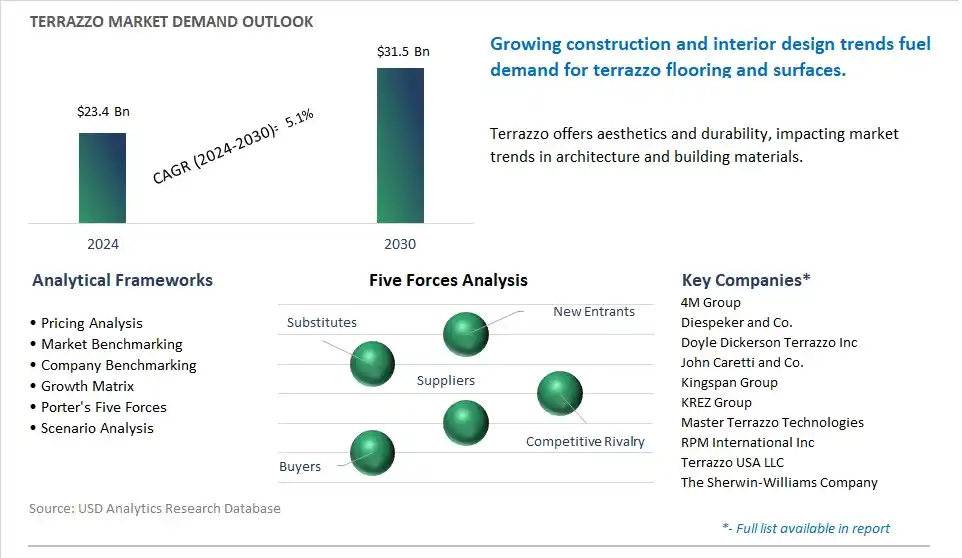
The market report analyses the leading companies in the industry including 4M Group, Diespeker and Co., Doyle Dickerson Terrazzo Inc, John Caretti and Co., Kingspan Group, KREZ Group, Master Terrazzo Technologies, RPM International Inc, Terrazzo USA LLC, The Sherwin-Williams Company.
A prominent trend in the terrazzo market is the resurgence of terrazzo in interior design and architecture. Once considered a flooring material of the past, terrazzo has experienced a revival in recent years as designers and architects rediscover its versatility, durability, and aesthetic appeal. Modern terrazzo incorporates a variety of aggregates such as marble, quartz, glass, and metal chips, creating unique and customizable patterns that enhance the visual appeal of spaces. From flooring and countertops to wall cladding and furniture, terrazzo is being embraced for its timeless elegance and ability to add character to both residential and commercial interiors. This trend towards terrazzo's resurgence reflects a broader interest in sustainable and enduring design materials that offer both beauty and functionality.
A key driver for the terrazzo market is the demand for sustainable and durable building materials. As sustainability becomes increasingly important in the construction and design industries, there is a growing preference for materials that are environmentally friendly, long-lasting, and low maintenance. Terrazzo, composed of natural stone aggregates bound by a cementitious or resinous matrix, meets these criteria by offering durability, longevity, and recyclability. Additionally, terrazzo's ability to incorporate recycled materials further enhances its sustainability credentials. The demand for terrazzo as a sustainable building material is driven by architects, designers, and building owners seeking to create environmentally responsible and aesthetically pleasing spaces.
An opportunity within the terrazzo market lies in the expansion into new applications and markets. While terrazzo is traditionally associated with flooring and architectural surfaces, there is potential to explore new applications and markets where terrazzo's unique properties can be leveraged. For example, terrazzo can be used to create bespoke furniture pieces, decorative objects, and artistic installations, offering designers and manufacturers opportunities to showcase creativity and craftsmanship. Additionally, there is potential to introduce terrazzo into outdoor spaces such as landscaping, public parks, and urban streetscapes, where its durability and design flexibility can enhance aesthetics and functionality. By diversifying into new applications and markets, stakeholders in the terrazzo market can tap into emerging trends, expand their customer base, and unlock new revenue streams.
The cement segment is the largest segment in the Terrazzo Market due to its long-standing history, widespread availability, and versatility in applications. Cement-based terrazzo is a traditional and widely used flooring material composed of Portland cement, aggregates (such as marble chips, quartz, or granite), and pigments. Cement terrazzo offers diverse advantages, including durability, strength, ease of installation, and a wide range of design options. Its versatility allows for the creation of intricate patterns, vibrant colors, and customizable designs, making it suitable for both interior and exterior applications in residential, commercial, and institutional buildings. Additionally, cement terrazzo is highly durable and resistant to wear, abrasion, stains, and heavy foot traffic, making it ideal for high-traffic areas such as airports, shopping malls, schools, hospitals, and public spaces. In addition, cement terrazzo flooring can be polished to achieve a smooth, glossy surface that enhances the aesthetic appeal of architectural spaces. Further, cement-based terrazzo is a sustainable flooring option, as it utilizes recycled materials, minimizes waste, and has a long lifespan, reducing the need for replacement and contributing to environmental conservation efforts. As architects, designers, and building owners recognize the durability, versatility, and aesthetic appeal of cement terrazzo, its demand continues to grow, solidifying its position as the largest segment in the Terrazzo Market.
The commercial segment is the fastest-growing segment in the Terrazzo Market due to increasing demand for durable, aesthetically pleasing, and low-maintenance flooring solutions in commercial spaces. Terrazzo flooring offers diverse advantages for commercial applications, including retail stores, office buildings, hotels, restaurants, and entertainment venues. The commercial spaces often experience high foot traffic, requiring flooring materials that can withstand wear, abrasion, and frequent cleaning. Terrazzo, with its inherent durability and resistance to stains and scratches, meets these requirements effectively, reducing maintenance costs and ensuring long-term performance. Additionally, commercial environments place a premium on aesthetics and branding, with flooring playing a crucial role in creating a welcoming atmosphere and conveying the desired image. Terrazzo flooring offers design flexibility, allowing for customization with various colors, aggregates, and patterns to reflect the brand identity and enhance the Over the forecast period ambiance of commercial spaces. In addition, terrazzo's seamless installation and smooth surface contribute to a clean and hygienic environment, which is essential for businesses in the hospitality, healthcare, and food service industries. Further, the growing emphasis on sustainability and green building practices in the commercial sector drives the adoption of terrazzo, as it utilizes recycled materials, minimizes waste, and contributes to LEED certification requirements. As commercial property owners, developers, and designers prioritize durability, aesthetics, and sustainability in their flooring choices, the demand for terrazzo in commercial applications is expected to experience rapid growth, positioning the commercial segment as the fastest-growing segment in the Terrazzo Market.
By Product
Cement
Epoxy
Sand Cushion
Bonded
Monolithic
Polyacrylate
Rustic
By Application
Educational
Commercial
Government
Transport
Others
Regions Included
North America (US, Canada, Mexico)
Europe (Germany, UK, France, Spain, Italy, Russia, Rest of Europe)
Asia Pacific (China, India, Japan, South Korea, Australia, South East Asia, Rest of Asia)
South America (Brazil, Argentina, Rest of South America)
Middle East and Africa (Saudi Arabia, UAE, Rest of Middle East, South Africa, Egypt, Rest of Africa)
4M Group
Diespeker and Co.
Doyle Dickerson Terrazzo Inc
John Caretti and Co.
Kingspan Group
KREZ Group
Master Terrazzo Technologies
RPM International Inc
Terrazzo USA LLC
The Sherwin-Williams Company
*- List Not Exhaustive
TABLE OF CONTENTS
1 Introduction to 2024 Terrazzo Market
1.1 Market Overview
1.2 Quick Facts
1.3 Scope/Objective of the Study
1.4 Market Definition
1.5 Countries and Regions Covered
1.6 Units, Currency, and Conversions
1.7 Industry Value Chain
2 Research Methodology
2.1 Market Size Estimation
2.2 Sources and Research Methodology
2.3 Data Triangulation
2.4 Assumptions and Limitations
3 Executive Summary
3.1 Global Terrazzo Market Size Outlook, $ Million, 2021 to 2030
3.2 Terrazzo Market Outlook by Type, $ Million, 2021 to 2030
3.3 Terrazzo Market Outlook by Product, $ Million, 2021 to 2030
3.4 Terrazzo Market Outlook by Application, $ Million, 2021 to 2030
3.5 Terrazzo Market Outlook by Key Countries, $ Million, 2021 to 2030
4 Market Dynamics
4.1 Key Driving Forces of Terrazzo Industry
4.2 Key Market Trends in Terrazzo Industry
4.3 Potential Opportunities in Terrazzo Industry
4.4 Key Challenges in Terrazzo Industry
5 Market Factor Analysis
5.1 Value Chain Analysis
5.2 Competitive Landscape
5.2.1 Global Terrazzo Market Share by Company (%), 2023
5.2.2 Product Offerings by Company
5.3 Porter’s Five Forces Analysis
5.4 Pricing Analysis and Outlook
6 Growth Outlook Across Scenarios
6.1 Growth Analysis-Case Scenario Definitions
6.2 Low Growth Scenario Forecasts
6.3 Reference Growth Scenario Forecasts
6.4 High Growth Scenario Forecasts
7 Global Terrazzo Market Outlook by Segments
7.1 Terrazzo Market Outlook by Segments, $ Million, 2021- 2030
By Product
Cement
Epoxy
Sand Cushion
Bonded
Monolithic
Polyacrylate
Rustic
By Application
Educational
Commercial
Government
Transport
Others
8 North America Terrazzo Market Analysis and Outlook To 2030
8.1 Introduction to North America Terrazzo Markets in 2024
8.2 North America Terrazzo Market Size Outlook by Country, 2021-2030
8.2.1 United States
8.2.2 Canada
8.2.3 Mexico
8.3 North America Terrazzo Market size Outlook by Segments, 2021-2030
By Product
Cement
Epoxy
Sand Cushion
Bonded
Monolithic
Polyacrylate
Rustic
By Application
Educational
Commercial
Government
Transport
Others
9 Europe Terrazzo Market Analysis and Outlook To 2030
9.1 Introduction to Europe Terrazzo Markets in 2024
9.2 Europe Terrazzo Market Size Outlook by Country, 2021-2030
9.2.1 Germany
9.2.2 France
9.2.3 Spain
9.2.4 United Kingdom
9.2.4 Italy
9.2.5 Russia
9.2.6 Norway
9.2.7 Rest of Europe
9.3 Europe Terrazzo Market Size Outlook by Segments, 2021-2030
By Product
Cement
Epoxy
Sand Cushion
Bonded
Monolithic
Polyacrylate
Rustic
By Application
Educational
Commercial
Government
Transport
Others
10 Asia Pacific Terrazzo Market Analysis and Outlook To 2030
10.1 Introduction to Asia Pacific Terrazzo Markets in 2024
10.2 Asia Pacific Terrazzo Market Size Outlook by Country, 2021-2030
10.2.1 China
10.2.2 India
10.2.3 Japan
10.2.4 South Korea
10.2.5 Indonesia
10.2.6 Malaysia
10.2.7 Australia
10.2.8 Rest of Asia Pacific
10.3 Asia Pacific Terrazzo Market size Outlook by Segments, 2021-2030
By Product
Cement
Epoxy
Sand Cushion
Bonded
Monolithic
Polyacrylate
Rustic
By Application
Educational
Commercial
Government
Transport
Others
11 South America Terrazzo Market Analysis and Outlook To 2030
11.1 Introduction to South America Terrazzo Markets in 2024
11.2 South America Terrazzo Market Size Outlook by Country, 2021-2030
11.2.1 Brazil
11.2.2 Argentina
11.2.3 Rest of South America
11.3 South America Terrazzo Market size Outlook by Segments, 2021-2030
By Product
Cement
Epoxy
Sand Cushion
Bonded
Monolithic
Polyacrylate
Rustic
By Application
Educational
Commercial
Government
Transport
Others
12 Middle East and Africa Terrazzo Market Analysis and Outlook To 2030
12.1 Introduction to Middle East and Africa Terrazzo Markets in 2024
12.2 Middle East and Africa Terrazzo Market Size Outlook by Country, 2021-2030
12.2.1 Saudi Arabia
12.2.2 UAE
12.2.3 Oman
12.2.4 Rest of Middle East
12.2.5 Egypt
12.2.6 Nigeria
12.2.7 South Africa
12.2.8 Rest of Africa
12.3 Middle East and Africa Terrazzo Market size Outlook by Segments, 2021-2030
By Product
Cement
Epoxy
Sand Cushion
Bonded
Monolithic
Polyacrylate
Rustic
By Application
Educational
Commercial
Government
Transport
Others
13 Company Profiles
13.1 Company Snapshot
13.2 SWOT Profiles
13.3 Products and Services
13.4 Recent Developments
13.5 Financial Profile
4M Group
Diespeker and Co.
Doyle Dickerson Terrazzo Inc
John Caretti and Co.
Kingspan Group
KREZ Group
Master Terrazzo Technologies
RPM International Inc
Terrazzo USA LLC
The Sherwin-Williams Company
14 Appendix
14.1 Customization Offerings
14.2 Subscription Services
14.3 Related Reports
14.4 Publisher Expertise
By Product
Cement
Epoxy
Sand Cushion
Bonded
Monolithic
Polyacrylate
Rustic
By Application
Educational
Commercial
Government
Transport
Others
Countries Analyzed
North America (US, Canada, Mexico)
Europe (Germany, UK, France, Spain, Italy, Russia, Rest of Europe)
Asia Pacific (China, India, Japan, South Korea, Australia, South East Asia, Rest of Asia)
South America (Brazil, Argentina, Rest of South America)
Middle East and Africa (Saudi Arabia, UAE, Rest of Middle East, South Africa, Egypt, Rest of Africa)
Global Terrazzo is forecast to reach $31.5 Billion in 2030 from $23.4 Billion in 2024, registering a CAGR of 5.1%
Emerging Markets across Asia Pacific, Europe, and Americas present robust growth prospects.
4M Group, Diespeker and Co., Doyle Dickerson Terrazzo Inc, John Caretti and Co., Kingspan Group, KREZ Group, Master Terrazzo Technologies, RPM International Inc, Terrazzo USA LLC, The Sherwin-Williams Company
Base Year- 2023; Estimated Year- 2024; Historic Period- 2018-2023; Forecast period- 2024 to 2030; Currency: Revenue (USD); Volume