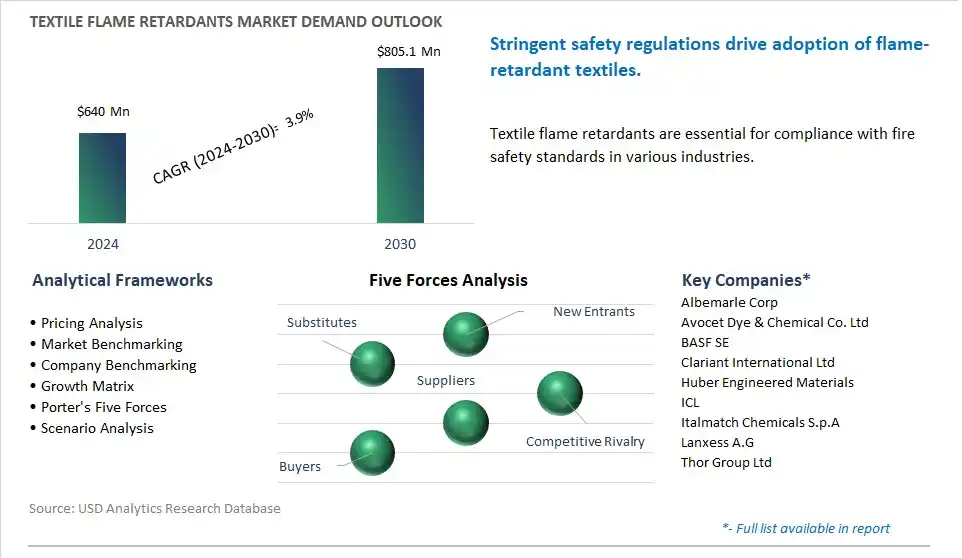
The global Textile Flame Retardants Market is poised to register a 3.9% CAGR from $640 Million in 2024 to $805.1 Million in 2030.
The global Textile Flame Retardants Market Study analyzes and forecasts the market size across 6 regions and 24 countries for diverse segments -By Product (Halogenated, Non-Halogenated), By Application (Polyester, Cotton, Viscose, Nylon, Polypropylene, Aramid, Others), By Type (Durable, Semi Durable, Non-Durable), By Technology (Dyeing, Spraying, Printing, Foam Coating, Others), By End-User (Industrial, Defense, Public Safety Services, Transportation, Household, Others).
An Introduction to Global Textile Flame Retardants Market in 2024
Textile flame retardants are chemicals or coatings applied to textiles to reduce their flammability and inhibit the spread of fire, ensuring safety in various applications such as apparel, upholstery, and protective gear. The future of textile flame retardants is influenced by several key trends, including advancements in flame retardant chemistry, regulatory standards, and sustainable manufacturing practices. One significant trend is the development of novel flame retardant formulations that offer effective fire protection while minimizing environmental and health concerns associated with traditional flame retardant chemicals such as halogenated compounds and heavy metals. Manufacturers are investing in research and development to innovate new flame retardant additives, phosphorus-based compounds, and intumescent coatings that provide superior fire performance, durability, and compatibility with different textile substrates, meeting the stringent flammability standards and consumer safety requirements of diverse industries. Additionally, the integration of sustainable and eco-friendly flame retardants derived from renewable feedstocks or recycled materials is driving innovations in green chemistry solutions for flame retardancy, reducing reliance on hazardous chemicals and promoting circular economy principles in the textile industry. Moreover, the expanding applications of flame retardant textiles in critical sectors such as transportation, construction, and healthcare are driving demand for high-performance flame retardant solutions that meet regulatory compliance, performance specifications, and sustainability certifications such as OEKO-TEX® and REACH (Registration, Evaluation, Authorization, and Restriction of Chemicals). Furthermore, collaborations between flame retardant manufacturers, textile producers, and regulatory agencies are driving innovation and market growth by delivering customized solutions that meet the specific fire safety, performance, and sustainability requirements of diverse stakeholders, ensuring continued adoption and advancement of textile flame retardants in the global marketplace.
Textile Flame Retardants Market Competitive Landscape
The market report analyses the leading companies in the industry including Albemarle Corp, Avocet Dye & Chemical Co. Ltd, BASF SE, Clariant International Ltd, Huber Engineered Materials, ICL, Italmatch Chemicals S.p.A, Lanxess A.G, Thor Group Ltd.
Textile Flame Retardants Market Dynamics
Textile Flame Retardants Market Trend: Increasing Demand for Environmentally Friendly Flame Retardant Solutions
A prominent market trend in the textile flame retardant industry is the increasing demand for environmentally friendly flame retardant solutions. Textile flame retardants are chemicals applied to textiles to reduce the flammability of fabrics and ensure compliance with safety standards and regulations. With growing concerns about environmental impact and health hazards associated with conventional flame retardants, there is a rising demand for eco-friendly alternatives that offer effective flame resistance without harmful side effects. This trend is driven by regulatory restrictions on hazardous chemicals, consumer preferences for sustainable products, and advancements in flame retardant technology, driving the adoption of environmentally friendly flame retardant solutions in various textile applications.
Textile Flame Retardants Market Driver: Stringent Fire Safety Regulations and Standards in the Textile Industry
A key driver behind the growth of the textile flame retardants market is the presence of stringent fire safety regulations and standards in the textile industry. Governments and regulatory bodies worldwide enforce strict requirements for flame resistance in textiles used in various applications such as apparel, home furnishings, automotive interiors, and public transportation. Textile manufacturers must comply with these regulations to ensure product safety, protect consumers from fire hazards, and minimize property damage in fire incidents. Flame retardants play a crucial role in meeting fire safety standards by providing fabrics with flame-resistance properties that prevent or delay the spread of flames and reduce smoke generation. The need for compliance with fire safety regulations and standards drives market demand for flame retardant solutions, stimulating innovation and investment in flame retardant technologies and formulations.
Textile Flame Retardants Market Opportunity: Development of Next-Generation Eco-Friendly Flame Retardants
An opportunity exists for manufacturers of textile flame retardants to develop next-generation eco-friendly flame retardants that meet evolving market needs and regulatory requirements. With increasing focus on sustainability and green chemistry principles, there is demand for flame retardant solutions that offer effective fire protection while minimizing environmental impact and human health risks. Manufacturers can explore opportunities to develop bio-based, renewable, and non-toxic flame retardants derived from natural sources or bio-based polymers that provide comparable or superior flame resistance performance to conventional chemicals. Additionally, there is opportunity to innovate in flame retardant formulations and application techniques to enhance efficiency, durability, and compatibility with different textile substrates. By investing in research and development of eco-friendly flame retardant solutions, manufacturers can capitalize on emerging market trends, differentiate their products, and address the growing demand for sustainable flame retardant options in the textile industry.
Textile Flame Retardants Market Share Analysis: Halogenated generated the highest revenue in 2024
The largest segment in the Textile Flame Retardants Market is the Halogenated category. This is because halogenated flame retardants have historically been widely used in textiles due to their effectiveness in imparting flame resistance to a variety of materials. Halogenated flame retardants contain elements such as chlorine or bromine, which can interfere with the combustion process by releasing halogen radicals that disrupt the chemical reactions involved in fire propagation. Accordingly, textiles treated with halogenated flame retardants exhibit improved fire resistance and reduced flammability, making them suitable for applications where fire safety is a critical concern, such as upholstery, curtains, mattresses, and protective clothing. Additionally, halogenated flame retardants are often cost-effective and offer a high level of flame retardancy compared to alternative technologies. However, concerns about the environmental and health impacts of halogenated flame retardants, including their persistence, bioaccumulation, and potential toxicity, have led to regulatory restrictions and increased interest in non-halogenated alternatives. Despite these concerns, the halogenated segment remains the largest in the Textile Flame Retardants Market due to its established use and effectiveness in providing flame resistance to textiles.
Textile Flame Retardants Market Share Analysis: Polyester segment is poised to register the fastest growth rate (CAGR) over the forecast period to 2030
The fastest growing segment in the Textile Flame Retardants Market is the Polyester category. polyester textiles are widely used in various applications such as apparel, home textiles, automotive interiors, and technical textiles due to their durability, versatility, and affordability. However, polyester fabrics are inherently flammable and can contribute to the rapid spread of fires. Accordingly, there is a growing demand for flame retardant treatments for polyester textiles to enhance their fire safety performance and meet regulatory requirements. Flame retardant treatments for polyester textiles involve the application of chemicals that inhibit or suppress combustion, reducing the flammability and flame spread of the fabric. Additionally, advancements in flame retardant technologies have led to the development of innovative formulations that offer effective flame resistance without compromising the performance or aesthetics of polyester textiles. Furthermore, increasing awareness of fire safety and stricter regulations governing flammability standards in various industries drive the adoption of flame retardant treatments for polyester textiles. As the demand for flame retardant polyester textiles continues to rise, particularly in applications where fire safety is a critical concern, the Polyester segment is expected to experience rapid growth in the Textile Flame Retardants Market.
Textile Flame Retardants Market Share Analysis: Durable segment is poised to register the fastest growth rate (CAGR) over the forecast period to 2030
The fastest growing segment in the Textile Flame Retardants Market is the Durable category. durable flame retardants offer long-lasting protection against fire hazards, making them suitable for textiles used in high-risk environments where fire safety is a critical concern, such as public buildings, transportation, and industrial settings. Durable flame retardants are chemically bonded to the textile substrate, providing permanent flame resistance that withstands multiple laundering or cleaning cycles without losing efficacy. Additionally, advancements in flame retardant technologies have led to the development of durable formulations that offer enhanced performance, durability, and environmental sustainability compared to traditional treatments. Furthermore, increasing regulatory requirements and consumer demand for flame-resistant textiles drive the adoption of durable flame retardants as they offer reliable and long-term fire protection, reducing the risk of fire-related accidents and injuries. As industries continue to prioritize fire safety and compliance with flammability standards, the demand for durable flame retardants in the Textile Flame Retardants Market is expected to experience rapid growth.
Textile Flame Retardants Market Report Segmentation
By Product
Halogenated
-Brominated
-Chlorinated
-Antimony Oxide
-Boron Based
-Others
Non-Halogenated
-Aluminum Hydroxide
-Magnesium Dihydroxide
-Organophosphorus
-Others
By Application
Polyester
Cotton
Viscose
Nylon
Polypropylene
Aramid
Others
By Type
Durable
Semi Durable
Non-Durable
By Technology
Dyeing
-Padding
-Back-Coating
Spraying
Printing
Foam Coating
Others
By End-User
Industrial
Defense
Public Safety Services
Transportation
Household
Others
Regions Included
North America (US, Canada, Mexico)
Europe (Germany, UK, France, Spain, Italy, Russia, Rest of Europe)
Asia Pacific (China, India, Japan, South Korea, Australia, South East Asia, Rest of Asia)
South America (Brazil, Argentina, Rest of South America)
Middle East and Africa (Saudi Arabia, UAE, Rest of Middle East, South Africa, Egypt, Rest of Africa)
Textile Flame Retardants Companies Profiled in the Market Study
Albemarle Corp
Avocet Dye & Chemical Co. Ltd
BASF SE
Clariant International Ltd
Huber Engineered Materials
ICL
Italmatch Chemicals S.p.A
Lanxess A.G
Thor Group Ltd
*- List Not Exhaustive
TABLE OF CONTENTS
1 Introduction to 2024 Textile Flame Retardants Market
1.1 Market Overview
1.2 Quick Facts
1.3 Scope/Objective of the Study
1.4 Market Definition
1.5 Countries and Regions Covered
1.6 Units, Currency, and Conversions
1.7 Industry Value Chain
2 Research Methodology
2.1 Market Size Estimation
2.2 Sources and Research Methodology
2.3 Data Triangulation
2.4 Assumptions and Limitations
3 Executive Summary
3.1 Global Textile Flame Retardants Market Size Outlook, $ Million, 2021 to 2030
3.2 Textile Flame Retardants Market Outlook by Type, $ Million, 2021 to 2030
3.3 Textile Flame Retardants Market Outlook by Product, $ Million, 2021 to 2030
3.4 Textile Flame Retardants Market Outlook by Application, $ Million, 2021 to 2030
3.5 Textile Flame Retardants Market Outlook by Key Countries, $ Million, 2021 to 2030
4 Market Dynamics
4.1 Key Driving Forces of Textile Flame Retardants Industry
4.2 Key Market Trends in Textile Flame Retardants Industry
4.3 Potential Opportunities in Textile Flame Retardants Industry
4.4 Key Challenges in Textile Flame Retardants Industry
5 Market Factor Analysis
5.1 Value Chain Analysis
5.2 Competitive Landscape
5.2.1 Global Textile Flame Retardants Market Share by Company (%), 2023
5.2.2 Product Offerings by Company
5.3 Porter’s Five Forces Analysis
5.4 Pricing Analysis and Outlook
6 Growth Outlook Across Scenarios
6.1 Growth Analysis-Case Scenario Definitions
6.2 Low Growth Scenario Forecasts
6.3 Reference Growth Scenario Forecasts
6.4 High Growth Scenario Forecasts
7 Global Textile Flame Retardants Market Outlook by Segments
7.1 Textile Flame Retardants Market Outlook by Segments, $ Million, 2021- 2030
By Product
Halogenated
-Brominated
-Chlorinated
-Antimony Oxide
-Boron Based
-Others
Non-Halogenated
-Aluminum Hydroxide
-Magnesium Dihydroxide
-Organophosphorus
-Others
By Application
Polyester
Cotton
Viscose
Nylon
Polypropylene
Aramid
Others
By Type
Durable
Semi Durable
Non-Durable
By Technology
Dyeing
-Padding
-Back-Coating
Spraying
Printing
Foam Coating
Others
By End-User
Industrial
Defense
Public Safety Services
Transportation
Household
Others
8 North America Textile Flame Retardants Market Analysis and Outlook To 2030
8.1 Introduction to North America Textile Flame Retardants Markets in 2024
8.2 North America Textile Flame Retardants Market Size Outlook by Country, 2021-2030
8.2.1 United States
8.2.2 Canada
8.2.3 Mexico
8.3 North America Textile Flame Retardants Market size Outlook by Segments, 2021-2030
By Product
Halogenated
-Brominated
-Chlorinated
-Antimony Oxide
-Boron Based
-Others
Non-Halogenated
-Aluminum Hydroxide
-Magnesium Dihydroxide
-Organophosphorus
-Others
By Application
Polyester
Cotton
Viscose
Nylon
Polypropylene
Aramid
Others
By Type
Durable
Semi Durable
Non-Durable
By Technology
Dyeing
-Padding
-Back-Coating
Spraying
Printing
Foam Coating
Others
By End-User
Industrial
Defense
Public Safety Services
Transportation
Household
Others
9 Europe Textile Flame Retardants Market Analysis and Outlook To 2030
9.1 Introduction to Europe Textile Flame Retardants Markets in 2024
9.2 Europe Textile Flame Retardants Market Size Outlook by Country, 2021-2030
9.2.1 Germany
9.2.2 France
9.2.3 Spain
9.2.4 United Kingdom
9.2.4 Italy
9.2.5 Russia
9.2.6 Norway
9.2.7 Rest of Europe
9.3 Europe Textile Flame Retardants Market Size Outlook by Segments, 2021-2030
By Product
Halogenated
-Brominated
-Chlorinated
-Antimony Oxide
-Boron Based
-Others
Non-Halogenated
-Aluminum Hydroxide
-Magnesium Dihydroxide
-Organophosphorus
-Others
By Application
Polyester
Cotton
Viscose
Nylon
Polypropylene
Aramid
Others
By Type
Durable
Semi Durable
Non-Durable
By Technology
Dyeing
-Padding
-Back-Coating
Spraying
Printing
Foam Coating
Others
By End-User
Industrial
Defense
Public Safety Services
Transportation
Household
Others
10 Asia Pacific Textile Flame Retardants Market Analysis and Outlook To 2030
10.1 Introduction to Asia Pacific Textile Flame Retardants Markets in 2024
10.2 Asia Pacific Textile Flame Retardants Market Size Outlook by Country, 2021-2030
10.2.1 China
10.2.2 India
10.2.3 Japan
10.2.4 South Korea
10.2.5 Indonesia
10.2.6 Malaysia
10.2.7 Australia
10.2.8 Rest of Asia Pacific
10.3 Asia Pacific Textile Flame Retardants Market size Outlook by Segments, 2021-2030
By Product
Halogenated
-Brominated
-Chlorinated
-Antimony Oxide
-Boron Based
-Others
Non-Halogenated
-Aluminum Hydroxide
-Magnesium Dihydroxide
-Organophosphorus
-Others
By Application
Polyester
Cotton
Viscose
Nylon
Polypropylene
Aramid
Others
By Type
Durable
Semi Durable
Non-Durable
By Technology
Dyeing
-Padding
-Back-Coating
Spraying
Printing
Foam Coating
Others
By End-User
Industrial
Defense
Public Safety Services
Transportation
Household
Others
11 South America Textile Flame Retardants Market Analysis and Outlook To 2030
11.1 Introduction to South America Textile Flame Retardants Markets in 2024
11.2 South America Textile Flame Retardants Market Size Outlook by Country, 2021-2030
11.2.1 Brazil
11.2.2 Argentina
11.2.3 Rest of South America
11.3 South America Textile Flame Retardants Market size Outlook by Segments, 2021-2030
By Product
Halogenated
-Brominated
-Chlorinated
-Antimony Oxide
-Boron Based
-Others
Non-Halogenated
-Aluminum Hydroxide
-Magnesium Dihydroxide
-Organophosphorus
-Others
By Application
Polyester
Cotton
Viscose
Nylon
Polypropylene
Aramid
Others
By Type
Durable
Semi Durable
Non-Durable
By Technology
Dyeing
-Padding
-Back-Coating
Spraying
Printing
Foam Coating
Others
By End-User
Industrial
Defense
Public Safety Services
Transportation
Household
Others
12 Middle East and Africa Textile Flame Retardants Market Analysis and Outlook To 2030
12.1 Introduction to Middle East and Africa Textile Flame Retardants Markets in 2024
12.2 Middle East and Africa Textile Flame Retardants Market Size Outlook by Country, 2021-2030
12.2.1 Saudi Arabia
12.2.2 UAE
12.2.3 Oman
12.2.4 Rest of Middle East
12.2.5 Egypt
12.2.6 Nigeria
12.2.7 South Africa
12.2.8 Rest of Africa
12.3 Middle East and Africa Textile Flame Retardants Market size Outlook by Segments, 2021-2030
By Product
Halogenated
-Brominated
-Chlorinated
-Antimony Oxide
-Boron Based
-Others
Non-Halogenated
-Aluminum Hydroxide
-Magnesium Dihydroxide
-Organophosphorus
-Others
By Application
Polyester
Cotton
Viscose
Nylon
Polypropylene
Aramid
Others
By Type
Durable
Semi Durable
Non-Durable
By Technology
Dyeing
-Padding
-Back-Coating
Spraying
Printing
Foam Coating
Others
By End-User
Industrial
Defense
Public Safety Services
Transportation
Household
Others
13 Company Profiles
13.1 Company Snapshot
13.2 SWOT Profiles
13.3 Products and Services
13.4 Recent Developments
13.5 Financial Profile
Albemarle Corp
Avocet Dye & Chemical Co. Ltd
BASF SE
Clariant International Ltd
Huber Engineered Materials
ICL
Italmatch Chemicals S.p.A
Lanxess A.G
Thor Group Ltd
14 Appendix
14.1 Customization Offerings
14.2 Subscription Services
14.3 Related Reports
14.4 Publisher Expertise
By Product
Halogenated
-Brominated
-Chlorinated
-Antimony Oxide
-Boron Based
-Others
Non-Halogenated
-Aluminum Hydroxide
-Magnesium Dihydroxide
-Organophosphorus
-Others
By Application
Polyester
Cotton
Viscose
Nylon
Polypropylene
Aramid
Others
By Type
Durable
Semi Durable
Non-Durable
By Technology
Dyeing
-Padding
-Back-Coating
Spraying
Printing
Foam Coating
Others
By End-User
Industrial
Defense
Public Safety Services
Transportation
Household
Others
Countries Analyzed
North America (US, Canada, Mexico)
Europe (Germany, UK, France, Spain, Italy, Russia, Rest of Europe)
Asia Pacific (China, India, Japan, South Korea, Australia, South East Asia, Rest of Asia)
South America (Brazil, Argentina, Rest of South America)
Middle East and Africa (Saudi Arabia, UAE, Rest of Middle East, South Africa, Egypt, Rest of Africa)
