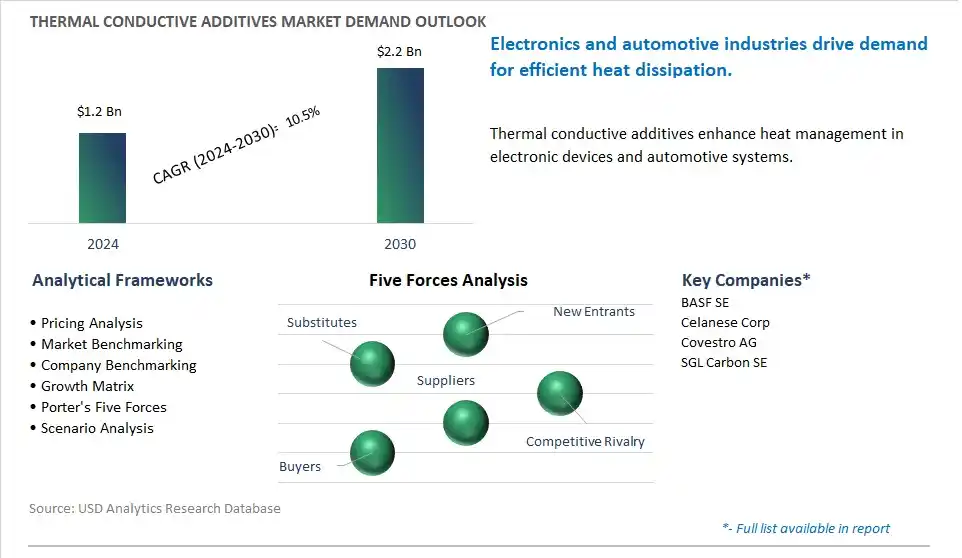
The global Thermal Conductive Additives Market is poised to register a 10.5% CAGR from $1.2 Billion in 2024 to $2.2 Billion in 2030.
The global Thermal Conductive Additives Market Study analyzes and forecasts the market size across 6 regions and 24 countries for diverse segments -By Plastic (Thermoplastic Additive, Thermosetting Additive), By Product (Graphite, Boron Nitride, Consumer Goods), By Application (Automotive, LED Lighting, Consumer Goods, Electronics & Electrical, Others).
An Introduction to Global Thermal Conductive Additives Market in 2024
Thermal conductive additives are materials added to polymers, ceramics, or other substrates to enhance their thermal conductivity, allowing efficient heat transfer within electronic devices, heat sinks, and thermal interface materials. The future of thermal conductive additives is influenced by several key trends, including advancements in nanomaterials, composite formulations, and applications in electronics cooling and thermal management. One significant trend is the development of novel nanocomposite materials incorporating carbon nanotubes, graphene, or metal nanoparticles as thermal conductive fillers, enabling high thermal conductivity while maintaining mechanical properties and processing flexibility. Manufacturers are investing in research and development to optimize filler dispersion, interfacial bonding, and composite microstructures to achieve enhanced thermal performance and reliability in electronic packaging, LED lighting, and automotive power electronics. Additionally, the integration of thermal conductive additives into phase change materials (PCMs), gels, and adhesives is driving innovations in passive thermal management solutions for battery packs, CPUs, and LED displays, enabling efficient heat dissipation and temperature regulation in compact and high-power electronic devices. Moreover, the expanding applications of thermal conductive additives in 5G telecommunications, electric vehicles, and renewable energy systems are driving demand for advanced materials that enable efficient heat transfer and thermal stability in harsh operating environments, contributing to the performance and reliability of next-generation electronic devices and infrastructure. Furthermore, collaborations between additive manufacturers, electronics designers, and thermal engineers are driving innovation and market growth by delivering customized solutions that meet the specific thermal conductivity, processing, and reliability requirements of diverse industries and applications, ensuring continued adoption and advancement of thermal conductive additives in the global marketplace.
Thermal Conductive Additives Market Competitive Landscape
The market report analyses the leading companies in the industry including BASF SE, Celanese Corp, Covestro AG, SGL Carbon SE.
Thermal Conductive Additives Market Dynamics
Thermal Conductive Additives Market Trend: Growing Demand for Thermal Conductive Additives in Electronics and Automotive Industries
A prominent market trend in the thermal conductive additives industry is the growing demand for thermal conductive additives in electronics and automotive applications. Thermal conductive additives are materials added to polymers, adhesives, and coatings to improve thermal conductivity and heat dissipation properties. With the increasing complexity and miniaturization of electronic devices, as well as the rise of electric vehicles and advanced automotive electronics, there is a rising need for thermal management solutions that can effectively dissipate heat generated by electronic components. This trend is driven by the need for improved thermal performance, reliability, and lifespan of electronic devices and automotive systems, stimulating the adoption of thermal conductive additives as essential components in thermal management materials and formulations.
Thermal Conductive Additives Market Driver: Continuous Innovation in Electronic and Automotive Technologies
A key driver behind the growth of the thermal conductive additives market is continuous innovation in electronic and automotive technologies, driving the need for more efficient thermal management solutions. As electronic devices become smaller, more powerful, and more densely packed with components, and as automotive electronics become more sophisticated, the heat generated by these systems increases, posing challenges for thermal management. Thermal conductive additives play a crucial role in enhancing the thermal conductivity of materials used in electronic enclosures, heat sinks, power modules, and automotive under-the-hood components, enabling efficient heat dissipation and temperature regulation. The demand for innovative thermal management solutions that can meet the evolving performance requirements of electronic and automotive systems drives market demand for thermal conductive additives, stimulating research and development efforts in materials science and polymer chemistry.
Thermal Conductive Additives Market Opportunity: Development of High-Performance and Specialty Thermal Conductive Additives
An opportunity exists for manufacturers of thermal conductive additives to develop high-performance and specialty additives that address specific application needs and market requirements. With the increasing demand for thermal management solutions tailored to the unique challenges of electronics and automotive industries, there is potential to innovate in additive formulations, particle morphology, surface treatments, and dispersion techniques to optimize thermal conductivity, mechanical properties, and compatibility with different substrates. Manufacturers can explore opportunities to develop specialty additives such as electrically insulating additives, flame-retardant additives, or additives with enhanced thermal stability and reliability for use in harsh operating conditions. Additionally, there is opportunity to collaborate with electronics and automotive manufacturers to develop customized thermal management solutions that meet specific performance targets and regulatory requirements. By focusing on product innovation and customization, thermal conductive additives manufacturers can differentiate their offerings, add value to their customers, and capture new opportunities for growth and market expansion.
Thermal Conductive Additives Market Share Analysis: Thermoplastic Additive generated the highest revenue in 2024
The largest segment in the Thermal Conductive Additives Market is the Thermoplastic Additive category. This is because thermoplastic materials are widely used in various industries due to their versatility, ease of processing, and recyclability. Thermoplastic additives are incorporated into polymer matrices to enhance their thermal conductivity, making them suitable for applications where efficient heat dissipation is essential. Thermoplastic materials are commonly used in electronics, automotive, aerospace, and consumer goods industries for applications such as heat sinks, LED lighting, electronic enclosures, and automotive components. Additionally, thermoplastics offer advantages such as flexibility, impact resistance, and design freedom, making them preferred materials for thermal management solutions. Furthermore, advancements in thermoplastic additive technology enable the development of high-performance materials with improved thermal conductivity while maintaining other desirable properties. Over the forecast period, the widespread use and versatility of thermoplastic additives contribute to their dominance as the largest segment in the Thermal Conductive Additives Market.
Thermal Conductive Additives Market Share Analysis: Graphite segment is poised to register the fastest growth rate (CAGR) over the forecast period to 2030
The fastest growing segment in the Thermal Conductive Additives Market is the Graphite category. Graphite is a highly effective thermal conductor due to its layered atomic structure, which allows heat to propagate through the material quickly and efficiently. Accordingly, graphite is widely used as a thermal conductive additive in various applications, including electronics, automotive, aerospace, and consumer goods. In electronics, graphite-filled polymer composites are used for thermal management solutions such as heat sinks, thermal interface materials, and electronic enclosures to dissipate heat generated by electronic components. Additionally, graphite additives offer advantages such as low cost, availability, and compatibility with existing manufacturing processes, making them preferred choices for thermal management applications. Furthermore, the increasing demand for high-performance electronic devices, electric vehicles, and energy-efficient appliances drives the adoption of graphite-based thermal conductive additives to address thermal management challenges and improve product reliability and performance. As industries continue to prioritize thermal management solutions for enhancing product performance and efficiency, the demand for graphite additives in the Thermal Conductive Additives Market is expected to experience rapid growth.
Thermal Conductive Additives Market Share Analysis: LED Lighting segment is poised to register the fastest growth rate (CAGR) over the forecast period to 2030
The fastest growing segment in the Thermal Conductive Additives Market is the LED Lighting category. LED lighting technology has gained significant traction in recent years due to its energy efficiency, long lifespan, and environmental sustainability compared to traditional lighting technologies such as incandescent and fluorescent bulbs. As the demand for LED lighting continues to increase, there is a growing need for effective thermal management solutions to dissipate the heat generated by LED chips and ensure optimal performance and reliability. Thermal conductive additives play a crucial role in enhancing the thermal conductivity of polymers used in LED heat sinks, enclosures, and thermal interface materials, enabling efficient heat dissipation and prolonging the lifespan of LED lighting systems. Additionally, advancements in LED technology, including higher power densities and smaller form factors, pose greater thermal challenges that require innovative thermal management solutions. Furthermore, the expansion of the LED lighting market into various applications such as automotive lighting, architectural lighting, and horticultural lighting further drives the demand for thermal conductive additives in LED lighting applications. As industries and consumers increasingly adopt LED lighting for its energy-saving benefits and environmental advantages, the demand for thermal conductive additives in the LED Lighting segment is expected to experience rapid growth in the Thermal Conductive Additives Market.
Thermal Conductive Additives Market Report Segmentation
By Plastic
Thermoplastic Additive
Thermosetting Additive
By Product
Graphite
Boron Nitride
Consumer Goods
By Application
Automotive
LED Lighting
Consumer Goods
Electronics & Electrical
Others
Regions Included
North America (US, Canada, Mexico)
Europe (Germany, UK, France, Spain, Italy, Russia, Rest of Europe)
Asia Pacific (China, India, Japan, South Korea, Australia, South East Asia, Rest of Asia)
South America (Brazil, Argentina, Rest of South America)
Middle East and Africa (Saudi Arabia, UAE, Rest of Middle East, South Africa, Egypt, Rest of Africa)
Thermal Conductive Additives Companies Profiled in the Market Study
BASF SE
Celanese Corp
Covestro AG
SGL Carbon SE
*- List Not Exhaustive
TABLE OF CONTENTS
1 Introduction to 2024 Thermal Conductive Additives Market
1.1 Market Overview
1.2 Quick Facts
1.3 Scope/Objective of the Study
1.4 Market Definition
1.5 Countries and Regions Covered
1.6 Units, Currency, and Conversions
1.7 Industry Value Chain
2 Research Methodology
2.1 Market Size Estimation
2.2 Sources and Research Methodology
2.3 Data Triangulation
2.4 Assumptions and Limitations
3 Executive Summary
3.1 Global Thermal Conductive Additives Market Size Outlook, $ Million, 2021 to 2030
3.2 Thermal Conductive Additives Market Outlook by Type, $ Million, 2021 to 2030
3.3 Thermal Conductive Additives Market Outlook by Product, $ Million, 2021 to 2030
3.4 Thermal Conductive Additives Market Outlook by Application, $ Million, 2021 to 2030
3.5 Thermal Conductive Additives Market Outlook by Key Countries, $ Million, 2021 to 2030
4 Market Dynamics
4.1 Key Driving Forces of Thermal Conductive Additives Industry
4.2 Key Market Trends in Thermal Conductive Additives Industry
4.3 Potential Opportunities in Thermal Conductive Additives Industry
4.4 Key Challenges in Thermal Conductive Additives Industry
5 Market Factor Analysis
5.1 Value Chain Analysis
5.2 Competitive Landscape
5.2.1 Global Thermal Conductive Additives Market Share by Company (%), 2023
5.2.2 Product Offerings by Company
5.3 Porter’s Five Forces Analysis
5.4 Pricing Analysis and Outlook
6 Growth Outlook Across Scenarios
6.1 Growth Analysis-Case Scenario Definitions
6.2 Low Growth Scenario Forecasts
6.3 Reference Growth Scenario Forecasts
6.4 High Growth Scenario Forecasts
7 Global Thermal Conductive Additives Market Outlook by Segments
7.1 Thermal Conductive Additives Market Outlook by Segments, $ Million, 2021- 2030
By Plastic
Thermoplastic Additive
Thermosetting Additive
By Product
Graphite
Boron Nitride
Consumer Goods
By Application
Automotive
LED Lighting
Consumer Goods
Electronics & Electrical
Others
8 North America Thermal Conductive Additives Market Analysis and Outlook To 2030
8.1 Introduction to North America Thermal Conductive Additives Markets in 2024
8.2 North America Thermal Conductive Additives Market Size Outlook by Country, 2021-2030
8.2.1 United States
8.2.2 Canada
8.2.3 Mexico
8.3 North America Thermal Conductive Additives Market size Outlook by Segments, 2021-2030
By Plastic
Thermoplastic Additive
Thermosetting Additive
By Product
Graphite
Boron Nitride
Consumer Goods
By Application
Automotive
LED Lighting
Consumer Goods
Electronics & Electrical
Others
9 Europe Thermal Conductive Additives Market Analysis and Outlook To 2030
9.1 Introduction to Europe Thermal Conductive Additives Markets in 2024
9.2 Europe Thermal Conductive Additives Market Size Outlook by Country, 2021-2030
9.2.1 Germany
9.2.2 France
9.2.3 Spain
9.2.4 United Kingdom
9.2.4 Italy
9.2.5 Russia
9.2.6 Norway
9.2.7 Rest of Europe
9.3 Europe Thermal Conductive Additives Market Size Outlook by Segments, 2021-2030
By Plastic
Thermoplastic Additive
Thermosetting Additive
By Product
Graphite
Boron Nitride
Consumer Goods
By Application
Automotive
LED Lighting
Consumer Goods
Electronics & Electrical
Others
10 Asia Pacific Thermal Conductive Additives Market Analysis and Outlook To 2030
10.1 Introduction to Asia Pacific Thermal Conductive Additives Markets in 2024
10.2 Asia Pacific Thermal Conductive Additives Market Size Outlook by Country, 2021-2030
10.2.1 China
10.2.2 India
10.2.3 Japan
10.2.4 South Korea
10.2.5 Indonesia
10.2.6 Malaysia
10.2.7 Australia
10.2.8 Rest of Asia Pacific
10.3 Asia Pacific Thermal Conductive Additives Market size Outlook by Segments, 2021-2030
By Plastic
Thermoplastic Additive
Thermosetting Additive
By Product
Graphite
Boron Nitride
Consumer Goods
By Application
Automotive
LED Lighting
Consumer Goods
Electronics & Electrical
Others
11 South America Thermal Conductive Additives Market Analysis and Outlook To 2030
11.1 Introduction to South America Thermal Conductive Additives Markets in 2024
11.2 South America Thermal Conductive Additives Market Size Outlook by Country, 2021-2030
11.2.1 Brazil
11.2.2 Argentina
11.2.3 Rest of South America
11.3 South America Thermal Conductive Additives Market size Outlook by Segments, 2021-2030
By Plastic
Thermoplastic Additive
Thermosetting Additive
By Product
Graphite
Boron Nitride
Consumer Goods
By Application
Automotive
LED Lighting
Consumer Goods
Electronics & Electrical
Others
12 Middle East and Africa Thermal Conductive Additives Market Analysis and Outlook To 2030
12.1 Introduction to Middle East and Africa Thermal Conductive Additives Markets in 2024
12.2 Middle East and Africa Thermal Conductive Additives Market Size Outlook by Country, 2021-2030
12.2.1 Saudi Arabia
12.2.2 UAE
12.2.3 Oman
12.2.4 Rest of Middle East
12.2.5 Egypt
12.2.6 Nigeria
12.2.7 South Africa
12.2.8 Rest of Africa
12.3 Middle East and Africa Thermal Conductive Additives Market size Outlook by Segments, 2021-2030
By Plastic
Thermoplastic Additive
Thermosetting Additive
By Product
Graphite
Boron Nitride
Consumer Goods
By Application
Automotive
LED Lighting
Consumer Goods
Electronics & Electrical
Others
13 Company Profiles
13.1 Company Snapshot
13.2 SWOT Profiles
13.3 Products and Services
13.4 Recent Developments
13.5 Financial Profile
BASF SE
Celanese Corp
Covestro AG
SGL Carbon SE
14 Appendix
14.1 Customization Offerings
14.2 Subscription Services
14.3 Related Reports
14.4 Publisher Expertise
By Plastic
Thermoplastic Additive
Thermosetting Additive
By Product
Graphite
Boron Nitride
Consumer Goods
By Application
Automotive
LED Lighting
Consumer Goods
Electronics & Electrical
Others
Countries Analyzed
North America (US, Canada, Mexico)
Europe (Germany, UK, France, Spain, Italy, Russia, Rest of Europe)
Asia Pacific (China, India, Japan, South Korea, Australia, South East Asia, Rest of Asia)
South America (Brazil, Argentina, Rest of South America)
Middle East and Africa (Saudi Arabia, UAE, Rest of Middle East, South Africa, Egypt, Rest of Africa)
