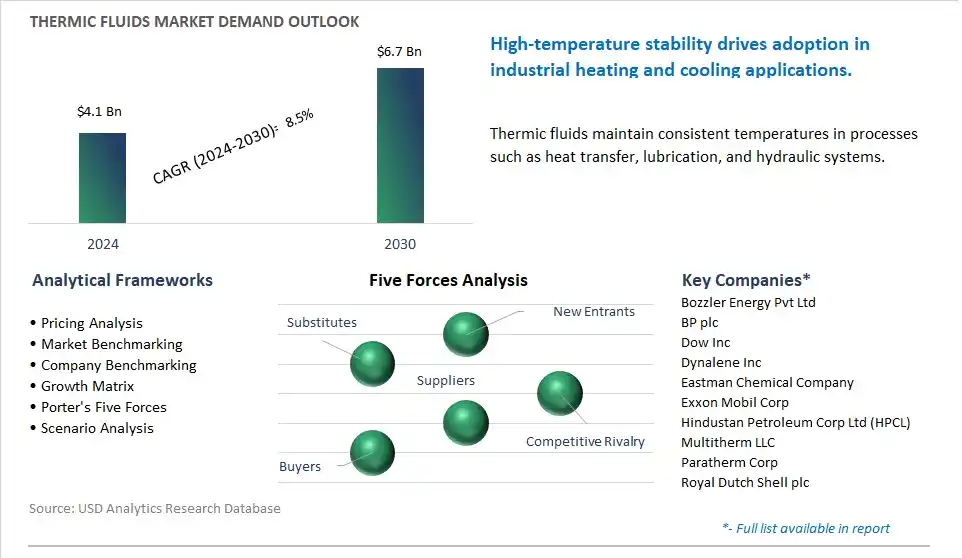
The global Thermic Fluids Market is poised to register a 8.5% CAGR from $4.1 Billion in 2024 to $6.7 Billion in 2030.
The global Thermic Fluids Market Study analyzes and forecasts the market size across 6 regions and 24 countries for diverse segments -By Type (Mineral Oils, Silicon and Aromatics, Glycols, Others), By End-User (Food and Beverage, Chemical, Pharmaceutical, Oil and Gas, Concentrated Solar Power, Others).
An Introduction to Global Thermic Fluids Market in 2024
Thermic fluids, also known as heat transfer fluids or thermal oils, are substances used to transfer heat from one system to another while maintaining a consistent temperature range. The future of thermic fluids is influenced by several key trends, including advancements in fluid chemistry, energy efficiency, and sustainability. One significant trend is the development of high-performance thermic fluids with improved thermal stability, heat transfer efficiency, and environmental compatibility, meeting the demands of various industrial processes such as oil and gas refining, chemical processing, and renewable energy generation. Manufacturers are investing in research and development to innovate new fluid formulations using synthetic oils, silicone-based fluids, or bio-based alternatives that offer enhanced thermal conductivity, oxidation resistance, and low viscosity at high temperatures, enabling efficient heat exchange and prolonged fluid life in demanding applications. Additionally, the integration of thermic fluids into advanced thermal energy storage systems, concentrating solar power plants, and waste heat recovery units is driving innovations in energy storage, conversion, and utilization, enabling greater energy efficiency and flexibility in energy-intensive industries. Moreover, the increasing focus on sustainability and environmental stewardship is driving the adoption of biodegradable and non-toxic thermic fluids that minimize environmental impact, reduce health hazards for workers, and comply with regulatory requirements for environmental protection and workplace safety. Furthermore, collaborations between fluid manufacturers, equipment suppliers, and end-users are driving innovation and market growth by delivering customized solutions that meet the specific thermal performance, operational requirements, and sustainability goals of diverse industries and applications, ensuring continued adoption and advancement of thermic fluids in the global marketplace.
Thermic Fluids Market Competitive Landscape
The market report analyses the leading companies in the industry including Bozzler Energy Pvt Ltd, BP plc, Dow Inc, Dynalene Inc, Eastman Chemical Company, Exxon Mobil Corp, Hindustan Petroleum Corp Ltd (HPCL), Multitherm LLC, Paratherm Corp, Royal Dutch Shell plc.
Thermic Fluids Market Dynamics
Thermic Fluids Market Trend: Shift Towards High-Performance and Environmentally Friendly Thermic Fluids
A prominent market trend in the thermic fluids industry is the shift towards high-performance and environmentally friendly formulations. Thermic fluids, also known as heat transfer fluids, are used in various industrial processes for heating, cooling, and temperature control applications. With increasing emphasis on energy efficiency, operational safety, and environmental sustainability, there is a growing demand for thermic fluids that offer superior thermal stability, efficiency, and environmental compatibility. This trend is driven by regulatory pressures, industry standards, and the need for reliable heat transfer solutions in diverse sectors such as manufacturing, chemicals, pharmaceuticals, and food processing.
Thermic Fluids Market Driver: Industrial Growth and Expansion of Process Heating Applications
A key driver behind the growth of the thermic fluids market is industrial growth and the expansion of process heating applications across different industries. As industrial processes become more sophisticated and diverse, there is an increasing reliance on thermic fluids to provide precise temperature control, rapid heat transfer, and consistent performance in demanding operating conditions. Industries such as chemicals, petrochemicals, plastics, food and beverage, and pharmaceuticals rely on thermic fluids for heating reactors, distillation columns, heat exchangers, and other equipment. The need to optimize energy efficiency, productivity, and product quality in industrial operations drives market demand for thermic fluids as essential components of thermal management systems.
Thermic Fluids Market Opportunity: Development of Specialty Formulations for Specific Industrial Applications
An opportunity exists for thermic fluid manufacturers to develop specialty formulations tailored to specific industrial applications and performance requirements. With the diversification of industrial processes and the emergence of new technologies, there is potential to innovate in thermic fluid formulations to address the unique challenges and operating conditions of different industries. Manufacturers can explore opportunities to develop specialty fluids such as synthetic oils, silicone-based fluids, and bio-based fluids with enhanced thermal stability, oxidation resistance, and compatibility with specific materials and equipment. Additionally, there is an opportunity to integrate additives and modifiers to impart additional functionalities such as corrosion protection, antifouling properties, and extended fluid life. By collaborating with industry partners and conducting research and development, thermic fluid manufacturers can capitalize on market opportunities and provide customized solutions that meet the evolving needs of industrial customers.
Thermic Fluids Market Share Analysis: Mineral Oils generated the highest revenue in 2024
The largest segment in the Thermic Fluids Market is the Mineral Oils category. mineral oils have been traditionally used as thermic fluids due to their excellent thermal stability, high heat transfer efficiency, and cost-effectiveness. Mineral oils, derived from crude oil, offer good thermal conductivity and heat retention properties, making them suitable for a wide range of industrial applications, including heat transfer systems, thermal processing, and temperature control in various manufacturing processes. Additionally, mineral oils are readily available, widely accepted, and easy to handle, store, and transport, contributing to their widespread use in industrial applications. Furthermore, mineral oils offer good compatibility with common materials of construction such as metals, elastomers, and seals, minimizing the risk of corrosion and system downtime. Over the forecast period, the combination of favorable properties, availability, and cost-effectiveness makes mineral oils the largest segment in the Thermic Fluids Market.
Thermic Fluids Market Share Analysis: Concentrated Solar Power segment is poised to register the fastest growth rate (CAGR) over the forecast period to 2030
The fastest growing segment in the Thermic Fluids Market is the Concentrated Solar Power (CSP) category. Concentrated Solar Power (CSP) systems are increasingly being deployed for large-scale solar thermal energy generation, especially in regions with abundant sunlight. CSP plants use mirrors or lenses to concentrate sunlight onto a receiver, where a heat transfer fluid (thermic fluid) absorbs the solar energy and transfers it to a power generation system, a steam turbine, to produce electricity. As governments worldwide focus on reducing greenhouse gas emissions and transitioning to renewable energy sources, there is a growing emphasis on expanding solar energy capacity, including CSP installations. Additionally, CSP technology offers potential advantages such as energy storage capability, dispatchability, and the potential for hybridization with conventional power plants, making it a viable option for providing stable and reliable electricity supply. Furthermore, advancements in thermic fluid formulations and technologies tailored for CSP applications, such as high-temperature stability, thermal efficiency, and resistance to degradation, further drive the adoption of thermic fluids in Concentrated Solar Power plants. As the demand for renewable energy continues to grow, particularly in emerging markets and regions with favorable solar resources, the CSP segment is expected to experience rapid growth in the Thermic Fluids Market.
Thermic Fluids Market Report Segmentation
By Type
Mineral Oils
Silicon and Aromatics
Glycols
Others
By End-User
Food and Beverage
Chemical
Pharmaceutical
Oil and Gas
Concentrated Solar Power
Others
Regions Included
North America (US, Canada, Mexico)
Europe (Germany, UK, France, Spain, Italy, Russia, Rest of Europe)
Asia Pacific (China, India, Japan, South Korea, Australia, South East Asia, Rest of Asia)
South America (Brazil, Argentina, Rest of South America)
Middle East and Africa (Saudi Arabia, UAE, Rest of Middle East, South Africa, Egypt, Rest of Africa)
Thermic Fluids Companies Profiled in the Market Study
Bozzler Energy Pvt Ltd
BP plc
Dow Inc
Dynalene Inc
Eastman Chemical Company
Exxon Mobil Corp
Hindustan Petroleum Corp Ltd (HPCL)
Multitherm LLC
Paratherm Corp
Royal Dutch Shell plc
*- List Not Exhaustive
TABLE OF CONTENTS
1 Introduction to 2024 Thermic Fluids Market
1.1 Market Overview
1.2 Quick Facts
1.3 Scope/Objective of the Study
1.4 Market Definition
1.5 Countries and Regions Covered
1.6 Units, Currency, and Conversions
1.7 Industry Value Chain
2 Research Methodology
2.1 Market Size Estimation
2.2 Sources and Research Methodology
2.3 Data Triangulation
2.4 Assumptions and Limitations
3 Executive Summary
3.1 Global Thermic Fluids Market Size Outlook, $ Million, 2021 to 2030
3.2 Thermic Fluids Market Outlook by Type, $ Million, 2021 to 2030
3.3 Thermic Fluids Market Outlook by Product, $ Million, 2021 to 2030
3.4 Thermic Fluids Market Outlook by Application, $ Million, 2021 to 2030
3.5 Thermic Fluids Market Outlook by Key Countries, $ Million, 2021 to 2030
4 Market Dynamics
4.1 Key Driving Forces of Thermic Fluids Industry
4.2 Key Market Trends in Thermic Fluids Industry
4.3 Potential Opportunities in Thermic Fluids Industry
4.4 Key Challenges in Thermic Fluids Industry
5 Market Factor Analysis
5.1 Value Chain Analysis
5.2 Competitive Landscape
5.2.1 Global Thermic Fluids Market Share by Company (%), 2023
5.2.2 Product Offerings by Company
5.3 Porter’s Five Forces Analysis
5.4 Pricing Analysis and Outlook
6 Growth Outlook Across Scenarios
6.1 Growth Analysis-Case Scenario Definitions
6.2 Low Growth Scenario Forecasts
6.3 Reference Growth Scenario Forecasts
6.4 High Growth Scenario Forecasts
7 Global Thermic Fluids Market Outlook by Segments
7.1 Thermic Fluids Market Outlook by Segments, $ Million, 2021- 2030
By Type
Mineral Oils
Silicon and Aromatics
Glycols
Others
By End-User
Food and Beverage
Chemical
Pharmaceutical
Oil and Gas
Concentrated Solar Power
Others
8 North America Thermic Fluids Market Analysis and Outlook To 2030
8.1 Introduction to North America Thermic Fluids Markets in 2024
8.2 North America Thermic Fluids Market Size Outlook by Country, 2021-2030
8.2.1 United States
8.2.2 Canada
8.2.3 Mexico
8.3 North America Thermic Fluids Market size Outlook by Segments, 2021-2030
By Type
Mineral Oils
Silicon and Aromatics
Glycols
Others
By End-User
Food and Beverage
Chemical
Pharmaceutical
Oil and Gas
Concentrated Solar Power
Others
9 Europe Thermic Fluids Market Analysis and Outlook To 2030
9.1 Introduction to Europe Thermic Fluids Markets in 2024
9.2 Europe Thermic Fluids Market Size Outlook by Country, 2021-2030
9.2.1 Germany
9.2.2 France
9.2.3 Spain
9.2.4 United Kingdom
9.2.4 Italy
9.2.5 Russia
9.2.6 Norway
9.2.7 Rest of Europe
9.3 Europe Thermic Fluids Market Size Outlook by Segments, 2021-2030
By Type
Mineral Oils
Silicon and Aromatics
Glycols
Others
By End-User
Food and Beverage
Chemical
Pharmaceutical
Oil and Gas
Concentrated Solar Power
Others
10 Asia Pacific Thermic Fluids Market Analysis and Outlook To 2030
10.1 Introduction to Asia Pacific Thermic Fluids Markets in 2024
10.2 Asia Pacific Thermic Fluids Market Size Outlook by Country, 2021-2030
10.2.1 China
10.2.2 India
10.2.3 Japan
10.2.4 South Korea
10.2.5 Indonesia
10.2.6 Malaysia
10.2.7 Australia
10.2.8 Rest of Asia Pacific
10.3 Asia Pacific Thermic Fluids Market size Outlook by Segments, 2021-2030
By Type
Mineral Oils
Silicon and Aromatics
Glycols
Others
By End-User
Food and Beverage
Chemical
Pharmaceutical
Oil and Gas
Concentrated Solar Power
Others
11 South America Thermic Fluids Market Analysis and Outlook To 2030
11.1 Introduction to South America Thermic Fluids Markets in 2024
11.2 South America Thermic Fluids Market Size Outlook by Country, 2021-2030
11.2.1 Brazil
11.2.2 Argentina
11.2.3 Rest of South America
11.3 South America Thermic Fluids Market size Outlook by Segments, 2021-2030
By Type
Mineral Oils
Silicon and Aromatics
Glycols
Others
By End-User
Food and Beverage
Chemical
Pharmaceutical
Oil and Gas
Concentrated Solar Power
Others
12 Middle East and Africa Thermic Fluids Market Analysis and Outlook To 2030
12.1 Introduction to Middle East and Africa Thermic Fluids Markets in 2024
12.2 Middle East and Africa Thermic Fluids Market Size Outlook by Country, 2021-2030
12.2.1 Saudi Arabia
12.2.2 UAE
12.2.3 Oman
12.2.4 Rest of Middle East
12.2.5 Egypt
12.2.6 Nigeria
12.2.7 South Africa
12.2.8 Rest of Africa
12.3 Middle East and Africa Thermic Fluids Market size Outlook by Segments, 2021-2030
By Type
Mineral Oils
Silicon and Aromatics
Glycols
Others
By End-User
Food and Beverage
Chemical
Pharmaceutical
Oil and Gas
Concentrated Solar Power
Others
13 Company Profiles
13.1 Company Snapshot
13.2 SWOT Profiles
13.3 Products and Services
13.4 Recent Developments
13.5 Financial Profile
Bozzler Energy Pvt Ltd
BP plc
Dow Inc
Dynalene Inc
Eastman Chemical Company
Exxon Mobil Corp
Hindustan Petroleum Corp Ltd (HPCL)
Multitherm LLC
Paratherm Corp
Royal Dutch Shell plc
14 Appendix
14.1 Customization Offerings
14.2 Subscription Services
14.3 Related Reports
14.4 Publisher Expertise
By Type
Mineral Oils
Silicon and Aromatics
Glycols
Others
By End-User
Food and Beverage
Chemical
Pharmaceutical
Oil and Gas
Concentrated Solar Power
Others
Countries Analyzed
North America (US, Canada, Mexico)
Europe (Germany, UK, France, Spain, Italy, Russia, Rest of Europe)
Asia Pacific (China, India, Japan, South Korea, Australia, South East Asia, Rest of Asia)
South America (Brazil, Argentina, Rest of South America)
Middle East and Africa (Saudi Arabia, UAE, Rest of Middle East, South Africa, Egypt, Rest of Africa)
