Thrombectomy Devices Market is estimated to increase at a Compounded Annual Growth Rate of 7.5% CAGR over the forecast period from 2024 to 2030
The Thrombectomy Devices Market study analyzes and forecasts the market size across 6 regions and 24 countries for diverse segments- By Product (Aspiration Thrombectomy Devices, Mechanical Thrombectomy Devices, Ultrasonic Thrombectomy Devices, Others), By Application (Cardiovascular Thrombectomy, Neurovascular Thrombectomy, Peripheral Vascular Thrombectomy), By End-User (Hospitals/Clinics, Ambulatory Centers, Others).
An Introduction to Thrombectomy Devices Market in 2024
Thrombectomy devices are medical devices used to remove blood clots or thrombi from blood vessels in patients with acute ischemic stroke, deep vein thrombosis (DVT), pulmonary embolism (PE), or peripheral arterial occlusion. In 2024, the market for thrombectomy devices is experiencing rapid growth, driven by the increasing prevalence of thrombotic disorders, the growing adoption of endovascular therapies, and the technological advancements in thrombectomy device design and efficacy. Thrombectomy devices utilize various mechanical, aspiration, or combined mechanisms to mechanically disrupt, fragment, or extract thrombi from blood vessels, restoring blood flow and preventing tissue damage or organ dysfunction. These devices are commonly used in conjunction with catheter-based interventions such as angioplasty and stenting to treat acute ischemic stroke or peripheral vascular occlusions, offering a minimally invasive alternative to surgical thrombectomy procedures. With advancements in device technology, navigation systems, and imaging modalities, thrombectomy devices offer improved precision, efficacy, and safety in thrombus removal procedures. Moreover, the expansion of treatment guidelines, reimbursement policies, and clinical evidence supporting the use of thrombectomy in stroke care has contributed to the widespread adoption of thrombectomy devices as standard-of-care treatment for eligible patients. As healthcare systems prioritize timely intervention, patient outcomes, and quality of life, thrombectomy devices play a critical role in improving access to life-saving treatments, reducing disability, and optimizing healthcare resource utilization in the management of acute thrombotic events.
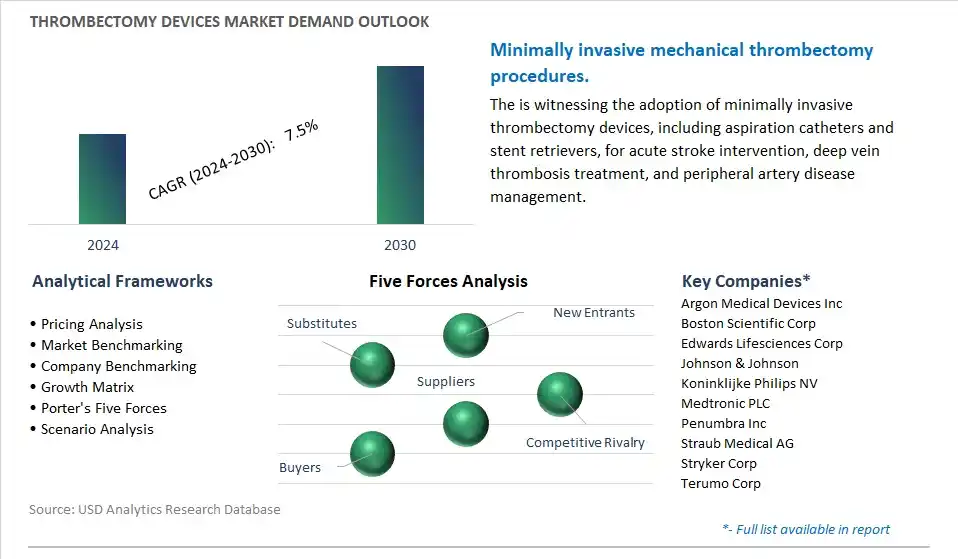
Market Trend: Shift Towards Minimally Invasive Thrombectomy Procedures
A prominent trend in the thrombectomy devices market is the shift towards minimally invasive thrombectomy procedures. With advancements in medical technology and interventional radiology techniques, there is increasing adoption of minimally invasive approaches for the treatment of arterial and venous thromboembolic disorders. Minimally invasive thrombectomy procedures, such as mechanical thrombectomy and catheter-directed thrombolysis, offer several advantages over traditional surgical interventions, including reduced procedural risks, shorter recovery times, and improved patient outcomes. As healthcare providers strive to minimize patient morbidity and healthcare costs while optimizing treatment efficacy, there is growing demand for thrombectomy devices that enable precise, controlled, and minimally invasive removal of thrombi from blood vessels. This trend reflects the ongoing evolution of thrombectomy techniques towards less invasive and more patient-friendly treatment options.
Market Driver: Increasing Incidence of Cardiovascular and Stroke Events
A key driver propelling the growth of the thrombectomy devices market is the increasing incidence of cardiovascular and stroke events worldwide. Cardiovascular diseases, including acute myocardial infarction, peripheral arterial disease, and deep vein thrombosis, remain leading causes of morbidity and mortality globally, contributing to a significant burden on healthcare systems and economies. Additionally, ischemic stroke, caused by arterial thromboembolism or cerebral artery occlusion, is a major cause of disability and death, emphasizing the critical need for timely and effective thrombectomy interventions. The rising prevalence of risk factors such as hypertension, diabetes, obesity, and sedentary lifestyle further exacerbates the burden of thromboembolic disorders. As the demand for prompt and efficient thrombus removal continues to increase, there is a corresponding demand for innovative thrombectomy devices that offer superior performance, safety, and ease of use in managing acute thrombotic events.
Market Opportunity: Development of Next-Generation Thrombectomy Devices with Enhanced Navigation and Recanalization Capabilities
An emerging opportunity in the thrombectomy devices market lies in the development of next-generation devices with enhanced navigation and recanalization capabilities. While existing thrombectomy devices have demonstrated efficacy in thrombus removal, there is room for improvement in terms of device deliverability, precision, and adaptability to different anatomical locations and thrombus compositions. Manufacturers can capitalize on this opportunity by innovating new thrombectomy technologies that incorporate advanced imaging modalities, robotic-assisted navigation systems, and customizable device designs to optimize procedural outcomes and patient safety. Additionally, there is a growing demand for thrombectomy devices capable of addressing challenging thrombus characteristics such as chronicity, organization, and resistance to lysis, which may require specialized devices with enhanced suction, fragmentation, or aspiration capabilities. By investing in research and development of next-generation thrombectomy devices, manufacturers can address unmet clinical needs, expand their product portfolios, and capture opportunities in the evolving landscape of endovascular thrombectomy interventions.
Thrombectomy Devices Market Share Analysis: Mechanical Thrombectomy Devices is the fastest growing segment over the forecast period to 2030
Among the segments in the Thrombectomy Devices Market, Mechanical Thrombectomy Devices emerge as the fastest growing segment, and this can be attributed to several key factors. Mechanical thrombectomy devices offer a minimally invasive approach for removing blood clots, which is increasingly preferred over traditional surgical methods due to reduced risks, shorter recovery times, and improved patient outcomes. The rising incidence of cardiovascular and neurovascular diseases, such as stroke and deep vein thrombosis (DVT), has fueled the demand for effective thrombectomy procedures. Mechanical thrombectomy devices, characterized by their ability to mechanically disrupt and extract clots, have demonstrated superior efficacy in achieving rapid and complete revascularization compared to other techniques. Moreover, technological advancements in mechanical thrombectomy devices have led to the development of innovative devices with enhanced navigability, flexibility, and thrombus removal capabilities, further driving their adoption among healthcare providers. Additionally, increasing awareness among clinicians and patients about the benefits of mechanical thrombectomy in restoring blood flow and preventing complications has contributed to the growing acceptance of these devices. Furthermore, expanding healthcare infrastructure, especially in emerging economies, has widened the accessibility of mechanical thrombectomy procedures, supporting market growth. Overall, the Mechanical Thrombectomy Devices segment experiences rapid expansion driven by its effectiveness, technological advancements, increasing disease prevalence, and growing adoption by healthcare facilities worldwide.
Thrombectomy Devices Competitive Analysis
The market research study provides in-depth insights into leading companies including the SWOT analyses, product profile, financial details, and recent developments acrossArgon Medical Devices Inc, Boston Scientific Corp, Edwards Lifesciences Corp, Johnson & Johnson, Koninklijke Philips NV, Medtronic PLC, Penumbra Inc, Straub Medical AG, Stryker Corp, Terumo Corp
Thrombectomy Devices Market Segmentation
By Product
Aspiration Thrombectomy Devices
Mechanical Thrombectomy Devices
Ultrasonic Thrombectomy Devices
Others
By Application
Cardiovascular Thrombectomy
Neurovascular Thrombectomy
Peripheral Vascular Thrombectomy
By End-User
Hospitals/Clinics
Ambulatory Centers
Others
Geographical Analysis
North America (United States, Canada, Mexico)
Europe (Germany, France, United Kingdom, Spain, Italy, Rest of Europe)
Asia Pacific (China, India, Japan, South Korea, Rest of Asia Pacific)
South America (Brazil, Argentina, Rest of South America)
Middle East and Africa (Saudi Arabia, UAE, Rest of Middle East, South Africa, Egypt, Rest of Africa)
Thrombectomy Devices Market Companies
Argon Medical Devices Inc
Boston Scientific Corp
Edwards Lifesciences Corp
Johnson & Johnson
Koninklijke Philips NV
Medtronic PLC
Penumbra Inc
Straub Medical AG
Stryker Corp
Terumo Corp
Reasons to Buy the Thrombectomy Devices Market Study
• Deepen your industry insights and navigate uncertainties for strategy formulation, CAPEX, and Operational decisions
• Gain access to detailed insights on the Thrombectomy Devices Market, encompassing current market size, growth trends, and forecasts till 2030.
• Access detailed competitor analysis, enabling competitive advantage through a thorough understanding of market players, strategies, and potential differentiation opportunities
• Stay ahead of the curve with insights on technological advancements, innovations, and upcoming trends
• Identify lucrative investment avenues and expansion opportunities within the Thrombectomy Devices Market industry, guided by robust, data-backed analysis.
• Understand regional and global markets through country-wise analysis, regional market potential, regulatory nuances, and dynamics
• Execute strategies with confidence and speed through information, analytics, and insights on the industry value chain
• Corporate leaders, strategists, financial experts, shareholders, asset managers, and governmental representatives can make long-term planning scenarios and build an integrated and timely understanding of market dynamics
• Benefit from tailored solutions and expert consultation based on report insights, providing personalized strategies aligned with specific business needs.
TABLE OF CONTENTS
1 Introduction to 2024 Thrombectomy Devices Market
1.1 Market Overview
1.2 Quick Facts
1.3 Scope/Objective of the Study
1.4 Market Definition
1.5 Countries and Regions Covered
1.6 Units, Currency, and Conversions
1.7 Industry Value Chain
2 Research Methodology
2.1 Market Size Estimation
2.2 Sources and Research Methodology
2.3 Data Triangulation
2.4 Assumptions and Limitations
3 Executive Summary
3.1 Global Thrombectomy Devices Market Size Outlook, $ Million, 2021 to 2030
3.2 Thrombectomy Devices Market Outlook by Type, $ Million, 2021 to 2030
3.3 Thrombectomy Devices Market Outlook by Product, $ Million, 2021 to 2030
3.4 Thrombectomy Devices Market Outlook by Application, $ Million, 2021 to 2030
3.5 Thrombectomy Devices Market Outlook by Key Countries, $ Million, 2021 to 2030
4 Market Dynamics
4.1 Key Driving Forces of Thrombectomy Devices Industry
4.2 Key Market Trends in Thrombectomy Devices Industry
4.3 Potential Opportunities in Thrombectomy Devices Industry
4.4 Key Challenges in Thrombectomy Devices Industry
5 Market Factor Analysis
5.1 Value Chain Analysis
5.2 Competitive Landscape
5.2.1 Global Thrombectomy Devices Market Share by Company (%), 2023
5.2.2 Product Offerings by Company
5.3 Porter’s Five Forces Analysis
5.4 Pricing Analysis and Outlook
6 Growth Outlook Across Scenarios
6.1 Growth Analysis-Case Scenario Definitions
6.2 Low Growth Scenario Forecasts
6.3 Reference Growth Scenario Forecasts
6.4 High Growth Scenario Forecasts
7 Global Thrombectomy Devices Market Outlook by Segments
7.1 Thrombectomy Devices Market Outlook by Segments, $ Million, 2021- 2030
By Product
Aspiration Thrombectomy Devices
Mechanical Thrombectomy Devices
Ultrasonic Thrombectomy Devices
Others
By Application
Cardiovascular Thrombectomy
Neurovascular Thrombectomy
Peripheral Vascular Thrombectomy
By End-User
Hospitals/Clinics
Ambulatory Centers
Others
8 North America Thrombectomy Devices Market Analysis and Outlook To 2030
8.1 Introduction to North America Thrombectomy Devices Markets in 2024
8.2 North America Thrombectomy Devices Market Size Outlook by Country, 2021-2030
8.2.1 United States
8.2.2 Canada
8.2.3 Mexico
8.3 North America Thrombectomy Devices Market size Outlook by Segments, 2021-2030
By Product
Aspiration Thrombectomy Devices
Mechanical Thrombectomy Devices
Ultrasonic Thrombectomy Devices
Others
By Application
Cardiovascular Thrombectomy
Neurovascular Thrombectomy
Peripheral Vascular Thrombectomy
By End-User
Hospitals/Clinics
Ambulatory Centers
Others
9 Europe Thrombectomy Devices Market Analysis and Outlook To 2030
9.1 Introduction to Europe Thrombectomy Devices Markets in 2024
9.2 Europe Thrombectomy Devices Market Size Outlook by Country, 2021-2030
9.2.1 Germany
9.2.2 France
9.2.3 Spain
9.2.4 United Kingdom
9.2.4 Italy
9.2.5 Russia
9.2.6 Norway
9.2.7 Rest of Europe
9.3 Europe Thrombectomy Devices Market Size Outlook by Segments, 2021-2030
By Product
Aspiration Thrombectomy Devices
Mechanical Thrombectomy Devices
Ultrasonic Thrombectomy Devices
Others
By Application
Cardiovascular Thrombectomy
Neurovascular Thrombectomy
Peripheral Vascular Thrombectomy
By End-User
Hospitals/Clinics
Ambulatory Centers
Others
10 Asia Pacific Thrombectomy Devices Market Analysis and Outlook To 2030
10.1 Introduction to Asia Pacific Thrombectomy Devices Markets in 2024
10.2 Asia Pacific Thrombectomy Devices Market Size Outlook by Country, 2021-2030
10.2.1 China
10.2.2 India
10.2.3 Japan
10.2.4 South Korea
10.2.5 Indonesia
10.2.6 Malaysia
10.2.7 Australia
10.2.8 Rest of Asia Pacific
10.3 Asia Pacific Thrombectomy Devices Market size Outlook by Segments, 2021-2030
By Product
Aspiration Thrombectomy Devices
Mechanical Thrombectomy Devices
Ultrasonic Thrombectomy Devices
Others
By Application
Cardiovascular Thrombectomy
Neurovascular Thrombectomy
Peripheral Vascular Thrombectomy
By End-User
Hospitals/Clinics
Ambulatory Centers
Others
11 South America Thrombectomy Devices Market Analysis and Outlook To 2030
11.1 Introduction to South America Thrombectomy Devices Markets in 2024
11.2 South America Thrombectomy Devices Market Size Outlook by Country, 2021-2030
11.2.1 Brazil
11.2.2 Argentina
11.2.3 Rest of South America
11.3 South America Thrombectomy Devices Market size Outlook by Segments, 2021-2030
By Product
Aspiration Thrombectomy Devices
Mechanical Thrombectomy Devices
Ultrasonic Thrombectomy Devices
Others
By Application
Cardiovascular Thrombectomy
Neurovascular Thrombectomy
Peripheral Vascular Thrombectomy
By End-User
Hospitals/Clinics
Ambulatory Centers
Others
12 Middle East and Africa Thrombectomy Devices Market Analysis and Outlook To 2030
12.1 Introduction to Middle East and Africa Thrombectomy Devices Markets in 2024
12.2 Middle East and Africa Thrombectomy Devices Market Size Outlook by Country, 2021-2030
12.2.1 Saudi Arabia
12.2.2 UAE
12.2.3 Oman
12.2.4 Rest of Middle East
12.2.5 Egypt
12.2.6 Nigeria
12.2.7 South Africa
12.2.8 Rest of Africa
12.3 Middle East and Africa Thrombectomy Devices Market size Outlook by Segments, 2021-2030
By Product
Aspiration Thrombectomy Devices
Mechanical Thrombectomy Devices
Ultrasonic Thrombectomy Devices
Others
By Application
Cardiovascular Thrombectomy
Neurovascular Thrombectomy
Peripheral Vascular Thrombectomy
By End-User
Hospitals/Clinics
Ambulatory Centers
Others
13 Company Profiles
13.1 Company Snapshot
13.2 SWOT Profiles
13.3 Products and Services
13.4 Recent Developments
13.5 Financial Profile
List of Companies
Argon Medical Devices Inc
Boston Scientific Corp
Edwards Lifesciences Corp
Johnson & Johnson
Koninklijke Philips NV
Medtronic PLC
Penumbra Inc
Straub Medical AG
Stryker Corp
Terumo Corp
14 Appendix
14.1 Customization Offerings
14.2 Subscription Services
14.3 Related Reports
14.4 Publisher Expertise
By Product
Aspiration Thrombectomy Devices
Mechanical Thrombectomy Devices
Ultrasonic Thrombectomy Devices
Others
By Application
Cardiovascular Thrombectomy
Neurovascular Thrombectomy
Peripheral Vascular Thrombectomy
By End-User
Hospitals/Clinics
Ambulatory Centers
Others
Countries Analyzed
North America (United States, Canada, Mexico)
Europe (Germany, France, United Kingdom, Spain, Italy, Rest of Europe)
Asia Pacific (China, India, Japan, South Korea, Rest of Asia Pacific)
South America (Brazil, Argentina, Rest of South America)
Middle East and Africa (Saudi Arabia, UAE, Rest of Middle East, South Africa, Egypt, Rest of Africa)
