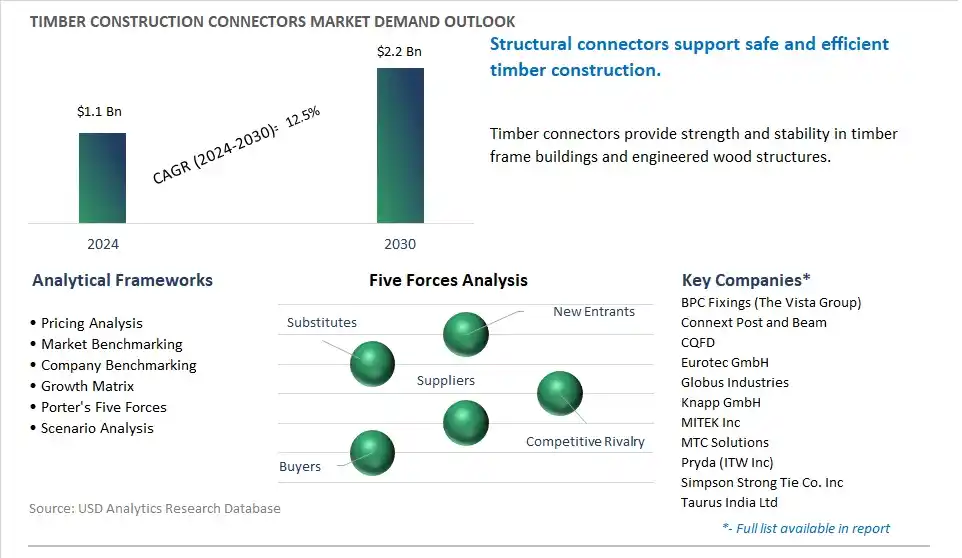
The global Timber Construction Connectors Market is poised to register a 12.5% CAGR from $1.1 Billion in 2024 to $2.2 Billion in 2030.
The global Timber Construction Connectors Market Study analyzes and forecasts the market size across 6 regions and 24 countries for diverse segments -By Product (Timber to Timber, Timber to Masonry, Timber to Steel), By Application (Residential, Commercial, Infrastructure).
An Introduction to Global Timber Construction Connectors Market in 2024
Timber construction connectors are specialized hardware components used to join timber members together in various wood construction applications, including residential, commercial, and industrial structures. The future of timber construction connectors is influenced by several key trends, including advancements in wood engineering, sustainability, and building codes. One significant trend is the development of innovative connector designs and materials that optimize structural performance, durability, and ease of installation while minimizing material waste and environmental impact. Manufacturers are investing in research and development to engineer connectors with enhanced load-carrying capacities, corrosion resistance, and compatibility with different wood species and construction methods, enabling the construction of taller, larger, and more resilient timber buildings. Additionally, the integration of advanced manufacturing technologies such as computer-aided design (CAD), computer numerical control (CNC) machining, and robotic assembly is driving innovations in customized connectors, prefabricated assemblies, and mass timber construction systems that streamline construction processes, reduce labor costs, and accelerate project timelines for timber construction projects. Moreover, the increasing recognition of timber as a sustainable building material and the adoption of green building certifications such as LEED (Leadership in Energy and Environmental Design) and Passive House are driving demand for timber construction connectors that meet stringent environmental criteria, including renewable sourcing, carbon sequestration, and life cycle assessment. Furthermore, collaborations between connector manufacturers, structural engineers, and architects are driving innovation and market growth by delivering customized solutions that meet the specific structural, aesthetic, and sustainability requirements of diverse timber construction projects and regulatory environments, ensuring continued adoption and advancement of timber construction connectors in the global building industry.
Timber Construction Connectors Market Competitive Landscape
The market report analyses the leading companies in the industry including BPC Fixings (The Vista Group), Connext Post and Beam, CQFD, Eurotec GmbH, Globus Industries, Knapp GmbH, MITEK Inc, MTC Solutions, Pryda (ITW Inc), Simpson Strong Tie Co. Inc, Taurus India Ltd, Timberplates.
Timber Construction Connectors Market Dynamics
Timber Construction Connectors Market Trend: Increasing Adoption of Timber Construction in Sustainable Building Practices
A prominent market trend in the timber construction connectors industry is the increasing adoption of timber construction in sustainable building practices. Timber, as a renewable and environmentally friendly construction material, is gaining popularity due to its sustainability, carbon sequestration properties, and aesthetic appeal. Timber construction connectors play a crucial role in joining and reinforcing timber structural elements such as beams, trusses, and frames, ensuring structural integrity and safety in timber-built structures. With growing awareness of environmental issues and the need for sustainable building solutions, there is a rising demand for timber construction connectors that enable efficient and durable timber construction methods. This trend is driven by green building certifications, government incentives for sustainable construction projects, and consumer preferences for eco-friendly buildings with reduced carbon footprints.
Timber Construction Connectors Market Driver: Growth in Residential and Commercial Construction Activities
A key driver behind the growth of the timber construction connectors market is the growth in residential and commercial construction activities worldwide. Timber construction is increasingly being used in a wide range of building projects including residential homes, commercial buildings, educational facilities, and industrial structures. Factors such as population growth, urbanization, infrastructure development, and housing demand drive market demand for timber construction connectors as essential components of timber-built structures. Additionally, advancements in timber engineering, prefabrication techniques, and construction technology facilitate the use of timber in larger and more complex building projects, further fueling market demand for timber construction connectors as critical construction hardware.
Timber Construction Connectors Market Opportunity: Innovation in Connector Design and Material Technologies
An opportunity exists for manufacturers of timber construction connectors to innovate in connector design and material technologies to meet the evolving needs of the construction industry. Manufacturers can explore opportunities to develop connectors with improved performance characteristics such as higher load-bearing capacity, corrosion resistance, and ease of installation. Additionally, there is an opportunity to leverage advanced materials such as engineered wood composites, high-strength steel alloys, and corrosion-resistant coatings to enhance the durability and longevity of timber construction connectors in various environmental conditions. By collaborating with architects, engineers, and construction professionals, manufacturers can identify market needs and develop innovative connector solutions that optimize construction efficiency, structural performance, and sustainability in timber-built projects.
Timber Construction Connectors Market Share Analysis: Timber to Timber generated the highest revenue in 2024
The largest segment in the Timber Construction Connectors Market is the Timber to Timber category. timber-to-timber connections are essential in various construction applications, including residential, commercial, and industrial buildings, as well as bridges and infrastructure projects. These connections involve joining timber members such as beams, columns, and trusses to form structural frameworks and support systems. Further, timber is a widely used construction material due to its abundance, sustainability, and cost-effectiveness. Timber construction offers numerous benefits, including design flexibility, thermal insulation, and aesthetic appeal, making it a popular choice among architects, engineers, and builders. Additionally, timber-to-timber connectors play a critical role in ensuring the structural integrity and stability of timber constructions, providing resistance against loads, forces, and seismic events. Furthermore, advancements in connector technology, such as engineered wood products and innovative fastening systems, enhance the performance and reliability of timber-to-timber connections, further driving their widespread adoption in construction projects. Over the forecast period, the combination of the popularity of timber construction, the importance of timber-to-timber connections in structural stability, and ongoing advancements in connector technology make the Timber to Timber segment the largest in the Timber Construction Connectors Market.
Timber Construction Connectors Market Share Analysis: Residential segment is poised to register the fastest growth rate (CAGR) over the forecast period to 2030
The fastest growing segment in the Timber Construction Connectors Market is the Residential category. There is a rising demand for timber construction in the residential sector due to its sustainability, cost-effectiveness, and aesthetic appeal. Timber offers flexibility in design and construction, allowing for the creation of modern, energy-efficient, and eco-friendly homes that meet the evolving needs and preferences of homeowners. Additionally, timber construction techniques, such as timber framing and mass timber systems (e. g. , cross-laminated timber, glulam), have gained popularity in residential building projects due to their speed of construction, durability, and seismic resilience. Further, the growing trend towards off-site and modular construction methods accelerates the adoption of timber construction connectors, as they play a crucial role in prefabricated timber elements and panelized building systems used in residential construction. Furthermore, government incentives, building regulations, and sustainability initiatives promote the use of timber as a renewable and low-carbon construction material, further driving the growth of the residential timber construction market. Over the forecast period, the combination of consumer preferences, construction trends, and regulatory support makes the Residential segment the fastest growing in the Timber Construction Connectors Market.
Timber Construction Connectors Market Report Segmentation
By Product
Timber to Timber
Timber to Masonry
Timber to Steel
By Application
Residential
Commercial
Infrastructure
Regions Included
North America (US, Canada, Mexico)
Europe (Germany, UK, France, Spain, Italy, Russia, Rest of Europe)
Asia Pacific (China, India, Japan, South Korea, Australia, South East Asia, Rest of Asia)
South America (Brazil, Argentina, Rest of South America)
Middle East and Africa (Saudi Arabia, UAE, Rest of Middle East, South Africa, Egypt, Rest of Africa)
Timber Construction Connectors Companies Profiled in the Market Study
BPC Fixings (The Vista Group)
Connext Post and Beam
CQFD
Eurotec GmbH
Globus Industries
Knapp GmbH
MITEK Inc
MTC Solutions
Pryda (ITW Inc)
Simpson Strong Tie Co. Inc
Taurus India Ltd
Timberplates
*- List Not Exhaustive
TABLE OF CONTENTS
1 Introduction to 2024 Timber Construction Connectors Market
1.1 Market Overview
1.2 Quick Facts
1.3 Scope/Objective of the Study
1.4 Market Definition
1.5 Countries and Regions Covered
1.6 Units, Currency, and Conversions
1.7 Industry Value Chain
2 Research Methodology
2.1 Market Size Estimation
2.2 Sources and Research Methodology
2.3 Data Triangulation
2.4 Assumptions and Limitations
3 Executive Summary
3.1 Global Timber Construction Connectors Market Size Outlook, $ Million, 2021 to 2030
3.2 Timber Construction Connectors Market Outlook by Type, $ Million, 2021 to 2030
3.3 Timber Construction Connectors Market Outlook by Product, $ Million, 2021 to 2030
3.4 Timber Construction Connectors Market Outlook by Application, $ Million, 2021 to 2030
3.5 Timber Construction Connectors Market Outlook by Key Countries, $ Million, 2021 to 2030
4 Market Dynamics
4.1 Key Driving Forces of Timber Construction Connectors Industry
4.2 Key Market Trends in Timber Construction Connectors Industry
4.3 Potential Opportunities in Timber Construction Connectors Industry
4.4 Key Challenges in Timber Construction Connectors Industry
5 Market Factor Analysis
5.1 Value Chain Analysis
5.2 Competitive Landscape
5.2.1 Global Timber Construction Connectors Market Share by Company (%), 2023
5.2.2 Product Offerings by Company
5.3 Porter’s Five Forces Analysis
5.4 Pricing Analysis and Outlook
6 Growth Outlook Across Scenarios
6.1 Growth Analysis-Case Scenario Definitions
6.2 Low Growth Scenario Forecasts
6.3 Reference Growth Scenario Forecasts
6.4 High Growth Scenario Forecasts
7 Global Timber Construction Connectors Market Outlook by Segments
7.1 Timber Construction Connectors Market Outlook by Segments, $ Million, 2021- 2030
By Product
Timber to Timber
Timber to Masonry
Timber to Steel
By Application
Residential
Commercial
Infrastructure
8 North America Timber Construction Connectors Market Analysis and Outlook To 2030
8.1 Introduction to North America Timber Construction Connectors Markets in 2024
8.2 North America Timber Construction Connectors Market Size Outlook by Country, 2021-2030
8.2.1 United States
8.2.2 Canada
8.2.3 Mexico
8.3 North America Timber Construction Connectors Market size Outlook by Segments, 2021-2030
By Product
Timber to Timber
Timber to Masonry
Timber to Steel
By Application
Residential
Commercial
Infrastructure
9 Europe Timber Construction Connectors Market Analysis and Outlook To 2030
9.1 Introduction to Europe Timber Construction Connectors Markets in 2024
9.2 Europe Timber Construction Connectors Market Size Outlook by Country, 2021-2030
9.2.1 Germany
9.2.2 France
9.2.3 Spain
9.2.4 United Kingdom
9.2.4 Italy
9.2.5 Russia
9.2.6 Norway
9.2.7 Rest of Europe
9.3 Europe Timber Construction Connectors Market Size Outlook by Segments, 2021-2030
By Product
Timber to Timber
Timber to Masonry
Timber to Steel
By Application
Residential
Commercial
Infrastructure
10 Asia Pacific Timber Construction Connectors Market Analysis and Outlook To 2030
10.1 Introduction to Asia Pacific Timber Construction Connectors Markets in 2024
10.2 Asia Pacific Timber Construction Connectors Market Size Outlook by Country, 2021-2030
10.2.1 China
10.2.2 India
10.2.3 Japan
10.2.4 South Korea
10.2.5 Indonesia
10.2.6 Malaysia
10.2.7 Australia
10.2.8 Rest of Asia Pacific
10.3 Asia Pacific Timber Construction Connectors Market size Outlook by Segments, 2021-2030
By Product
Timber to Timber
Timber to Masonry
Timber to Steel
By Application
Residential
Commercial
Infrastructure
11 South America Timber Construction Connectors Market Analysis and Outlook To 2030
11.1 Introduction to South America Timber Construction Connectors Markets in 2024
11.2 South America Timber Construction Connectors Market Size Outlook by Country, 2021-2030
11.2.1 Brazil
11.2.2 Argentina
11.2.3 Rest of South America
11.3 South America Timber Construction Connectors Market size Outlook by Segments, 2021-2030
By Product
Timber to Timber
Timber to Masonry
Timber to Steel
By Application
Residential
Commercial
Infrastructure
12 Middle East and Africa Timber Construction Connectors Market Analysis and Outlook To 2030
12.1 Introduction to Middle East and Africa Timber Construction Connectors Markets in 2024
12.2 Middle East and Africa Timber Construction Connectors Market Size Outlook by Country, 2021-2030
12.2.1 Saudi Arabia
12.2.2 UAE
12.2.3 Oman
12.2.4 Rest of Middle East
12.2.5 Egypt
12.2.6 Nigeria
12.2.7 South Africa
12.2.8 Rest of Africa
12.3 Middle East and Africa Timber Construction Connectors Market size Outlook by Segments, 2021-2030
By Product
Timber to Timber
Timber to Masonry
Timber to Steel
By Application
Residential
Commercial
Infrastructure
13 Company Profiles
13.1 Company Snapshot
13.2 SWOT Profiles
13.3 Products and Services
13.4 Recent Developments
13.5 Financial Profile
BPC Fixings (The Vista Group)
Connext Post and Beam
CQFD
Eurotec GmbH
Globus Industries
Knapp GmbH
MITEK Inc
MTC Solutions
Pryda (ITW Inc)
Simpson Strong Tie Co. Inc
Taurus India Ltd
Timberplates
14 Appendix
14.1 Customization Offerings
14.2 Subscription Services
14.3 Related Reports
14.4 Publisher Expertise
By Product
Timber to Timber
Timber to Masonry
Timber to Steel
By Application
Residential
Commercial
Infrastructure
Countries Analyzed
North America (US, Canada, Mexico)
Europe (Germany, UK, France, Spain, Italy, Russia, Rest of Europe)
Asia Pacific (China, India, Japan, South Korea, Australia, South East Asia, Rest of Asia)
South America (Brazil, Argentina, Rest of South America)
Middle East and Africa (Saudi Arabia, UAE, Rest of Middle East, South Africa, Egypt, Rest of Africa)
