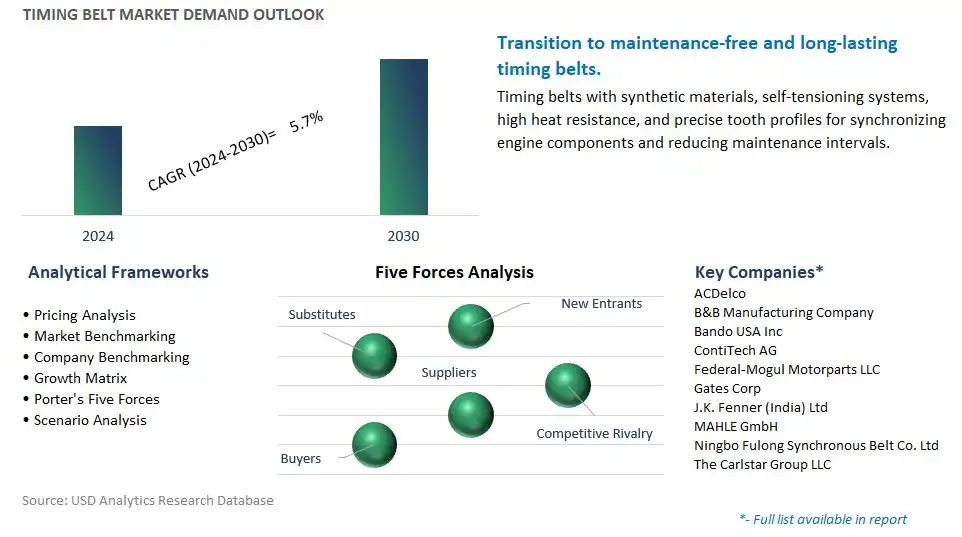
Timing Belt Market is estimated to increase at a growth rate of 5.7% CAGR over the forecast period from 2024 to 2030.
The global Timing Belt Market study analyzes and forecasts the market size across 6 regions and 24 countries for diverse segments including By Type (Belt-in-Oil, Chains, Dry Belts), By Vehicle (Passenger Vehicle, Commercial Vehicle, Hybrid Vehicle), By Component (Tensioner, Idler Pulleys, Timing Shield/Cover, Sprocket).
An Introduction to Global Timing Belt Market, 2024
The timing belt market is witnessing steady growth in 2024, driven by the demand for reliable, low-maintenance engine timing solutions in automotive vehicles. Timing belts, also known as cam belts, are toothed belts that synchronize the rotation of the engine's camshaft and crankshaft, ensuring precise valve timing and efficient engine operation. With the increasing prevalence of interference engines, overhead camshaft designs, and extended service intervals, automakers are adopting timing belt systems as a cost-effective and space-efficient alternative to timing chains for timing drive applications. Moreover, advancements in timing belt materials, such as high-strength synthetic rubbers and aramid fibers, are improving durability, wear resistance, and temperature stability, resulting in longer service life and reduced maintenance requirements for vehicle owners. As vehicle manufacturers and aftermarket suppliers continue to prioritize reliability and durability in engine components, the timing belt market remains a critical segment of the automotive industry, offering solutions that ensure smooth and efficient engine performance for millions of vehicles worldwide.
Timing Belt Competitive Landscape
The global Timing Belt market is highly competitive with a large number of companies focusing on niche market segments. Amidst intense competitive conditions, Timing Belt Companies are investing in new product launches and strengthening distribution channels. Key companies operating in the Timing Belt Market Industry include- ACDelco, B&B Manufacturing Company, Bando USA Inc, ContiTech AG, Federal-Mogul Motorparts LLC, Gates Corp, J.K. Fenner (India) Ltd, MAHLE GmbH, Ningbo Fulong Synchronous Belt Co. Ltd, The Carlstar Group LLC.
Timing Belt Market Trend: Adoption of High-Performance and Long-Lasting Timing Belt Materials
In the Timing Belt Market, a prominent trend is the adoption of high-performance and long-lasting timing belt materials. As automotive manufacturers seek to improve engine performance, durability, and reliability, there is a growing demand for timing belts made from advanced materials such as synthetic rubber compounds, aramid fibers, and high-strength polymers. These materials offer superior resistance to wear, heat, and deformation, resulting in longer service life and reduced maintenance requirements for timing belt systems. Additionally, advancements in material technology enable the development of quieter and more efficient timing belt designs, contributing to improved engine performance and overall vehicle reliability. This trend towards high-performance timing belt materials is driving market growth and innovation in the timing belt segment.
Timing Belt Market Driver: Increasing Automotive Production and Vehicle Fleet Expansion
A key driver propelling the Timing Belt Market is the increasing automotive production and vehicle fleet expansion worldwide. With rising global population, urbanization, and disposable incomes, there is a growing demand for passenger cars, commercial vehicles, and off-highway equipment across various regions. Timing belts are critical components in internal combustion engines, ensuring proper synchronization of engine components and efficient power transmission. As automotive production volumes continue to rise and vehicle fleets expand, the demand for timing belts and related components such as tensioners, idlers, and pulleys is expected to increase proportionally, driving market demand for timing belt systems and aftermarket parts.
Timing Belt Market Opportunity: Integration of Smart Monitoring and Predictive Maintenance Technologies
An opportunity within the Timing Belt Market lies in the integration of smart monitoring and predictive maintenance technologies. As vehicle manufacturers and fleet operators seek to optimize maintenance schedules, minimize downtime, and reduce maintenance costs, there is potential to integrate sensors and IoT (Internet of Things) technology into timing belt systems to enable real-time monitoring of belt condition and performance. Smart sensors embedded in timing belts can collect data on belt tension, wear, and operating conditions, providing insights into the health of the timing belt and allowing for predictive maintenance interventions before belt failure occurs. Additionally, predictive maintenance algorithms can analyze sensor data to forecast potential timing belt failures and recommend proactive maintenance actions, reducing the risk of unexpected breakdowns and costly repairs. By integrating smart monitoring and predictive maintenance technologies into timing belt systems, manufacturers and service providers can offer value-added solutions that enhance vehicle reliability, prolong timing belt service life, and optimize maintenance practices, thereby creating new opportunities for growth and differentiation in the Timing Belt Market.
Timing Belt Market Segmentation
By Type
Belt-in-Oil
Chains
Dry Belts
By Vehicle
Passenger Vehicle
Commercial Vehicle
Hybrid Vehicle
-HEV
-PHEV
By Component
Tensioner
Idler Pulleys
Timing Shield/Cover
SprocketGeographical Analysis
North America (United States, Canada, Mexico)
Europe (Germany, France, United Kingdom, Spain, Italy, Rest of Europe)
Asia Pacific (China, India, Japan, South Korea, Rest of Asia Pacific)
South America (Brazil, Argentina, Rest of South America)
Middle East and Africa (Saudi Arabia, UAE, Rest of Middle East, South Africa, Egypt, Rest of Africa
Timing Belt Companies
ACDelco
B&B Manufacturing Company
Bando USA Inc
ContiTech AG
Federal-Mogul Motorparts LLC
Gates Corp
J.K. Fenner (India) Ltd
MAHLE GmbH
Ningbo Fulong Synchronous Belt Co. Ltd
The Carlstar Group LLC
*- List not Exhaustive
TABLE OF CONTENTS
1 Introduction to 2024 Timing Belt Market
1.1 Market Overview
1.2 Quick Facts
1.3 Scope/Objective of the Study
1.4 Market Definition
1.5 Countries and Regions Analyzed
1.6 Units, Currency, and Conversions
1.7 Industry Value Chain
2 Research Methodology
2.1 Market Size Estimation
2.2 Sources and Research Methodology
2.3 Data Triangulation
2.4 Assumptions and Limitations
3 Executive Summary
3.1 Global Timing Belt Market Size Outlook, $ Million, 2021 to 2030
3.2 Timing Belt Market Outlook by Type, $ Million, 2021 to 2030
3.3 Timing Belt Market Outlook by Product, $ Million, 2021 to 2030
3.4 Timing Belt Market Outlook by Application, $ Million, 2021 to 2030
3.5 Timing Belt Market Outlook by Key Countries, $ Million, 2021 to 2030
4 Market Dynamics
4.1 Key Driving Forces of Timing Belt Industry
4.2 Key Market Trends in Timing Belt Industry
4.3 Potential Opportunities in Timing Belt Industry
4.4 Key Challenges in Timing Belt Industry
5 Market Factor Analysis
5.1 Value Chain Analysis
5.2 Competitive Landscape
5.2.1 Global Timing Belt Market Share by Company (%), 2023
5.2.2 Product Offerings by Company
5.3 Porter’s Five Forces Analysis
5.4 Pricing Analysis and Outlook
6 Growth Outlook Across Scenarios
6.1 Growth Analysis-Case Scenario Definitions
6.2 Low Growth Scenario Forecasts
6.3 Reference Growth Scenario Forecasts
6.4 High Growth Scenario Forecasts
7 Global Timing Belt Market Outlook by Segments
7.1 Timing Belt Market Outlook by Segments, $ Million, 2021- 2030
By Type
Belt-in-Oil
Chains
Dry Belts
By Vehicle
Passenger Vehicle
Commercial Vehicle
Hybrid Vehicle
-HEV
-PHEV
By Component
Tensioner
Idler Pulleys
Timing Shield/Cover
Sprocket
8 North America Timing Belt Market Analysis and Outlook To 2030
8.1 Introduction to North America Timing Belt Markets in 2024
8.2 North America Timing Belt Market Size Outlook by Country, 2021-2030
8.2.1 United States
8.2.2 Canada
8.2.3 Mexico
8.3 North America Timing Belt Market size Outlook by Segments, 2021-2030
By Type
Belt-in-Oil
Chains
Dry Belts
By Vehicle
Passenger Vehicle
Commercial Vehicle
Hybrid Vehicle
-HEV
-PHEV
By Component
Tensioner
Idler Pulleys
Timing Shield/Cover
Sprocket
9 Europe Timing Belt Market Analysis and Outlook To 2030
9.1 Introduction to Europe Timing Belt Markets in 2024
9.2 Europe Timing Belt Market Size Outlook by Country, 2021-2030
9.2.1 Germany
9.2.2 France
9.2.3 Spain
9.2.4 United Kingdom
9.2.4 Italy
9.2.5 Russia
9.2.6 Norway
9.2.7 Rest of Europe
9.3 Europe Timing Belt Market Size Outlook by Segments, 2021-2030
By Type
Belt-in-Oil
Chains
Dry Belts
By Vehicle
Passenger Vehicle
Commercial Vehicle
Hybrid Vehicle
-HEV
-PHEV
By Component
Tensioner
Idler Pulleys
Timing Shield/Cover
Sprocket
10 Asia Pacific Timing Belt Market Analysis and Outlook To 2030
10.1 Introduction to Asia Pacific Timing Belt Markets in 2024
10.2 Asia Pacific Timing Belt Market Size Outlook by Country, 2021-2030
10.2.1 China
10.2.2 India
10.2.3 Japan
10.2.4 South Korea
10.2.5 Indonesia
10.2.6 Malaysia
10.2.7 Australia
10.2.8 Rest of Asia Pacific
10.3 Asia Pacific Timing Belt Market size Outlook by Segments, 2021-2030
By Type
Belt-in-Oil
Chains
Dry Belts
By Vehicle
Passenger Vehicle
Commercial Vehicle
Hybrid Vehicle
-HEV
-PHEV
By Component
Tensioner
Idler Pulleys
Timing Shield/Cover
Sprocket
11 South America Timing Belt Market Analysis and Outlook To 2030
11.1 Introduction to South America Timing Belt Markets in 2024
11.2 South America Timing Belt Market Size Outlook by Country, 2021-2030
11.2.1 Brazil
11.2.2 Argentina
11.2.3 Rest of South America
11.3 South America Timing Belt Market size Outlook by Segments, 2021-2030
By Type
Belt-in-Oil
Chains
Dry Belts
By Vehicle
Passenger Vehicle
Commercial Vehicle
Hybrid Vehicle
-HEV
-PHEV
By Component
Tensioner
Idler Pulleys
Timing Shield/Cover
Sprocket
12 Middle East and Africa Timing Belt Market Analysis and Outlook To 2030
12.1 Introduction to Middle East and Africa Timing Belt Markets in 2024
12.2 Middle East and Africa Timing Belt Market Size Outlook by Country, 2021-2030
12.2.1 Saudi Arabia
12.2.2 UAE
12.2.3 Oman
12.2.4 Rest of Middle East
12.2.5 Egypt
12.2.6 Nigeria
12.2.7 South Africa
12.2.8 Rest of Africa
12.3 Middle East and Africa Timing Belt Market size Outlook by Segments, 2021-2030
By Type
Belt-in-Oil
Chains
Dry Belts
By Vehicle
Passenger Vehicle
Commercial Vehicle
Hybrid Vehicle
-HEV
-PHEV
By Component
Tensioner
Idler Pulleys
Timing Shield/Cover
Sprocket
13 Company Profiles
13.1 Company Snapshot
13.2 SWOT Profiles
13.3 Products and Services
13.4 Recent Developments
13.5 Financial Profile
List of Companies
ACDelco
B&B Manufacturing Company
Bando USA Inc
ContiTech AG
Federal-Mogul Motorparts LLC
Gates Corp
J.K. Fenner (India) Ltd
MAHLE GmbH
Ningbo Fulong Synchronous Belt Co. Ltd
The Carlstar Group LLC
14 Appendix
14.1 Customization Offerings
14.2 Subscription Services
14.3 Related Reports
14.4 Publisher Expertise
By Type
Belt-in-Oil
Chains
Dry Belts
By Vehicle
Passenger Vehicle
Commercial Vehicle
Hybrid Vehicle
-HEV
-PHEV
By Component
Tensioner
Idler Pulleys
Timing Shield/Cover
Sprocket
