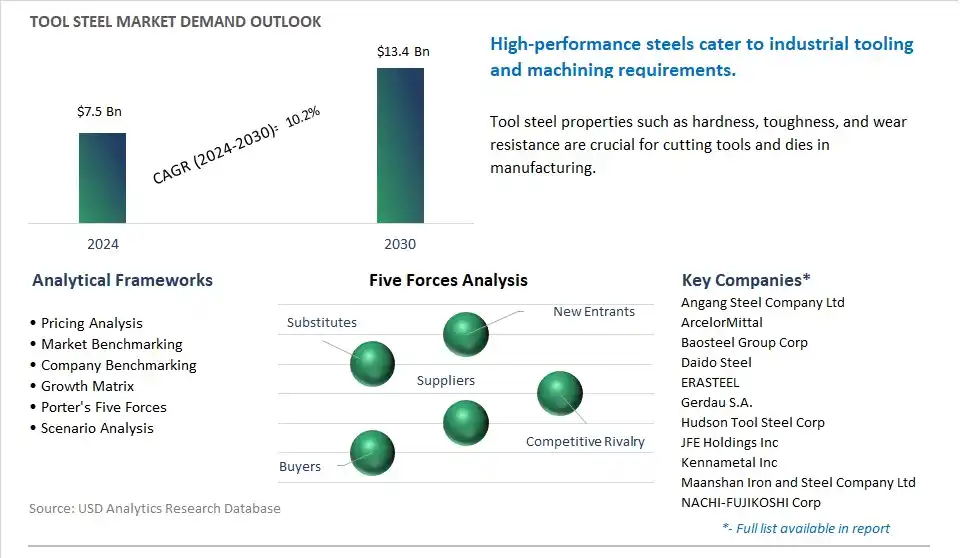
The global Tool Steel Market is poised to register a 10.2% CAGR from $7.5 Billion in 2024 to $13.4 Billion in 2030.
The global Tool Steel Market Study analyzes and forecasts the market size across 6 regions and 24 countries for diverse segments -By Material (Tungsten, Chromium, Vanadium, Molybdenum), By Application (Injection Molding, Die Work, Forging), By Product (Water-Hardening, Cold-Work, Shock-Resisting, High Speed, Hot-Working, Special Purpose), By End-User (General Manufacturing, Automotive, Defence and Aerospace, Electronic and Electrical, Ship Building, Others), By Format (Round Format, Square Format, Others), By Process (Forged, Rolled).
An Introduction to Global Tool Steel Market in 2024
Tool steel is a type of carbon and alloy steel specifically designed for use in making tools, dies, and machine components that require high hardness, wear resistance, and toughness. The future of tool steel is shaped by several key trends, including advancements in metallurgy, manufacturing processes, and applications in industries such as automotive, aerospace, and manufacturing. One significant trend is the development of advanced tool steel grades with improved properties such as hardness, toughness, and machinability, enabling the production of cutting tools, molds, and dies capable of withstanding high-temperature, high-stress operating conditions in modern manufacturing environments. Manufacturers are investing in research and development to engineer tool steels with tailored compositions, microstructures, and heat treatment processes that optimize performance and tool life while reducing production costs and lead times for end-users. Additionally, the integration of additive manufacturing technologies such as selective laser melting (SLM) and powder bed fusion (PBF) is driving innovations in tool steel production, enabling the fabrication of complex tooling geometries, customized tool inserts, and rapid prototyping of tooling solutions for various applications. Moreover, the increasing demand for lightweighting, fuel efficiency, and sustainability in automotive and aerospace industries is driving the adoption of advanced tool steel grades that enable the machining of lightweight materials such as aluminum alloys, titanium, and composites, contributing to improved productivity, cost efficiency, and environmental performance in manufacturing processes. Furthermore, collaborations between tool steel manufacturers, toolmakers, and end-users are driving innovation and market growth by delivering customized tooling solutions that meet the specific performance, reliability, and cost requirements of diverse industries and applications, ensuring continued advancement and adoption of tool steel in the global manufacturing sector.
Tool Steel Market Competitive Landscape
The market report analyses the leading companies in the industry including Angang Steel Company Ltd, ArcelorMittal, Baosteel Group Corp, Daido Steel, ERASTEEL, Gerdau S.A., Hudson Tool Steel Corp, JFE Holdings Inc, Kennametal Inc, Maanshan Iron and Steel Company Ltd, NACHI-FUJIKOSHI Corp, Nippon Steel and Sumitomo Metal Corp, POSCO, Sandvik AB, TATA Steel Ltd, United States Steel, voestalpine High Performance Metals GmbH.
Tool Steel Market Dynamics
Tool Steel Market Trend: Increasing Demand for High-Performance and Customized Tooling Solutions
A prominent market trend in the tool steel industry is the increasing demand for high-performance and customized tooling solutions. As industries such as automotive, aerospace, manufacturing, and construction continue to evolve and demand precision, efficiency, and durability in their production processes, there is a growing need for tool steels that offer superior hardness, wear resistance, and thermal stability. Additionally, with the rise of advanced manufacturing technologies such as additive manufacturing and CNC machining, there is a trend toward custom-designed tooling solutions tailored to specific applications and production requirements. This trend is driven by the pursuit of operational excellence, cost reduction, and product quality improvement across various industrial sectors, driving market demand for advanced tool steel grades and specialty alloys.
Tool Steel Market Driver: Growth in Industrial Manufacturing and Infrastructure Development
A key driver behind the growth of the tool steel market is the growth in industrial manufacturing and infrastructure development worldwide. Tool steels are essential materials used in the production of cutting tools, dies, molds, punches, and other components critical to manufacturing processes in industries such as automotive, machinery, construction, and consumer goods. As global economies expand, urbanization accelerates, and infrastructure projects increase, there is a corresponding demand for tool steels to support manufacturing activities, construction projects, and infrastructure development initiatives. The need for reliable and high-quality tooling solutions to meet production demands, improve productivity, and ensure product quality drives market growth for tool steels as indispensable materials in industrial manufacturing and construction sectors.
Tool Steel Market Opportunity: Innovation in Material Composition and Processing Technologies
An opportunity exists for tool steel manufacturers to innovate in material composition and processing technologies to address evolving market needs and differentiate their product offerings. Manufacturers can explore opportunities to develop advanced tool steel grades with enhanced properties such as higher hardness, improved toughness, and better machinability to meet the demands of modern manufacturing processes. Additionally, there is an opportunity to leverage innovative processing techniques such as powder metallurgy, rapid solidification, and surface coating technologies to improve the performance and longevity of tool steel components in harsh operating conditions. By investing in research and development, collaboration with end-users, and technology partnerships, tool steel manufacturers can capitalize on market opportunities and provide innovative solutions that drive efficiency, reliability, and competitiveness in industrial manufacturing and construction applications.
Tool Steel Market Share Analysis: Chromium generated the highest revenue in 2024
The Chromium segment is the largest in the tool steel market. Chromium is renowned for its exceptional hardness, wear resistance, and corrosion resistance properties, making it an ideal material for a wide range of cutting tools, dies, and molds used in various industries such as automotive, aerospace, and manufacturing. Additionally, chromium-based tool steels exhibit superior heat resistance, retaining their hardness and dimensional stability even at elevated temperatures, which is crucial for maintaining tool integrity during high-speed machining operations. Furthermore, the versatility of chromium alloys allows for the production of a diverse array of tooling applications, ranging from drills and taps to injection molds and stamping dies. As industries continue to demand high-performance tooling solutions capable of withstanding harsh operating conditions and delivering precision performance, the chromium segment of the tool steel market is poised for sustained growth due to its unmatched combination of mechanical properties and versatility.
Tool Steel Market Share Analysis: Injection Molding segment is poised to register the fastest growth rate (CAGR) over the forecast period to 2030
The Injection Molding segment is the fastest-growing segment in the tool steel market. Injection molding has become increasingly prevalent across industries such as automotive, consumer goods, and electronics due to its efficiency in mass-producing complex components with high precision and repeatability. As the demand for lightweight, durable, and intricately designed plastic parts continues to soar, the need for robust and wear-resistant tooling solutions in injection molding processes becomes paramount. Tool steels used in injection molding applications must withstand high temperatures, abrasion, and mechanical stresses associated with the molding process to ensure consistent and high-quality part production. Additionally, advancements in tool steel manufacturing technologies have enabled the development of specialized grades tailored to the unique requirements of injection molding, further driving the growth of this segment. Further, the expansion of industries reliant on injection molding for component manufacturing, coupled with ongoing innovations in materials and processes, will sustain the rapid growth trajectory of the injection molding segment within the tool steel market.
Tool Steel Market Share Analysis: High Speed segment is poised to register the fastest growth rate (CAGR) over the forecast period to 2030
The High-Speed segment is the fastest-growing segment in the tool steel market due to Diverse critical factors. High-speed tool steels are engineered to withstand extreme temperatures and mechanical stresses encountered in high-speed machining operations, such as milling, drilling, and turning. As industries increasingly adopt advanced machining techniques to enhance productivity and precision, the demand for high-speed tooling solutions has surged significantly. High-speed tool steels offer exceptional hardness, wear resistance, and heat resistance properties, enabling them to maintain cutting-edge sharpness and dimensional stability even under intense operating conditions. Additionally, the versatility of high-speed tool steels allows for the fabrication of a wide range of cutting tools used across diverse industries, including aerospace, automotive, and metalworking. As manufacturers prioritize efficiency, accuracy, and cost-effectiveness in their machining processes, the high-speed segment of the tool steel market is poised for rapid and sustained growth, driven by the ever-expanding demand for high-performance cutting tools capable of meeting stringent production requirements.
Tool Steel Market Report Segmentation
By Material
Tungsten
Chromium
Vanadium
Molybdenum
By Application
Injection Molding
Die Work
Forging
By Product
Water-Hardening
Cold-Work
Shock-Resisting
High Speed
Hot-Working
Special Purpose
By End-User
General Manufacturing
Automotive
Defence and Aerospace
Electronic and Electrical
Ship Building
Others
By Format
Round Format
Square Format
Others
By Process
Forged
Rolled
Regions Included
North America (US, Canada, Mexico)
Europe (Germany, UK, France, Spain, Italy, Russia, Rest of Europe)
Asia Pacific (China, India, Japan, South Korea, Australia, South East Asia, Rest of Asia)
South America (Brazil, Argentina, Rest of South America)
Middle East and Africa (Saudi Arabia, UAE, Rest of Middle East, South Africa, Egypt, Rest of Africa)
Tool Steel Companies Profiled in the Market Study
Angang Steel Company Ltd
ArcelorMittal
Baosteel Group Corp
Daido Steel
ERASTEEL
Gerdau S.A.
Hudson Tool Steel Corp
JFE Holdings Inc
Kennametal Inc
Maanshan Iron and Steel Company Ltd
NACHI-FUJIKOSHI Corp
Nippon Steel and Sumitomo Metal Corp
POSCO
Sandvik AB
TATA Steel Ltd
United States Steel
voestalpine High Performance Metals GmbH
*- List Not Exhaustive
TABLE OF CONTENTS
1 Introduction to 2024 Tool Steel Market
1.1 Market Overview
1.2 Quick Facts
1.3 Scope/Objective of the Study
1.4 Market Definition
1.5 Countries and Regions Covered
1.6 Units, Currency, and Conversions
1.7 Industry Value Chain
2 Research Methodology
2.1 Market Size Estimation
2.2 Sources and Research Methodology
2.3 Data Triangulation
2.4 Assumptions and Limitations
3 Executive Summary
3.1 Global Tool Steel Market Size Outlook, $ Million, 2021 to 2030
3.2 Tool Steel Market Outlook by Type, $ Million, 2021 to 2030
3.3 Tool Steel Market Outlook by Product, $ Million, 2021 to 2030
3.4 Tool Steel Market Outlook by Application, $ Million, 2021 to 2030
3.5 Tool Steel Market Outlook by Key Countries, $ Million, 2021 to 2030
4 Market Dynamics
4.1 Key Driving Forces of Tool Steel Industry
4.2 Key Market Trends in Tool Steel Industry
4.3 Potential Opportunities in Tool Steel Industry
4.4 Key Challenges in Tool Steel Industry
5 Market Factor Analysis
5.1 Value Chain Analysis
5.2 Competitive Landscape
5.2.1 Global Tool Steel Market Share by Company (%), 2023
5.2.2 Product Offerings by Company
5.3 Porter’s Five Forces Analysis
5.4 Pricing Analysis and Outlook
6 Growth Outlook Across Scenarios
6.1 Growth Analysis-Case Scenario Definitions
6.2 Low Growth Scenario Forecasts
6.3 Reference Growth Scenario Forecasts
6.4 High Growth Scenario Forecasts
7 Global Tool Steel Market Outlook by Segments
7.1 Tool Steel Market Outlook by Segments, $ Million, 2021- 2030
By Material
Tungsten
Chromium
Vanadium
Molybdenum
By Application
Injection Molding
Die Work
Forging
By Product
Water-Hardening
Cold-Work
Shock-Resisting
High Speed
Hot-Working
Special Purpose
By End-User
General Manufacturing
Automotive
Defence and Aerospace
Electronic and Electrical
Ship Building
Others
By Format
Round Format
Square Format
Others
By Process
Forged
Rolled
8 North America Tool Steel Market Analysis and Outlook To 2030
8.1 Introduction to North America Tool Steel Markets in 2024
8.2 North America Tool Steel Market Size Outlook by Country, 2021-2030
8.2.1 United States
8.2.2 Canada
8.2.3 Mexico
8.3 North America Tool Steel Market size Outlook by Segments, 2021-2030
By Material
Tungsten
Chromium
Vanadium
Molybdenum
By Application
Injection Molding
Die Work
Forging
By Product
Water-Hardening
Cold-Work
Shock-Resisting
High Speed
Hot-Working
Special Purpose
By End-User
General Manufacturing
Automotive
Defence and Aerospace
Electronic and Electrical
Ship Building
Others
By Format
Round Format
Square Format
Others
By Process
Forged
Rolled
9 Europe Tool Steel Market Analysis and Outlook To 2030
9.1 Introduction to Europe Tool Steel Markets in 2024
9.2 Europe Tool Steel Market Size Outlook by Country, 2021-2030
9.2.1 Germany
9.2.2 France
9.2.3 Spain
9.2.4 United Kingdom
9.2.4 Italy
9.2.5 Russia
9.2.6 Norway
9.2.7 Rest of Europe
9.3 Europe Tool Steel Market Size Outlook by Segments, 2021-2030
By Material
Tungsten
Chromium
Vanadium
Molybdenum
By Application
Injection Molding
Die Work
Forging
By Product
Water-Hardening
Cold-Work
Shock-Resisting
High Speed
Hot-Working
Special Purpose
By End-User
General Manufacturing
Automotive
Defence and Aerospace
Electronic and Electrical
Ship Building
Others
By Format
Round Format
Square Format
Others
By Process
Forged
Rolled
10 Asia Pacific Tool Steel Market Analysis and Outlook To 2030
10.1 Introduction to Asia Pacific Tool Steel Markets in 2024
10.2 Asia Pacific Tool Steel Market Size Outlook by Country, 2021-2030
10.2.1 China
10.2.2 India
10.2.3 Japan
10.2.4 South Korea
10.2.5 Indonesia
10.2.6 Malaysia
10.2.7 Australia
10.2.8 Rest of Asia Pacific
10.3 Asia Pacific Tool Steel Market size Outlook by Segments, 2021-2030
By Material
Tungsten
Chromium
Vanadium
Molybdenum
By Application
Injection Molding
Die Work
Forging
By Product
Water-Hardening
Cold-Work
Shock-Resisting
High Speed
Hot-Working
Special Purpose
By End-User
General Manufacturing
Automotive
Defence and Aerospace
Electronic and Electrical
Ship Building
Others
By Format
Round Format
Square Format
Others
By Process
Forged
Rolled
11 South America Tool Steel Market Analysis and Outlook To 2030
11.1 Introduction to South America Tool Steel Markets in 2024
11.2 South America Tool Steel Market Size Outlook by Country, 2021-2030
11.2.1 Brazil
11.2.2 Argentina
11.2.3 Rest of South America
11.3 South America Tool Steel Market size Outlook by Segments, 2021-2030
By Material
Tungsten
Chromium
Vanadium
Molybdenum
By Application
Injection Molding
Die Work
Forging
By Product
Water-Hardening
Cold-Work
Shock-Resisting
High Speed
Hot-Working
Special Purpose
By End-User
General Manufacturing
Automotive
Defence and Aerospace
Electronic and Electrical
Ship Building
Others
By Format
Round Format
Square Format
Others
By Process
Forged
Rolled
12 Middle East and Africa Tool Steel Market Analysis and Outlook To 2030
12.1 Introduction to Middle East and Africa Tool Steel Markets in 2024
12.2 Middle East and Africa Tool Steel Market Size Outlook by Country, 2021-2030
12.2.1 Saudi Arabia
12.2.2 UAE
12.2.3 Oman
12.2.4 Rest of Middle East
12.2.5 Egypt
12.2.6 Nigeria
12.2.7 South Africa
12.2.8 Rest of Africa
12.3 Middle East and Africa Tool Steel Market size Outlook by Segments, 2021-2030
By Material
Tungsten
Chromium
Vanadium
Molybdenum
By Application
Injection Molding
Die Work
Forging
By Product
Water-Hardening
Cold-Work
Shock-Resisting
High Speed
Hot-Working
Special Purpose
By End-User
General Manufacturing
Automotive
Defence and Aerospace
Electronic and Electrical
Ship Building
Others
By Format
Round Format
Square Format
Others
By Process
Forged
Rolled
13 Company Profiles
13.1 Company Snapshot
13.2 SWOT Profiles
13.3 Products and Services
13.4 Recent Developments
13.5 Financial Profile
Angang Steel Company Ltd
ArcelorMittal
Baosteel Group Corp
Daido Steel
ERASTEEL
Gerdau S.A.
Hudson Tool Steel Corp
JFE Holdings Inc
Kennametal Inc
Maanshan Iron and Steel Company Ltd
NACHI-FUJIKOSHI Corp
Nippon Steel and Sumitomo Metal Corp
POSCO
Sandvik AB
TATA Steel Ltd
United States Steel
voestalpine High Performance Metals GmbH
14 Appendix
14.1 Customization Offerings
14.2 Subscription Services
14.3 Related Reports
14.4 Publisher Expertise
By Material
Tungsten
Chromium
Vanadium
Molybdenum
By Application
Injection Molding
Die Work
Forging
By Product
Water-Hardening
Cold-Work
Shock-Resisting
High Speed
Hot-Working
Special Purpose
By End-User
General Manufacturing
Automotive
Defence and Aerospace
Electronic and Electrical
Ship Building
Others
By Format
Round Format
Square Format
Others
By Process
Forged
Rolled
Countries Analyzed
North America (US, Canada, Mexico)
Europe (Germany, UK, France, Spain, Italy, Russia, Rest of Europe)
Asia Pacific (China, India, Japan, South Korea, Australia, South East Asia, Rest of Asia)
South America (Brazil, Argentina, Rest of South America)
Middle East and Africa (Saudi Arabia, UAE, Rest of Middle East, South Africa, Egypt, Rest of Africa)
