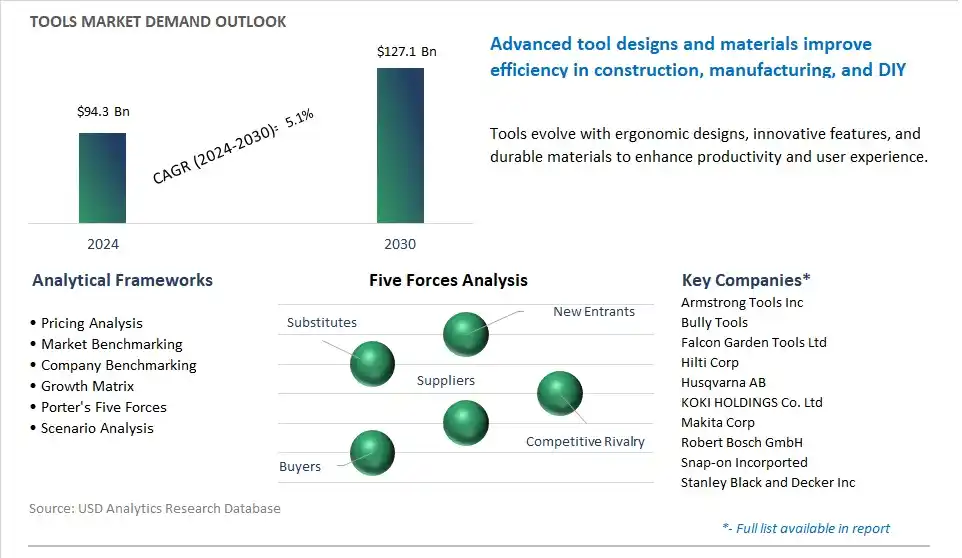
The global Tools Market is poised to register a 5.1% CAGR from $94.3 Billion in 2024 to $127.1 Billion in 2030.
The global Tools Market Study analyzes and forecasts the market size across 6 regions and 24 countries for diverse segments -By Category (Hand Tools, Power Tools ), By Distribution Channel (In-store, Online ), By End-User (DIY, Industrial, Commercial).
An Introduction to Global Tools Market in 2024
Tools are devices or implements used to perform specific tasks, ranging from hand tools such as wrenches and screwdrivers to power tools such as drills and saws, used in construction, manufacturing, and maintenance activities. The future of tools is shaped by several key trends, including advancements in tool design, materials, and ergonomics, as well as digitalization and automation in manufacturing processes. One significant trend is the development of smart tools equipped with sensors, connectivity, and data analytics capabilities, enabling real-time monitoring of tool performance, usage patterns, and predictive maintenance insights to optimize tool life, productivity, and safety in industrial settings. Manufacturers are investing in research and development to integrate IoT (Internet of Things) technologies, RFID (Radio-Frequency Identification) tags, and cloud-based platforms into tooling systems, enabling remote diagnostics, asset tracking, and fleet management functionalities that enhance operational efficiency and cost-effectiveness for tool users and operators. Additionally, the integration of lightweight and high-strength materials such as carbon fiber, titanium, and advanced polymers into tool construction is driving innovations in ergonomic designs, reduced vibration, and fatigue reduction, improving user comfort and productivity in manual and repetitive tasks. Moreover, the increasing demand for precision, speed, and versatility in manufacturing processes is driving the adoption of CNC (Computer Numerical Control) machine tools, robotic automation, and additive manufacturing technologies that enable complex part machining, lights-out production, and rapid prototyping capabilities, transforming the way tools are used and produced in modern industrial environments. Furthermore, collaborations between tool manufacturers, software developers, and end-users are driving innovation and market growth by delivering integrated tooling solutions that meet the specific performance, reliability, and cost requirements of diverse industries and applications, ensuring continued advancement and adoption of tools in the global manufacturing landscape.
Tools Market Competitive Landscape
The market report analyses the leading companies in the industry including Armstrong Tools Inc, Bully Tools, Falcon Garden Tools Ltd, Hilti Corp, Husqvarna AB, KOKI HOLDINGS Co. Ltd, Makita Corp, Robert Bosch GmbH, Snap-on Incorported, Stanley Black and Decker Inc.
Tools Market Dynamics
Tools Market Trend: Digitization and Adoption of Smart Tools in Manufacturing and Construction
A prominent market trend in the tools industry is the digitization and adoption of smart tools in manufacturing and construction. With the advancement of Industry 4.0 technologies, there is a growing demand for tools equipped with sensors, connectivity features, and data analytics capabilities. Smart tools enable real-time monitoring, remote operation, and predictive maintenance, improving efficiency, accuracy, and safety in various industrial applications. Additionally, in the construction sector, there is a trend towards the integration of Building Information Modeling (BIM) technologies with tools, enabling seamless coordination and optimization of construction activities. This trend is driven by the need for automation, productivity enhancement, and cost reduction in manufacturing and construction processes, influencing the development and adoption of smart tools across industries.
Tools Market Driver: Growth in Construction and Infrastructure Development Projects
A key driver behind the growth of the tools market is the growth in construction and infrastructure development projects worldwide. Tools are essential equipment used in construction activities such as excavation, drilling, cutting, fastening, and finishing. With increasing urbanization, population growth, and investments in infrastructure projects, there is a rising demand for tools to support building construction, road construction, utilities installation, and renovation projects. The expansion of residential, commercial, and industrial construction sectors, coupled with government initiatives for infrastructure development, drives market demand for a wide range of hand tools, power tools, and specialized equipment used in construction activities.
Tools Market Opportunity: Development of Ergonomic and Sustainable Tool Designs
An opportunity exists for tool manufacturers to innovate in the development of ergonomic and sustainable tool designs to meet the evolving needs of users and address environmental concerns. Ergonomic designs focus on improving user comfort, safety, and efficiency by reducing strain, fatigue, and injury risk during tool operation. Manufacturers can explore opportunities to incorporate ergonomic features such as cushioned grips, adjustable handles, and lightweight materials into tool designs to enhance user experience and productivity. Additionally, there is opportunity to develop tools with sustainable materials, energy-efficient operation, and recyclability features to reduce environmental impact and promote sustainability in manufacturing and construction processes. By prioritizing ergonomic design principles and sustainability considerations, tool manufacturers can differentiate their products, capture market share, and contribute to the advancement of the tools industry towards more user-friendly and eco-conscious solutions.
Tools Market Share Analysis: Power Tools generated the highest revenue in 2024
The Power Tools segment is the largest in the tools market. Power tools offer enhanced efficiency, productivity, and versatility compared to traditional hand tools, making them indispensable across various industries and applications. With advancements in technology and manufacturing processes, power tools have become increasingly accessible and affordable to consumers and professionals alike. Additionally, the growing trend towards automation and mechanization in industries such as construction, manufacturing, and DIY projects has fueled the demand for power tools. These tools enable faster completion of tasks, increased precision, and reduced manual labor, driving their widespread adoption. Further, innovations such as cordless power tools and smart technology integration further enhance the appeal and utility of power tools, contributing to their dominance in the tools market. As industries continue to prioritize efficiency and productivity, the power tools segment is expected to maintain its position as the largest segment, driven by ongoing technological advancements and evolving consumer preferences.
Tools Market Share Analysis: Online segment is poised to register the fastest growth rate (CAGR) over the forecast period to 2030
The Online segment is the fastest-growing segment in the tools market. The proliferation of e-commerce platforms and digital marketplaces has revolutionized the way consumers purchase tools, offering convenience, accessibility, and a wide range of options at their fingertips. Online channels provide consumers with the flexibility to browse and compare products, read reviews, and make purchases from the comfort of their homes or workplaces. Additionally, the COVID-19 pandemic accelerated the shift towards online shopping as social distancing measures and lockdowns limited in-store retail experiences. Accordingly, consumers increasingly turned to online platforms to fulfill their tool-related needs, driving substantial growth in online tool sales. Further, the ease of transactions, doorstep delivery, and various payment options offered by online retailers further contribute to the appeal of online shopping for tools. As digitalization continues to reshape consumer behavior and preferences, the online segment of the tools market is poised for continued rapid growth, supported by ongoing advancements in e-commerce technology and infrastructure.
Tools Market Share Analysis: DIY segment is poised to register the fastest growth rate (CAGR) over the forecast period to 2030
The DIY segment is the fastest-growing segment in the tools market. With the increasing popularity of home improvement projects, crafting hobbies, and small-scale repairs, DIY enthusiasts represent a significant and expanding consumer base for tools. The rise of online tutorials, social media influencers, and home renovation television shows has inspired more individuals to take on DIY projects, driving demand for a wide range of tools and equipment. Additionally, the COVID-19 pandemic, with its stay-at-home orders and restrictions, led to a surge in DIY activities as people sought productive and engaging ways to spend their time indoors. The accessibility of tools through online platforms and retail stores further fuels the growth of the DIY segment, allowing hobbyists and homeowners to easily acquire the tools they need for their projects. Further, the affordability and availability of entry-level tools catered towards DIY users contribute to the segment's rapid growth. As the trend towards DIY continues to gain momentum, driven by factors like creativity, self-sufficiency, and cost savings, the DIY segment of the tools market is poised for sustained expansion in the foreseeable future.
Tools Market Report Segmentation
By Category
Hand Tools
Power Tools
By Distribution Channel
In-store
Online
By End-User
DIY
Industrial
Commercial
Regions Included
North America (US, Canada, Mexico)
Europe (Germany, UK, France, Spain, Italy, Russia, Rest of Europe)
Asia Pacific (China, India, Japan, South Korea, Australia, South East Asia, Rest of Asia)
South America (Brazil, Argentina, Rest of South America)
Middle East and Africa (Saudi Arabia, UAE, Rest of Middle East, South Africa, Egypt, Rest of Africa)
Tools Companies Profiled in the Market Study
Armstrong Tools Inc
Bully Tools
Falcon Garden Tools Ltd
Hilti Corp
Husqvarna AB
KOKI HOLDINGS Co. Ltd
Makita Corp
Robert Bosch GmbH
Snap-on Incorported
Stanley Black and Decker Inc
*- List Not Exhaustive
TABLE OF CONTENTS
1 Introduction to 2024 Tools Market
1.1 Market Overview
1.2 Quick Facts
1.3 Scope/Objective of the Study
1.4 Market Definition
1.5 Countries and Regions Covered
1.6 Units, Currency, and Conversions
1.7 Industry Value Chain
2 Research Methodology
2.1 Market Size Estimation
2.2 Sources and Research Methodology
2.3 Data Triangulation
2.4 Assumptions and Limitations
3 Executive Summary
3.1 Global Tools Market Size Outlook, $ Million, 2021 to 2030
3.2 Tools Market Outlook by Type, $ Million, 2021 to 2030
3.3 Tools Market Outlook by Product, $ Million, 2021 to 2030
3.4 Tools Market Outlook by Application, $ Million, 2021 to 2030
3.5 Tools Market Outlook by Key Countries, $ Million, 2021 to 2030
4 Market Dynamics
4.1 Key Driving Forces of Tools Industry
4.2 Key Market Trends in Tools Industry
4.3 Potential Opportunities in Tools Industry
4.4 Key Challenges in Tools Industry
5 Market Factor Analysis
5.1 Value Chain Analysis
5.2 Competitive Landscape
5.2.1 Global Tools Market Share by Company (%), 2023
5.2.2 Product Offerings by Company
5.3 Porter’s Five Forces Analysis
5.4 Pricing Analysis and Outlook
6 Growth Outlook Across Scenarios
6.1 Growth Analysis-Case Scenario Definitions
6.2 Low Growth Scenario Forecasts
6.3 Reference Growth Scenario Forecasts
6.4 High Growth Scenario Forecasts
7 Global Tools Market Outlook by Segments
7.1 Tools Market Outlook by Segments, $ Million, 2021- 2030
By Category
Hand Tools
Power Tools
By Distribution Channel
In-store
Online
By End-User
DIY
Industrial
Commercial
8 North America Tools Market Analysis and Outlook To 2030
8.1 Introduction to North America Tools Markets in 2024
8.2 North America Tools Market Size Outlook by Country, 2021-2030
8.2.1 United States
8.2.2 Canada
8.2.3 Mexico
8.3 North America Tools Market size Outlook by Segments, 2021-2030
By Category
Hand Tools
Power Tools
By Distribution Channel
In-store
Online
By End-User
DIY
Industrial
Commercial
9 Europe Tools Market Analysis and Outlook To 2030
9.1 Introduction to Europe Tools Markets in 2024
9.2 Europe Tools Market Size Outlook by Country, 2021-2030
9.2.1 Germany
9.2.2 France
9.2.3 Spain
9.2.4 United Kingdom
9.2.4 Italy
9.2.5 Russia
9.2.6 Norway
9.2.7 Rest of Europe
9.3 Europe Tools Market Size Outlook by Segments, 2021-2030
By Category
Hand Tools
Power Tools
By Distribution Channel
In-store
Online
By End-User
DIY
Industrial
Commercial
10 Asia Pacific Tools Market Analysis and Outlook To 2030
10.1 Introduction to Asia Pacific Tools Markets in 2024
10.2 Asia Pacific Tools Market Size Outlook by Country, 2021-2030
10.2.1 China
10.2.2 India
10.2.3 Japan
10.2.4 South Korea
10.2.5 Indonesia
10.2.6 Malaysia
10.2.7 Australia
10.2.8 Rest of Asia Pacific
10.3 Asia Pacific Tools Market size Outlook by Segments, 2021-2030
By Category
Hand Tools
Power Tools
By Distribution Channel
In-store
Online
By End-User
DIY
Industrial
Commercial
11 South America Tools Market Analysis and Outlook To 2030
11.1 Introduction to South America Tools Markets in 2024
11.2 South America Tools Market Size Outlook by Country, 2021-2030
11.2.1 Brazil
11.2.2 Argentina
11.2.3 Rest of South America
11.3 South America Tools Market size Outlook by Segments, 2021-2030
By Category
Hand Tools
Power Tools
By Distribution Channel
In-store
Online
By End-User
DIY
Industrial
Commercial
12 Middle East and Africa Tools Market Analysis and Outlook To 2030
12.1 Introduction to Middle East and Africa Tools Markets in 2024
12.2 Middle East and Africa Tools Market Size Outlook by Country, 2021-2030
12.2.1 Saudi Arabia
12.2.2 UAE
12.2.3 Oman
12.2.4 Rest of Middle East
12.2.5 Egypt
12.2.6 Nigeria
12.2.7 South Africa
12.2.8 Rest of Africa
12.3 Middle East and Africa Tools Market size Outlook by Segments, 2021-2030
By Category
Hand Tools
Power Tools
By Distribution Channel
In-store
Online
By End-User
DIY
Industrial
Commercial
13 Company Profiles
13.1 Company Snapshot
13.2 SWOT Profiles
13.3 Products and Services
13.4 Recent Developments
13.5 Financial Profile
Armstrong Tools Inc
Bully Tools
Falcon Garden Tools Ltd
Hilti Corp
Husqvarna AB
KOKI HOLDINGS Co. Ltd
Makita Corp
Robert Bosch GmbH
Snap-on Incorported
Stanley Black and Decker Inc
14 Appendix
14.1 Customization Offerings
14.2 Subscription Services
14.3 Related Reports
14.4 Publisher Expertise
By Category
Hand Tools
Power Tools
By Distribution Channel
In-store
Online
By End-User
DIY
Industrial
Commercial
Countries Analyzed
North America (US, Canada, Mexico)
Europe (Germany, UK, France, Spain, Italy, Russia, Rest of Europe)
Asia Pacific (China, India, Japan, South Korea, Australia, South East Asia, Rest of Asia)
South America (Brazil, Argentina, Rest of South America)
Middle East and Africa (Saudi Arabia, UAE, Rest of Middle East, South Africa, Egypt, Rest of Africa)
