
The global Topical Contraceptive Market Comprehensive Study analyzes and forecasts the market size across 6 regions and 24 countries for diverse segments -By Age Group (20 to 35 Years, Above 35 Years), By Distribution Channel (Online, Offline)
The topical contraceptive market in 2024 represents a pivotal intersection of reproductive health, convenience, and innovation. With increasing emphasis on women's autonomy in family planning and sexual health, topical contraceptives offer a non-invasive and discreet alternative to traditional contraceptive methods. These products, ranging from contraceptive patches and gels to foams and films, provide localized hormone delivery to prevent pregnancy effectively. Moreover, advancements in formulation technology aim to improve efficacy, minimize side effects, and enhance user experience, fostering greater acceptance and usage. As the global demand for accessible and customizable birth control options grows, the topical contraceptive market is expected to witness sustained growth, supported by ongoing research and development efforts to expand product offerings and address unmet needs in contraceptive care.
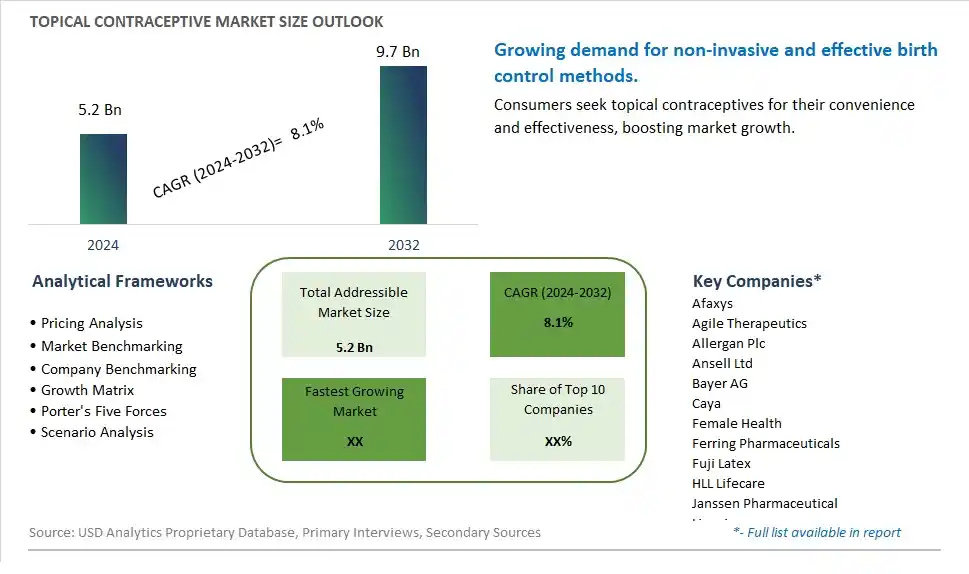
The market report analyses the leading companies in the industry including Afaxys, Agile Therapeutics, Allergan Plc, Ansell Ltd, Bayer AG, Caya, Female Health, Ferring Pharmaceuticals, Fuji Latex, HLL Lifecare, Janssen Pharmaceutical, Lipocine, Lupin Ltd, Mayer Laboratories, Merck KGaA, Mylan NV, Okamoto Industries, Pfizer Inc, Reckitt Benckiser Group Plc, Syzygy Healthcare, Teva Pharmaceuticals, and Others.
One prominent market trend in the topical contraceptive industry is the increasing preference for non-hormonal contraceptive options. As awareness of hormonal contraceptive side effects and concerns about long-term usage grow, consumers are seeking alternative methods for birth control. Non-hormonal topical contraceptives, such as barrier methods like spermicides, foams, gels, and films, are gaining popularity due to their effectiveness and perceived safety. This trend is driven by a desire for more natural and non-invasive contraceptive solutions that offer reliable protection against unintended pregnancies without the potential hormonal side effects. Manufacturers are responding to this trend by innovating and developing new formulations of non-hormonal topical contraceptives to meet the evolving needs and preferences of consumers seeking hormone-free birth control options.
A key market driver for topical contraceptives is the rising awareness of reproductive health and family planning among individuals and communities worldwide. As access to information about sexual and reproductive health improves through education initiatives, social media, and healthcare providers, more people are taking proactive steps to manage their fertility and prevent unplanned pregnancies. The increasing emphasis on family planning and responsible sexual behavior is driving the demand for accessible and effective contraceptive methods, including topical contraceptives. Moreover, government-led initiatives, public health campaigns, and partnerships with non-profit organizations are promoting the importance of contraception and empowering individuals to make informed choices about their reproductive health, contributing to the growth of the topical contraceptive market.
An opportunity for the topical contraceptive market lies in innovation in delivery systems and formulations to enhance user experience and efficacy. Manufacturers have the opportunity to develop advanced formulations of topical contraceptives that offer improved convenience, ease of use, and effectiveness. Innovations such as novel applicator designs, microbicide technologies, and sustained-release formulations can enhance product performance and user satisfaction. Furthermore, there is potential for the integration of digital health technologies, such as smartphone apps and connected devices, to provide real-time feedback and support for contraceptive users. By investing in research and development to create innovative delivery systems and formulations, companies can address unmet needs in the market, expand product offerings, and capture a larger share of the growing topical contraceptive segment.
In the Topical Contraceptive Market segmented by age groups, the 20 to 35 Years category is the largest segment. This dominance is primarily due to the higher prevalence of contraceptive use among individuals within this age range who are typically sexually active and in their reproductive years. Young adults aged 20 to 35 are more to prioritize family planning and contraception to prevent unintended pregnancies while pursuing education, career goals, or establishing stable relationships. Additionally, this demographic often seeks convenient and discreet contraceptive options, making topical contraceptives such as condoms and spermicides popular choices. Further, awareness campaigns and educational initiatives targeting this age group contribute to increased contraceptive usage, further solidifying their prominence as the largest segment in the topical contraceptive market. As a result, pharmaceutical companies focus on developing and marketing topical contraceptive products tailored to the needs and preferences of individuals aged 20 to 35, maintaining the dominance of this segment in the market.
In the Topical Contraceptive Market segmented by distribution channels, the Online category is the fastest-growing segment. This rapid growth is primarily driven by the increasing trend of consumers purchasing healthcare products, including contraceptives, through online channels. Online platforms offer convenience, privacy, and a wide range of product options, making them an attractive choice for individuals seeking discreet access to contraceptives. Additionally, the COVID-19 pandemic has accelerated the shift towards e-commerce as consumers prioritize safety and social distancing measures. Further, online channels provide opportunities for pharmaceutical companies to reach a broader audience, implement targeted marketing strategies, and offer competitive pricing, further fueling the growth of the online segment in the topical contraceptive market. As a result, companies are investing in expanding their online presence, optimizing digital marketing efforts, and ensuring secure and efficient delivery systems to capitalize on the burgeoning demand for topical contraceptives through online channels.
By Age Group
20 to 35 Years
Above 35 Years
By Distribution Channel
Online
Offline
Countries Analyzed
North America (US, Canada, Mexico)
Europe (Germany, UK, France, Spain, Italy, Russia, Rest of Europe)
Asia Pacific (China, India, Japan, South Korea, Australia, South East Asia, Rest of Asia)
South America (Brazil, Argentina, Rest of South America)
Middle East and Africa (Saudi Arabia, UAE, Rest of Middle East, South Africa, Egypt, Rest of Africa)
Afaxys
Agile Therapeutics
Allergan Plc
Ansell Ltd
Bayer AG
Caya
Female Health
Ferring Pharmaceuticals
Fuji Latex
HLL Lifecare
Janssen Pharmaceutical
Lipocine
Lupin Ltd
Mayer Laboratories
Merck KGaA
Mylan NV
Okamoto Industries
Pfizer Inc
Reckitt Benckiser Group Plc
Syzygy Healthcare
Teva Pharmaceuticals
*- List Not Exhaustive
Chapter 1. TABLE OF CONTENTS
Chapter 2. Introduction to Topical Contraceptive Market
2.1. Market Overview
2.2. Key Statistics and Report Highlights
2.3. Scope of the Comprehensive Study
2.3.1. Market Definition
2.3.2 Countries and Regions Covered
2.3.3 Research Objective
2.3.4 Units, Currency, and Conversions
2.3.5 Industry Value Chain
2.4. Key Market Segments
2.5. Key Companies
2.6. Study Period
Chapter 3. Strategic Analysis Review
3.1. Topical Contraceptive Pricing Analysis and Forecast
3.2. Porter’s Five Forces
3.3. Market Ecosystem
3.4. SWOT Analysis
3.5. Regulatory Scenario
3.3. Effects of Inflation, Russia-Ukraine War, moderating economic growth, and other macroeconomic factors
Chapter 4. Competitive Landscape
4.1. Market Share Analysis
4.1.1. Global Topical Contraceptive Market Share by Company, 2023
4.1.2. Product Offerings of Leading Topical Contraceptive Companies
4.2. Market Entropy
4.2.1. New Product Launches in the Industry
4.2.2. Mergers, Acquisitions, Joint ventures, and Partnerships
4.3. Key Strategies and Best Practices
Chapter 5. Global Market Projections: Best, Reference, and Low Case Scenarios
5.1. Growth Analysis- Case Scenario Definitions
5.2. Low Growth Case Scenario Forecasts
5.3. Reference Growth Case Scenario Forecasts
5.4. High Growth Case Scenario Forecasts
Chapter 6. Market Dynamics
6.1. Topical Contraceptive Market Drivers
6.2. Topical Contraceptive Market Challenges
6.6. Topical Contraceptive Market Opportunities
6.4. Topical Contraceptive Market Trends
Chapter 7. Global Topical Contraceptive Market Outlook Trends
7.1. Global Topical Contraceptive Revenue (USD Million) and CAGR (%) by Type (2021-2032)
7.2. Global Topical Contraceptive Revenue (USD Million) and CAGR (%) by Application (2021-2032)
7.3. Global Topical Contraceptive Revenue (USD Million) and CAGR (%) by Product (2021-2032)
By Age Group
20 to 35 Years
Above 35 Years
By Distribution Channel
Online
Offline
Chapter 8. Global Topical Contraceptive Regional Analysis and Outlook
8.1. Global Topical Contraceptive Revenue (USD Million) By Regions (2021- 2032)
8.2. North America Topical Contraceptive Revenue (USD Million) by Country (2021-2032)
8.2.1. United States Topical Contraceptive Regional Analysis and Outlook
8.2.2. Canada Topical Contraceptive Regional Analysis and Outlook
8.2.3. Mexico Topical Contraceptive Regional Analysis and Outlook
8.3. Europe Topical Contraceptive Revenue (USD Million), by Country (2021-2032)
8.3.1. Germany Topical Contraceptive Regional Analysis and Outlook
8.3.2. France Topical Contraceptive Regional Analysis and Outlook
8.3.3. United Kingdom Topical Contraceptive Regional Analysis and Outlook
8.3.4. Spain Topical Contraceptive Regional Analysis and Outlook
8.3.5. Italy Topical Contraceptive Regional Analysis and Outlook
8.3.6. Russia Topical Contraceptive Regional Analysis and Outlook
8.3.7. Rest of Europe Topical Contraceptive Regional Analysis and Outlook
8.4. Asia Pacific Topical Contraceptive Revenue (USD Million) by Country (2021-2032)
8.4.1. China Topical Contraceptive Regional Analysis and Outlook
8.4.2. Japan Topical Contraceptive Regional Analysis and Outlook
8.4.3. India Topical Contraceptive Regional Analysis and Outlook
8.4.4. South Korea Topical Contraceptive Regional Analysis and Outlook
8.4.5. Australia Topical Contraceptive Regional Analysis and Outlook
8.4.6. South East Asia Topical Contraceptive Regional Analysis and Outlook
8.4.7. Rest of Asia Pacific Topical Contraceptive Regional Analysis and Outlook
8.5. South America Topical Contraceptive Revenue (USD Million), by Country (2021-2032)
8.5.1. Brazil Topical Contraceptive Regional Analysis and Outlook
8.5.2. Argentina Topical Contraceptive Regional Analysis and Outlook
8.5.3. Rest of South America Topical Contraceptive Regional Analysis and Outlook
8.6. Middle East and Africa Topical Contraceptive Revenue (USD Million) by Country (2021-2032)
8.6.1. Middle East Topical Contraceptive Regional Analysis and Outlook
8.6.2. Africa Topical Contraceptive Regional Analysis and Outlook
Chapter 9. North America Topical Contraceptive Analysis and Outlook
9.1. North America Topical Contraceptive Revenue (USD Million) by Segments (2021-2032)
9.1.1. North America Topical Contraceptive Revenue (USD Million) by Type (2021-2032)
9.1.2. North America Topical Contraceptive Revenue (USD Million) by Application (2021-2032)
9.1.3. North America Topical Contraceptive Revenue (USD Million) by Product (2021-2032)
By Age Group
20 to 35 Years
Above 35 Years
By Distribution Channel
Online
Offline
Chapter 10. Europe Topical Contraceptive Analysis and Outlook
10.1. Europe Topical Contraceptive Revenue (USD Million), by Segments (USD Million) (2021-2032)
10.1.1. Europe Topical Contraceptive Revenue (USD Million) by Type (2021-2032)
10.1.2. Europe Topical Contraceptive Revenue (USD Million) by Application (2021-2032)
10.1.3. Europe Topical Contraceptive Revenue (USD Million) by Product (2021-2032)
By Age Group
20 to 35 Years
Above 35 Years
By Distribution Channel
Online
Offline
Chapter 11. Asia Pacific Topical Contraceptive Analysis and Outlook
11.1. Asia Pacific Topical Contraceptive Revenue (USD Million), and Revenue (USD Million) by Segments (2021-2032)
11.1.1. Asia Pacific Topical Contraceptive Revenue (USD Million) by Type (2021-2032)
11.1.2. Asia Pacific Topical Contraceptive Revenue (USD Million) by Application (2021-2032)
11.1.3. Asia Pacific Topical Contraceptive Revenue (USD Million) by Product (2021-2032)
By Age Group
20 to 35 Years
Above 35 Years
By Distribution Channel
Online
Offline
Chapter 12. South America Topical Contraceptive Analysis and Outlook
12.1. South America Topical Contraceptive Revenue (USD Million), by Segments (2021-2032)
12.1.1. South America Topical Contraceptive Revenue (USD Million) by Type (2021-2032)
12.1.2. South America Topical Contraceptive Revenue (USD Million) by Application (2021-2032)
12.1.3. South America Topical Contraceptive Revenue (USD Million) by Product (2021-2032)
By Age Group
20 to 35 Years
Above 35 Years
By Distribution Channel
Online
Offline
Chapter 13. Middle East and Africa Topical Contraceptive Analysis and Outlook
13.1. Middle East and Africa Topical Contraceptive Revenue (USD Million), by Segments (2021-2032)
13.1.1. Middle East and Africa Topical Contraceptive Revenue (USD Million) by Type (2021-2032)
13.1.2. Middle East and Africa Topical Contraceptive Revenue (USD Million) by Application (2021-2032)
13.1.3. Middle East and Africa Topical Contraceptive Revenue (USD Million) by Product (2021-2032)
By Age Group
20 to 35 Years
Above 35 Years
By Distribution Channel
Online
Offline
Chapter 14. Topical Contraceptive Company Profiles
14.1 Business Overview
14.2 Product Profiles
14.3 SWOT Profiles
14.5 Recent Developments
14.6 Financial Profile
List of Companies
Afaxys
Agile Therapeutics
Allergan Plc
Ansell Ltd
Bayer AG
Caya
Female Health
Ferring Pharmaceuticals
Fuji Latex
HLL Lifecare
Janssen Pharmaceutical
Lipocine
Lupin Ltd
Mayer Laboratories
Merck KGaA
Mylan NV
Okamoto Industries
Pfizer Inc
Reckitt Benckiser Group Plc
Syzygy Healthcare
Teva Pharmaceuticals
15. Methodology and Data Sources
15.1 Customization Offerings
15.2 Subscription Services
15.3 Related Reports
15.4 Publisher Expertise
LIST OF TABLES
Table 1 Market Segmentation Analysis
Table 2 Global Topical Contraceptive Market Share of Leading Companies, 2023
Table 3 Product Offerings of Leading Companies
Table 4 Low Growth Scenario Forecasts
Table 5 Reference Case Growth Scenario
Table 6 High Growth Case Scenario
Table 7 Global Topical Contraceptive Revenue (USD Million) And CAGR (%) By Type (2021-2032)
Table 8 Global Topical Contraceptive Revenue (USD Million) And CAGR (%) By Application (2021-2032)
Table 9 Global Topical Contraceptive Revenue (USD Million) And CAGR (%) By Product (2021-2032)
Table 10 Global Topical Contraceptive Market Revenue (USD Million) By Regions (2021-2032)
Table 11 Global Topical Contraceptive Market Share (%) By Regions (2021-2032)
Table 12 North America Topical Contraceptive Revenue (USD Million) By Country (2021-2032)
Table 13 Europe Topical Contraceptive Revenue (USD Million) By Country (2021-2032)
Table 14 Asia Pacific Topical Contraceptive Revenue (USD Million) By Country (2021-2032)
Table 15 South America Topical Contraceptive Revenue (USD Million) By Country (2021-2032)
Table 16 Middle East and Africa Topical Contraceptive Revenue (USD Million) By Region (2021-2032)
Table 17 North America Topical Contraceptive Revenue (USD Million) By Type (2021-2032)
Table 18 North America Topical Contraceptive Revenue (USD Million) By Application (2021-2032)
Table 19 North America Topical Contraceptive Revenue (USD Million) By Product (2021-2032)
Table 20 Europe Topical Contraceptive Revenue (USD Million) By Type (2021-2032)
Table 21 Europe Topical Contraceptive Revenue (USD Million) By Application (2021-2032)
Table 22 Europe Topical Contraceptive Revenue (USD Million) By Product (2021-2032)
Table 23 Asia Pacific Topical Contraceptive Revenue (USD Million) By Type (2021-2032)
Table 24 Asia Pacific Topical Contraceptive Revenue (USD Million) By Application (2021-2032)
Table 25 Asia Pacific Topical Contraceptive Revenue (USD Million) By Product (2021-2032)
Table 26 South America Topical Contraceptive Revenue (USD Million) By Type (2021-2032)
Table 27 South America Topical Contraceptive Revenue (USD Million) By Application (2021-2032)
Table 28 South America Topical Contraceptive Revenue (USD Million) By Product (2021-2032)
Table 29 Middle East and Africa Topical Contraceptive Revenue (USD Million) By Type (2021-2032)
Table 30 Middle East and Africa Topical Contraceptive Revenue (USD Million) By Application (2021-2032)
Table 31 Middle East and Africa Topical Contraceptive Revenue (USD Million) By Product (2021-2032)
LIST OF FIGURES
Figure 1. Market Scope
Figure 2. Pricing Forecasts Per Unit, 2023- 2032
Figure 3. Porter’s Five Forces
Figure 4. Global Topical Contraceptive Market Revenue (USD Million) By Regions (2021-2032)
Figure 5. Global Topical Contraceptive Market Share (%) By Regions (2023)
Figure 6. North America Topical Contraceptive Revenue (USD Million) By Country (2021-2032)
Figure 7. United States Topical Contraceptive Revenue (USD Million) By Country (2021-2032)
Figure 8. Canada Topical Contraceptive Revenue (USD Million) By Country (2021-2032)
Figure 9. Mexico Topical Contraceptive Revenue (USD Million) By Country (2021-2032)
Figure 10. Europe Topical Contraceptive Revenue (USD Million) By Country (2021-2032)
Figure 11. Germany Topical Contraceptive Revenue (USD Million) By Country (2021-2032)
Figure 12. France Topical Contraceptive Revenue (USD Million) By Country (2021-2032)
Figure 13. United Kingdom Topical Contraceptive Revenue (USD Million) By Country (2021-2032)
Figure 14. Spain Topical Contraceptive Revenue (USD Million) By Country (2021-2032)
Figure 15. Italy Topical Contraceptive Revenue (USD Million) By Country (2021-2032)
Figure 16. Russia Topical Contraceptive Revenue (USD Million) By Country (2021-2032)
Figure 17. Rest of Europe Topical Contraceptive Revenue (USD Million) By Country (2021-2032)
Figure 11. Asia Pacific Topical Contraceptive Revenue (USD Million) By Country (2021-2032)
Figure 12. China Topical Contraceptive Revenue (USD Million) By Country (2021-2032)
Figure 13. Japan Topical Contraceptive Revenue (USD Million) By Country (2021-2032)
Figure 14. India Topical Contraceptive Revenue (USD Million) By Country (2021-2032)
Figure 15. South Korea Topical Contraceptive Revenue (USD Million) By Country (2021-2032)
Figure 16. Australia Topical Contraceptive Revenue (USD Million) By Country (2021-2032)
Figure 17. South East Asia Topical Contraceptive Revenue (USD Million) By Country (2021-2032)
Figure 18. South America Topical Contraceptive Revenue (USD Million) By Country (2021-2032)
Figure 19. Brazil Topical Contraceptive Revenue (USD Million) By Country (2021-2032)
Figure 20. Argentina Topical Contraceptive Revenue (USD Million) By Country (2021-2032)
Figure 21. Rest of Asia Pacific Topical Contraceptive Revenue (USD Million) By Country (2021-2032)
Figure 22. Middle East and Africa Topical Contraceptive Revenue (USD Million) By Region (2021-2032)
Figure 23. Saudi Arabia Topical Contraceptive Revenue (USD Million) By Region (2021-2032)
Figure 24. The UAE Topical Contraceptive Revenue (USD Million) By Region (2021-2032)
Figure 25. Rest of Middle East Topical Contraceptive Revenue (USD Million) By Region (2021-2032)
Figure 26. South Africa Topical Contraceptive Revenue (USD Million) By Region (2021-2032)
Figure 27. Africa Topical Contraceptive Revenue (USD Million) By Region (2021-2032)
Figure 28. North America Topical Contraceptive Revenue (USD Million) By Type (2021-2032)
Figure 29. North America Topical Contraceptive Revenue (USD Million) By Application (2021-2032)
Figure 30. North America Topical Contraceptive Revenue (USD Million) By Product (2021-2032)
Figure 31. Europe Topical Contraceptive Revenue (USD Million) By Type (2021-2032)
Figure 32. Europe Topical Contraceptive Revenue (USD Million) By Application (2021-2032)
Figure 33. Europe Topical Contraceptive Revenue (USD Million) By Product (2021-2032)
Figure 34. Asia Pacific Topical Contraceptive Revenue (USD Million) By Type (2021-2032)
Figure 35. Asia Pacific Topical Contraceptive Revenue (USD Million) By Application (2021-2032)
Figure 36. Asia Pacific Topical Contraceptive Revenue (USD Million) By Product (2021-2032)
Figure 37. South America Topical Contraceptive Revenue (USD Million) By Type (2021-2032)
Figure 38. South America Topical Contraceptive Revenue (USD Million) By Application (2021-2032)
Figure 39. South America Topical Contraceptive Revenue (USD Million) By Product (2021-2032)
Figure 40. Middle East and Africa Topical Contraceptive Revenue (USD Million) By Type (2021-2032)
Figure 41. Middle East and Africa Topical Contraceptive Revenue (USD Million) By Application (2021-2032)
Figure 42. Middle East and Africa Topical Contraceptive Revenue (USD Million) By Product (2021-2032)
By Age Group
20 to 35 Years
Above 35 Years
By Distribution Channel
Online
Offline
Countries Analyzed
North America (US, Canada, Mexico)
Europe (Germany, UK, France, Spain, Italy, Russia, Rest of Europe)
Asia Pacific (China, India, Japan, South Korea, Australia, South East Asia, Rest of Asia)
South America (Brazil, Argentina, Rest of South America)
Middle East and Africa (Saudi Arabia, UAE, Rest of Middle East, South Africa, Egypt, Rest of Africa)
Global Topical Contraceptive Market Size is valued at $5.2 Billion in 2024 and is forecast to register a growth rate (CAGR) of 8.1% to reach $9.7 Billion by 2032.
Emerging Markets across Asia Pacific, Europe, and Americas present robust growth prospects.
Afaxys, Agile Therapeutics, Allergan Plc, Ansell Ltd, Bayer AG, Caya, Female Health, Ferring Pharmaceuticals, Fuji Latex, HLL Lifecare, Janssen Pharmaceutical, Lipocine, Lupin Ltd, Mayer Laboratories, Merck KGaA, Mylan NV, Okamoto Industries, Pfizer Inc, Reckitt Benckiser Group Plc, Syzygy Healthcare, Teva Pharmaceuticals
Base Year- 2023; Estimated Year- 2024; Historic Period- 2018-2023; Forecast period- 2024 to 2032; Currency: Revenue (USD); Volume