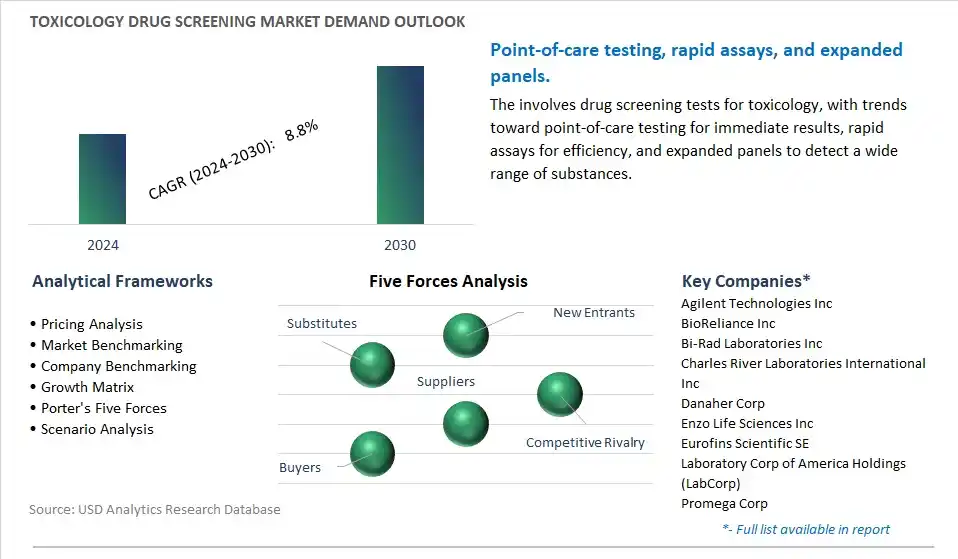
Toxicology Drug Screening Market is estimated to increase at a Compounded Annual Growth Rate of 8.8% CAGR over the forecast period from 2024 to 2030
The Toxicology Drug Screening Market study analyzes and forecasts the market size across 6 regions and 24 countries for diverse segments- By Type (In Vitro, In Vivo, In Silico), By Product (Instruments, Reagents and Consumables, Animal Models, Software, Others), By Application (Immunotoxicity, Systemictoxicity, Developmental and Reproductive Toxicity (DART), Endocrine Disruption, Others).
An Introduction to Toxicology Drug Screening Market in 2024
In 2024, the market for toxicology drug screening continues to be essential in clinical and forensic settings, providing accurate and reliable testing for the detection of drugs and toxic substances in biological specimens such as urine, blood, and saliva. Toxicology drug screening assays are used for various purposes, including workplace drug testing, drug abuse monitoring, and overdose management, as well as forensic investigations and legal proceedings. With advancements in analytical methodologies, sample preparation techniques, and detection technologies, toxicology screening assays offer increased sensitivity, specificity, and throughput for the detection of a broad range of drugs of abuse, pharmaceuticals, and environmental toxins. Moreover, the market is influenced by trends such as the development of multi-panel immunoassay kits for simultaneous detection of multiple drug classes, the integration of mass spectrometry and chromatography techniques for confirmatory testing and quantitation, and the customization of screening panels and cutoff levels for different testing scenarios and populations. Additionally, ongoing research focuses on expanding the scope of toxicology screening to include emerging drugs and designer compounds, improving sample stability and storage conditions, and implementing quality assurance measures to ensure reliable test results and compliance with regulatory requirements, reflecting the continuous innovation and improvement in toxicology drug screening technology to address the evolving challenges of substance abuse and public health.
Market Trend: Increasing Demand for Workplace and Drug Rehabilitation Screening
One prominent market trend in toxicology drug screening is the increasing demand for workplace and drug rehabilitation screening. With rising concerns about substance abuse in the workplace and the opioid epidemic, employers, healthcare providers, and rehabilitation centers are increasingly turning to toxicology drug screening to ensure workplace safety, monitor patient compliance, and support addiction treatment programs. Toxicology drug screening plays a critical role in detecting the presence of drugs or their metabolites in biological samples such as urine, blood, or saliva, enabling timely intervention, treatment planning, and support services for individuals affected by substance use disorders. The trend towards increased workplace and drug rehabilitation screening reflects a growing recognition of the importance of identifying and addressing substance abuse issues in various settings to promote public health and safety.
Market Driver: Stringent Regulatory Requirements and Workplace Safety Concerns
A significant market driver for toxicology drug screening is the stringent regulatory requirements and workplace safety concerns. Regulatory agencies and industry standards mandate drug screening programs in certain industries such as transportation, healthcare, and law enforcement to ensure public safety and compliance with legal requirements. Employers also implement drug screening policies to mitigate risks associated with impaired performance, accidents, and liability issues in the workplace. Additionally, healthcare providers rely on toxicology drug screening to monitor medication adherence, detect drug misuse, and ensure patient safety in clinical settings. The need to comply with regulatory mandates, maintain workplace safety, and uphold standards of care drives the demand for toxicology drug screening services and products as essential tools for drug detection and prevention.
Market Opportunity: Expansion into Point-of-Care and Mobile Testing Solutions
One potential opportunity in the toxicology drug screening market lies in the expansion into point-of-care and mobile testing solutions. While traditional laboratory-based drug screening methods offer high sensitivity and accuracy, there is a growing demand for rapid, convenient, and on-site testing options that can deliver timely results in various settings. Point-of-care and mobile testing solutions offer advantages such as rapid turnaround times, reduced logistical challenges, and increased accessibility, making them well-suited for applications such as workplace testing, roadside screening, and community outreach programs. By developing innovative point-of-care devices, handheld analyzers, or smartphone-based testing platforms, manufacturers can capitalize on this opportunity to meet the evolving needs of customers for portable, user-friendly, and cost-effective toxicology drug screening solutions.
Toxicology Drug Screening Market Share Analysis: In Vitro Testing
In the Toxicology Drug Screening Market, the type segment of In Vitro Testing is experiencing rapid growth. In vitro testing involves the use of laboratory-based techniques to evaluate the toxicity of chemical substances on biological systems, such as cells, tissues, or isolated organs, outside of a living organism. In vitro assays offer several advantages over in vivo and in silico testing methods, including cost-effectiveness, high throughput capabilities, and reduced ethical concerns associated with animal testing. As regulatory agencies increasingly advocate for alternative testing methods to assess the safety and toxicity of drugs and chemical compounds, there has been a significant surge in demand for in vitro toxicology screening assays. These assays are utilized across various stages of drug development and safety assessment, including preclinical research, toxicity screening, and regulatory submissions. Additionally, advancements in cell culture techniques, automation, and high-content screening technologies have further propelled the adoption of in vitro testing methods in toxicology drug screening. Immunotoxicity, systemic toxicity, developmental and reproductive toxicity (DART), and endocrine disruption are among the key applications of in vitro toxicology screening assays, reflecting their utility in assessing different aspects of chemical toxicity. As the pharmaceutical and chemical industries continue to prioritize safety assessment and regulatory compliance, the market for in vitro toxicology screening assays is expected to maintain its rapid growth trajectory. Ongoing research efforts focused on improving assay predictivity, reproducibility, and relevance to human biology further contribute to market expansion in this segment.
Toxicology Drug Screening Competitive Analysis
The market research study provides in-depth insights into leading companies including the SWOT analyses, product profile, financial details, and recent developments acrossAgilent Technologies Inc, BioReliance Inc, Bi-Rad Laboratories Inc, Charles River Laboratories International Inc, Danaher Corp, Enzo Life Sciences Inc, Eurofins Scientific SE, Laboratory Corp of America Holdings (LabCorp), Promega Corp, The Jackson Laboratory, Thermo Fisher Scientific Inc, WuXi AppTec Co. Ltd
Toxicology Drug Screening Market Segmentation
By Type
In Vitro
In Vivo
In Silico
By Product
Instruments
Reagents and Consumables
Animal Models
Software
Others
By Application
Immunotoxicity
Systemictoxicity
Developmental and Reproductive Toxicity (DART)
Endocrine Disruption
Others
Geographical Analysis
North America (United States, Canada, Mexico)
Europe (Germany, France, United Kingdom, Spain, Italy, Rest of Europe)
Asia Pacific (China, India, Japan, South Korea, Rest of Asia Pacific)
South America (Brazil, Argentina, Rest of South America)
Middle East and Africa (Saudi Arabia, UAE, Rest of Middle East, South Africa, Egypt, Rest of Africa)
Toxicology Drug Screening Market Companies
Agilent Technologies Inc
BioReliance Inc
Bi-Rad Laboratories Inc
Charles River Laboratories International Inc
Danaher Corp
Enzo Life Sciences Inc
Eurofins Scientific SE
Laboratory Corp of America Holdings (LabCorp)
Promega Corp
The Jackson Laboratory
Thermo Fisher Scientific Inc
WuXi AppTec Co. Ltd
Reasons to Buy the Toxicology Drug Screening Market Study
• Deepen your industry insights and navigate uncertainties for strategy formulation, CAPEX, and Operational decisions
• Gain access to detailed insights on the Toxicology Drug Screening Market, encompassing current market size, growth trends, and forecasts till 2030.
• Access detailed competitor analysis, enabling competitive advantage through a thorough understanding of market players, strategies, and potential differentiation opportunities
• Stay ahead of the curve with insights on technological advancements, innovations, and upcoming trends
• Identify lucrative investment avenues and expansion opportunities within the Toxicology Drug Screening Market industry, guided by robust, data-backed analysis.
• Understand regional and global markets through country-wise analysis, regional market potential, regulatory nuances, and dynamics
• Execute strategies with confidence and speed through information, analytics, and insights on the industry value chain
• Corporate leaders, strategists, financial experts, shareholders, asset managers, and governmental representatives can make long-term planning scenarios and build an integrated and timely understanding of market dynamics
• Benefit from tailored solutions and expert consultation based on report insights, providing personalized strategies aligned with specific business needs.
TABLE OF CONTENTS
1 Introduction to 2024 Toxicology Drug Screening Market
1.1 Market Overview
1.2 Quick Facts
1.3 Scope/Objective of the Study
1.4 Market Definition
1.5 Countries and Regions Covered
1.6 Units, Currency, and Conversions
1.7 Industry Value Chain
2 Research Methodology
2.1 Market Size Estimation
2.2 Sources and Research Methodology
2.3 Data Triangulation
2.4 Assumptions and Limitations
3 Executive Summary
3.1 Global Toxicology Drug Screening Market Size Outlook, $ Million, 2021 to 2030
3.2 Toxicology Drug Screening Market Outlook by Type, $ Million, 2021 to 2030
3.3 Toxicology Drug Screening Market Outlook by Product, $ Million, 2021 to 2030
3.4 Toxicology Drug Screening Market Outlook by Application, $ Million, 2021 to 2030
3.5 Toxicology Drug Screening Market Outlook by Key Countries, $ Million, 2021 to 2030
4 Market Dynamics
4.1 Key Driving Forces of Toxicology Drug Screening Industry
4.2 Key Market Trends in Toxicology Drug Screening Industry
4.3 Potential Opportunities in Toxicology Drug Screening Industry
4.4 Key Challenges in Toxicology Drug Screening Industry
5 Market Factor Analysis
5.1 Value Chain Analysis
5.2 Competitive Landscape
5.2.1 Global Toxicology Drug Screening Market Share by Company (%), 2023
5.2.2 Product Offerings by Company
5.3 Porter’s Five Forces Analysis
5.4 Pricing Analysis and Outlook
6 Growth Outlook Across Scenarios
6.1 Growth Analysis-Case Scenario Definitions
6.2 Low Growth Scenario Forecasts
6.3 Reference Growth Scenario Forecasts
6.4 High Growth Scenario Forecasts
7 Global Toxicology Drug Screening Market Outlook by Segments
7.1 Toxicology Drug Screening Market Outlook by Segments, $ Million, 2021- 2030
By Type
In Vitro
In Vivo
In Silico
By Product
Instruments
Reagents and Consumables
Animal Models
Software
Others
By Application
Immunotoxicity
Systemictoxicity
Developmental and Reproductive Toxicity (DART)
Endocrine Disruption
Others
8 North America Toxicology Drug Screening Market Analysis and Outlook To 2030
8.1 Introduction to North America Toxicology Drug Screening Markets in 2024
8.2 North America Toxicology Drug Screening Market Size Outlook by Country, 2021-2030
8.2.1 United States
8.2.2 Canada
8.2.3 Mexico
8.3 North America Toxicology Drug Screening Market size Outlook by Segments, 2021-2030
By Type
In Vitro
In Vivo
In Silico
By Product
Instruments
Reagents and Consumables
Animal Models
Software
Others
By Application
Immunotoxicity
Systemictoxicity
Developmental and Reproductive Toxicity (DART)
Endocrine Disruption
Others
9 Europe Toxicology Drug Screening Market Analysis and Outlook To 2030
9.1 Introduction to Europe Toxicology Drug Screening Markets in 2024
9.2 Europe Toxicology Drug Screening Market Size Outlook by Country, 2021-2030
9.2.1 Germany
9.2.2 France
9.2.3 Spain
9.2.4 United Kingdom
9.2.4 Italy
9.2.5 Russia
9.2.6 Norway
9.2.7 Rest of Europe
9.3 Europe Toxicology Drug Screening Market Size Outlook by Segments, 2021-2030
By Type
In Vitro
In Vivo
In Silico
By Product
Instruments
Reagents and Consumables
Animal Models
Software
Others
By Application
Immunotoxicity
Systemictoxicity
Developmental and Reproductive Toxicity (DART)
Endocrine Disruption
Others
10 Asia Pacific Toxicology Drug Screening Market Analysis and Outlook To 2030
10.1 Introduction to Asia Pacific Toxicology Drug Screening Markets in 2024
10.2 Asia Pacific Toxicology Drug Screening Market Size Outlook by Country, 2021-2030
10.2.1 China
10.2.2 India
10.2.3 Japan
10.2.4 South Korea
10.2.5 Indonesia
10.2.6 Malaysia
10.2.7 Australia
10.2.8 Rest of Asia Pacific
10.3 Asia Pacific Toxicology Drug Screening Market size Outlook by Segments, 2021-2030
By Type
In Vitro
In Vivo
In Silico
By Product
Instruments
Reagents and Consumables
Animal Models
Software
Others
By Application
Immunotoxicity
Systemictoxicity
Developmental and Reproductive Toxicity (DART)
Endocrine Disruption
Others
11 South America Toxicology Drug Screening Market Analysis and Outlook To 2030
11.1 Introduction to South America Toxicology Drug Screening Markets in 2024
11.2 South America Toxicology Drug Screening Market Size Outlook by Country, 2021-2030
11.2.1 Brazil
11.2.2 Argentina
11.2.3 Rest of South America
11.3 South America Toxicology Drug Screening Market size Outlook by Segments, 2021-2030
By Type
In Vitro
In Vivo
In Silico
By Product
Instruments
Reagents and Consumables
Animal Models
Software
Others
By Application
Immunotoxicity
Systemictoxicity
Developmental and Reproductive Toxicity (DART)
Endocrine Disruption
Others
12 Middle East and Africa Toxicology Drug Screening Market Analysis and Outlook To 2030
12.1 Introduction to Middle East and Africa Toxicology Drug Screening Markets in 2024
12.2 Middle East and Africa Toxicology Drug Screening Market Size Outlook by Country, 2021-2030
12.2.1 Saudi Arabia
12.2.2 UAE
12.2.3 Oman
12.2.4 Rest of Middle East
12.2.5 Egypt
12.2.6 Nigeria
12.2.7 South Africa
12.2.8 Rest of Africa
12.3 Middle East and Africa Toxicology Drug Screening Market size Outlook by Segments, 2021-2030
By Type
In Vitro
In Vivo
In Silico
By Product
Instruments
Reagents and Consumables
Animal Models
Software
Others
By Application
Immunotoxicity
Systemictoxicity
Developmental and Reproductive Toxicity (DART)
Endocrine Disruption
Others
13 Company Profiles
13.1 Company Snapshot
13.2 SWOT Profiles
13.3 Products and Services
13.4 Recent Developments
13.5 Financial Profile
List of Companies
Agilent Technologies Inc
BioReliance Inc
Bi-Rad Laboratories Inc
Charles River Laboratories International Inc
Danaher Corp
Enzo Life Sciences Inc
Eurofins Scientific SE
Laboratory Corp of America Holdings (LabCorp)
Promega Corp
The Jackson Laboratory
Thermo Fisher Scientific Inc
WuXi AppTec Co. Ltd
14 Appendix
14.1 Customization Offerings
14.2 Subscription Services
14.3 Related Reports
14.4 Publisher Expertise
By Type
In Vitro
In Vivo
In Silico
By Product
Instruments
Reagents and Consumables
Animal Models
Software
Others
By Application
Immunotoxicity
Systemictoxicity
Developmental and Reproductive Toxicity (DART)
Endocrine Disruption
Others
Countries Analyzed
North America (United States, Canada, Mexico)
Europe (Germany, France, United Kingdom, Spain, Italy, Rest of Europe)
Asia Pacific (China, India, Japan, South Korea, Rest of Asia Pacific)
South America (Brazil, Argentina, Rest of South America)
Middle East and Africa (Saudi Arabia, UAE, Rest of Middle East, South Africa, Egypt, Rest of Africa)
