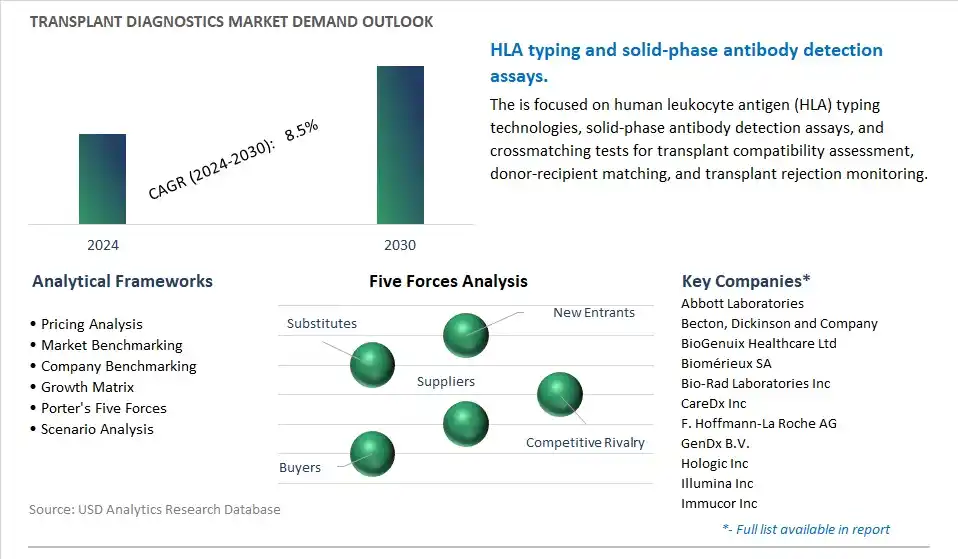
Transplant Diagnostics Market is estimated to increase at a Compounded Annual Growth Rate of 8.5% CAGR over the forecast period from 2024 to 2030
The Transplant Diagnostics Market study analyzes and forecasts the market size across 6 regions and 24 countries for diverse segments- By Technology (Molecular, Sequencing-based Molecular Assays, Non-molecular), By Product (Instrument, Reagent, Software), By Transplant Type (Solid Organ, Stem Cell, Soft Tissue, Bone Marrow), By Application (Diagnostic, Research).
An Introduction to Transplant Diagnostics Market in 2024
Transplant Diagnostics refers to the specialized testing and analysis performed before, during, and after organ transplantation procedures to assess compatibility between the donor and recipient, monitor graft function, and detect signs of rejection or complications. These diagnostic tests encompass a range of immunological assays, histocompatibility testing, and molecular techniques aimed at evaluating the immune response, tissue compatibility, and genetic markers associated with transplant outcomes. Pre-transplant diagnostics involve screening potential donors and recipients for human leukocyte antigens (HLA), blood group compatibility, and serological markers to identify suitable matches and minimize the risk of transplant rejection. During transplantation, real-time monitoring of graft function through biomarker analysis, imaging studies, and biopsy evaluations helps clinicians assess the viability and success of the transplant procedure. Post-transplant diagnostics focus on detecting early signs of rejection, infection, or graft dysfunction through immune monitoring, cytokine profiling, and genetic testing, enabling timely intervention and adjustment of immunosuppressive therapy. Transplant diagnostics play a critical role in optimizing transplant outcomes, prolonging graft survival, and improving patient survival rates in solid organ transplantation, hematopoietic stem cell transplantation, and tissue grafting procedures.
Market Trend: Increased Utilization of Non-Invasive and Molecular Diagnostic Techniques
A prominent trend in the transplant diagnostics market is the increased utilization of non-invasive and molecular diagnostic techniques. Traditional transplant diagnostics often involve invasive procedures such as tissue biopsies for graft assessment and monitoring. However, there's a growing emphasis on non-invasive methods that offer less discomfort to patients while providing valuable information on graft health and rejection risk. Molecular diagnostic techniques, including polymerase chain reaction (PCR), next-generation sequencing (NGS), and gene expression profiling, are being increasingly employed for the detection of transplant-related biomarkers and immune response monitoring. These non-invasive approaches offer higher sensitivity, specificity, and efficiency compared to traditional methods, driving their adoption in transplant diagnostics and reshaping clinical practice in transplantation medicine.
Market Driver: Rising Demand for Organ Transplants and Precision Medicine
A key driver fueling the growth of the transplant diagnostics market is the rising demand for organ transplants and the adoption of precision medicine approaches in transplantation. Organ transplantation is a life-saving treatment for patients with end-stage organ failure, offering improved quality of life and extended survival. As the demand for organ transplants continues to rise worldwide, there's a growing need for advanced diagnostic tools to assess graft compatibility, predict rejection risk, and personalize immunosuppressive therapy. Precision medicine approaches in transplantation aim to tailor treatment strategies based on individual patient factors, including genetic markers, immune status, and disease phenotype. This personalized approach requires comprehensive transplant diagnostics to inform clinical decision-making and optimize patient outcomes, driving the demand for innovative diagnostic solutions in the transplant field.
Market Opportunity: Development of Integrated Diagnostic Platforms for Comprehensive Transplant Care
An opportunity for growth in the transplant diagnostics market lies in the development of integrated diagnostic platforms for comprehensive transplant care. Transplant recipients require ongoing monitoring and management to detect graft rejection, infection, and other complications early and adjust treatment regimens accordingly. Integrated diagnostic platforms that combine multiple diagnostic modalities, such as histocompatibility testing, serology, molecular profiling, and imaging, into a single workflow offer several advantages, including streamlined testing, rapid turnaround times, and enhanced clinical decision support. Moreover, there's potential for the integration of artificial intelligence (AI) and machine learning algorithms to analyze multi-dimensional data sets and provide predictive insights into transplant outcomes. By focusing on the development of integrated diagnostic platforms for comprehensive transplant care, companies can address the evolving needs of transplant clinicians and improve patient outcomes in transplantation medicine.
Transplant Diagnostics Market Share Analysis: Molecular Technology is the fastest growing segment over the forecast period to 2030
The Transplant Diagnostics market is witnessing significant growth, with the molecular technology segment emerging as the fastest-growing category. This growth can be attributed to several key factors. Firstly, advancements in molecular technologies, particularly sequencing-based molecular assays, have revolutionized transplant diagnostics by enabling precise and comprehensive assessment of donor-recipient compatibility, graft rejection, and post-transplant monitoring. These molecular assays offer high sensitivity, specificity, and multiplexing capabilities, allowing clinicians to accurately identify genetic mismatches, monitor immune responses, and optimize transplant outcomes. Additionally, the increasing prevalence of chronic diseases, coupled with the rising demand for solid organ transplants, has propelled the adoption of molecular diagnostics in transplant procedures, driving market growth. Furthermore, ongoing research activities aimed at developing innovative diagnostic tools and therapeutic interventions for improving transplant outcomes are driving the demand for transplant diagnostic products, including instruments, reagents, and software solutions. As a result, the molecular technology segment is expected to continue its rapid growth trajectory, supported by advancements in molecular assays and the increasing demand for precise and personalized transplant diagnostics across diagnostic and research applications.
Transplant Diagnostics Competitive Analysis
The market research study provides in-depth insights into leading companies including the SWOT analyses, product profile, financial details, and recent developments acrossAbbott Laboratories, Becton, Dickinson and Company, BioGenuix Healthcare Ltd, Biomérieux SA, Bio-Rad Laboratories Inc, CareDx Inc, F. Hoffmann-La Roche AG, GenDx B.V., Hologic Inc, Illumina Inc, Immucor Inc, Omixon Ltd, Qiagen NV, Thermo Fisher Scientific Inc
Transplant Diagnostics Market Segmentation
By Technology
Molecular
Sequencing-based Molecular Assays
Non-molecular
By Product
Instrument
Reagent
Software
By Transplant Type
Solid Organ
Stem Cell
Soft Tissue
Bone Marrow
By Application
Diagnostic
Research
Geographical Analysis
North America (United States, Canada, Mexico)
Europe (Germany, France, United Kingdom, Spain, Italy, Rest of Europe)
Asia Pacific (China, India, Japan, South Korea, Rest of Asia Pacific)
South America (Brazil, Argentina, Rest of South America)
Middle East and Africa (Saudi Arabia, UAE, Rest of Middle East, South Africa, Egypt, Rest of Africa)
Transplant Diagnostics Market Companies
Abbott Laboratories
Becton, Dickinson and Company
BioGenuix Healthcare Ltd
Biomérieux SA
Bio-Rad Laboratories Inc
CareDx Inc
F. Hoffmann-La Roche AG
GenDx B.V.
Hologic Inc
Illumina Inc
Immucor Inc
Omixon Ltd
Qiagen NV
Thermo Fisher Scientific Inc
Reasons to Buy the Transplant Diagnostics Market Study
• Deepen your industry insights and navigate uncertainties for strategy formulation, CAPEX, and Operational decisions
• Gain access to detailed insights on the Transplant Diagnostics Market, encompassing current market size, growth trends, and forecasts till 2030.
• Access detailed competitor analysis, enabling competitive advantage through a thorough understanding of market players, strategies, and potential differentiation opportunities
• Stay ahead of the curve with insights on technological advancements, innovations, and upcoming trends
• Identify lucrative investment avenues and expansion opportunities within the Transplant Diagnostics Market industry, guided by robust, data-backed analysis.
• Understand regional and global markets through country-wise analysis, regional market potential, regulatory nuances, and dynamics
• Execute strategies with confidence and speed through information, analytics, and insights on the industry value chain
• Corporate leaders, strategists, financial experts, shareholders, asset managers, and governmental representatives can make long-term planning scenarios and build an integrated and timely understanding of market dynamics
• Benefit from tailored solutions and expert consultation based on report insights, providing personalized strategies aligned with specific business needs.
TABLE OF CONTENTS
1 Introduction to 2024 Transplant Diagnostics Market
1.1 Market Overview
1.2 Quick Facts
1.3 Scope/Objective of the Study
1.4 Market Definition
1.5 Countries and Regions Covered
1.6 Units, Currency, and Conversions
1.7 Industry Value Chain
2 Research Methodology
2.1 Market Size Estimation
2.2 Sources and Research Methodology
2.3 Data Triangulation
2.4 Assumptions and Limitations
3 Executive Summary
3.1 Global Transplant Diagnostics Market Size Outlook, $ Million, 2021 to 2030
3.2 Transplant Diagnostics Market Outlook by Type, $ Million, 2021 to 2030
3.3 Transplant Diagnostics Market Outlook by Product, $ Million, 2021 to 2030
3.4 Transplant Diagnostics Market Outlook by Application, $ Million, 2021 to 2030
3.5 Transplant Diagnostics Market Outlook by Key Countries, $ Million, 2021 to 2030
4 Market Dynamics
4.1 Key Driving Forces of Transplant Diagnostics Industry
4.2 Key Market Trends in Transplant Diagnostics Industry
4.3 Potential Opportunities in Transplant Diagnostics Industry
4.4 Key Challenges in Transplant Diagnostics Industry
5 Market Factor Analysis
5.1 Value Chain Analysis
5.2 Competitive Landscape
5.2.1 Global Transplant Diagnostics Market Share by Company (%), 2023
5.2.2 Product Offerings by Company
5.3 Porter’s Five Forces Analysis
5.4 Pricing Analysis and Outlook
6 Growth Outlook Across Scenarios
6.1 Growth Analysis-Case Scenario Definitions
6.2 Low Growth Scenario Forecasts
6.3 Reference Growth Scenario Forecasts
6.4 High Growth Scenario Forecasts
7 Global Transplant Diagnostics Market Outlook by Segments
7.1 Transplant Diagnostics Market Outlook by Segments, $ Million, 2021- 2030
By Technology
Molecular
Sequencing-based Molecular Assays
Non-molecular
By Product
Instrument
Reagent
Software
By Transplant Type
Solid Organ
Stem Cell
Soft Tissue
Bone Marrow
By Application
Diagnostic
Research
8 North America Transplant Diagnostics Market Analysis and Outlook To 2030
8.1 Introduction to North America Transplant Diagnostics Markets in 2024
8.2 North America Transplant Diagnostics Market Size Outlook by Country, 2021-2030
8.2.1 United States
8.2.2 Canada
8.2.3 Mexico
8.3 North America Transplant Diagnostics Market size Outlook by Segments, 2021-2030
By Technology
Molecular
Sequencing-based Molecular Assays
Non-molecular
By Product
Instrument
Reagent
Software
By Transplant Type
Solid Organ
Stem Cell
Soft Tissue
Bone Marrow
By Application
Diagnostic
Research
9 Europe Transplant Diagnostics Market Analysis and Outlook To 2030
9.1 Introduction to Europe Transplant Diagnostics Markets in 2024
9.2 Europe Transplant Diagnostics Market Size Outlook by Country, 2021-2030
9.2.1 Germany
9.2.2 France
9.2.3 Spain
9.2.4 United Kingdom
9.2.4 Italy
9.2.5 Russia
9.2.6 Norway
9.2.7 Rest of Europe
9.3 Europe Transplant Diagnostics Market Size Outlook by Segments, 2021-2030
By Technology
Molecular
Sequencing-based Molecular Assays
Non-molecular
By Product
Instrument
Reagent
Software
By Transplant Type
Solid Organ
Stem Cell
Soft Tissue
Bone Marrow
By Application
Diagnostic
Research
10 Asia Pacific Transplant Diagnostics Market Analysis and Outlook To 2030
10.1 Introduction to Asia Pacific Transplant Diagnostics Markets in 2024
10.2 Asia Pacific Transplant Diagnostics Market Size Outlook by Country, 2021-2030
10.2.1 China
10.2.2 India
10.2.3 Japan
10.2.4 South Korea
10.2.5 Indonesia
10.2.6 Malaysia
10.2.7 Australia
10.2.8 Rest of Asia Pacific
10.3 Asia Pacific Transplant Diagnostics Market size Outlook by Segments, 2021-2030
By Technology
Molecular
Sequencing-based Molecular Assays
Non-molecular
By Product
Instrument
Reagent
Software
By Transplant Type
Solid Organ
Stem Cell
Soft Tissue
Bone Marrow
By Application
Diagnostic
Research
11 South America Transplant Diagnostics Market Analysis and Outlook To 2030
11.1 Introduction to South America Transplant Diagnostics Markets in 2024
11.2 South America Transplant Diagnostics Market Size Outlook by Country, 2021-2030
11.2.1 Brazil
11.2.2 Argentina
11.2.3 Rest of South America
11.3 South America Transplant Diagnostics Market size Outlook by Segments, 2021-2030
By Technology
Molecular
Sequencing-based Molecular Assays
Non-molecular
By Product
Instrument
Reagent
Software
By Transplant Type
Solid Organ
Stem Cell
Soft Tissue
Bone Marrow
By Application
Diagnostic
Research
12 Middle East and Africa Transplant Diagnostics Market Analysis and Outlook To 2030
12.1 Introduction to Middle East and Africa Transplant Diagnostics Markets in 2024
12.2 Middle East and Africa Transplant Diagnostics Market Size Outlook by Country, 2021-2030
12.2.1 Saudi Arabia
12.2.2 UAE
12.2.3 Oman
12.2.4 Rest of Middle East
12.2.5 Egypt
12.2.6 Nigeria
12.2.7 South Africa
12.2.8 Rest of Africa
12.3 Middle East and Africa Transplant Diagnostics Market size Outlook by Segments, 2021-2030
By Technology
Molecular
Sequencing-based Molecular Assays
Non-molecular
By Product
Instrument
Reagent
Software
By Transplant Type
Solid Organ
Stem Cell
Soft Tissue
Bone Marrow
By Application
Diagnostic
Research
13 Company Profiles
13.1 Company Snapshot
13.2 SWOT Profiles
13.3 Products and Services
13.4 Recent Developments
13.5 Financial Profile
List of Companies
Abbott Laboratories
Becton, Dickinson and Company
BioGenuix Healthcare Ltd
Biomérieux SA
Bio-Rad Laboratories Inc
CareDx Inc
F. Hoffmann-La Roche AG
GenDx B.V.
Hologic Inc
Illumina Inc
Immucor Inc
Omixon Ltd
Qiagen NV
Thermo Fisher Scientific Inc
14 Appendix
14.1 Customization Offerings
14.2 Subscription Services
14.3 Related Reports
14.4 Publisher Expertise
By Technology
Molecular
Sequencing-based Molecular Assays
Non-molecular
By Product
Instrument
Reagent
Software
By Transplant Type
Solid Organ
Stem Cell
Soft Tissue
Bone Marrow
By Application
Diagnostic
Research
Countries Analyzed
North America (United States, Canada, Mexico)
Europe (Germany, France, United Kingdom, Spain, Italy, Rest of Europe)
Asia Pacific (China, India, Japan, South Korea, Rest of Asia Pacific)
South America (Brazil, Argentina, Rest of South America)
Middle East and Africa (Saudi Arabia, UAE, Rest of Middle East, South Africa, Egypt, Rest of Africa)
