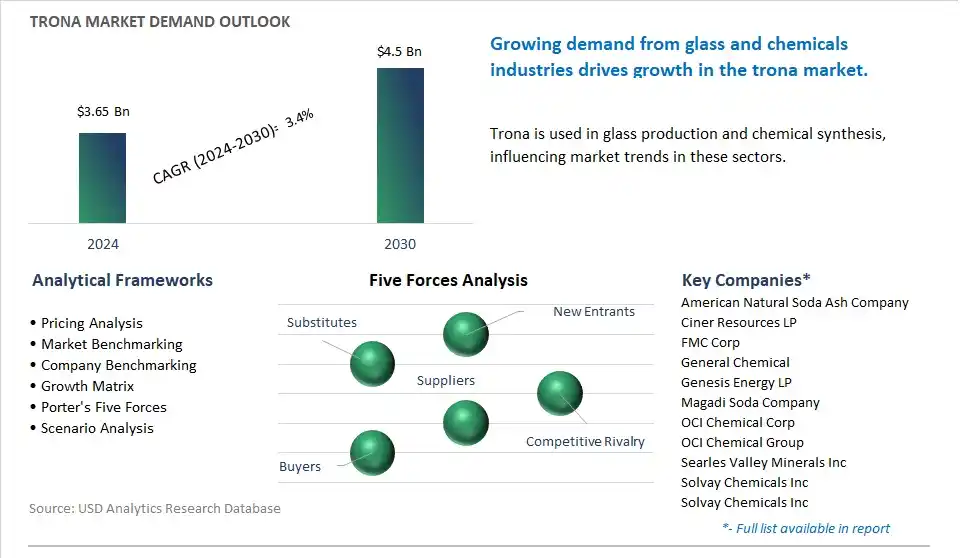
The global Trona Market is poised to register a 3.4% CAGR from $3.65 Billion in 2024 to $4.5 Billion in 2030.
The global Trona Market Study analyzes and forecasts the market size across 6 regions and 24 countries for diverse segments -By Type (Natural, Synthetic ), By Application (Soaps, Detergents, Glass, Air Pollution Control, Animal Feed, Paper & Pulp, Others), By Technology (Dry Scrubbing System, Wet Scrubbing System ), By End-User (Power, Glass, Steel, Cement, Waste Management, Oil & Gas, Others).
An Introduction to Global Trona Market in 2024
The trona market is witnessing growth driven by its diverse applications in industries such as glass manufacturing, chemicals production, environmental remediation, and water treatment. Key trends shaping the future of the industry include advancements in trona mining and processing technologies, extraction methods, and product quality control to meet customer specifications and regulatory standards. Innovations such as improved purification processes, particle size distribution control, and beneficiation techniques enhance trona's purity, consistency, and market competitiveness. Moreover, the growing demand for environmentally friendly and cost-effective alkali chemicals fuels market growth, as trona serves as a key raw material for soda ash production, a critical component in glassmaking, detergents, and chemical synthesis. Additionally, the adoption of trona-based solutions in flue gas desulfurization (FGD) systems, wastewater treatment, and air pollution control applications addresses environmental compliance requirements and promotes sustainable industrial practices. As stakeholders collaborate to optimize trona mining operations, expand product portfolios, and explore new market opportunities, the trona market is poised for sustained growth as a versatile and essential mineral resource supporting various industrial sectors and environmental applications.
Trona Market Competitive Landscape
The market report analyses the leading companies in the industry including American Natural Soda Ash Company, Ciner Resources LP, FMC Corp, General Chemical, Genesis Energy LP, Magadi Soda Company, OCI Chemical Corp, OCI Chemical Group, Searles Valley Minerals Inc, Solvay Chemicals Inc, Solvay Chemicals Inc, Tata Chemicals, Tata Chemicals North America Corp.
Trona Market Dynamics
Trona Market Trend: Rising Demand for Environmentally Friendly and Sustainable Industrial Chemicals
A prominent trend in the trona market is the rising demand for environmentally friendly and sustainable industrial chemicals. Trona, a naturally occurring mineral primarily composed of sodium carbonate, serves as a key raw material in various industrial applications such as glass manufacturing, pulp and paper production, and water treatment. With increasing awareness of environmental sustainability and regulatory pressure to reduce carbon emissions and minimize chemical waste, there is a growing preference for trona-derived chemicals that offer environmentally friendly alternatives to traditional industrial chemicals. This trend drives the adoption of trona-based products as sustainable solutions in various industrial processes, reflecting a broader shift towards eco-friendly practices in the chemical industry.
Trona Market Driver: Growth in Glass Production and Construction Industries
A key driver for the trona market is the growth in glass production and construction industries. Trona is a vital ingredient in the manufacture of glass, where it is used as a flux to lower the melting point of silica and improve the workability of glass melts. With increasing construction activities worldwide, driven by urbanization, infrastructure development, and housing demand, there is a growing need for glass products in residential, commercial, and industrial sectors. Additionally, the automotive and electronics industries contribute to the demand for specialty glass products, further stimulating the consumption of trona as a raw material. The expansion of glass production and construction industries drives the demand for trona as a critical component in glass manufacturing processes.
Trona Market Opportunity: Diversification into New Applications and Value-Added Products
An opportunity within the trona market lies in diversification into new applications and value-added products. While trona is primarily associated with glass manufacturing and other traditional applications, there is potential to explore new markets and develop innovative trona-derived products that address emerging needs and trends. For example, trona can be processed into sodium bicarbonate (baking soda), which finds applications in food and beverage, pharmaceuticals, and personal care products. Additionally, trona can be used in environmental remediation projects to neutralize acidic wastewater or in flue gas desulfurization systems to reduce sulfur dioxide emissions from power plants. By diversifying into new applications and value-added products, manufacturers of trona can expand their customer base, mitigate market risks, and capitalize on opportunities for growth and profitability.
Trona Market Share Analysis: Natural segment generated the highest revenue in the industry
The natural segment is the largest segment in the Trona Market due to its abundance, accessibility, and favorable properties for various industrial applications. Natural trona, also known as sodium sesquicarbonate or sodium carbonate sesquihydrate, is a naturally occurring mineral deposit found in evaporite deposits and saline lakes. Trona deposits are primarily located in regions with arid climates, such as the Green River Basin in the United States and the Qinghai Province in China. The natural segment dominates the Trona Market for diverse reasons. The natural trona is a cost-effective and environmentally friendly source of sodium carbonate (soda ash), a key raw material in the production of glass, detergents, chemicals, and other industrial products. Trona mining operations extract and process natural trona ore to produce soda ash through a series of beneficiation, calcination, and purification processes. Additionally, natural trona contains high concentrations of sodium carbonate and sodium bicarbonate, making it an efficient and economical feedstock for soda ash production. In addition, natural trona is characterized by its purity, consistency, and low impurity levels, ensuring the quality and performance of soda ash produced from natural trona deposits. Further, natural trona reserves are abundant and widely distributed geographically, providing a reliable and sustainable source of soda ash for global markets. As industries such as glass manufacturing, detergents, pulp and paper, and chemicals continue to grow and evolve, the demand for soda ash derived from natural trona remains strong, driving the dominance of the natural segment in the Trona Market. Additionally, the environmentally friendly nature of natural trona mining and processing operations aligns with sustainability initiatives and regulatory requirements, further supporting its position as the largest segment in the Trona Market.
Trona Market Share Analysis: Air Pollution Control Segment is poised to register the fastest growth rate (CAGR) over the forecast period to 2030
The air pollution control segment is the fastest-growing segment in the Trona Market due to increasing environmental regulations and the growing focus on reducing emissions from industrial processes and power generation facilities. Trona, particularly in the form of sodium sesquicarbonate, is widely used as a sorbent in flue gas desulfurization (FGD) systems for the removal of sulfur dioxide (SO2) emissions from power plants and industrial boilers. The air pollution control segment experiences rapid growth due to diverse factors. The stringent air quality standards and emission regulations drive the adoption of FGD technologies to reduce sulfur emissions from combustion processes, particularly in coal-fired power plants and industrial facilities. Trona-based FGD systems offer cost-effective and efficient solutions for SO2 removal, utilizing a dry sorbent injection or wet scrubbing process to capture and neutralize sulfur pollutants from flue gases. Additionally, the versatility and effectiveness of trona as a sorbent for SO2 capture make it an attractive option for utilities and industries seeking compliance with emission limits and environmental mandates. In addition, the growing awareness of the health and environmental impacts of air pollution drives investments in emission control technologies and pollution abatement measures, further boosting the demand for trona-based air pollution control solutions. Further, trona's abundance, availability, and low cost compared to alternative sorbents such as limestone and lime enhance its competitiveness in the air pollution control market. As governments, industries, and environmental organizations prioritize clean air initiatives and sustainable development goals, the demand for trona-based air pollution control technologies is expected to continue growing rapidly, positioning the air pollution control segment as the fastest-growing segment in the Trona Market.
Trona Market Share Analysis: Wet Scrubbing System Segment is poised to register the fastest growth rate (CAGR) over the forecast period to 2030
The wet scrubbing system segment is the fastest-growing segment in the Trona Market due to its effectiveness in removing sulfur dioxide (SO2) emissions from industrial flue gases and its versatility in various applications. Wet scrubbing systems utilize a liquid absorbent, water or an alkaline solution, to capture and neutralize SO2 and other acidic gases from combustion processes. Trona, in the form of sodium sesquicarbonate, is commonly used as a sorbent in wet scrubbing systems due to its high reactivity with SO2 and its ability to form stable sulfite and sulfate compounds. Wet scrubbing systems offer diverse advantages over dry scrubbing systems, including higher SO2 removal efficiency, lower operating costs, and reduced equipment maintenance requirements. Additionally, wet scrubbing systems are well-suited for retrofitting existing industrial facilities and power plants to comply with emission regulations, as they can be integrated into existing flue gas ductwork with minimal modifications. Further, the wet scrubbing technology continues to evolve with advancements in scrubber design, process optimization, and control systems, further enhancing its performance and reliability. As industries prioritize emission reduction and environmental compliance, the demand for wet scrubbing systems utilizing trona-based sorbents is expected to experience rapid growth, solidifying the wet scrubbing system segment as the fastest-growing segment in the Trona Market.
Trona Market Report Segmentation
By Type
Natural
Synthetic
By Application
Soaps
Detergents
Glass
Air Pollution Control
Animal Feed
Paper & Pulp
Others
By Technology
Dry Scrubbing System
Wet Scrubbing System
By End-User
Power
Glass
Steel
Cement
Waste Management
Oil & Gas
Others
Regions Included
North America (US, Canada, Mexico)
Europe (Germany, UK, France, Spain, Italy, Russia, Rest of Europe)
Asia Pacific (China, India, Japan, South Korea, Australia, South East Asia, Rest of Asia)
South America (Brazil, Argentina, Rest of South America)
Middle East and Africa (Saudi Arabia, UAE, Rest of Middle East, South Africa, Egypt, Rest of Africa)
Trona Companies Profiled in the Market Study
American Natural Soda Ash Company
Ciner Resources LP
FMC Corp
General Chemical
Genesis Energy LP
Magadi Soda Company
OCI Chemical Corp
OCI Chemical Group
Searles Valley Minerals Inc
Solvay Chemicals Inc
Solvay Chemicals Inc
Tata Chemicals
Tata Chemicals North America Corp
*- List Not Exhaustive
TABLE OF CONTENTS
1 Introduction to 2024 Trona Market
1.1 Market Overview
1.2 Quick Facts
1.3 Scope/Objective of the Study
1.4 Market Definition
1.5 Countries and Regions Covered
1.6 Units, Currency, and Conversions
1.7 Industry Value Chain
2 Research Methodology
2.1 Market Size Estimation
2.2 Sources and Research Methodology
2.3 Data Triangulation
2.4 Assumptions and Limitations
3 Executive Summary
3.1 Global Trona Market Size Outlook, $ Million, 2021 to 2030
3.2 Trona Market Outlook by Type, $ Million, 2021 to 2030
3.3 Trona Market Outlook by Product, $ Million, 2021 to 2030
3.4 Trona Market Outlook by Application, $ Million, 2021 to 2030
3.5 Trona Market Outlook by Key Countries, $ Million, 2021 to 2030
4 Market Dynamics
4.1 Key Driving Forces of Trona Industry
4.2 Key Market Trends in Trona Industry
4.3 Potential Opportunities in Trona Industry
4.4 Key Challenges in Trona Industry
5 Market Factor Analysis
5.1 Value Chain Analysis
5.2 Competitive Landscape
5.2.1 Global Trona Market Share by Company (%), 2023
5.2.2 Product Offerings by Company
5.3 Porter’s Five Forces Analysis
5.4 Pricing Analysis and Outlook
6 Growth Outlook Across Scenarios
6.1 Growth Analysis-Case Scenario Definitions
6.2 Low Growth Scenario Forecasts
6.3 Reference Growth Scenario Forecasts
6.4 High Growth Scenario Forecasts
7 Global Trona Market Outlook by Segments
7.1 Trona Market Outlook by Segments, $ Million, 2021- 2030
By Type
Natural
Synthetic
By Application
Soaps
Detergents
Glass
Air Pollution Control
Animal Feed
Paper & Pulp
Others
By Technology
Dry Scrubbing System
Wet Scrubbing System
By End-User
Power
Glass
Steel
Cement
Waste Management
Oil & Gas
Others
8 North America Trona Market Analysis and Outlook To 2030
8.1 Introduction to North America Trona Markets in 2024
8.2 North America Trona Market Size Outlook by Country, 2021-2030
8.2.1 United States
8.2.2 Canada
8.2.3 Mexico
8.3 North America Trona Market size Outlook by Segments, 2021-2030
By Type
Natural
Synthetic
By Application
Soaps
Detergents
Glass
Air Pollution Control
Animal Feed
Paper & Pulp
Others
By Technology
Dry Scrubbing System
Wet Scrubbing System
By End-User
Power
Glass
Steel
Cement
Waste Management
Oil & Gas
Others
9 Europe Trona Market Analysis and Outlook To 2030
9.1 Introduction to Europe Trona Markets in 2024
9.2 Europe Trona Market Size Outlook by Country, 2021-2030
9.2.1 Germany
9.2.2 France
9.2.3 Spain
9.2.4 United Kingdom
9.2.4 Italy
9.2.5 Russia
9.2.6 Norway
9.2.7 Rest of Europe
9.3 Europe Trona Market Size Outlook by Segments, 2021-2030
By Type
Natural
Synthetic
By Application
Soaps
Detergents
Glass
Air Pollution Control
Animal Feed
Paper & Pulp
Others
By Technology
Dry Scrubbing System
Wet Scrubbing System
By End-User
Power
Glass
Steel
Cement
Waste Management
Oil & Gas
Others
10 Asia Pacific Trona Market Analysis and Outlook To 2030
10.1 Introduction to Asia Pacific Trona Markets in 2024
10.2 Asia Pacific Trona Market Size Outlook by Country, 2021-2030
10.2.1 China
10.2.2 India
10.2.3 Japan
10.2.4 South Korea
10.2.5 Indonesia
10.2.6 Malaysia
10.2.7 Australia
10.2.8 Rest of Asia Pacific
10.3 Asia Pacific Trona Market size Outlook by Segments, 2021-2030
By Type
Natural
Synthetic
By Application
Soaps
Detergents
Glass
Air Pollution Control
Animal Feed
Paper & Pulp
Others
By Technology
Dry Scrubbing System
Wet Scrubbing System
By End-User
Power
Glass
Steel
Cement
Waste Management
Oil & Gas
Others
11 South America Trona Market Analysis and Outlook To 2030
11.1 Introduction to South America Trona Markets in 2024
11.2 South America Trona Market Size Outlook by Country, 2021-2030
11.2.1 Brazil
11.2.2 Argentina
11.2.3 Rest of South America
11.3 South America Trona Market size Outlook by Segments, 2021-2030
By Type
Natural
Synthetic
By Application
Soaps
Detergents
Glass
Air Pollution Control
Animal Feed
Paper & Pulp
Others
By Technology
Dry Scrubbing System
Wet Scrubbing System
By End-User
Power
Glass
Steel
Cement
Waste Management
Oil & Gas
Others
12 Middle East and Africa Trona Market Analysis and Outlook To 2030
12.1 Introduction to Middle East and Africa Trona Markets in 2024
12.2 Middle East and Africa Trona Market Size Outlook by Country, 2021-2030
12.2.1 Saudi Arabia
12.2.2 UAE
12.2.3 Oman
12.2.4 Rest of Middle East
12.2.5 Egypt
12.2.6 Nigeria
12.2.7 South Africa
12.2.8 Rest of Africa
12.3 Middle East and Africa Trona Market size Outlook by Segments, 2021-2030
By Type
Natural
Synthetic
By Application
Soaps
Detergents
Glass
Air Pollution Control
Animal Feed
Paper & Pulp
Others
By Technology
Dry Scrubbing System
Wet Scrubbing System
By End-User
Power
Glass
Steel
Cement
Waste Management
Oil & Gas
Others
13 Company Profiles
13.1 Company Snapshot
13.2 SWOT Profiles
13.3 Products and Services
13.4 Recent Developments
13.5 Financial Profile
American Natural Soda Ash Company
Ciner Resources LP
FMC Corp
General Chemical
Genesis Energy LP
Magadi Soda Company
OCI Chemical Corp
OCI Chemical Group
Searles Valley Minerals Inc
Solvay Chemicals Inc
Solvay Chemicals Inc
Tata Chemicals
Tata Chemicals North America Corp
14 Appendix
14.1 Customization Offerings
14.2 Subscription Services
14.3 Related Reports
14.4 Publisher Expertise
By Type
Natural
Synthetic
By Application
Soaps
Detergents
Glass
Air Pollution Control
Animal Feed
Paper & Pulp
Others
By Technology
Dry Scrubbing System
Wet Scrubbing System
By End-User
Power
Glass
Steel
Cement
Waste Management
Oil & Gas
Others
Countries Analyzed
North America (US, Canada, Mexico)
Europe (Germany, UK, France, Spain, Italy, Russia, Rest of Europe)
Asia Pacific (China, India, Japan, South Korea, Australia, South East Asia, Rest of Asia)
South America (Brazil, Argentina, Rest of South America)
Middle East and Africa (Saudi Arabia, UAE, Rest of Middle East, South Africa, Egypt, Rest of Africa)
