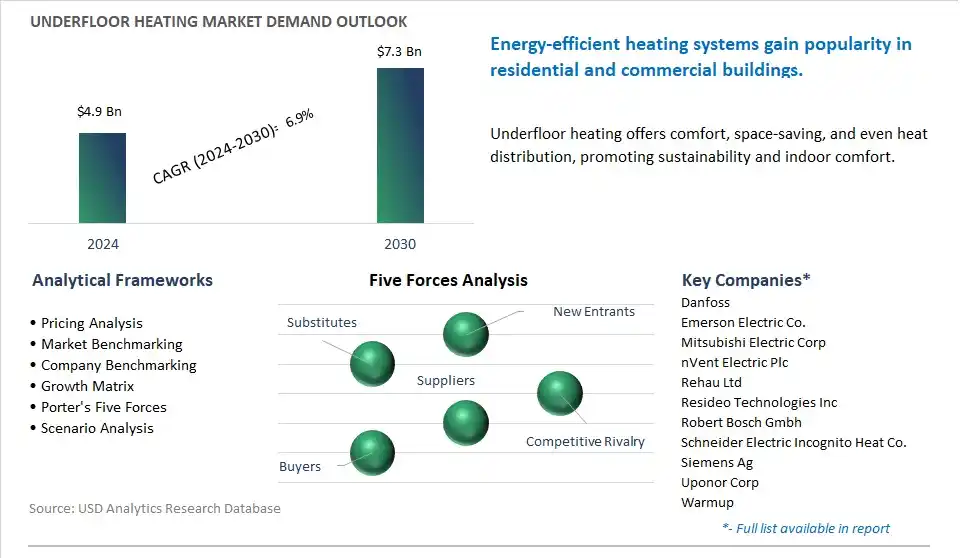
The global Underfloor Heating Market is poised to register a 6.9% CAGR from $4.9 Billion in 2024 to $7.3 Billion in 2030.
The global Underfloor Heating Market Study analyzes and forecasts the market size across 6 regions and 24 countries for diverse segments -By Offering (Hardware, Services), By Product (Hydronic Underfloor heating, Electric Underfloor heating), By Installation (New Installations/ New Building, Retrofit installations/Existing building), By Application (Residential, Commercial, Industrial, Healthcare, Sports & Entertainment, Others).
An Introduction to Global Underfloor Heating Market in 2024
Underfloor heating systems are a type of radiant heating system installed beneath the floor surface to provide uniform heating and thermal comfort in residential, commercial, and industrial buildings. The future of underfloor heating is shaped by several key trends, including advancements in system design, energy efficiency, and smart building integration to meet the demands of sustainable building design, energy conservation, and occupant comfort. One significant trend is the adoption of low-temperature hydronic and electric underfloor heating systems that utilize renewable energy sources such as solar thermal, geothermal, and heat pump technologies to provide efficient, cost-effective heating solutions with reduced carbon footprint and environmental impact compared to traditional fossil fuel-based heating systems. Building designers, contractors, and HVAC engineers are incorporating underfloor heating systems into energy-efficient building designs that optimize thermal comfort, indoor air quality, and occupant wellness while minimizing energy consumption, operating costs, and greenhouse gas emissions, promoting sustainable building practices and green building certifications such as LEED (Leadership in Energy and Environmental Design) and Passive House standards. Additionally, the integration of smart controls, wireless sensors, and building automation systems is driving innovations in underfloor heating management, monitoring, and optimization that enable remote operation, energy monitoring, and predictive maintenance, enhancing system performance, reliability, and user comfort while reducing lifecycle costs and environmental impact over the building's lifespan. Moreover, the increasing demand for hydronic underfloor heating systems in retrofit projects, renovation projects, and multifamily residential buildings is driving investments in prefabricated modular systems, installation techniques, and retrofit solutions that minimize disruption, installation time, and cost while maximizing energy savings and thermal comfort for building occupants, ensuring broad market adoption and scalability of underfloor heating technology in the residential and commercial building sectors. Furthermore, collaborations between heating system manufacturers, building contractors, and energy utilities are driving innovation and market growth by delivering customized underfloor heating solutions that meet the specific performance, reliability, and sustainability requirements of diverse building projects and stakeholders, ensuring continued advancement and adoption of underfloor heating as a viable heating technology in the global building industry.
Underfloor Heating Market Competitive Landscape
The market report analyses the leading companies in the industry including Danfoss, Emerson Electric Co., Mitsubishi Electric Corp, nVent Electric Plc, Rehau Ltd, Resideo Technologies Inc, Robert Bosch Gmbh, Schneider Electric Incognito Heat Co., Siemens Ag, Uponor Corp, Warmup.
Underfloor Heating Market Dynamics
Underfloor Heating Market Trend: Growing Preference for Energy-efficient Heating Solutions
A prominent market trend in the underfloor heating industry is the growing preference for energy-efficient heating solutions in residential and commercial buildings. Underfloor heating systems offer several advantages over traditional heating methods, including improved comfort, uniform heat distribution, reduced energy consumption, and space-saving design. As energy costs rise and environmental concerns become more pronounced, there is increasing demand for heating systems that provide efficient and sustainable warmth while minimizing carbon footprint. This trend is driven by factors such as government regulations promoting energy efficiency, green building certifications, and consumer awareness of the benefits of underfloor heating in achieving energy savings and indoor comfort.
Underfloor Heating Market Driver: Retrofitting and Renovation Projects in Existing Buildings
A key driver behind the growth of the underfloor heating market is the increasing demand for retrofitting and renovation projects in existing buildings. As property owners seek to improve energy efficiency, comfort, and property value, there is a rising interest in upgrading heating systems to underfloor heating in older homes, commercial buildings, and historic properties. Underfloor heating offers flexibility in installation and can be retrofitted into existing structures without major disruptions or modifications to interior spaces. Additionally, advancements in retrofit-friendly underfloor heating systems, such as thin-profile electric mats or retrofit water-based systems, make it easier and more cost-effective to upgrade heating systems in existing buildings. This driver is further supported by incentives, rebates, and financing options offered by governments and utilities to encourage energy-efficient upgrades and renovations in buildings.
Underfloor Heating Market Opportunity: Integration with Smart Home Automation Technologies
An opportunity exists for underfloor heating manufacturers to integrate their products with smart home automation technologies to enhance convenience, control, and energy savings for end-users. Smart thermostats, sensors, and mobile apps allow users to remotely monitor and adjust heating settings based on occupancy, outdoor temperature, and energy usage patterns, optimizing comfort and efficiency. By offering compatibility with popular smart home platforms such as Google Nest, Amazon Alexa, and Apple HomeKit, underfloor heating systems can seamlessly integrate into smart home ecosystems and provide users with intuitive controls and energy management features. Additionally, there is opportunity to develop predictive analytics and machine learning algorithms that optimize heating schedules and energy usage based on user behavior and environmental conditions. By embracing smart technologies, underfloor heating manufacturers can differentiate their products, expand market reach, and meet the evolving needs of tech-savvy consumers in the residential and commercial building sectors.
Underfloor Heating Market Share Analysis: Hardware generated the highest revenue in 2024
The largest segment in the Underfloor Heating Market is the Hardware segment. This is primarily because hardware offerings in underfloor heating systems encompass the essential components required for the installation and operation of heating systems, including heating mats or cables, thermostats, insulation boards, manifold systems, and sensors. These hardware components form the foundation of underfloor heating systems and are essential for effectively distributing heat throughout a building or space. Additionally, the demand for underfloor heating hardware is driven by the increasing adoption of energy-efficient heating solutions, growing awareness of indoor comfort and wellness, and the expansion of residential and commercial construction activities globally. As underfloor heating systems gain popularity as a sustainable and efficient heating solution, the demand for hardware offerings is expected to remain high, solidifying its position as the largest segment in the Underfloor Heating Market.
Underfloor Heating Market Share Analysis: Electric Underfloor Heating segment is poised to register the fastest growth rate (CAGR) over the forecast period to 2030
The fastest-growing segment in the Underfloor Heating Market is the Electric Underfloor Heating segment. electric underfloor heating systems offer potential advantages over hydronic systems, including easier installation, lower upfront costs, and individual room temperature control. Electric underfloor heating systems consist of heating cables or mats installed directly beneath the floor surface, which radiate heat evenly across the room when powered on. This provides efficient and comfortable heating without the need for bulky radiators or complex piping systems associated with hydronic systems. Additionally, advancements in electric underfloor heating technology, such as smart thermostats, WiFi-enabled controls, and energy-efficient heating elements, enhance user convenience and energy savings. Further, the growing trend towards home renovation, retrofitting, and increasing demand for luxury and comfort features in residential and commercial buildings drive the adoption of electric underfloor heating systems. Furthermore, the transition towards renewable energy sources and the availability of electricity from sustainable sources further boosts the popularity of electric underfloor heating systems as an environmentally friendly heating solution. Accordingly, the Electric Underfloor Heating segment is expected to experience rapid growth in the Underfloor Heating Market.
Underfloor Heating Market Share Analysis: Retrofit Installations/Existing Building segment is poised to register the fastest growth rate (CAGR) over the forecast period to 2030
The fastest-growing segment in the Underfloor Heating Market is the Retrofit Installations/Existing Building segment. There is a growing trend towards energy efficiency and sustainability in existing buildings, driven by regulations, incentives, and consumer awareness. Retrofitting existing buildings with underfloor heating systems offers a cost-effective and space-saving solution to improve heating efficiency and comfort without the need for major structural modifications. Additionally, advancements in retrofit-friendly underfloor heating systems, such as thin-profile heating mats or cables and wireless control systems, make installation easier and less disruptive, reducing installation time and costs. Further, the increasing availability of retrofit solutions tailored for different floor types, including wooden floors, tiles, and carpets, expands the applicability of underfloor heating in existing buildings. Furthermore, the demand for home renovation and remodeling projects, coupled with the desire for luxury and comfort features, drives the adoption of underfloor heating systems in retrofit applications. As building owners and homeowners seek to upgrade their properties for improved comfort, energy efficiency, and value, the Retrofit Installations/Existing Building segment is expected to experience rapid growth in the Underfloor Heating Market.
Underfloor Heating Market Report Segmentation
By Offering
Hardware
Services
By Product
Hydronic Underfloor heating (wet system)
-Heating Pipes
-Thermostats and Sensors
-Thermal Actuators
-Zone Valves
-Wiring Centres
-Manifold and Valves
Electric Underfloor heating (dry system)
-Heating Cables
-Heating Cables
-Thermostat and Sensors
By Installation
New Installations/ New Building
Retrofit installations/Existing building
By Application
Residential
Commercial
Industrial
Healthcare
Sports & Entertainment
Others
Regions Included
North America (US, Canada, Mexico)
Europe (Germany, UK, France, Spain, Italy, Russia, Rest of Europe)
Asia Pacific (China, India, Japan, South Korea, Australia, South East Asia, Rest of Asia)
South America (Brazil, Argentina, Rest of South America)
Middle East and Africa (Saudi Arabia, UAE, Rest of Middle East, South Africa, Egypt, Rest of Africa)
Underfloor Heating Companies Profiled in the Market Study
Danfoss
Emerson Electric Co.
Mitsubishi Electric Corp
nVent Electric Plc
Rehau Ltd
Resideo Technologies Inc
Robert Bosch Gmbh
Schneider Electric Incognito Heat Co.
Siemens Ag
Uponor Corp
Warmup
*- List Not Exhaustive
TABLE OF CONTENTS
1 Introduction to 2024 Underfloor Heating Market
1.1 Market Overview
1.2 Quick Facts
1.3 Scope/Objective of the Study
1.4 Market Definition
1.5 Countries and Regions Covered
1.6 Units, Currency, and Conversions
1.7 Industry Value Chain
2 Research Methodology
2.1 Market Size Estimation
2.2 Sources and Research Methodology
2.3 Data Triangulation
2.4 Assumptions and Limitations
3 Executive Summary
3.1 Global Underfloor Heating Market Size Outlook, $ Million, 2021 to 2030
3.2 Underfloor Heating Market Outlook by Type, $ Million, 2021 to 2030
3.3 Underfloor Heating Market Outlook by Product, $ Million, 2021 to 2030
3.4 Underfloor Heating Market Outlook by Application, $ Million, 2021 to 2030
3.5 Underfloor Heating Market Outlook by Key Countries, $ Million, 2021 to 2030
4 Market Dynamics
4.1 Key Driving Forces of Underfloor Heating Industry
4.2 Key Market Trends in Underfloor Heating Industry
4.3 Potential Opportunities in Underfloor Heating Industry
4.4 Key Challenges in Underfloor Heating Industry
5 Market Factor Analysis
5.1 Value Chain Analysis
5.2 Competitive Landscape
5.2.1 Global Underfloor Heating Market Share by Company (%), 2023
5.2.2 Product Offerings by Company
5.3 Porter’s Five Forces Analysis
5.4 Pricing Analysis and Outlook
6 Growth Outlook Across Scenarios
6.1 Growth Analysis-Case Scenario Definitions
6.2 Low Growth Scenario Forecasts
6.3 Reference Growth Scenario Forecasts
6.4 High Growth Scenario Forecasts
7 Global Underfloor Heating Market Outlook by Segments
7.1 Underfloor Heating Market Outlook by Segments, $ Million, 2021- 2030
By Offering
Hardware
Services
By Product
Hydronic Underfloor heating (wet system)
-Heating Pipes
-Thermostats and Sensors
-Thermal Actuators
-Zone Valves
-Wiring Centres
-Manifold and Valves
Electric Underfloor heating (dry system)
-Heating Cables
-Heating Cables
-Thermostat and Sensors
By Installation
New Installations/ New Building
Retrofit installations/Existing building
By Application
Residential
Commercial
Industrial
Healthcare
Sports & Entertainment
Others
8 North America Underfloor Heating Market Analysis and Outlook To 2030
8.1 Introduction to North America Underfloor Heating Markets in 2024
8.2 North America Underfloor Heating Market Size Outlook by Country, 2021-2030
8.2.1 United States
8.2.2 Canada
8.2.3 Mexico
8.3 North America Underfloor Heating Market size Outlook by Segments, 2021-2030
By Offering
Hardware
Services
By Product
Hydronic Underfloor heating (wet system)
-Heating Pipes
-Thermostats and Sensors
-Thermal Actuators
-Zone Valves
-Wiring Centres
-Manifold and Valves
Electric Underfloor heating (dry system)
-Heating Cables
-Heating Cables
-Thermostat and Sensors
By Installation
New Installations/ New Building
Retrofit installations/Existing building
By Application
Residential
Commercial
Industrial
Healthcare
Sports & Entertainment
Others
9 Europe Underfloor Heating Market Analysis and Outlook To 2030
9.1 Introduction to Europe Underfloor Heating Markets in 2024
9.2 Europe Underfloor Heating Market Size Outlook by Country, 2021-2030
9.2.1 Germany
9.2.2 France
9.2.3 Spain
9.2.4 United Kingdom
9.2.4 Italy
9.2.5 Russia
9.2.6 Norway
9.2.7 Rest of Europe
9.3 Europe Underfloor Heating Market Size Outlook by Segments, 2021-2030
By Offering
Hardware
Services
By Product
Hydronic Underfloor heating (wet system)
-Heating Pipes
-Thermostats and Sensors
-Thermal Actuators
-Zone Valves
-Wiring Centres
-Manifold and Valves
Electric Underfloor heating (dry system)
-Heating Cables
-Heating Cables
-Thermostat and Sensors
By Installation
New Installations/ New Building
Retrofit installations/Existing building
By Application
Residential
Commercial
Industrial
Healthcare
Sports & Entertainment
Others
10 Asia Pacific Underfloor Heating Market Analysis and Outlook To 2030
10.1 Introduction to Asia Pacific Underfloor Heating Markets in 2024
10.2 Asia Pacific Underfloor Heating Market Size Outlook by Country, 2021-2030
10.2.1 China
10.2.2 India
10.2.3 Japan
10.2.4 South Korea
10.2.5 Indonesia
10.2.6 Malaysia
10.2.7 Australia
10.2.8 Rest of Asia Pacific
10.3 Asia Pacific Underfloor Heating Market size Outlook by Segments, 2021-2030
By Offering
Hardware
Services
By Product
Hydronic Underfloor heating (wet system)
-Heating Pipes
-Thermostats and Sensors
-Thermal Actuators
-Zone Valves
-Wiring Centres
-Manifold and Valves
Electric Underfloor heating (dry system)
-Heating Cables
-Heating Cables
-Thermostat and Sensors
By Installation
New Installations/ New Building
Retrofit installations/Existing building
By Application
Residential
Commercial
Industrial
Healthcare
Sports & Entertainment
Others
11 South America Underfloor Heating Market Analysis and Outlook To 2030
11.1 Introduction to South America Underfloor Heating Markets in 2024
11.2 South America Underfloor Heating Market Size Outlook by Country, 2021-2030
11.2.1 Brazil
11.2.2 Argentina
11.2.3 Rest of South America
11.3 South America Underfloor Heating Market size Outlook by Segments, 2021-2030
By Offering
Hardware
Services
By Product
Hydronic Underfloor heating (wet system)
-Heating Pipes
-Thermostats and Sensors
-Thermal Actuators
-Zone Valves
-Wiring Centres
-Manifold and Valves
Electric Underfloor heating (dry system)
-Heating Cables
-Heating Cables
-Thermostat and Sensors
By Installation
New Installations/ New Building
Retrofit installations/Existing building
By Application
Residential
Commercial
Industrial
Healthcare
Sports & Entertainment
Others
12 Middle East and Africa Underfloor Heating Market Analysis and Outlook To 2030
12.1 Introduction to Middle East and Africa Underfloor Heating Markets in 2024
12.2 Middle East and Africa Underfloor Heating Market Size Outlook by Country, 2021-2030
12.2.1 Saudi Arabia
12.2.2 UAE
12.2.3 Oman
12.2.4 Rest of Middle East
12.2.5 Egypt
12.2.6 Nigeria
12.2.7 South Africa
12.2.8 Rest of Africa
12.3 Middle East and Africa Underfloor Heating Market size Outlook by Segments, 2021-2030
By Offering
Hardware
Services
By Product
Hydronic Underfloor heating (wet system)
-Heating Pipes
-Thermostats and Sensors
-Thermal Actuators
-Zone Valves
-Wiring Centres
-Manifold and Valves
Electric Underfloor heating (dry system)
-Heating Cables
-Heating Cables
-Thermostat and Sensors
By Installation
New Installations/ New Building
Retrofit installations/Existing building
By Application
Residential
Commercial
Industrial
Healthcare
Sports & Entertainment
Others
13 Company Profiles
13.1 Company Snapshot
13.2 SWOT Profiles
13.3 Products and Services
13.4 Recent Developments
13.5 Financial Profile
Danfoss
Emerson Electric Co.
Mitsubishi Electric Corp
nVent Electric Plc
Rehau Ltd
Resideo Technologies Inc
Robert Bosch Gmbh
Schneider Electric Incognito Heat Co.
Siemens Ag
Uponor Corp
Warmup
14 Appendix
14.1 Customization Offerings
14.2 Subscription Services
14.3 Related Reports
14.4 Publisher Expertise
By Offering
Hardware
Services
By Product
Hydronic Underfloor heating (wet system)
-Heating Pipes
-Thermostats and Sensors
-Thermal Actuators
-Zone Valves
-Wiring Centres
-Manifold and Valves
Electric Underfloor heating (dry system)
-Heating Cables
-Heating Cables
-Thermostat and Sensors
By Installation
New Installations/ New Building
Retrofit installations/Existing building
By Application
Residential
Commercial
Industrial
Healthcare
Sports & Entertainment
Others
Countries Analyzed
North America (US, Canada, Mexico)
Europe (Germany, UK, France, Spain, Italy, Russia, Rest of Europe)
Asia Pacific (China, India, Japan, South Korea, Australia, South East Asia, Rest of Asia)
South America (Brazil, Argentina, Rest of South America)
Middle East and Africa (Saudi Arabia, UAE, Rest of Middle East, South Africa, Egypt, Rest of Africa)
