Urinary Catheters Market is estimated to increase at a Compounded Annual Growth Rate of 5.2% CAGR over the forecast period from 2024 to 2030
The Urinary Catheters Market study analyzes and forecasts the market size across 6 regions and 24 countries for diverse segments- By Product (Intermittent Catheters, Foley/ Indwelling Catheters, External Catheters), By Application (Benign Prostate Hyperplasia & Prostate Surgeries, Urinary Incontinence, Spinal Cord Injury, Others), By Type (Coated Catheters, Uncoated Catheters), By Gender (Male, Female), By End-User (Hospital, Clinics, Long-term Care Facilities, Others).
An Introduction to Urinary Catheters Market in 2024
Urinary Catheters are medical devices used to drain urine from the bladder when normal urination is not possible due to urinary retention, urinary incontinence, or surgical procedures requiring bladder drainage. Urinary catheters consist of flexible tubes made of silicone, latex, or polyurethane, with drainage ports and balloons or cuffs to secure the catheter in place within the bladder. Catheters are inserted into the bladder through the urethra (urethral catheters) or through a surgically created opening in the abdomen (suprapubic catheters) and are connected to drainage bags or collection systems to collect urine. Urinary catheters may be indwelling (left in place for an extended period) or intermittent (inserted as needed for short-term drainage). Indications for urinary catheterization include urinary retention, bladder outlet obstruction, neurogenic bladder dysfunction, and perioperative bladder management. However, urinary catheterization carries risks of urinary tract infections, urethral trauma, and catheter-associated complications, necessitating appropriate catheter selection, insertion techniques, and catheter care protocols to minimize adverse events. With advancements in catheter design, antimicrobial coatings, and catheterization techniques, urinary catheters continue to evolve as essential tools in managing urinary dysfunction and providing urinary drainage support for patients across various clinical settings.
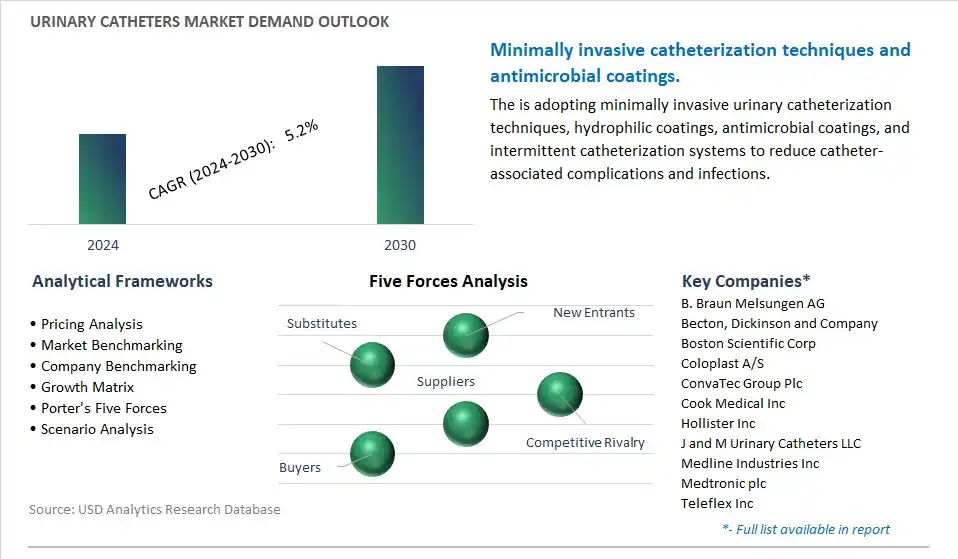
Market Trend: Increasing Adoption of Minimally Invasive and Disposable Catheters
A prominent trend in the urinary catheters market is the increasing adoption of minimally invasive and disposable catheters. Traditional urinary catheters are associated with risks of infection, discomfort, and complications such as urethral trauma and urinary tract infections (UTIs). In response, there's a growing demand for catheters designed for minimally invasive insertion techniques, such as hydrophilic-coated catheters and compact catheters, which offer smoother insertion, reduced friction, and lower risk of tissue damage. Additionally, there's a shift towards disposable catheters over reusable ones, driven by concerns about infection control, convenience, and cost-effectiveness. As healthcare providers prioritize patient safety, comfort, and infection prevention, the demand for minimally invasive and disposable urinary catheters is expected to continue rising, driving market growth and innovation in catheter design and materials.
Market Driver: Aging Population and Increasing Prevalence of Urinary Disorders
A key driver fueling the growth of the urinary catheters market is the aging population and the increasing prevalence of urinary disorders such as urinary incontinence, urinary retention, and neurogenic bladder dysfunction. Elderly individuals are more susceptible to urinary problems due to age-related changes in bladder function, mobility limitations, and comorbidities such as diabetes and prostate enlargement. Moreover, the prevalence of chronic conditions such as spinal cord injury, multiple sclerosis, and Parkinson's disease is rising, leading to a higher demand for urinary catheters for long-term bladder management. As the aging population grows and healthcare systems strive to improve quality of life for patients with urinary disorders, the demand for urinary catheters as essential medical devices is expected to increase, driving market expansion and investment in catheter technology and innovation.
Market Opportunity: Development of Catheters with Antimicrobial and Self-Cleaning Properties
An opportunity for growth in the urinary catheters market lies in the development of catheters with antimicrobial and self-cleaning properties to reduce the risk of infection and improve patient outcomes. Catheter-associated urinary tract infections (CAUTIs) are a significant healthcare concern, leading to increased morbidity, mortality, and healthcare costs. There's a need for catheters that incorporate antimicrobial agents, such as silver ions or antibiotics, into their design to prevent bacterial colonization and biofilm formation on catheter surfaces. Additionally, there's potential for the development of catheters with self-cleaning mechanisms, such as coatings that resist bacterial adhesion or release antimicrobial agents upon contact with urine. By focusing on the development of catheters with advanced infection prevention capabilities, companies can address unmet clinical needs, reduce the incidence of CAUTIs, and improve patient outcomes, thereby enhancing the value proposition of urinary catheters in clinical practice.
Urinary Catheters Market Share Analysis: Intermittent Catheters is the fastest growing segment over the forecast period to 2030
The fastest-growing segment in the Urinary Catheters Market is Intermittent Catheters within the Product category. This growth is driven by several factors, including the increasing prevalence of urinary incontinence and the rising demand for minimally invasive urinary catheterization procedures. Intermittent catheters are preferred for their reduced risk of infection, improved patient comfort, and ease of use compared to indwelling catheters. Additionally, advancements in catheter design, such as hydrophilic and antimicrobial coatings, contribute to the rapid growth of Intermittent Catheters in the Urinary Catheters Market. Furthermore, the application of intermittent catheters in various conditions such as benign prostate hyperplasia, urinary incontinence, and spinal cord injury further boosts their demand among healthcare facilities including hospitals, clinics, and long-term care facilities.
Urinary Catheters Competitive Analysis
The market research study provides in-depth insights into leading companies including the SWOT analyses, product profile, financial details, and recent developments acrossB. Braun Melsungen AG, Becton, Dickinson and Company, Boston Scientific Corp, Coloplast A/S, ConvaTec Group Plc, Cook Medical Inc, Hollister Inc, J and M Urinary Catheters LLC, Medline Industries Inc, Medtronic plc, Teleflex Inc
Urinary Catheters Market Segmentation
By Product
Intermittent Catheters
Foley/ Indwelling Catheters
External Catheters
By Application
Benign Prostate Hyperplasia & Prostate Surgeries
Urinary Incontinence
Spinal Cord Injury
Others
By Type
Coated Catheters
Uncoated Catheters
By Gender
Male
Female
By End-User
Hospital
Clinics
Long-term Care Facilities
Others
Geographical Analysis
North America (United States, Canada, Mexico)
Europe (Germany, France, United Kingdom, Spain, Italy, Rest of Europe)
Asia Pacific (China, India, Japan, South Korea, Rest of Asia Pacific)
South America (Brazil, Argentina, Rest of South America)
Middle East and Africa (Saudi Arabia, UAE, Rest of Middle East, South Africa, Egypt, Rest of Africa)
Urinary Catheters Market Companies
B. Braun Melsungen AG
Becton, Dickinson and Company
Boston Scientific Corp
Coloplast A/S
ConvaTec Group Plc
Cook Medical Inc
Hollister Inc
J and M Urinary Catheters LLC
Medline Industries Inc
Medtronic plc
Teleflex Inc
Reasons to Buy the Urinary Catheters Market Study
• Deepen your industry insights and navigate uncertainties for strategy formulation, CAPEX, and Operational decisions
• Gain access to detailed insights on the Urinary Catheters Market, encompassing current market size, growth trends, and forecasts till 2030.
• Access detailed competitor analysis, enabling competitive advantage through a thorough understanding of market players, strategies, and potential differentiation opportunities
• Stay ahead of the curve with insights on technological advancements, innovations, and upcoming trends
• Identify lucrative investment avenues and expansion opportunities within the Urinary Catheters Market industry, guided by robust, data-backed analysis.
• Understand regional and global markets through country-wise analysis, regional market potential, regulatory nuances, and dynamics
• Execute strategies with confidence and speed through information, analytics, and insights on the industry value chain
• Corporate leaders, strategists, financial experts, shareholders, asset managers, and governmental representatives can make long-term planning scenarios and build an integrated and timely understanding of market dynamics
• Benefit from tailored solutions and expert consultation based on report insights, providing personalized strategies aligned with specific business needs.
TABLE OF CONTENTS
1 Introduction to 2024 Urinary Catheters Market
1.1 Market Overview
1.2 Quick Facts
1.3 Scope/Objective of the Study
1.4 Market Definition
1.5 Countries and Regions Covered
1.6 Units, Currency, and Conversions
1.7 Industry Value Chain
2 Research Methodology
2.1 Market Size Estimation
2.2 Sources and Research Methodology
2.3 Data Triangulation
2.4 Assumptions and Limitations
3 Executive Summary
3.1 Global Urinary Catheters Market Size Outlook, $ Million, 2021 to 2030
3.2 Urinary Catheters Market Outlook by Type, $ Million, 2021 to 2030
3.3 Urinary Catheters Market Outlook by Product, $ Million, 2021 to 2030
3.4 Urinary Catheters Market Outlook by Application, $ Million, 2021 to 2030
3.5 Urinary Catheters Market Outlook by Key Countries, $ Million, 2021 to 2030
4 Market Dynamics
4.1 Key Driving Forces of Urinary Catheters Industry
4.2 Key Market Trends in Urinary Catheters Industry
4.3 Potential Opportunities in Urinary Catheters Industry
4.4 Key Challenges in Urinary Catheters Industry
5 Market Factor Analysis
5.1 Value Chain Analysis
5.2 Competitive Landscape
5.2.1 Global Urinary Catheters Market Share by Company (%), 2023
5.2.2 Product Offerings by Company
5.3 Porter’s Five Forces Analysis
5.4 Pricing Analysis and Outlook
6 Growth Outlook Across Scenarios
6.1 Growth Analysis-Case Scenario Definitions
6.2 Low Growth Scenario Forecasts
6.3 Reference Growth Scenario Forecasts
6.4 High Growth Scenario Forecasts
7 Global Urinary Catheters Market Outlook by Segments
7.1 Urinary Catheters Market Outlook by Segments, $ Million, 2021- 2030
By Product
Intermittent Catheters
Foley/ Indwelling Catheters
External Catheters
By Application
Benign Prostate Hyperplasia & Prostate Surgeries
Urinary Incontinence
Spinal Cord Injury
Others
By Type
Coated Catheters
Uncoated Catheters
By Gender
Male
Female
By End-User
Hospital
Clinics
Long-term Care Facilities
Others
8 North America Urinary Catheters Market Analysis and Outlook To 2030
8.1 Introduction to North America Urinary Catheters Markets in 2024
8.2 North America Urinary Catheters Market Size Outlook by Country, 2021-2030
8.2.1 United States
8.2.2 Canada
8.2.3 Mexico
8.3 North America Urinary Catheters Market size Outlook by Segments, 2021-2030
By Product
Intermittent Catheters
Foley/ Indwelling Catheters
External Catheters
By Application
Benign Prostate Hyperplasia & Prostate Surgeries
Urinary Incontinence
Spinal Cord Injury
Others
By Type
Coated Catheters
Uncoated Catheters
By Gender
Male
Female
By End-User
Hospital
Clinics
Long-term Care Facilities
Others
9 Europe Urinary Catheters Market Analysis and Outlook To 2030
9.1 Introduction to Europe Urinary Catheters Markets in 2024
9.2 Europe Urinary Catheters Market Size Outlook by Country, 2021-2030
9.2.1 Germany
9.2.2 France
9.2.3 Spain
9.2.4 United Kingdom
9.2.4 Italy
9.2.5 Russia
9.2.6 Norway
9.2.7 Rest of Europe
9.3 Europe Urinary Catheters Market Size Outlook by Segments, 2021-2030
By Product
Intermittent Catheters
Foley/ Indwelling Catheters
External Catheters
By Application
Benign Prostate Hyperplasia & Prostate Surgeries
Urinary Incontinence
Spinal Cord Injury
Others
By Type
Coated Catheters
Uncoated Catheters
By Gender
Male
Female
By End-User
Hospital
Clinics
Long-term Care Facilities
Others
10 Asia Pacific Urinary Catheters Market Analysis and Outlook To 2030
10.1 Introduction to Asia Pacific Urinary Catheters Markets in 2024
10.2 Asia Pacific Urinary Catheters Market Size Outlook by Country, 2021-2030
10.2.1 China
10.2.2 India
10.2.3 Japan
10.2.4 South Korea
10.2.5 Indonesia
10.2.6 Malaysia
10.2.7 Australia
10.2.8 Rest of Asia Pacific
10.3 Asia Pacific Urinary Catheters Market size Outlook by Segments, 2021-2030
By Product
Intermittent Catheters
Foley/ Indwelling Catheters
External Catheters
By Application
Benign Prostate Hyperplasia & Prostate Surgeries
Urinary Incontinence
Spinal Cord Injury
Others
By Type
Coated Catheters
Uncoated Catheters
By Gender
Male
Female
By End-User
Hospital
Clinics
Long-term Care Facilities
Others
11 South America Urinary Catheters Market Analysis and Outlook To 2030
11.1 Introduction to South America Urinary Catheters Markets in 2024
11.2 South America Urinary Catheters Market Size Outlook by Country, 2021-2030
11.2.1 Brazil
11.2.2 Argentina
11.2.3 Rest of South America
11.3 South America Urinary Catheters Market size Outlook by Segments, 2021-2030
By Product
Intermittent Catheters
Foley/ Indwelling Catheters
External Catheters
By Application
Benign Prostate Hyperplasia & Prostate Surgeries
Urinary Incontinence
Spinal Cord Injury
Others
By Type
Coated Catheters
Uncoated Catheters
By Gender
Male
Female
By End-User
Hospital
Clinics
Long-term Care Facilities
Others
12 Middle East and Africa Urinary Catheters Market Analysis and Outlook To 2030
12.1 Introduction to Middle East and Africa Urinary Catheters Markets in 2024
12.2 Middle East and Africa Urinary Catheters Market Size Outlook by Country, 2021-2030
12.2.1 Saudi Arabia
12.2.2 UAE
12.2.3 Oman
12.2.4 Rest of Middle East
12.2.5 Egypt
12.2.6 Nigeria
12.2.7 South Africa
12.2.8 Rest of Africa
12.3 Middle East and Africa Urinary Catheters Market size Outlook by Segments, 2021-2030
By Product
Intermittent Catheters
Foley/ Indwelling Catheters
External Catheters
By Application
Benign Prostate Hyperplasia & Prostate Surgeries
Urinary Incontinence
Spinal Cord Injury
Others
By Type
Coated Catheters
Uncoated Catheters
By Gender
Male
Female
By End-User
Hospital
Clinics
Long-term Care Facilities
Others
13 Company Profiles
13.1 Company Snapshot
13.2 SWOT Profiles
13.3 Products and Services
13.4 Recent Developments
13.5 Financial Profile
List of Companies
B. Braun Melsungen AG
Becton, Dickinson and Company
Boston Scientific Corp
Coloplast A/S
ConvaTec Group Plc
Cook Medical Inc
Hollister Inc
J and M Urinary Catheters LLC
Medline Industries Inc
Medtronic plc
Teleflex Inc
14 Appendix
14.1 Customization Offerings
14.2 Subscription Services
14.3 Related Reports
14.4 Publisher Expertise
By Product
Intermittent Catheters
Foley/ Indwelling Catheters
External Catheters
By Application
Benign Prostate Hyperplasia & Prostate Surgeries
Urinary Incontinence
Spinal Cord Injury
Others
By Type
Coated Catheters
Uncoated Catheters
By Gender
Male
Female
By End-User
Hospital
Clinics
Long-term Care Facilities
Others
Countries Analyzed
North America (United States, Canada, Mexico)
Europe (Germany, France, United Kingdom, Spain, Italy, Rest of Europe)
Asia Pacific (China, India, Japan, South Korea, Rest of Asia Pacific)
South America (Brazil, Argentina, Rest of South America)
Middle East and Africa (Saudi Arabia, UAE, Rest of Middle East, South Africa, Egypt, Rest of Africa)
