
The global Urinary Incontinence Products Market Study analyzes and forecasts the market size across 6 regions and 24 countries for diverse segments including By Type (Urine Absorbents, Urine Accepted Products/ Incontinence Bags, Others), By Application (Hospital, Homecare, Nursing Homes, Others).
The Urinary Incontinence Products Market comprises incontinence pads, adult diapers, urinary catheters, and absorbent products used in continence management, bladder control, and urinary leakage protection for individuals with urinary incontinence, overactive bladder, or pelvic floor dysfunction. Urinary incontinence products provide moisture absorption, leakage containment, and skin protection, offering comfort, dignity, and discretion in managing urinary incontinence symptoms and bladder control issues. Market dynamics include incontinence product types, absorbent materials, gender-specific products, and eco-friendly incontinence solutions for personalized continence care, urinary leakage management, and incontinence product innovation.
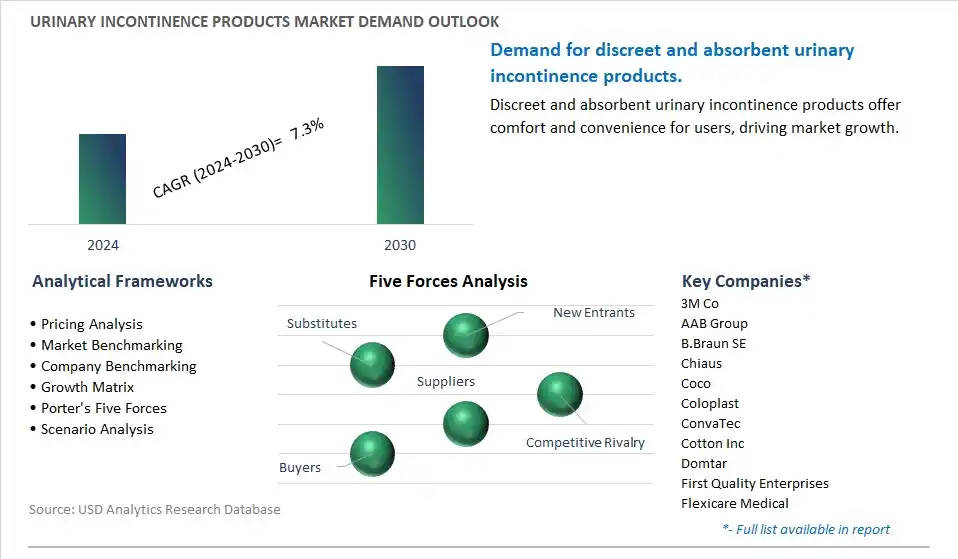
The global Urinary Incontinence Products Industry is highly competitive with a large number of companies focusing on niche market segments. Amidst intense competitive conditions, Urinary Incontinence Products Companies are investing in new product launches and strengthening distribution channels. Key companies operating in the Urinary Incontinence Products Industry include- 3M Co, AAB Group, B.Braun SE, Chiaus, Coco, Coloplast, ConvaTec, Cotton Inc, Domtar, First Quality Enterprises, Flexicare Medical, Fuburg, Hengan Group, Hollister, Kimberly-Clark, Marlen Manufacturing & Development, Medline, Medtronic Plc, Procter & Gamble, SCA, Tranquility, Unicharm.
A significant trend in the market for Urinary Incontinence Products is the continuous advancements in pharmacotherapy and behavioral therapies for managing urinary incontinence. Urinary incontinence is a prevalent condition that can significantly impact an individual's quality of life, leading to embarrassment, social isolation, and decreased self-esteem. While absorbent products such as pads, diapers, and protective underwear provide temporary relief from leakage episodes, there is a growing demand for more comprehensive treatment options that address the underlying causes of urinary incontinence and improve bladder control. Advances in pharmacological agents, including anticholinergics, beta-3 adrenergic agonists, and topical estrogen therapies, offer pharmacotherapy options for reducing urinary frequency, urgency, and leakage episodes. Additionally, behavioral therapies such as pelvic floor muscle training, bladder training, and lifestyle modifications play a crucial role in improving bladder function, strengthening pelvic floor muscles, and optimizing urinary continence. This trend is driving the development and commercialization of innovative urinary incontinence products that integrate pharmacotherapy, behavioral therapy, and patient education to provide holistic and personalized solutions for individuals with urinary incontinence.
A key driver for the market of Urinary Incontinence Products is the aging population and the growing awareness of urinary health among consumers. Urinary incontinence is more prevalent among older adults due to age-related changes in bladder function, pelvic floor muscles, and neurological control mechanisms. As the global population ages and life expectancies increase, there is a corresponding rise in the prevalence of urinary incontinence and the demand for products that address the unique needs and preferences of older adults. Additionally, increased awareness of urinary health and bladder control among consumers has led to greater acceptance of urinary incontinence products as essential tools for managing leakage episodes and maintaining an active lifestyle. The aging population and the growing emphasis on proactive healthcare management create a significant market opportunity for urinary incontinence products, as manufacturers develop innovative solutions to meet the evolving needs of consumers seeking effective and discreet options for managing urinary incontinence.
An exciting opportunity for the market of Urinary Incontinence Products lies in the development of environmentally sustainable and biodegradable products that minimize environmental impact and promote eco-friendly practices. Traditional urinary incontinence products such as disposable pads, diapers, and liners contribute to the accumulation of non-biodegradable waste in landfills and pose challenges in terms of disposal and environmental sustainability. By investing in research and innovation, manufacturers can develop urinary incontinence products made from renewable materials, biodegradable polymers, and eco-friendly fabrics that reduce carbon footprint and support circular economy principles. Environmentally sustainable urinary incontinence products offer benefits such as reduced resource consumption, lower greenhouse gas emissions, and enhanced corporate social responsibility. Additionally, promoting eco-friendly urinary incontinence products aligns with consumer preferences for environmentally conscious brands and can create a competitive advantage for manufacturers in the increasingly sustainability-focused marketplace.
Among Urinary Incontinence Products, the segment experiencing the most rapid growth is Urine Absorbents. Urine absorbents are specialized products designed to manage urinary incontinence by effectively absorbing and containing urine leakage, providing comfort and discretion for individuals dealing with this condition. These products come in various forms such as pads, liners, briefs, and underwear, offering a wide range of options to suit different preferences and levels of incontinence severity. The increasing prevalence of urinary incontinence, coupled with growing awareness and acceptance of incontinence management solutions, is driving the demand for urine absorbents, particularly in the homecare and nursing home settings where individuals seek effective and convenient solutions to maintain their independence and dignity. Additionally, advancements in absorbent materials and product design have led to the development of more discreet, comfortable, and effective urine absorbents, further fueling their adoption among consumers. As a result, manufacturers are expanding their product lines and investing in research and development efforts to meet the escalating demand for urine absorbents and cater to the evolving needs of individuals with urinary incontinence across various healthcare settings.
By Type
Urine Absorbents
Urine Accepted Products/ Incontinence Bags
Others
By Application
Hospital
Homecare
Nursing Homes
Others
Geographical Analysis
North America (United States, Canada, Mexico)
Europe (Germany, France, United Kingdom, Spain, Italy, Rest of Europe)
Asia Pacific (China, India, Japan, South Korea, Rest of Asia Pacific)
South America (Brazil, Argentina, Rest of South America)
Middle East and Africa (Saudi Arabia, UAE, Rest of Middle East, South Africa, Egypt, Rest of Africa)
3M Co
AAB Group
B.Braun SE
Chiaus
Coco
Coloplast
ConvaTec
Cotton Inc
Domtar
First Quality Enterprises
Flexicare Medical
Fuburg
Hengan Group
Hollister
Kimberly-Clark
Marlen Manufacturing & Development
Medline
Medtronic Plc
Procter & Gamble
SCA
Tranquility
Unicharm
* List not Exhaustive
• Deepen your industry insights and navigate uncertainties for strategy formulation, CAPEX, and Operational decisions
• Gain access to detailed insights on the Urinary Incontinence Products Market, encompassing current market size, growth trends, and forecasts till 2030.
• Access detailed competitor analysis, enabling competitive advantage through a thorough understanding of market players, strategies, and potential differentiation opportunities
• Stay ahead of the curve with insights on technological advancements, innovations, and upcoming trends
• Identify lucrative investment avenues and expansion opportunities within the Urinary Incontinence Products Industry, guided by robust, data-backed analysis.
• Understand regional and global markets through country-wise analysis, regional market potential, regulatory nuances, and dynamics
• Execute strategies with confidence and speed through information, analytics, and insights on the industry value chain
• Corporate leaders, strategists, financial experts, shareholders, asset managers, and governmental representatives can make long-term planning scenarios and build an integrated and timely understanding of market dynamics
• Benefit from tailored solutions and expert consultation based on report insights, providing personalized strategies aligned with specific business needs.
TABLE OF CONTENTS
1 Introduction to 2024 Urinary Incontinence Products Market
1.1 Market Overview
1.2 Quick Facts
1.3 Scope/Objective of the Study
1.4 Market Definition
1.5 Countries and Regions Analyzed
1.6 Units, Currency, and Conversions
1.7 Industry Value Chain
2 Research Methodology
2.1 Market Size Estimation
2.2 Sources and Research Methodology
2.3 Data Triangulation
2.4 Assumptions and Limitations
3 Executive Summary
3.1 Global Urinary Incontinence Products Market Size Outlook, $ Million, 2021 to 2030
3.2 Urinary Incontinence Products Market Outlook by Type, $ Million, 2021 to 2030
3.3 Urinary Incontinence Products Market Outlook by Product, $ Million, 2021 to 2030
3.4 Urinary Incontinence Products Market Outlook by Application, $ Million, 2021 to 2030
3.5 Urinary Incontinence Products Market Outlook by Key Countries, $ Million, 2021 to 2030
4 Market Dynamics
4.1 Key Driving Forces of Urinary Incontinence Products Industry
4.2 Key Market Trends in Urinary Incontinence Products Industry
4.3 Potential Opportunities in Urinary Incontinence Products Industry
4.4 Key Challenges in Urinary Incontinence Products Industry
5 Market Factor Analysis
5.1 Value Chain Analysis
5.2 Competitive Landscape
5.2.1 Global Urinary Incontinence Products Market Share by Company (%), 2023
5.2.2 Product Offerings by Company
5.3 Porter’s Five Forces Analysis
5.4 Pricing Analysis and Outlook
6 Growth Outlook Across Scenarios
6.1 Growth Analysis-Case Scenario Definitions
6.2 Low Growth Scenario Forecasts
6.3 Reference Growth Scenario Forecasts
6.4 High Growth Scenario Forecasts
7 Global Urinary Incontinence Products Market Outlook by Segments
7.1 Urinary Incontinence Products Market Outlook by Segments, $ Million, 2021- 2030
By Type
Urine Absorbents
Urine Accepted Products/ Incontinence Bags
Others
By Application
Hospital
Homecare
Nursing Homes
Others
8 North America Urinary Incontinence Products Market Analysis and Outlook To 2030
8.1 Introduction to North America Urinary Incontinence Products Markets in 2024
8.2 North America Urinary Incontinence Products Market Size Outlook by Country, 2021-2030
8.2.1 United States
8.2.2 Canada
8.2.3 Mexico
8.3 North America Urinary Incontinence Products Market size Outlook by Segments, 2021-2030
By Type
Urine Absorbents
Urine Accepted Products/ Incontinence Bags
Others
By Application
Hospital
Homecare
Nursing Homes
Others
9 Europe Urinary Incontinence Products Market Analysis and Outlook To 2030
9.1 Introduction to Europe Urinary Incontinence Products Markets in 2024
9.2 Europe Urinary Incontinence Products Market Size Outlook by Country, 2021-2030
9.2.1 Germany
9.2.2 France
9.2.3 Spain
9.2.4 United Kingdom
9.2.4 Italy
9.2.5 Russia
9.2.6 Norway
9.2.7 Rest of Europe
9.3 Europe Urinary Incontinence Products Market Size Outlook by Segments, 2021-2030
By Type
Urine Absorbents
Urine Accepted Products/ Incontinence Bags
Others
By Application
Hospital
Homecare
Nursing Homes
Others
10 Asia Pacific Urinary Incontinence Products Market Analysis and Outlook To 2030
10.1 Introduction to Asia Pacific Urinary Incontinence Products Markets in 2024
10.2 Asia Pacific Urinary Incontinence Products Market Size Outlook by Country, 2021-2030
10.2.1 China
10.2.2 India
10.2.3 Japan
10.2.4 South Korea
10.2.5 Indonesia
10.2.6 Malaysia
10.2.7 Australia
10.2.8 Rest of Asia Pacific
10.3 Asia Pacific Urinary Incontinence Products Market size Outlook by Segments, 2021-2030
By Type
Urine Absorbents
Urine Accepted Products/ Incontinence Bags
Others
By Application
Hospital
Homecare
Nursing Homes
Others
11 South America Urinary Incontinence Products Market Analysis and Outlook To 2030
11.1 Introduction to South America Urinary Incontinence Products Markets in 2024
11.2 South America Urinary Incontinence Products Market Size Outlook by Country, 2021-2030
11.2.1 Brazil
11.2.2 Argentina
11.2.3 Rest of South America
11.3 South America Urinary Incontinence Products Market size Outlook by Segments, 2021-2030
By Type
Urine Absorbents
Urine Accepted Products/ Incontinence Bags
Others
By Application
Hospital
Homecare
Nursing Homes
Others
12 Middle East and Africa Urinary Incontinence Products Market Analysis and Outlook To 2030
12.1 Introduction to Middle East and Africa Urinary Incontinence Products Markets in 2024
12.2 Middle East and Africa Urinary Incontinence Products Market Size Outlook by Country, 2021-2030
12.2.1 Saudi Arabia
12.2.2 UAE
12.2.3 Oman
12.2.4 Rest of Middle East
12.2.5 Egypt
12.2.6 Nigeria
12.2.7 South Africa
12.2.8 Rest of Africa
12.3 Middle East and Africa Urinary Incontinence Products Market size Outlook by Segments, 2021-2030
By Type
Urine Absorbents
Urine Accepted Products/ Incontinence Bags
Others
By Application
Hospital
Homecare
Nursing Homes
Others
13 Company Profiles
13.1 Company Snapshot
13.2 SWOT Profiles
13.3 Products and Services
13.4 Recent Developments
13.5 Financial Profile
List of Companies
3M Co
AAB Group
B.Braun SE
Chiaus
Coco
Coloplast
ConvaTec
Cotton Inc
Domtar
First Quality Enterprises
Flexicare Medical
Fuburg
Hengan Group
Hollister
Kimberly-Clark
Marlen Manufacturing & Development
Medline
Medtronic Plc
Procter & Gamble
SCA
Tranquility
Unicharm
14 Appendix
14.1 Customization Offerings
14.2 Subscription Services
14.3 Related Reports
14.4 Publisher Expertise
By Type
Urine Absorbents
Urine Accepted Products/ Incontinence Bags
Others
By Application
Hospital
Homecare
Nursing Homes
Others
The global Urinary Incontinence Products Market is one of the lucrative growth markets, poised to register a 7.3% growth (CAGR) between 2024 and 2030.
Emerging Markets across Asia Pacific, Europe, and Americas present robust growth prospects.
3M Co, AAB Group, B.Braun SE, Chiaus, Coco, Coloplast, ConvaTec, Cotton Inc, Domtar, First Quality Enterprises, Flexicare Medical, Fuburg, Hengan Group, Hollister, Kimberly-Clark, Marlen Manufacturing & Development, Medline, Medtronic Plc, Procter & Gamble, SCA, Tranquility, Unicharm
Base Year- 2023; Estimated Year- 2024; Historic Period- 2018-2023; Forecast period- 2024 to 2030; Currency: USD; Volume