Uterine Fibroid Treatment Device Market is estimated to increase at a growth rate of 9.4% CAGR over the forecast period from 2024 to 2030.
The global Uterine Fibroid Treatment Device Marketstudy analyzes and forecasts the market size across 6 regions and 24 countries for diverse segments including By Technology (Surgical Techniques (Hysterectomy, Myomectomy), Laparoscopic techniques (Laparoscopic Myomectomy, Myolysis), Ablation Techniques (Microwave Ablation, Hydrothermal Ablation, Cryoablation, Ultrasound Ablation), Embolization Techniques), By Mode of Treatment (Invasive Treatment, Minimally Invasive Treatment, Non-invasive Treatment).
An introduction to Uterine Fibroid Treatment Device Market in 2024
In 2024, the uterine fibroid treatment device market is thriving due to advancements in minimally invasive treatment options and the increasing incidence of uterine fibroids among women worldwide. Uterine fibroid treatment devices include techniques such as uterine artery embolization (UAE), magnetic resonance-guided focused ultrasound (MRgFUS), and minimally invasive surgical procedures like laparoscopic or hysteroscopic myomectomy. These devices offer women alternatives to traditional hysterectomy, providing symptom relief while preserving fertility and minimizing recovery time. With a growing emphasis on women's health and patient-centered care, the uterine fibroid treatment device market is expected to continue expanding, offering innovative solutions for the management of uterine fibroids.
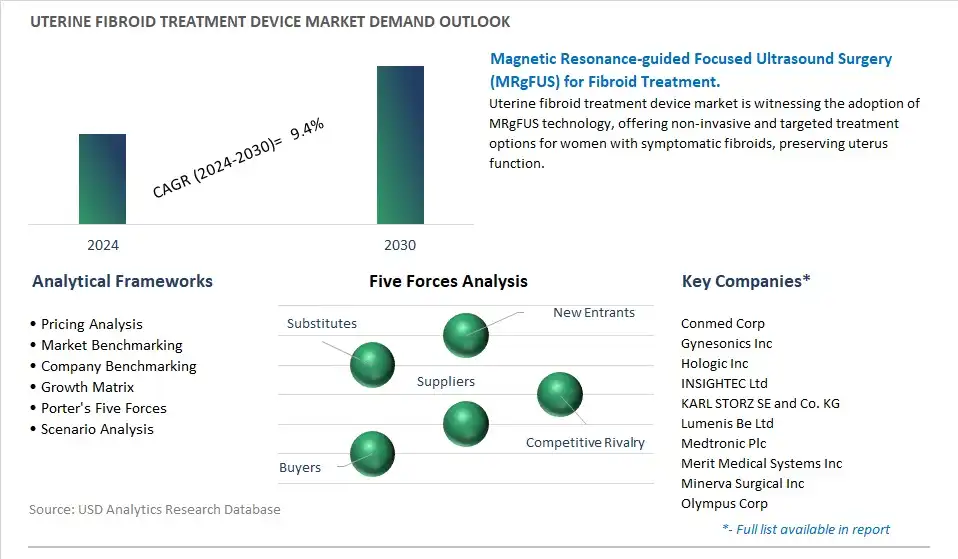
Uterine Fibroid Treatment Device Market Trend: Shift towards Minimally Invasive Treatment Options Shapes Uterine Fibroid Treatment Device Market
A significant trend in the uterine fibroid treatment device market is the increasing adoption of minimally invasive treatment options. Traditional surgical approaches for uterine fibroids, such as hysterectomy and myomectomy, are being replaced by minimally invasive techniques that offer reduced recovery time, shorter hospital stays, and fewer complications. Minimally invasive procedures, including uterine artery embolization (UAE), magnetic resonance-guided focused ultrasound (MRgFUS), and minimally invasive hysterectomy techniques, provide effective fibroid management while preserving fertility and quality of life. Additionally, advancements in medical technology and imaging modalities enable precise targeting of fibroids and improved patient outcomes. This trend reflects the industry's focus on patient-centered care, driving market growth and innovation in uterine fibroid treatment devices.
Uterine Fibroid Treatment Device Market Driver: Increasing Prevalence of Uterine Fibroids and Demand for Non-Surgical Treatment Options Propel Uterine Fibroid Treatment Device Market Growth
The rising prevalence of uterine fibroids and the growing demand for non-surgical treatment options serve as significant drivers for the uterine fibroid treatment device market. Uterine fibroids are common benign tumors affecting millions of women worldwide, leading to symptoms such as heavy menstrual bleeding, pelvic pain, and reproductive dysfunction. As women seek alternatives to surgical interventions that may impact fertility or require extensive recovery periods, there is a growing demand for minimally invasive and non-invasive treatment modalities. Additionally, factors such as increasing awareness of fibroid symptoms, advancements in diagnostic imaging, and improvements in treatment efficacy contribute to market growth in uterine fibroid treatment devices. As healthcare systems prioritize personalized medicine and minimally invasive interventions, the demand for uterine fibroid treatment devices continues to grow, supporting market expansion and technological advancements.
Uterine Fibroid Treatment Device Market Opportunity: Expansion into Emerging Markets Presents Lucrative Opportunities in Uterine Fibroid Treatment Device Market
The expansion into emerging markets represents a promising opportunity for growth within the uterine fibroid treatment device market. Emerging economies, particularly in Asia-Pacific, Latin America, and the Middle East, are witnessing rapid urbanization, lifestyle changes, and improvements in healthcare infrastructure. As these regions experience demographic shifts, changes in healthcare preferences, and increasing healthcare expenditures, there is a growing burden of uterine fibroids and demand for advanced treatment options. Additionally, rising awareness of women's health issues, expanding access to healthcare services, and government initiatives to address reproductive health contribute to market growth in emerging markets. Capitalizing on this opportunity requires strategic partnerships, market entry strategies tailored to local regulations and preferences, and investment in distribution networks and clinical education programs to effectively penetrate and serve emerging healthcare markets, thus expanding market reach and driving revenue growth in the evolving landscape of women's health.
Uterine Fibroid Treatment Device Market Market Segmentation
By Technology
Surgical Techniques
-Hysterectomy
-Myomectomy
Laparoscopic techniques
-Laparoscopic Myomectomy
-Myolysis
Ablation Techniques
-Microwave Ablation
-Hydrothermal Ablation
-Cryoablation
-Ultrasound Ablation
Embolization Techniques
By Mode of Treatment
Invasive Treatment
Minimally Invasive Treatment
Non-invasive Treatment
Geographical Analysis
North America (United States, Canada, Mexico)
Europe (Germany, France, United Kingdom, Spain, Italy, Rest of Europe)
Asia Pacific (China, India, Japan, South Korea, Rest of Asia Pacific)
South America (Brazil, Argentina, Rest of South America)
Middle East and Africa (Saudi Arabia, UAE, Rest of Middle East, South Africa, Egypt, Rest of Africa)
Uterine Fibroid Treatment Device Market Companies
Conmed Corp
Gynesonics Inc
Hologic Inc
INSIGHTEC Ltd
KARL STORZ SE and Co. KG
Lumenis Be Ltd
Medtronic Plc
Merit Medical Systems Inc
Minerva Surgical Inc
Olympus Corp
The Cooper Companies Inc
Reasons to Buy the Uterine Fibroid Treatment Device Market Study
• Deepen your industry insights and navigate uncertainties for strategy formulation, CAPEX, and Operational decisions
• Gain access to detailed insights on the Uterine Fibroid Treatment Device Market, encompassing current market size, growth trends, and forecasts till 2030.
• Access detailed competitor analysis, enabling competitive advantage through a thorough understanding of market players, strategies, and potential differentiation opportunities
• Stay ahead of the curve with insights on technological advancements, innovations, and upcoming trends
• Identify lucrative investment avenues and expansion opportunities within the Uterine Fibroid Treatment Device Market industry, guided by robust, data-backed analysis.
• Understand regional and global markets through country-wise analysis, regional market potential, regulatory nuances, and dynamics
• Execute strategies with confidence and speed through information, analytics, and insights on the industry value chain
• Corporate leaders, strategists, financial experts, shareholders, asset managers, and governmental representatives can make long-term planning scenarios and build an integrated and timely understanding of market dynamics
• Benefit from tailored solutions and expert consultation based on report insights, providing personalized strategies aligned with specific business needs.
TABLE OF CONTENTS
1 Introduction to 2024 Uterine Fibroid Treatment Device Market
1.1 Market Overview
1.2 Quick Facts
1.3 Scope/Objective of the Study
1.4 Market Definition
1.5 Countries and Regions Analyzed
1.6 Units, Currency, and Conversions
1.7 Industry Value Chain
2 Research Methodology
2.1 Market Size Estimation
2.2 Sources and Research Methodology
2.3 Data Triangulation
2.4 Assumptions and Limitations
3 Executive Summary
3.1 Global Uterine Fibroid Treatment Device Market Size Outlook, $ Million, 2021 to 2030
3.2 Uterine Fibroid Treatment Device Market Outlook by Type, $ Million, 2021 to 2030
3.3 Uterine Fibroid Treatment Device Market Outlook by Product, $ Million, 2021 to 2030
3.4 Uterine Fibroid Treatment Device Market Outlook by Application, $ Million, 2021 to 2030
3.5 Uterine Fibroid Treatment Device Market Outlook by Key Countries, $ Million, 2021 to 2030
4 Market Dynamics
4.1 Key Driving Forces of Uterine Fibroid Treatment Device Industry
4.2 Key Market Trends in Uterine Fibroid Treatment Device Industry
4.3 Potential Opportunities in Uterine Fibroid Treatment Device Industry
4.4 Key Challenges in Uterine Fibroid Treatment Device Industry
5 Market Factor Analysis
5.1 Value Chain Analysis
5.2 Competitive Landscape
5.2.1 Global Uterine Fibroid Treatment Device Market Share by Company (%), 2023
5.2.2 Product Offerings by Company
5.3 Porter’s Five Forces Analysis
5.4 Pricing Analysis and Outlook
6 Growth Outlook Across Scenarios
6.1 Growth Analysis-Case Scenario Definitions
6.2 Low Growth Scenario Forecasts
6.3 Reference Growth Scenario Forecasts
6.4 High Growth Scenario Forecasts
7 Global Uterine Fibroid Treatment Device Market Outlook by Segments
7.1 Uterine Fibroid Treatment Device Market Outlook by Segments, $ Million, 2021- 2030
By Technology
Surgical Techniques
-Hysterectomy
-Myomectomy
Laparoscopic techniques
-Laparoscopic Myomectomy
-Myolysis
Ablation Techniques
-Microwave Ablation
-Hydrothermal Ablation
-Cryoablation
-Ultrasound Ablation
Embolization Techniques
By Mode of Treatment
Invasive Treatment
Minimally Invasive Treatment
Non-invasive Treatment
8 North America Uterine Fibroid Treatment Device Market Analysis and Outlook To 2030
8.1 Introduction to North America Uterine Fibroid Treatment Device Markets in 2024
8.2 North America Uterine Fibroid Treatment Device Market Size Outlook by Country, 2021-2030
8.2.1 United States
8.2.2 Canada
8.2.3 Mexico
8.3 North America Uterine Fibroid Treatment Device Market size Outlook by Segments, 2021-2030
By Technology
Surgical Techniques
-Hysterectomy
-Myomectomy
Laparoscopic techniques
-Laparoscopic Myomectomy
-Myolysis
Ablation Techniques
-Microwave Ablation
-Hydrothermal Ablation
-Cryoablation
-Ultrasound Ablation
Embolization Techniques
By Mode of Treatment
Invasive Treatment
Minimally Invasive Treatment
Non-invasive Treatment
9 Europe Uterine Fibroid Treatment Device Market Analysis and Outlook To 2030
9.1 Introduction to Europe Uterine Fibroid Treatment Device Markets in 2024
9.2 Europe Uterine Fibroid Treatment Device Market Size Outlook by Country, 2021-2030
9.2.1 Germany
9.2.2 France
9.2.3 Spain
9.2.4 United Kingdom
9.2.4 Italy
9.2.5 Russia
9.2.6 Norway
9.2.7 Rest of Europe
9.3 Europe Uterine Fibroid Treatment Device Market Size Outlook by Segments, 2021-2030
By Technology
Surgical Techniques
-Hysterectomy
-Myomectomy
Laparoscopic techniques
-Laparoscopic Myomectomy
-Myolysis
Ablation Techniques
-Microwave Ablation
-Hydrothermal Ablation
-Cryoablation
-Ultrasound Ablation
Embolization Techniques
By Mode of Treatment
Invasive Treatment
Minimally Invasive Treatment
Non-invasive Treatment
10 Asia Pacific Uterine Fibroid Treatment Device Market Analysis and Outlook To 2030
10.1 Introduction to Asia Pacific Uterine Fibroid Treatment Device Markets in 2024
10.2 Asia Pacific Uterine Fibroid Treatment Device Market Size Outlook by Country, 2021-2030
10.2.1 China
10.2.2 India
10.2.3 Japan
10.2.4 South Korea
10.2.5 Indonesia
10.2.6 Malaysia
10.2.7 Australia
10.2.8 Rest of Asia Pacific
10.3 Asia Pacific Uterine Fibroid Treatment Device Market size Outlook by Segments, 2021-2030
By Technology
Surgical Techniques
-Hysterectomy
-Myomectomy
Laparoscopic techniques
-Laparoscopic Myomectomy
-Myolysis
Ablation Techniques
-Microwave Ablation
-Hydrothermal Ablation
-Cryoablation
-Ultrasound Ablation
Embolization Techniques
By Mode of Treatment
Invasive Treatment
Minimally Invasive Treatment
Non-invasive Treatment
11 South America Uterine Fibroid Treatment Device Market Analysis and Outlook To 2030
11.1 Introduction to South America Uterine Fibroid Treatment Device Markets in 2024
11.2 South America Uterine Fibroid Treatment Device Market Size Outlook by Country, 2021-2030
11.2.1 Brazil
11.2.2 Argentina
11.2.3 Rest of South America
11.3 South America Uterine Fibroid Treatment Device Market size Outlook by Segments, 2021-2030
By Technology
Surgical Techniques
-Hysterectomy
-Myomectomy
Laparoscopic techniques
-Laparoscopic Myomectomy
-Myolysis
Ablation Techniques
-Microwave Ablation
-Hydrothermal Ablation
-Cryoablation
-Ultrasound Ablation
Embolization Techniques
By Mode of Treatment
Invasive Treatment
Minimally Invasive Treatment
Non-invasive Treatment
12 Middle East and Africa Uterine Fibroid Treatment Device Market Analysis and Outlook To 2030
12.1 Introduction to Middle East and Africa Uterine Fibroid Treatment Device Markets in 2024
12.2 Middle East and Africa Uterine Fibroid Treatment Device Market Size Outlook by Country, 2021-2030
12.2.1 Saudi Arabia
12.2.2 UAE
12.2.3 Oman
12.2.4 Rest of Middle East
12.2.5 Egypt
12.2.6 Nigeria
12.2.7 South Africa
12.2.8 Rest of Africa
12.3 Middle East and Africa Uterine Fibroid Treatment Device Market size Outlook by Segments, 2021-2030
By Technology
Surgical Techniques
-Hysterectomy
-Myomectomy
Laparoscopic techniques
-Laparoscopic Myomectomy
-Myolysis
Ablation Techniques
-Microwave Ablation
-Hydrothermal Ablation
-Cryoablation
-Ultrasound Ablation
Embolization Techniques
By Mode of Treatment
Invasive Treatment
Minimally Invasive Treatment
Non-invasive Treatment
13 Company Profiles
13.1 Company Snapshot
13.2 SWOT Profiles
13.3 Products and Services
13.4 Recent Developments
13.5 Financial Profile
List of Companies
Conmed Corp
Gynesonics Inc
Hologic Inc
INSIGHTEC Ltd
KARL STORZ SE and Co. KG
Lumenis Be Ltd
Medtronic Plc
Merit Medical Systems Inc
Minerva Surgical Inc
Olympus Corp
The Cooper Companies Inc
14 Appendix
14.1 Customization Offerings
14.2 Subscription Services
14.3 Related Reports
14.4 Publisher Expertise
By Technology
Surgical Techniques
-Hysterectomy
-Myomectomy
Laparoscopic techniques
-Laparoscopic Myomectomy
-Myolysis
Ablation Techniques
-Microwave Ablation
-Hydrothermal Ablation
-Cryoablation
-Ultrasound Ablation
Embolization Techniques
By Mode of Treatment
Invasive Treatment
Minimally Invasive Treatment
Non-invasive Treatment
